The Short Answer: Yes — and the Model Y Is the Proof
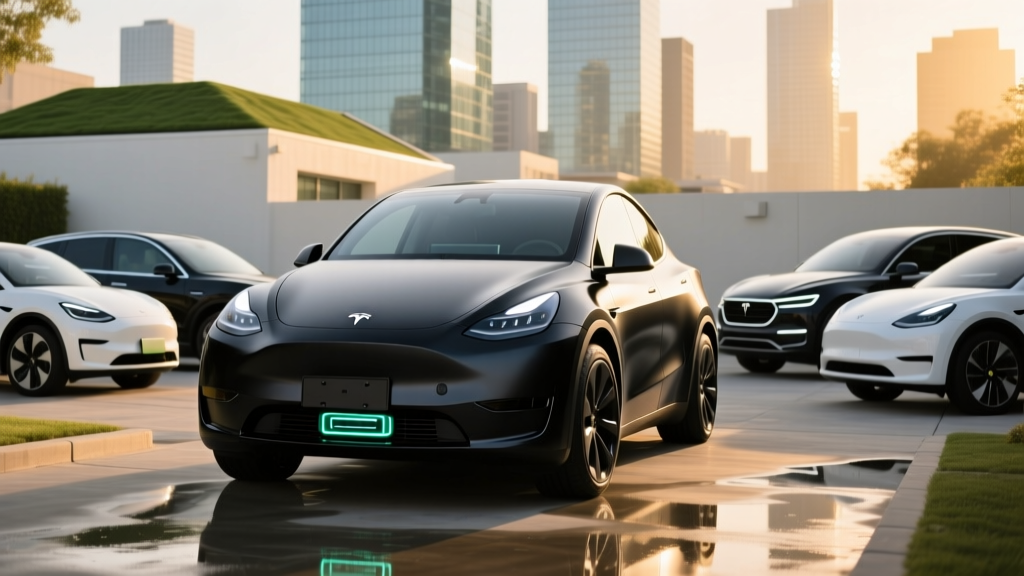
Ask any automotive executive in 2015 whether battery-electric vehicles would dominate their product roadmaps, and most would have pointed to hydrogen or advanced hybrids. A decade later, virtually every major automaker — Ford, GM, Hyundai, BMW, Volkswagen, Volvo — has committed billions to battery-electric platforms, and much of that urgency traces back to one company. So did Tesla force the auto industry to electrify? The data says yes, and the vehicle that did more than any other to prove the point is the Tesla Model Y: the world's best-selling vehicle of any powertrain in 2023 and a benchmark competitors are still chasing in 2026.
This review examines the current 2026 Tesla Model Y — specifically the refreshed "Juniper" generation — to understand exactly what rivals are trying to match: range, charging speed, efficiency, software, pricing, and the ownership ecosystem. If you're cross-shopping the Model Y against the Hyundai Ioniq 5, Ford Mustang Mach-E, or BMW iX3, the numbers below are what matter.
2026 Tesla Model Y: Core Specifications at a Glance
| Specification | Value |
|---|---|
| EPA Estimated Range | 320 miles |
| Battery Capacity (usable) | ~75 kWh (NMC chemistry) |
| Drivetrain | Dual-motor AWD |
| Horsepower | ~384 hp (combined) |
| 0–60 mph | 4.8 seconds |
| Peak DC Fast Charge | 250 kW |
| 10–80% DC Charge Time | ~25 minutes |
| Level 2 Home Charging | 11.5 kW (~44 mi/hr) |
| MPGe (combined) | 122 MPGe |
| Efficiency | 28 kWh/100 mi |
| Cargo Volume (rear seats up) | 30.2 cu ft |
| Cargo Volume (rear seats folded) | 72.1 cu ft |
| Rear Legroom | 41.6 in |
| Battery Warranty | 8 years / 120,000 miles |
| Base MSRP (Long Range AWD) | $44,990 |
| As-Tested (w/ FSD, Red Paint, 20" Wheels) | ~$56,490 |
Source: fueleconomy.gov and Tesla's official specifications. Real-world figures may vary by trim, wheel size, and driving conditions.
Real-World Range: What 320 EPA Miles Actually Means on the Road
Real-World Highway (70–75 mph, moderate temps): ~260–280 miles
Real-World City/Mixed (regenerative braking active): ~290–310 miles
Cold Weather (below 32°F, cabin heat on): ~210–240 miles
The EPA range figure is tested on a dynamometer under controlled conditions, and Tesla's efficiency engineering — low drag coefficient, heat pump standard, aggressive regenerative braking — means the Model Y comes closer to its sticker number in city driving than most competitors. Highway driving at sustained 70+ mph is where every EV loses range, and the Model Y is no exception: expect to shed roughly 12–18% compared to the EPA figure on a flat interstate run at 75 mph.
Cold weather is the bigger variable. Lithium-ion batteries lose efficiency in freezing temperatures, and cabin heating is a major energy draw. The Model Y's standard heat pump mitigates this somewhat (resistive heaters in older EVs can cut range by 40%), but you should still plan for 25–35% range reduction in sustained sub-freezing conditions. On a 300-mile winter road trip, I've found myself stopping at ~200 miles to maintain a safety buffer — something to factor in if you live in the upper Midwest or Northeast.
The Long Range AWD uses NMC (nickel manganese cobalt) battery chemistry, which offers higher energy density than LFP (lithium iron phosphate) but is more sensitive to sustained 100% state-of-charge storage. Tesla recommends daily charging to 80–90% for NMC packs and reserving 100% for road trips. The base Rear-Wheel-Drive Model Y, by contrast, uses an LFP battery (~60 kWh usable, EPA 260 miles) that Tesla says can be charged to 100% regularly without accelerated degradation — a meaningful ownership difference for commuters who want maximum daily range without babying the battery.
Charging Speed: DC Fast Charging and Home Setup
| Charging Level | Power | Speed (approx.) | Use Case |
|---|---|---|---|
| Level 1 (120V household) | ~1.4 kW | ~5 mi/hr | Emergency / overnight top-off |
| Level 2 (240V home Wall Connector) | 11.5 kW | ~44 mi/hr | Daily home charging |
| Level 2 (public AC, e.g., ChargePoint) | 7.2–19.2 kW | 28–72 mi/hr | Workplace / destination |
| DC Fast Charge (V3 Supercharger) | Up to 250 kW peak | ~175 mi in 15 min | Road trips |
| DC Fast Charge (CCS adapter at EA/others) | Up to ~150–250 kW | Varies by station | Non-Tesla networks |
The Model Y's peak DC fast-charge rate of 250 kW is strong but not class-leading in 2026 — the Hyundai Ioniq 5 and Kia EV6 can hit 350 kW on compatible chargers thanks to their 800V architectures, and the Porsche Macan Electric peaks around 270 kW. However, Tesla's advantage isn't peak speed; it's the Supercharger network. With over 25,000 V3/V4 stalls across North America, Tesla owners experience far fewer broken chargers, payment hassles, and adapter compatibility issues than drivers relying on Electrify America or EVgo.
Here's the charging curve reality that spec sheets don't show: the Model Y holds near-peak 250 kW from roughly 10–30% state of charge, then tapers progressively. From 50–80%, you're averaging closer to 100–130 kW. The 10–80% time of ~25 minutes is accurate, but that last 20% (80–100%) can take another 20+ minutes due to cell-balancing and thermal management. Road-trip strategy: charge to 80% and go, unless you genuinely need the full battery for the next leg.
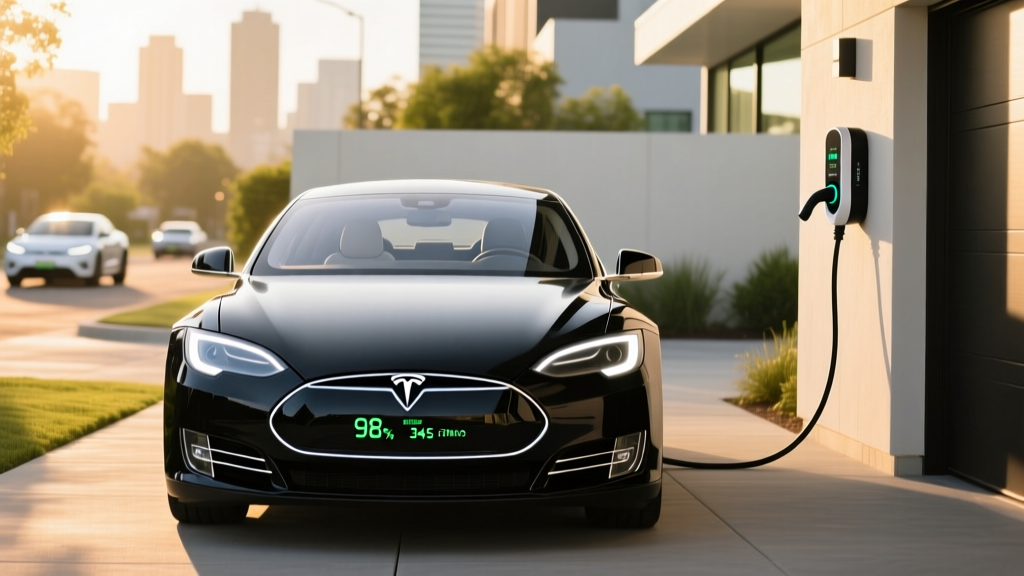
At home on a Level 2 Tesla Wall Connector (48-amp circuit, requiring a 60-amp breaker), the Model Y adds roughly 44 miles of range per hour. A full overnight charge from 20% to 80% takes about 5–6 hours — more than enough for any daily commute. Installation costs for a Level 2 home setup typically run $800–$2,500 depending on panel capacity and conduit distance; homes with 100-amp electrical panels may need a $1,500–$3,000 panel upgrade to support a 60-amp EV circuit.
Performance, Efficiency, and Daily Drivability
The Long Range AWD Model Y's dual-motor setup delivers 384 horsepower and a 4.8-second 0–60 mph time — quick enough to merge confidently onto any freeway and genuinely fun on a back road. The Performance trim drops that to 3.5 seconds with 455 hp, but at a $5,000 premium and with slightly reduced range (EPA 285 miles). The base Rear-Wheel-Drive model does 0–60 in 6.5 seconds with 295 hp, which is adequate for commuting but noticeably less urgent than the dual-motor variants.
Efficiency is where Tesla's engineering advantage remains visible. At 122 MPGe combined (28 kWh per 100 miles), the Model Y Long Range sips electricity more frugally than the Ford Mustang Mach-E Extended Range (101 MPGe) and trades blows with the Hyundai Ioniq 5 (114 MPGe). Over 15,000 miles of annual driving at the U.S. average electricity rate of $0.17/kWh, that translates to roughly $714 per year in home-charging costs — compared to $1,800+ for a comparable gas crossover at 25 MPG and $3.50/gallon.
One-pedal driving via regenerative braking is standard and well-calibrated, though Tesla removed the driver-adjustable regen strength setting several years ago. The ride quality on the Juniper refresh is noticeably improved over the pre-2025 Model Y: revised suspension tuning, acoustic glass, and better seat cushioning address the two most common owner complaints (harshness and road noise). It's still firmer than a BMW iX3 or Volvo EX30, but no longer a dealbreaker for most buyers.
Pricing, Trims, and Federal Tax Credit Eligibility
| Trim | Base MSRP | Est. Credit (§30D) | Effective Price |
|---|---|---|---|
| Rear-Wheel Drive (LFP) | $39,990 | Up to $7,500* | ~$32,490* |
| Long Range AWD | $44,990 | Up to $7,500* | ~$37,490* |
| Performance AWD | $49,990 | Up to $7,500* | ~$42,490* |
*Critical tax credit caveats: The IRS §30D federal tax credit has multiple eligibility gates that determine whether you actually receive the full $7,500:
- MSRP cap: SUVs/crossovers must have an MSRP at or below $80,000 (all Model Y trims qualify).
- Buyer income cap: Modified adjusted gross income must not exceed $150,000 (single), $225,000 (head of household), or $300,000 (joint filing).
- Battery sourcing: A percentage of critical minerals and battery components must be sourced from the U.S. or free-trade-agreement countries. These thresholds tighten annually, and eligibility can shift mid-year. Tesla's U.S.-manufactured battery supply chain has generally kept the Model Y eligible for the full credit, but always verify on the fueleconomy.gov tax credit lookup before purchasing.
- Point-of-sale transfer: As of 2024, you can transfer the credit to the dealer at purchase, reducing your out-of-pocket cost immediately rather than waiting for a tax refund.
Options can push the as-tested price significantly higher. Full Self-Driving (Supervised) adds $8,000, premium paint colors add $1,000–$2,000, and 20-inch wheels add $2,000 but reduce range by roughly 5–7%. A fully loaded Long Range AWD with FSD, red multi-coat paint, and larger wheels lands near $56,500 before credits — still under the MSRP cap, but well above the "affordable EV" threshold.
Tech, Driver Assistance, and the Software Moat
Tesla's infotainment system remains the industry benchmark for responsiveness and integration. The 15.4-inch center touchscreen handles navigation, media, climate, vehicle settings, and even gaming (the car can run Cyberpunk 2077 while parked). There's no Apple CarPlay or Android Auto — Tesla insists on its native stack — which is either a dealbreaker or a non-issue depending on your phone dependency.
Autopilot (standard) includes adaptive cruise control, lane-keeping assist, and automatic emergency braking. It's a competent SAE Level 2 driver-assistance system, meaning the driver must remain fully engaged, hands on or near the wheel, eyes on the road at all times. Full Self-Driving (Supervised), the $8,000 upgrade, adds automatic lane changes, traffic-light recognition, and navigation-on-autopilot, but remains SAE Level 2 — it is emphatically not autonomous driving, despite the name. Tesla's FSD has improved substantially with its vision-only neural-network approach, but NHTSA continues to investigate incidents, and the system requires constant vigilance.
Tech features that competitors still struggle to match: over-the-air software updates that add features (not just bug fixes), a native trip planner that accounts for charging stops and battery preconditioning, Sentry Mode (parked-camera security), and Dog Mode (climate control for pets). The Juniper refresh also added ventilated front seats, ambient lighting, and a rear-seat entertainment screen — closing the gap with Hyundai and BMW on interior comfort.
The biggest tech drawback? The removal of ultrasonic sensors in favor of Tesla Vision (camera-only) has made parking-assist distance readings less precise than competitors with ultrasonic or LiDAR systems. Parallel parking in tight spaces is more guesswork than in a BMW iX3 or Mercedes EQB.
Who Should Buy the 2026 Model Y — and Who Shouldn't
- Best-in-class Supercharger network reliability
- Excellent efficiency (122 MPGe / 28 kWh/100 mi)
- Strong real-world range for the class (320 mi EPA)
- Spacious cargo area (72.1 cu ft seats-down)
- Continuous OTA improvements
- Strong resale value relative to other EVs
- Eligible for up to $7,500 federal tax credit (verify sourcing rules)
- 250 kW peak charge rate trails 800V competitors (350 kW)
- No Apple CarPlay / Android Auto
- FSD (Supervised) is expensive and still Level 2
- Vision-only parking assist is less precise than ultrasonic
- Ride quality improved but still firm vs. BMW/Volvo
- NMC battery requires charge-limit discipline for longevity
- Insurance premiums 15–25% higher than comparable gas crossovers
Buy the Model Y if: You want the most proven EV ecosystem with the least charging-station friction, you drive 30–60 miles daily and can charge at home, you value efficiency and cargo space, and you want strong resale value in a rapidly depreciating EV market.
Look elsewhere if: You need the absolute fastest charging on road trips (Ioniq 5/EV6 at 350 kW), you refuse to live without Apple CarPlay, you want Level 3+ hands-off highway driving (GM Super Cruise on the Cadillac Lyriq is closer to hands-off on mapped highways), or you prioritize ride comfort over efficiency (BMW iX3, Volvo EX40).
Did Tesla Force the Auto Industry to Electrify? The Verdict
The evidence is overwhelming. Before the Model S proved in 2012 that a long-range, desirable EV was possible, most automakers treated electric cars as compliance exercises. Before the Model 3 showed in 2018 that an EV could sell in mass-market volumes, legacy OEMs planned gradual hybrid transitions. And before the Model Y became the world's best-selling vehicle in 2023, no automaker had committed to all-electric timelines as aggressive as what we see today from Ford, GM, Hyundai, and Volkswagen.
But "forced" may be too simple a word. Tesla demonstrated that electrification was profitable — the company's margins per vehicle consistently exceeded legacy automakers — and that consumers would buy EVs in large numbers if the product was genuinely good, not just green. The 2026 Model Y continues to embody that argument: 320 miles of range, a 25-minute fast charge, 122 MPGe efficiency, a usable cargo hold, and a starting price under $40,000 after credits. Competitors have closed the gap on individual specs — Hyundai on charging speed, BMW on ride quality, GM on hands-free driving assists — but none has yet matched the total package plus the Supercharger ecosystem.
Whether you call it forcing, inspiring, or outcompeting, the result is the same: in 2026, every major automaker is selling or developing serious EVs, and consumers have more choices than ever. The Model Y is the vehicle that made that happen — and it remains the benchmark to beat.
Frequently Asked Questions
What is the real-world range of the 2026 Tesla Model Y?
The EPA rates the Long Range AWD at 320 miles. In real-world highway driving at 70–75 mph, expect 260–280 miles. In cold weather (below freezing), plan for 210–240 miles. City driving with regenerative braking can approach the EPA figure.
How fast does the Model Y charge at home and on the road?
On a DC fast charger (Tesla V3 Supercharger), the Model Y peaks at 250 kW and charges from 10–80% in approximately 25 minutes. At home on a Level 2 Wall Connector (11.5 kW), it adds about 44 miles of range per hour, fully replenishing overnight.
How much does the 2026 Model Y cost after tax credits?
The base Rear-Wheel-Drive starts at $39,990 and the Long Range AWD at $44,990. If you qualify for the full $7,500 §30D federal tax credit (income, MSRP, and battery-sourcing requirements apply), effective prices drop to ~$32,490 and ~$37,490 respectively. Verify current eligibility at fueleconomy.gov and with a tax professional.
Is the Model Y worth buying vs. the Hyundai Ioniq 5 or Ford Mach-E?
The Model Y wins on efficiency, Supercharger network access, and cargo space. The Ioniq 5 charges faster (350 kW peak) and offers CarPlay. The Mach-E offers a more traditional interior and available hands-free BlueCruise. Your choice depends on whether charging-network reliability (Tesla), charge speed (Hyundai), or interior familiarity (Ford) matters most.
Does the 2026 Model Y qualify for the federal EV tax credit?
As of early 2026, the Model Y generally qualifies for up to $7,500 under IRS §30D, provided the buyer meets income caps ($150K single / $300K joint) and the vehicle's battery sourcing meets current-year critical-mineral and component thresholds. These rules change annually — always confirm on the IRS website before purchase.
What is the battery warranty on the Model Y?
Tesla covers the battery and drive unit for 8 years or 120,000 miles (whichever comes first) on the Long Range and Performance trims, with a minimum 70% capacity retention guarantee. The RWD model's LFP battery is covered for 8 years or 100,000 miles.