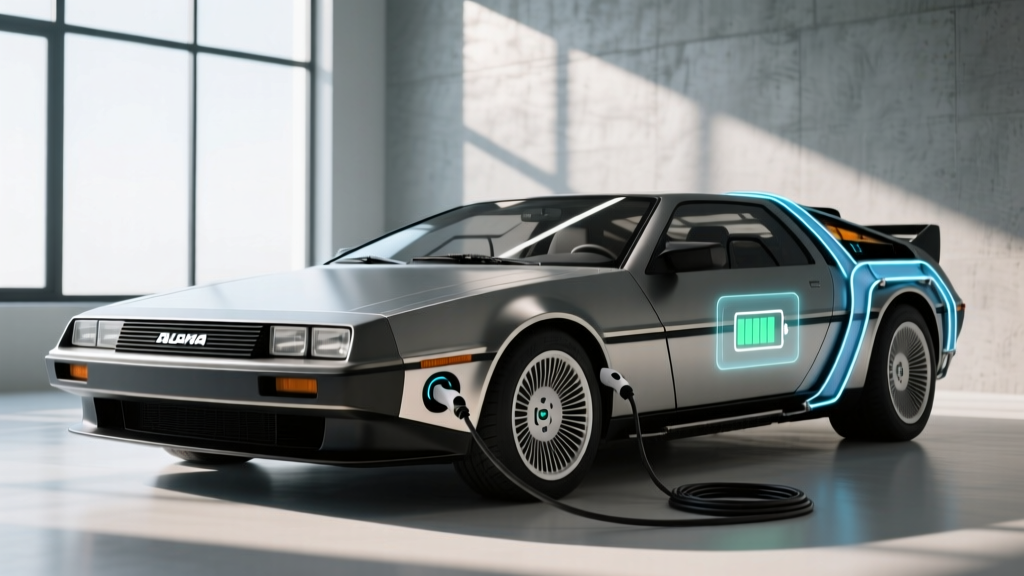
The DeLorean Alpha5 is an announced all-electric grand tourer from the revived DeLorean Motor Company, targeting a 300+ mile EPA-estimated range, a sub-3-second 0–60 mph time in its top Plutonium trim, and a starting MSRP expected around $90,000–$150,000 depending on variant. As of early 2026, the Alpha5 remains in pre-production status — reservations have been accepted, but no production vehicles have been delivered to retail customers, and final EPA certification figures are not yet published.
If you are researching the DeLorean electric vehicle as a potential purchase, the core facts are these: this is a low-volume, high-price specialty EV from a startup-tier manufacturer with no established service network. It should be evaluated more like a boutique sports car (think Lotus, Lucid Air early days) than a mainstream commuter EV. Below, we break down what is confirmed, what is estimated, and what ownership would actually look like.
What We Know About the DeLorean Alpha5 EV
DeLorean Motor Company (DMC), based in San Antonio, Texas, revealed the Alpha5 concept in 2022 with design by ItalDesign. The vehicle is a four-seat electric grand tourer featuring the brand's signature gull-wing doors and a louvered rear window homage to the original DMC-12. Here is a summary of announced and estimated specifications:
| Attribute | Alpha5 (Base) | Alpha5 Plutonium (Top Trim) |
|---|---|---|
| Drivetrain | AWD, dual motor (est.) | AWD, tri-motor (est.) |
| Battery Capacity | ~100 kWh usable (est., NMC) | ~110–120 kWh usable (est.) |
| EPA Range (Target) | 300+ miles | 250–280 miles (higher output) |
| 0–60 mph | ~4.0 sec (est.) | < 3.0 sec (claimed) |
| Peak DC Fast Charge | ~200–250 kW (est.) | ~250 kW (est.) |
| 10–80% DC Charge Time | ~25–30 min (est.) | ~25–30 min (est.) |
| Level 2 AC Charging | 11.5 kW (est.) | 11.5 kW (est.) |
| Top Speed | ~155 mph (est.) | ~180+ mph (claimed) |
| Estimated Base MSRP | ~$90,000–$100,000 | ~$130,000–$150,000 |
| Production Status | Announced / Pre-production — no deliveries as of early 2026 | |
Important caveat: These figures are preliminary and sourced from manufacturer announcements and industry estimates. Final EPA-certified range, actual battery chemistry, and sustained charging curves will not be confirmed until production vehicles undergo testing. Low-volume startups historically see spec revisions between concept and delivery — Lucid's original Air delivery timeline slipped by over a year, and Fisker's Ocean faced similar delays before the company's financial restructuring.
Real-World Range and Charging: What to Expect Beyond the Sticker
A 300-mile EPA target is competitive with vehicles like the BMW i4 eDrive40 (307 miles EPA) and the base Porsche Taycan (318 miles EPA for 2025 model year, per fueleconomy.gov). But EPA estimates assume a mix of city and highway driving at moderate temperatures. Real-world conditions tell a different story:
- EPA Target: 300+ miles
- Highway (75 mph, 70°F): Expect ~240–270 miles. Aerodynamic drag dominates at speed, and grand-tourer shapes with wide tires are typically less efficient than crossover EVs.
- Cold Weather (20°F, highway): Expect ~180–210 miles. Battery chemistry (likely NMC) loses 25–35% usable capacity in freezing temps without aggressive preconditioning.
- City/Mixed (moderate climate): ~280–310 miles, where regenerative braking recovers energy.
On charging, a 200–250 kW peak DC rate would place the Alpha5 in the upper tier of current EVs, though peak rate is not sustained rate. Expect the charge curve to taper significantly above 80% State of Charge (SoC) — this is standard for NMC lithium-ion chemistry to protect cell longevity. A realistic 10–80% session at a 350 kW Electrify America or Tesla Supercharger (with NACS adapter, depending on final connector spec) should take 25–30 minutes, but a 10–100% fill could take 45–55 minutes due to taper. For comparison, the Hyundai Ioniq 5 peaks at ~240 kW and achieves 10–80% in roughly 18 minutes on an optimal charger.
Cost Breakdown: Purchase, Charging, Insurance, and Maintenance
Owning a boutique EV at this price point involves costs beyond the sticker. Here is a five-year ownership estimate compared to a similarly priced gas grand tourer (e.g., BMW M850i xDrive, ~$105,000 MSRP, 20 mpg combined):
| Cost Category | DeLorean Alpha5 (Est.) | BMW M850i (Gas Baseline) |
|---|---|---|
| Purchase Price (MSRP) | $100,000 | $105,000 |
| Federal Tax Credit (§30D) | $0 (see eligibility note below) | $0 |
| Fuel / Electricity (5 yrs, 60k mi) | $5,400 (home L2 avg. $0.15/kWh) | $15,000 (premium gas, $4.00/gal) |
| Maintenance (5 yrs) | $1,500–$2,500 (tires, cabin filter, fluid) | $4,000–$6,000 (oil, brakes, belts) |
| Insurance (5 yrs, avg.) | $18,000–$24,000 (specialty/collector tier) | $12,000–$16,000 |
| Estimated Depreciation (5 yr) | Unknown — high risk (no resale history) | ~45–55% (~$47,000–$58,000) |
| Est. 5-Yr Operating Cost | ~$25,000–$32,000 | ~$31,000–$37,000 |
Federal tax credit (§30D) eligibility: The Alpha5 is unlikely to qualify for the up-to-$7,500 federal EV tax credit under current IRS §30D rules. The credit requires final assembly in North America, specific critical-mineral and battery-component sourcing thresholds, and MSRP caps of $55,000 for sedans or $80,000 for SUVs/trucks/vans. At a projected $90,000+ MSRP and with no confirmed North American battery sourcing, the Alpha5 would not meet these requirements. Always verify current-year eligibility with a tax professional.
Insurance is the hidden cost. Low-volume EVs from startups carry significantly higher premiums due to limited crash-test data, scarce parts availability, and specialized repair requirements. Expect quotes 40–70% above a mainstream EV at a similar price point. Contact Hagerty, Chubb, or your existing insurer for a specialty quote before committing.
DeLorean Alpha5 vs. Established Electric Grand Tourers
The Alpha5 competes in a narrow segment: luxury electric grand tourers priced near or above $100,000. Here is how it stacks up against vehicles you can actually buy today:
| Spec | DeLorean Alpha5 (Est.) | Lucid Air Pure | Porsche Taycan 4S | BMW i7 xDrive60 |
|---|---|---|---|---|
| EPA Range | 300+ mi (target) | 419 mi | 318 mi | 318 mi |
| Battery (kWh usable) | ~100 (est.) | 88 | 83.7 | 101.7 |
| 0–60 mph | ~4.0 sec (est.) | 5.0 sec | 3.8 sec | 4.5 sec |
| Peak DC Charge (kW) | ~200–250 (est.) | 200+ | 270 | 195 |
| 10–80% DC (min) | ~25–30 (est.) | ~25 | ~23 | ~34 |
| Base MSRP | ~$90,000–$100,000 | $77,400 | $103,800 | $120,300 |
| Service Network | None established | Growing (mobile + centers) | Extensive dealer network | Extensive dealer network |
| Availability | Pre-production (2026) | On sale now | On sale now | On sale now |
The Lucid Air Pure offers more range at a lower price, with an established (if still growing) service infrastructure. The Taycan and i7 come with full dealer support and proven reliability records. The Alpha5's value proposition rests entirely on design exclusivity and the DeLorean brand mystique — not on spec-sheet dominance.
First-Time EV Buyer Considerations for the Alpha5
If the Alpha5 is your first EV, several practical realities deserve attention:
Home charging is nearly mandatory at this price point. A Level 2 home charger (240V, 40–48 amp circuit) delivering 11.5 kW will add roughly 30–35 miles of range per hour of charging, fully replenishing a ~100 kWh battery in 9–10 hours overnight. Installation costs typically range from $800 to $2,500 depending on your electrical panel capacity, conduit run length, and local permitting — potentially more if your home needs a panel upgrade from 100A to 200A service ($2,000–$5,000). Relying solely on public DC fast charging is feasible but adds time cost (30+ minutes per session, 2–3 times per week) and expense (public DC rates average $0.35–$0.50/kWh vs. $0.12–$0.18/kWh at home).
Service and parts are the biggest unknown. Established EV makers have mobile service fleets, certified body shops, and parts supply chains. DMC currently has no comparable infrastructure. If your Alpha5 needs a windshield, a suspension component, or a battery module replacement, wait times could stretch to months. This is the single largest risk of buying from a startup automaker.
Battery longevity and warranty. No warranty details have been published for the Alpha5. Industry standard for EV batteries is 8 years / 100,000 miles with a capacity retention threshold of 70% (mandated minimum by federal law, per NHTSA emissions-related warranty guidance). For a $100,000+ vehicle, buyers should expect warranty terms at or above this baseline. An out-of-warranty NMC battery pack replacement for a ~100 kWh pack currently costs $15,000–$25,000 at independent EV shops.
Decision Framework: Should You Buy the DeLorean Alpha5?
- You want a head-turning, limited-production EV as a second or third vehicle
- You have reliable home Level 2 charging and do not depend on this car for daily commuting
- You are comfortable with startup risk — potential delays, limited service, uncertain resale value
- The DeLorean brand and design language are primary motivators, not spec-sheet optimization
- This will be your primary daily driver
- You need predictable service access and warranty coverage
- Maximizing range per dollar or charging speed matters to you
- You want verified EPA data, IIHS/NHTSA safety ratings, and proven crash performance
- Resale value predictability is important to your financial planning
Common Misconceptions About the DeLorean EV
| Myth | Fact |
|---|---|
| "The Alpha5 is available to buy now." | As of early 2026, the Alpha5 is in pre-production. Reservations have been taken, but no retail deliveries have occurred. Final specs remain unverified by the EPA. |
| "It will qualify for the $7,500 federal tax credit." | Extremely unlikely. The MSRP exceeds §30D sedan caps ($55,000), and battery sourcing requirements have not been confirmed. Consult IRS guidelines and a tax professional. |
| "300 miles of range means 300 miles in all conditions." | Expect 240–270 miles at highway speeds and 180–210 miles in freezing weather. This applies to all current NMC-based EVs. |
| "It's made by the same company as the 1981 DMC-12." | The current DeLorean Motor Company (San Antonio, TX) is a separate entity that acquired the DMC brand assets. The original DeLorean Motor Company ceased operations in 1982. |
| "EVs need no maintenance." | EVs eliminate oil changes and exhaust repairs, but tires wear 15–20% faster due to instant torque and vehicle weight. Cabin filters, brake fluid, coolant, and wiper components still require service. |
Frequently Asked Questions
When will the DeLorean Alpha5 be available for purchase?
DMC has targeted production commencement for 2025–2026, but as of early 2026 no confirmed delivery date has been announced. Low-volume EV startups frequently experience timeline extensions. Treat any delivery estimate as preliminary until VINs are being assigned and vehicles are physically shipping.
How much will the DeLorean Alpha5 cost?
Estimated pricing ranges from approximately $90,000–$100,000 for the base Alpha5 to $130,000–$150,000 for the Alpha5 Plutonium performance variant. Final MSRP by trim has not been officially published. A reservation deposit (reported at $250–$2,500 depending on tier) secures a place in the production queue but does not guarantee a specific delivery date.
Will the Alpha5 use Tesla's NACS connector or CCS?
DMC has not officially confirmed the charging connector standard. Given the industry-wide shift toward NACS (North American Charging Standard) through 2024–2026, NACS adoption is plausible, but CCS1 cannot be ruled out. This matters for public charging compatibility — verify before purchase, or budget for an adapter.
Is the DeLorean Alpha5 self-driving?
No announced autonomous driving capability places the Alpha5 above SAE Level 2 driver assistance. Like Tesla Autopilot, GM Super Cruise, and Ford BlueCruise, any ADAS features will require the driver to remain attentive with hands on or near the wheel. No Level 4 (driverless) capability has been claimed.
What is the battery chemistry and how long will it last?
Chemistry has not been officially disclosed, but NMC (nickel manganese cobalt) is the most likely choice given the performance and range targets. NMC offers higher energy density than LFP (lithium iron phosphate) but typically shows 10–15% capacity degradation over 100,000–150,000 miles. Best practices — avoiding sustained 100% SoC, minimizing DC fast charging frequency, and using preconditioning — can slow degradation. No specific warranty terms have been published.
How does the Alpha5 compare to a gas sports car like the Porsche 911 or BMW M8?
On operating costs, the Alpha5 will save roughly $8,000–$12,000 in fuel over five years compared to a 20 mpg gas grand tourer. However, higher insurance premiums ($6,000–$8,000 more over five years) and unknown depreciation offset much of that savings. The value equation for the Alpha5 is emotional and aesthetic — not financial.