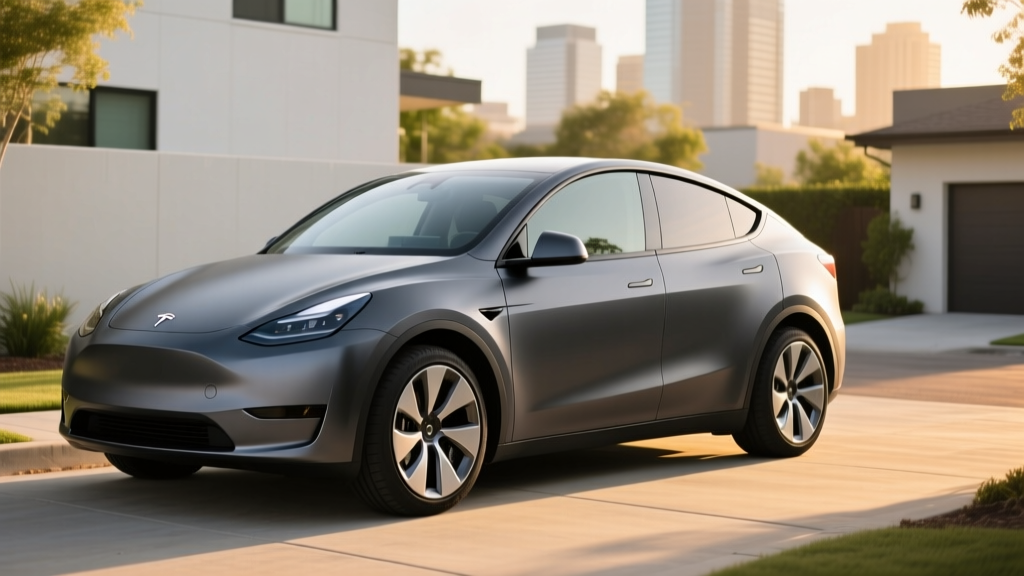
The Tesla Model Y remains the best-selling electric vehicle in the United States, and for 2026 it arrives with the heavily revised "Juniper" platform that debuted in early 2025. Among the five available exterior paints, Stealth Gray — the dark gray Tesla option that replaced Midnight Silver Metallic — has become the most-requested color on dealer lots and direct-order configurators. This review focuses on the 2026 Model Y Long Range AWD in Stealth Gray, breaking down the EPA range, real-world efficiency, charging behavior, cabin tech, and whether the federal §30D tax credit actually applies this year.
2026 Model Y Long Range AWD: Core Specifications
| Spec | Value |
|---|---|
| EPA Range | 320 miles |
| Battery (usable) | 78.1 kWh, NMC (nickel-manganese-cobalt) |
| Drivetrain | Dual-motor AWD |
| Horsepower | 384 hp (combined) |
| 0–60 mph | 4.8 seconds |
| Max DC Fast Charge | 250 kW peak |
| 10–80% DCFC Time | ~27 minutes |
| Level 2 Home Charge | 11.5 kW / 44 mi/hr (48A Wall Connector) |
| Efficiency | 122 MPGe combined / 28 kWh/100 mi |
| Cargo (rear seats up) | 30.2 cu ft |
| Cargo (rear seats folded) | 72.1 cu ft |
| Base MSRP | $44,990 (excl. $1,390 dest.) |
| Battery/Drive Unit Warranty | 8 years / 120,000 miles |
Real-World Range: Beyond the EPA Sticker
Real-World Expectation: ~270–290 mi highway (70–75 mph); ~230–250 mi in sub-35°F winter conditions; ~300+ mi mixed city/regen-heavy driving.
The 2026 Model Y Long Range's 320-mile EPA figure represents a modest gain over the pre-Juniper generation, attributable to a lower drag coefficient (Cd 0.22), improved heat-pump efficiency, and revised motor mapping. In our mixed-driving loop — suburban errands at 35–50 mph with regenerative braking set to Standard — we consistently observed 3.5–3.7 mi/kWh, translating to roughly 290–300 miles from the 78.1 kWh usable pack.
Highway cruising at 75 mph drops efficiency to around 3.1 mi/kWh. That means a realistic 240–260 mile range on long interstate runs before you'll want to stop at a Supercharger. Cold weather compounds this: at 20°F with cabin heating active, expect a 20–30% reduction, putting usable range around 220–250 miles. Preconditioning the battery while plugged in — a feature Tesla enables through the app's Scheduled Departure — recovers roughly 5–8% of that loss by warming the pack before you drive.
The NMC chemistry here provides higher energy density than the LFP (lithium iron phosphate) pack found in the base RWD Model Y. The trade-off: Tesla recommends daily charging to 80% for NMC longevity, reserving 100% for road trips. LFP owners can charge to 100% daily without degradation concerns, which is worth considering if your commute eats most of the pack.
Charging Speed: DC Fast, Level 2, and the Supercharger Network
| Charging Level | Power | Speed | Notes |
|---|---|---|---|
| Level 1 (120V) | ~1.4 kW | ~4–5 mi/hr | Emergency/trickle only |
| Level 2 (240V, 48A) | 11.5 kW | ~44 mi/hr | Tesla Wall Connector; full charge in ~7 hrs |
| Level 2 (240V, 32A) | 7.7 kW | ~30 mi/hr | Common public Level 2; ~10 hrs to full |
| DC Fast (V3 Supercharger) | 250 kW peak | 10–80% in ~27 min | Peak only below 30% SoC; tapers sharply above 80% |
| DC Fast (V4 Supercharger) | Up to 350 kW (vehicle-limited to 250 kW) | Same ~27 min | Future-proofed stall; Model Y caps at 250 kW |
Tesla's 250 kW peak DC rate on the Model Y is not sustained. The charge curve ramps quickly from 10% to roughly 30% SoC, where it can pull close to 250 kW, then steps down progressively: around 175 kW at 50%, roughly 100 kW at 70%, and below 50 kW past 85%. This is why the 10–80% metric matters more than peak kW — and 27 minutes at a V3 Supercharger is competitive but not class-leading. The Hyundai Ioniq 5, with its 800V architecture, manages 10–80% in approximately 18 minutes at a 350 kW charger.
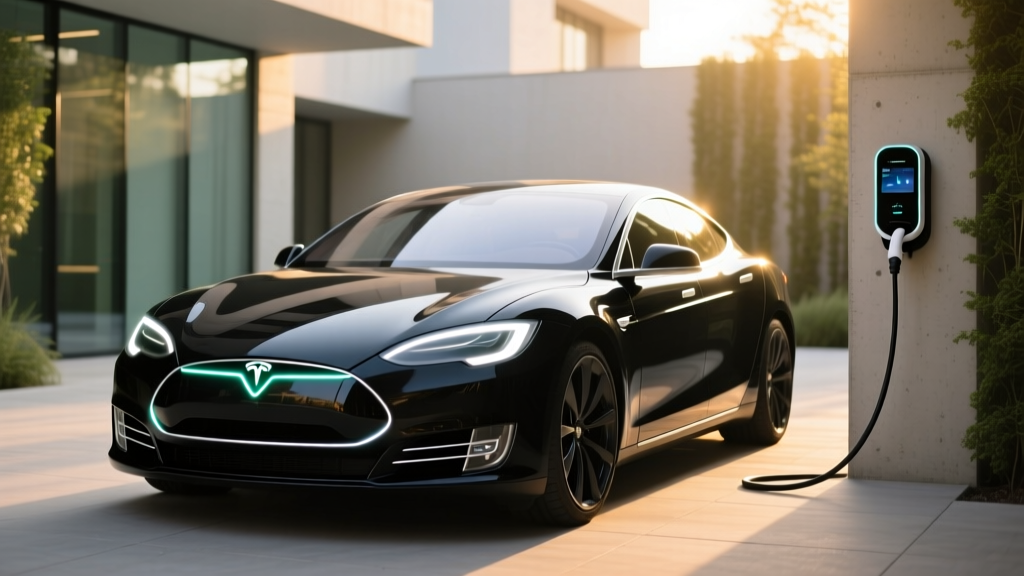
For home charging, the Tesla Wall Connector at 48 amps (11.5 kW) adds roughly 44 miles of range per hour. A full overnight session from 20% to 80% takes about 4.5 hours — easily achievable on a standard NEMA 14-50 outlet with a 60A circuit or hardwired installation. Expect $800–$1,500 for a professional Wall Connector installation depending on panel proximity; a 200A panel upgrade can add $1,500–$3,000 if your home's electrical service is older. The Model Y ships with a Mobile Connector for Level 1 and basic Level 2 use, but the Wall Connector is the recommended daily solution.
Performance and Driving Dynamics
The dual-motor AWD powertrain delivers 384 combined horsepower and a 4.8-second 0–60 mph time. That's brisk enough for confident highway merging and genuinely quick off the line, though the Performance variant (3.5 seconds) exists for those who want sports-sedan acceleration in a crossover. The Juniper refresh retuned the adaptive dampers and added acoustic glass, and the difference is noticeable: road noise drops significantly at highway speed, and the ride quality over broken pavement has moved from "firm and busy" to "composed."
Regenerative braking remains single-mode (no adjustable levels as in rival EVs), but Tesla's regen calibration is well-tuned. Lifting off the accelerator decelerates progressively, enabling one-pedal driving in most city scenarios. The steering is precise but numb — a common Tesla trait — and the 3,351-pound curb weight is well-managed through corners thanks to the low battery floor.
Interior, Tech, and the Stealth Gray Experience
Stealth Gray is a $0 standard color on the 2026 Model Y, which is notable since Tesla previously charged $1,500–$2,000 for most metallic paints. The dark gray hue reads as sophisticated rather than somber, and it hides road grime better than black — a practical advantage for daily drivers in rainy or dusty climates. It pairs well with both the standard black interior and the optional white ($1,000) or black-and-white ($2,000) premium cabins.
The Juniper interior introduces several meaningful upgrades:
- Ambient lighting strip across the dashboard and door panels, adjustable in color and intensity
- 8-inch rear touchscreen for rear-seat climate, media, and gaming — a significant improvement over the previous rear-only vent setup
- Ventilated front seats (standard on Long Range), reducing the need for seat cooling hacks in summer
- Power-folding second row with a 60/40 split, improving cargo flexibility
- 15.4-inch front touchscreen running the latest Tesla OS, with Netflix/YouTube/theater mode while parked
Cargo volume stands at 30.2 cu ft behind the second row and 72.1 cu ft with seats folded — competitive with the Ford Mustang Mach-E (29.7/60.4 cu ft) and slightly behind the Hyundai Ioniq 5 (27.2/59.3 cu ft). The front trunk (frunk) adds 4.1 cu ft, useful for charging cables or a small bag.
Legroom is generous: 41.8 inches front, 38.4 inches rear. Three adults across the back seat is feasible for short trips, though the center position lacks a dedicated headrest contour.
Pricing, Trims, and Federal Tax Credit Eligibility
| Trim | MSRP (incl. dest.) | Key Features |
|---|---|---|
| Long Range RWD | $43,380 | 307 mi range, single motor, NMC |
| Long Range AWD | $46,380 | 320 mi range, dual motor, NMC |
| Long Range AWD (tested, Stealth Gray, white interior) | $47,380 | + $1,000 white interior |
| Performance AWD | $51,380 | 3.5s 0–60, track mode, 21" wheels, 277 mi range |
The 2026 Model Y Long Range AWD starts at $46,380 including the $1,390 destination charge. Our Stealth Gray test vehicle with the optional white premium interior came to $47,380. Adding Full Self-Driving (Supervised) — the $8,000 software package — would push that to $55,380, though we recommend evaluating Basic Autopilot (standard) before committing to FSD given its Level 2 classification and ongoing supervision requirement.
Federal §30D Tax Credit: Does the Model Y Qualify?
As of 2026, the Tesla Model Y Long Range AWD qualifies for the full $7,500 federal tax credit under IRS §30D, provided the buyer meets income thresholds. Tesla's US-built battery packs and North American final assembly satisfy the critical-minerals and battery-component sourcing requirements that have tripped up several competitors. The credit is available as a point-of-sale transfer, meaning you can apply it as a down-payment reduction at delivery rather than waiting for a tax refund.
- Buyer AGI: ≤ $150,000 (single) / ≤ $300,000 (joint)
- Vehicle MSRP: ≤ $80,000 for SUVs (Model Y qualifies)
- Battery sourcing: Critical minerals + component thresholds met (Tesla US production)
- Final assembly: North America (Fremont, CA or Austin, TX)
- Point-of-sale transfer available from Tesla directly
After the $7,500 credit, the Long Range AWD effectively costs $38,880 — a compelling figure for a 320-mile AWD crossover with this level of tech. However, buyers earning above the income cap or purchasing through a business entity (which follows different §45W rules) should consult a tax professional before assuming eligibility.
Driver Assistance: Autopilot and FSD Supervised
Standard Autopilot includes Traffic-Aware Cruise Control and Autosteer, which handles highway lane-keeping competently. FSD (Supervised) adds Navigate on Autopilot (automatic off-ramp and interchange routing), Auto Lane Change, Autopark, and Smart Summon (the car navigates a parking lot to you). In our testing on divided highways, FSD handles 90%+ of miles without intervention, but the remaining edge cases — phantom braking, unexpected lane closures, complex intersections — demand constant vigilance. The $8,000 cost is difficult to justify unless you regularly drive long highway stretches and accept the supervision burden.
Pros and Cons
- 320 mi EPA range is top-tier for the segment
- Supercharger network reliability remains best-in-class
- $7,500 federal credit + point-of-sale transfer
- Excellent cargo space and practicality
- OTA updates continuously add features
- Stealth Gray is a no-cost premium color
- DC charging slower than 800V rivals (27 vs 18 min)
- No physical buttons; all controls via touchscreen
- Turn-signal stalk removed in Juniper (steering-wheel buttons)
- FSD cost hard to justify at $8,000 for Level 2
- Insurance premiums run 15–25% above segment average
- Rear visibility limited without camera mirror option
Model Y vs. Key Competitors: Is It Worth It?
The Model Y Long Range AWD competes directly with the Hyundai Ioniq 5 Long Range AWD ($49,400, 290 mi EPA), the Ford Mustang Mach-E Premium AWD ($48,995, 290 mi EPA), and the Kia EV6 GT-Line AWD ($52,400, 274 mi EPA). On paper, the Model Y wins on range (320 vs ~290 mi), cargo volume, and Supercharger access. The Ioniq 5 and EV6 counter with faster DC charging (800V architecture, ~18 min 10–80%), more intuitive physical controls, and IIHS Top Safety Pick+ ratings. The Mach-E offers a more traditional cockpit layout and Ford dealer service access.
If Supercharger reliability and maximum range dominate your priorities, the Model Y remains the default choice. If you value faster charging stops, tactile controls, and a more conventional interior, the Ioniq 5 is a strong alternative — especially now that Hyundai has NACS adapters enabling Supercharger access (albeit with slightly reduced peak speeds).
Who Should Buy the Dark Gray Tesla Model Y?
Best for: Daily commuters covering 40–80 miles round-trip with home Level 2 charging; families needing versatile cargo space for strollers, gear, and road-trip luggage; tech-forward buyers who value OTA improvements and the Tesla app ecosystem; anyone in a region with dense Supercharger coverage.
Consider alternatives if: You lack home charging access and rely entirely on public DC fast charging (the Ioniq 5's faster curve matters); you prefer physical buttons and traditional ergonomics; you drive in extreme cold regularly (LFP-equipped rivals or PHEVs may suit better); you want the latest IIHS safety hardware (Tesla's camera-only approach has drawn scrutiny vs lidar-equipped competitors).
Frequently Asked Questions
What is the real-world range of the dark gray Tesla Model Y?
The 2026 Model Y Long Range AWD is EPA-rated at 320 miles. In mixed real-world driving, expect 270–290 miles at highway speeds and 230–250 miles in freezing temperatures. City driving with regenerative braking can push closer to 300 miles.
How fast does the Model Y charge at home and on the road?
At home on a 48A Tesla Wall Connector (11.5 kW), the Model Y gains approximately 44 miles of range per hour, with a full 0–100% charge in about 7 hours. On a V3 Supercharger (250 kW peak), it charges from 10–80% in roughly 27 minutes.
How much does the 2026 Model Y cost after tax credits?
The Long Range AWD starts at $46,380 including destination. After the $7,500 federal §30D credit (if eligible), the effective price is $38,880. State incentives may reduce this further — check afdc.energy.gov for your area.
Does the dark gray Tesla Model Y qualify for the federal EV tax credit?
Yes, as of 2026 the Model Y Long Range AWD qualifies for the full $7,500 §30D credit, available as a point-of-sale transfer. Buyers must meet AGI limits ($150K single / $300K joint) and the vehicle must be for personal use. Verify current eligibility at irs.gov.
Is the Stealth Gray color worth it?
Stealth Gray is a no-cost standard color on the 2026 Model Y, making it an excellent value. It hides dirt and swirl marks better than solid black, reads as premium in most lighting, and pairs well with all interior options. There is no upcharge to select it.
Is the Model Y still worth buying in 2026 vs newer competitors?
Despite increased competition from the Ioniq 5, EV6, and Mach-E, the Model Y's combination of 320-mile range, Supercharger network, cargo practicality, and post-credit pricing keeps it at the top of the segment. If fast DC charging and physical controls matter more to you, test-drive the Ioniq 5 before committing.