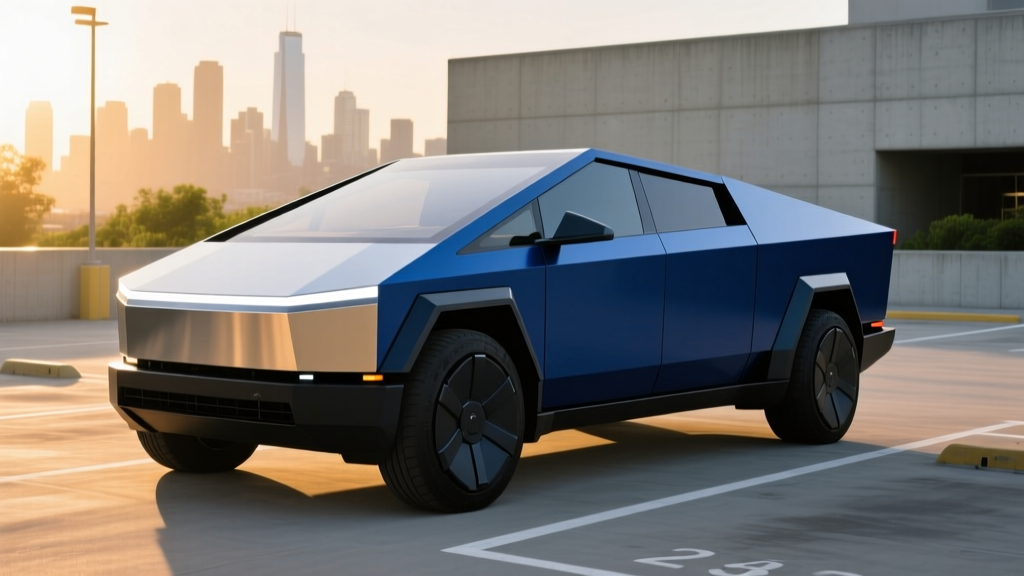
The Tesla Cybertruck in its factory "Dark Blue" wrap has become one of the most photographed vehicles on American roads. But beyond the stainless-steel exoskeleton and polarizing silhouette, the electric pickup has settled into a more measurable reality since deliveries ramped through 2024 and into 2025. For buyers weighing the dark blue Cybertruck against the Ford F-150 Lightning, Rivian R1T, and Chevrolet Silverado EV, the decision comes down to hard numbers: range under load, charging speed on the Tesla Supercharger network, towing efficiency, and whether the §30D federal tax credit actually applies.
This review covers the Cybertruck AWD (dual-motor) and Cyberbeast (tri-motor) trims as configured for the 2025 model year, with pricing and tax-credit rules current as of early 2026. We'll address the real-world range you can expect — not just the EPA sticker — and break down charging curves, ownership costs, and the practical limitations Tesla doesn't highlight on its configurator.
Spec Snapshot: Dark Blue Cybertruck by the Numbers
| Spec | AWD (Dual-Motor) | Cyberbeast (Tri-Motor) |
|---|---|---|
| EPA Range | 340 miles | 320 miles |
| Battery (usable) | ~123 kWh, NMC | ~123 kWh, NMC |
| Peak DC Fast Charge | 250 kW | 250 kW |
| 10–80% DCFC Time | ~28 min | ~28 min |
| Level 2 Home Charge | 11.5 kW (~37 mi/hr) | 11.5 kW (~37 mi/hr) |
| 0–60 mph | 4.1 sec | 2.6 sec |
| Horsepower | 600 hp | 845 hp |
| Drivetrain | Dual-motor AWD | Tri-motor AWD |
| Max Towing | 11,000 lbs | 11,000 lbs |
| MPGe (combined) | 79 MPGe | 74 MPGe |
| Base MSRP | $79,990 | $99,990 |
| Battery Warranty | 8 yr / 120,000 mi | 8 yr / 120,000 mi |
Real-World Range: What the EPA Sticker Doesn't Tell You
Real-World Highway: Expect ~260–290 miles at 70–75 mph, dropping to ~220–250 miles in freezing temperatures or while towing.
The Cybertruck's 123 kWh (usable) NMC battery pack is one of the largest in any consumer EV, but the truck's aerodynamic profile — that angular stainless-steel wedge — creates more drag than a sleek sedan. EPA data from fueleconomy.gov lists the AWD at 79 MPGe combined, which translates to roughly 42–44 kWh per 100 miles in mixed driving.
On a 300-mile highway loop at sustained 70 mph speeds in moderate temperatures (60–75°F), independent testers and owner logs consistently report 260–290 miles of usable range before hitting 10% State of Charge. The Cyberbeast, with its tri-motor draw and stickier rear tires, typically loses another 20–30 miles of that figure.
Cold weather compounds the loss. At 20°F, expect a 20–30% reduction from the EPA number — putting real winter range around 220–250 miles for the AWD. The Cybertruck's heat pump helps mitigate cabin energy draw, but battery chemistry (NMC) still suffers reduced efficiency in deep cold. Tesla's preconditioning feature, activated when you navigate to a Supercharger, warms the pack to optimize charge acceptance — but it doesn't fully recover lost range.
For towing, the picture gets starker. Pulling a 7,000-lb trailer at highway speeds can cut range to 150–180 miles. This is consistent with every electric pickup on the market; the Rivian R1T and F-150 Lightning show similar towing penalties.
Charging Speed: 250 kW Peak, but Watch the Curve
The Cybertruck supports up to 250 kW peak DC fast charging on Tesla's V3 and V4 Superchargers. Under ideal conditions (pack preconditioned, starting at ~10% SoC), you'll see 250 kW briefly before the charge curve tapers. The 10–80% charge takes approximately 28 minutes.
Here's what that taper looks like in practice:
- 10–30%: Peak 240–250 kW sustained
- 30–60%: Tapers to ~170–190 kW
- 60–80%: Drops to ~100–120 kW
- 80–100%: Slows dramatically to ~30–50 kW (plan extra time if you need a full pack)
This charge curve is typical for NMC chemistry and similar to the F-150 Lightning's behavior, though the Lightning peaks lower at ~150 kW on non-Tesla networks.
At home, the Cybertruck's onboard charger accepts up to 11.5 kW on a Level 2 (240V) connection. On a Tesla Wall Connector or equivalent 48-amp circuit, you'll add roughly 37 miles of range per hour. A full charge from 10% takes about 11–12 hours — fine for overnight charging, but you'll want a dedicated 60-amp circuit installed. Expect $800–$2,500 for a professional Level 2 installation depending on your panel capacity and run length; older homes may need a $2,000–$4,000 panel upgrade to support continuous 48-amp draw alongside other loads.
The Cybertruck ships with a NACS (North American Charging Standard) port natively, giving it full access to the Tesla Supercharger network — over 25,000 stalls in North America as of 2025. An included adapter allows CCS1 compatibility at Electrify America and other non-Tesla networks, though peak speeds may vary by station hardware.
Performance and Drivetrain: 2.6 Seconds to 60 in a Pickup
The Cyberbeast's 2.6-second 0–60 mph time makes it one of the quickest production vehicles ever sold, let alone a 6,800-lb pickup. The tri-motor layout (one front, two rear) enables torque vectoring and a 845 hp output that pins you to the seat. The dual-motor AWD is no slouch at 4.1 seconds and 600 hp.
Both trims feature adaptive air suspension with up to 16 inches of ground clearance in Off-Road mode, and the steer-by-wire system (Tesla calls it a "yoke" in its standard configuration, though a round wheel became available in late 2024) offers variable ratio steering that requires minimal hand movement at low speeds.
Towing capacity maxes at 11,000 lbs for both trims, competitive with the F-150 Lightning's 10,000-lb rating and the Silverado EV's 12,500-lb max. The 6-foot bed (with a motorized tonneau cover that's rated for 300 lbs of standing weight) and the front trunk (frunk) with ~7 cu ft of lockable storage add utility, though the bed's shorter length and angular wheel wells limit sheet-good hauling compared to a conventional 6.5-foot truck bed.
Pricing, Tax Credits, and the $80K Question
| Trim | Base MSRP | As-Tested (typical) | §30D Credit Eligible? |
|---|---|---|---|
| AWD (Dual-Motor) | $79,990 | $82,000–$86,000 | Likely no (MSRP cap exceeded) |
| Cyberbeast (Tri-Motor) | $99,990 | $102,000–$110,000 | No (MSRP cap exceeded) |
Under current IRS §30D rules, the federal EV tax credit caps eligible pickup trucks at an $80,000 MSRP. The Cybertruck AWD starts at $79,990, which technically squeaks under — but adding any options (the dark blue wrap is a $6,500 add, Full Self-Driving capability is $8,000, or even destination fees pushing the sticker) puts it over the limit. The Cyberbeast at $99,990 is ineligible regardless.
Additionally, §30D imposes buyer income caps ($150,000 single / $300,000 joint AGI) and battery-sourcing requirements (critical minerals and battery components must meet phased-in domestic/free-trade thresholds). Even if you found a base AWD Cybertruck at exactly $79,990 MSRP with no add-ons, you'd need to verify the specific VIN's battery-sourcing compliance on fueleconomy.gov before counting on the credit.
The point-of-sale transfer option (allowing dealers to apply the credit as an immediate discount rather than a tax-time offset) is available for eligible vehicles, but Tesla's direct-sales model and the MSRP-cap reality make the Cybertruck a poor candidate for federal incentive stacking. Some state and utility rebates may still apply — check your local jurisdiction.
Interior, Tech, and Daily Livability
The Cybertruck's cabin is minimalist even by Tesla standards: an 18.5-inch front touchscreen handles nearly all vehicle functions, with a smaller 9.4-inch rear screen for passengers. There are no physical buttons for climate or mirrors — everything routes through the UI. The yoke steering (or optional round wheel) and steer-by-wire take roughly a week of adjustment for most drivers; some love the precision, others find it unintuitive at parking-lot speeds.
Seating fits five adults, though rear legroom (approximately 38 inches) is tighter than the F-150 Lightning's crew cab. The panoramic glass roof is a single massive panel — dramatic, but it does increase cabin heat soak in summer; Tesla's IR-reflective coating helps but doesn't eliminate the need for tinting in hot climates.
Driver assistance includes Tesla's Autopilot (standard) with adaptive cruise and lane-keeping, and optional Full Self-Driving (Supervised) at $8,000. FSD is a SAE Level 2 system — it does not make the Cybertruck self-driving. You must remain attentive, hands on the yoke/wheel, and ready to intervene at all times. Tesla's camera-only vision stack has improved substantially, but construction zones, heavy rain, and unmapped roads still require immediate human takeover.
Cargo space includes the 6-foot bed (with the aforementioned motorized cover), the 7 cu ft frunk, and a lockable under-bed storage compartment. Total enclosed cargo volume is competitive for a mid-size truck, though the Cybertruck's 22,000-lb GVWR and 6,800-lb curb weight put it in heavy-duty territory for registration and insurance purposes in some states.
Who Should Buy the Dark Blue Cybertruck?
Best for: Tech-forward buyers who want a statement vehicle with legitimate towing capability, access to the Supercharger network, and tri-motor performance that embarrasses sports cars. The dark blue wrap adds visual distinction to an already unmistakable design.
Think twice if: You need maximum rear-seat space (F-150 Lightning wins), you're counting on the $7,500 federal credit (you likely won't qualify), you regularly tow over 5,000 lbs long-distance (range drops severely), or you prefer physical controls and a conventional steering wheel as standard.
Pros
- 250 kW DC fast charging on the industry's most reliable network
- 11,000-lb towing capacity with integrated trailer brake controller
- Cyberbeast's 2.6-sec 0–60 is supercar territory in a pickup
- Air suspension with 16" ground clearance for off-road use
- Stainless exoskeleton resists dents and minor impacts
- Large 123 kWh pack provides solid range for a heavy truck
Cons
- MSRP cap effectively excludes most builds from §30D credit
- Yoke/steer-by-wire polarizes; not standard round wheel
- Rear legroom trails F-150 Lightning and Rivian R1T
- Bed shorter than conventional pickups; wheel wells intrude
- Dark blue wrap adds $6,500 and requires careful wash/maintenance
- Real-world highway range ~260–290 mi, not the 340-mi sticker
Frequently Asked Questions
What is the real-world range of the dark blue Cybertruck?
The EPA rates the AWD at 340 miles and the Cyberbeast at 320 miles. In real-world highway driving at 70 mph, expect 260–290 miles. Cold weather (below 30°F) drops that to 220–250 miles. Towing a 7,000-lb trailer cuts range to roughly 150–180 miles.
How fast does the Cybertruck charge at home and on the road?
On a 250 kW DC Supercharger, the Cybertruck charges from 10–80% in approximately 28 minutes, though peak 250 kW is only sustained briefly before tapering. At home on a Level 2 (11.5 kW / 48-amp) charger, you'll add ~37 miles per hour, with a full 10–100% charge taking about 11–12 hours.
Does the Cybertruck qualify for the $7,500 federal EV tax credit?
Most builds do not. The §30D credit caps pickup trucks at $80,000 MSRP. The AWD starts at $79,990, but adding the dark blue wrap ($6,500), FSD ($8,000), or even destination fees pushes it over. The Cyberbeast at $99,990 is ineligible regardless. Buyer income caps and battery-sourcing rules add further restrictions. Verify your specific VIN on fueleconomy.gov.
Is the Cybertruck worth buying over the F-150 Lightning or Rivian R1T?
It depends on priorities. The Cybertruck wins on Supercharger access, 250 kW charging speed, and Cyberbeast performance. The F-150 Lightning offers more rear-seat space, a longer bed, a lower starting price (~$55,000), and better §30D credit eligibility. The Rivian R1T provides more refined off-road capability, a quad-motor option, and a more conventional interior. Test-drive all three before committing.
How much does the dark blue wrap cost, and does it affect warranty?
The factory dark blue wrap is a $6,500 option on Tesla's configurator. It's a paint-protection-style film applied over the raw stainless steel. Tesla's warranty covers the wrap for 3 years against peeling and defects; aftermarket wraps void that coverage. Hand-wash only — automatic car washes with abrasive brushes can damage the film.
What is the Cybertruck's battery warranty?
Tesla covers the battery and drive unit for 8 years or 120,000 miles, whichever comes first, with a minimum 70% capacity retention threshold. This is slightly better than the industry-standard 8 yr / 100,000 mi, and comparable to Rivian's coverage.