Why the Cybertruck With Topper Is the EV Overland Conversation of 2026
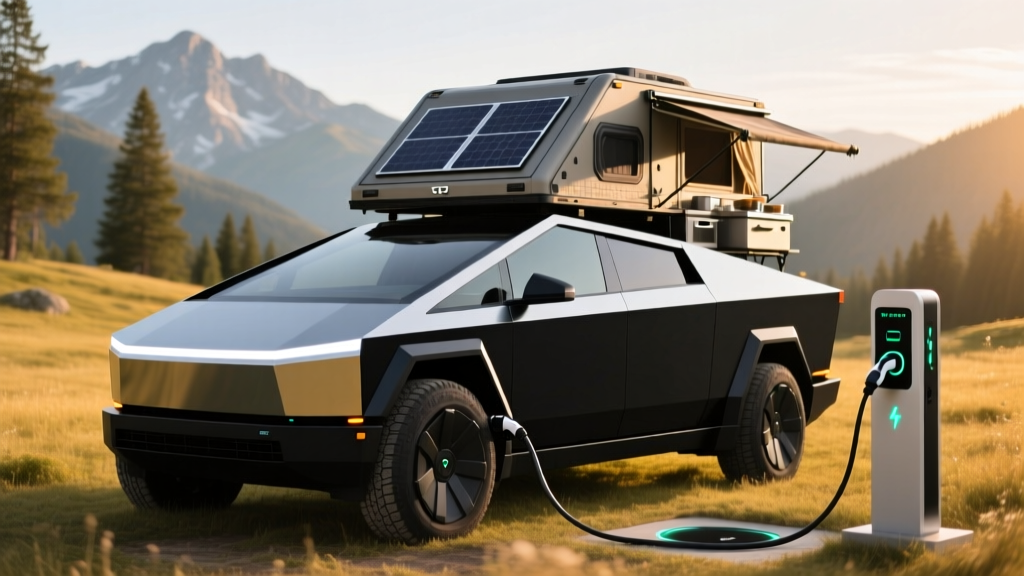
The Tesla Cybertruck's angular stainless-steel exoskeleton and 6-foot bed were practically begging for a camper shell from day one. Now in 2026, the aftermarket has delivered. From Basecamp's integrated camper toppers to Space Camp's pop-up shells and AT Overland's Summit bed cap, Cybertruck owners are converting their trucks into micro-camper rigs at a rapid pace. But bolting a topper onto a 6,800-pound electric truck fundamentally changes the aerodynamics, weight, and energy consumption equation — and most buyers don't realize how dramatically.
This profile examines the Cybertruck platform through the lens of a topper build: what happens to your range, how charging behaves under load, what the real costs look like, and whether this setup makes sense versus competing electric and hybrid trucks with camper conversions.
Cybertruck Trim Lineup and Core Specs (2026 Model Year)
Tesla currently offers the Cybertruck in three primary trims for the 2026 model year. All share the same 48-volt electrical architecture, steer-by-wire steering, and stainless-steel exoskeleton, but differ significantly in powertrain output, battery capacity, and range.
| Spec | Long Range (AWD) | Tri-Motor AWD | Cyberbeast |
|---|---|---|---|
| EPA Range | ~340 mi | ~320 mi | ~320 mi |
| Battery (usable, est.) | ~123 kWh (NMC) | ~123 kWh (NMC) | ~123 kWh (NMC) |
| Horsepower | ~600 hp | ~845 hp | ~845 hp |
| 0–60 mph | 3.9 sec | 2.6 sec | 2.6 sec |
| Drivetrain | Dual-motor AWD | Tri-motor AWD | Tri-motor AWD |
| Max Tow Rating | 11,000 lb | 11,000 lb | 11,000 lb |
| Payload Capacity | ~2,500 lb | ~2,500 lb | ~2,500 lb |
| Bed Length | 6 ft (72 in) | 6 ft (72 in) | 6 ft (72 in) |
| Bed Width (between wells) | ~49 in | ~49 in | ~49 in |
| Base MSRP | $79,990 | $99,990 | $114,990 |
| EPA Efficiency | ~58 MPGe (~57 kWh/100mi) | ~56 MPGe (~59 kWh/100mi) | ~56 MPGe (~59 kWh/100mi) |
| Battery/Drive Warranty | 8 yr / 120,000 mi | 8 yr / 120,000 mi | 8 yr / 120,000 mi |
Tesla uses NMC (nickel manganese cobalt) lithium-ion cells in the Cybertruck's structural battery pack. This chemistry favors energy density over cycle life compared to LFP, which matters for a large truck needing maximum range per charge. The structural pack integrates cells into the vehicle frame itself, reducing weight but making battery replacement far more complex and expensive than a conventional bolt-in pack.
Real-World Range: What a Topper Actually Does to Your Miles
The Cybertruck Long Range carries a ~340-mile EPA estimate. In real-world highway driving at 70 mph without a topper, expect approximately 270–290 miles. Add a hard-shell camper topper (150–300 lb) plus typical camping gear (200–400 lb), and that number drops to roughly 220–260 miles depending on speed, terrain, and temperature. In cold weather (below 32°F), add another 15–25% loss, potentially dropping effective range to 170–210 miles.
The Cybertruck's sharp-edged design already produces a higher drag coefficient (~0.38–0.42 Cd depending on aero-sail configuration) than most modern EVs. A topper changes the airflow separation point at the rear of the vehicle. Hard-shell toppers that extend above the cab roofline create a taller overall profile and increased frontal area, which hits highway efficiency the hardest.
Real-world testing by owners in the Cybertruck Owners Club forums has documented energy consumption increases of 12–22% with a loaded hard-shell topper at sustained highway speeds. Pop-up toppers like the Space Camp model, which fold flat during driving, mitigate much of this penalty — typically adding only 5–8% consumption when stowed.
Key factors that compound range loss with a topper build:
- Weight: Every 100 lb of added mass reduces range by approximately 1–2% in mixed driving. A fully loaded camper topper with water, batteries, and gear can add 400–600 lb.
- Aerodynamic drag: At 70 mph, aero accounts for roughly 60% of energy consumption. A topper that disrupts the Cybertruck's tapered rear creates a low-pressure wake zone, increasing drag substantially.
- Rolling resistance: All-terrain or mud-terrain tires (popular on overland builds) add another 5–10% consumption penalty over the stock Goodyear Wrangler Territory tires.
- Accessory load: Running a fridge, lights, or auxiliary heater off the Cybertruck's 120V/240V bed outlets draws from the traction battery — roughly 0.5–2 kWh per hour depending on the appliance.
Charging Speed and Infrastructure: DC Fast, Level 2, and NACS
Charging a Cybertruck with a topper presents both advantages and logistical challenges. The truck uses the NACS (North American Charging Standard) connector natively, giving it direct access to Tesla's Supercharger network — the most reliable DC fast-charging infrastructure in the U.S. as of 2026.
| Charging Level | Power | Rate / Time | Notes |
|---|---|---|---|
| Level 1 (120V) | ~1.4 kW | ~3–4 mi/hr | Emergency/trickle only; ~4 days for full charge |
| Level 2 (240V, 48A) | 11.5 kW | ~34–38 mi/hr | Home Wall Connector; ~9–10 hr for 10–100% |
| Level 2 (240V, 80A) | 19.2 kW | ~55–60 mi/hr | Requires 100A circuit; fastest home option |
| DC Fast (V4 Supercharger) | Peak ~250 kW | 10–80% in ~25 min | Sustained rate tapers significantly above 60% SoC |
| DC Fast (350 kW CCS w/ adapter) | Peak ~250 kW | 10–80% in ~25–28 min | Via NACS-to-CCS adapter at Electrify America, etc. |
The Cybertruck's ~123 kWh battery is massive, which means even at peak charge rates, filling it takes longer than smaller-battery EVs. The charge curve peaks around 250 kW between roughly 10–40% state of charge, then tapers to ~150 kW by 60%, and drops below 80 kW above 80%. This is typical NMC behavior — the battery management system protects cell longevity by reducing charge current as cells approach full capacity.
Topper-specific charging considerations:
- Supercharger parking geometry: Many Supercharger stalls are designed for sedans and compact SUVs. A Cybertruck with a topper (223.5 in long, ~79 in tall with most hard shells) may require pull-through stalls or end-cap spots. Tesla has been adding more pull-through Supercharger locations, but they're not yet universal.
- Campsite charging: Most campgrounds offer only 30A or 50A 240V outlets (NEMA 14-50), delivering 7.2–11.5 kW. Expect 10–14 hours for a full charge at a campsite — plan overnight stops accordingly.
- Preconditioning matters: The Cybertruck's battery thermal management is critical for achieving peak DC charge rates. Always navigate to a Supercharger using the truck's built-in nav to trigger automatic battery preconditioning. Arriving at a charger cold (especially in winter) can cut peak charge speed by 30–50%.
Topper Options for the Cybertruck in 2026
The aftermarket has matured considerably since the Cybertruck's late-2023 launch. Here are the most prominent topper categories available as of 2026:
Hard-Shell Camper Toppers
Companies like Basecamp, AT Overland (Summit), and Four Wheel Campers offer rigid fiberglass or composite shells that mount to the bed rails. These typically weigh 200–400 lb empty and provide standing or near-standing headroom with a fixed roof. They create the most interior space but impose the largest aerodynamic and weight penalty. Prices range from $4,000 to $12,000+ depending on amenities (insulation, windows, electrical pass-through).
Pop-Up / Wedge Campers
Space Camp, Project M by Four Wheel Campers, and Alu-Cab offer wedge-style pop-ups that fold flat during transit. These add only 4–6 inches of height when closed, preserving much of the Cybertruck's stock aerodynamics. Deployed, they provide sleeping space for two adults. Weight: 150–280 lb. Price: $3,500–$8,000.
Slide-In Truck Campers
Traditional slide-in campers (e.g., Scout Campers, NuCamp) can technically fit the Cybertruck's 6-foot bed, but payload is the limiting factor. With ~2,500 lb of payload capacity, a lightweight slide-in (800–1,200 lb) is feasible, but you'll sacrifice significant range and ride quality. This is the least popular approach among Cybertruck owners.
Bed Rack + Rooftop Tent
A bed rack system (Yakima, Thule, or custom) with a rooftop tent is the lightest "camper" option at 100–200 lb total. It preserves most of the truck's range while providing elevated sleeping. The trade-off is zero weather protection for bed-stored gear and full exposure to wind noise.
Pricing, Tax Credits, and Total Build Cost
The Cybertruck has been one of the more controversial vehicles regarding federal tax credit eligibility. Here's the current landscape for 2026:
| Trim | Base MSRP | §30D Credit Eligible? | Effective Price (w/ credit) |
|---|---|---|---|
| Long Range AWD | $79,990 | Yes (MSRP under $80K truck cap) | ~$72,490* |
| Tri-Motor AWD | $99,990 | No (exceeds $80K truck MSRP cap) | $99,990 |
| Cyberbeast | $114,990 | No (exceeds $80K truck MSRP cap) | $114,990 |
*Eligibility for the full $7,500 federal tax credit under IRS §30D depends on multiple factors: buyer modified adjusted gross income must not exceed $300,000 (joint) / $150,000 (single), the vehicle must meet critical mineral and battery component sourcing requirements, and MSRP must not exceed $80,000 for trucks. The Long Range AWD at $79,990 sits exactly at the cap — any dealer-installed options that push the sticker above $80,000 will disqualify it. Always verify current-year rules with a tax professional before purchasing.
The credit can now be transferred to the dealer at point of sale as an instant discount, which simplifies cash flow — you don't need to wait until tax filing to benefit.
Total Build Budget Estimate
- Cybertruck Long Range AWD: $79,990 (or ~$72,490 after credit)
- Pop-up topper (e.g., Space Camp): $5,000–$7,000
- Bed rack, lighting, electrical pass-through: $1,500–$3,000
- All-terrain tires (set of 5): $2,000–$3,500
- Home Level 2 charger (Tesla Wall Connector + install): $1,200–$2,500
- Total realistic build: $82,000–$96,000 before credit; $74,500–$88,500 after
Tech, Driver Assistance, and Overland-Specific Features
The Cybertruck carries Tesla's latest infotainment and driver-assistance suite. Key features relevant to a topper/camper build:
- 18.5-inch center touchscreen with integrated navigation, campsite waypoints, and Supercharger routing. The display handles all vehicle controls — there are no physical buttons, which can be frustrating with dirty or gloved hands on the trail.
- Autopilot (standard) includes adaptive cruise, lane centering, and automatic emergency braking. This is SAE Level 2 driver assistance — you must keep your hands on the yoke and eyes on the road at all times. It is not self-driving.
- Full Self-Driving (Supervised) is an optional $8,000 upgrade (or $99/month subscription as of 2026). Despite the name, FSD remains SAE Level 2 and requires active driver supervision. It handles highway on/off-ramps and some city intersections but is not a substitute for an attentive driver.
- Powershare (vehicle-to-load): The Cybertruck offers up to 11.5 kW of bidirectional power through bed-mounted 120V and 240V outlets. This is the killer feature for camper builds — you can run a fridge, induction cooktop, lights, and charge devices directly from the truck's battery without a separate generator. Budget roughly 1–3 kWh per hour for typical campsite appliance use.
- Air suspension: Adaptive air suspension with up to 16 inches of ground clearance in Extract Mode helps on rough forest roads. However, a loaded topper reduces the suspension's ability to self-level, and sustained heavy loads accelerate air spring wear.
- Steer-by-wire: The Cybertruck uses a fully electronic steering system with no mechanical connection between the yoke and wheels. This provides variable ratio steering (less turning of the yoke at low speeds), but some drivers find it unintuitive, especially on technical off-road terrain.
Autopilot and FSD (Supervised) are SAE Level 2 systems. The driver is legally and practically responsible for all vehicle operation at all times. These systems can and do fail to detect stopped vehicles, construction zones, and road debris. Never rely on them as a substitute for alert driving — especially on unfamiliar back roads where you may be fatigued from camping.
Who Should Build a Cybertruck With Topper (And Who Shouldn't)
- You want a dual-purpose daily driver and weekend camper without owning two vehicles
- You value Powershare's ability to run camp appliances without a generator
- Your typical camping trips are within 200 miles of home or along well-served Supercharger corridors
- You prioritize instant torque and performance (the Tri-Motor's 2.6-second 0–60 is absurd for a truck)
- You're comfortable with a 6-foot bed limitation (most competing trucks offer 6.5–8 ft beds)
- You need 300+ miles of real-world range with a loaded camper (consider the Rivian R1T with its Max Pack, or a Ford F-150 Lightning Extended Range)
- You frequently camp in remote areas with no charging infrastructure (a PHEV like the Jeep Wrangler 4xe with a topper eliminates range risk entirely)
- You need an 8-foot bed for larger slide-in campers
- You want a proven long-term reliability track record (the Cybertruck's steer-by-wire, 48V architecture, and air suspension are all first-generation systems with limited long-term data)
Cybertruck vs. Key Competitors for Camper Builds
| Attribute | Tesla Cybertruck LR | Rivian R1T Max Pack | Ford F-150 Lightning Ext. Range |
|---|---|---|---|
| EPA Range | ~340 mi | ~380 mi | ~320 mi |
| Real Range w/ Topper (est.) | ~230 mi | ~270 mi | ~230 mi |
| Bed Length | 6 ft | 4.5 ft (+ Gear Tunnel) | 5.5 ft (5.5' Styleside) |
| Max Tow | 11,000 lb | 11,000 lb | 10,000 lb |
| V2L / Bidirectional | 11.5 kW (Powershare) | Not available (as of 2026) | 9.6 kW (Pro Power Onboard) |
| Charging Network | NACS (Supercharger native) | NACS (adapter or native on newer models) | NACS (via adapter or newer models) |
| Base MSRP | $79,990 | ~$92,000 | ~$69,995 |
| §30D Credit Eligible | Long Range only | Yes (all trims under $80K cap — verify by trim) | Yes (select trims under $80K cap) |
The Rivian R1T's longer EPA range and Max Pack option make it the stronger choice for remote overlanding, though its shorter bed and higher price are trade-offs. The F-150 Lightning offers the most traditional truck experience and the lowest entry price, but its real-world range with a topper is similarly constrained. The Cybertruck's Powershare advantage is significant for off-grid camping — 11.5 kW of bidirectional power is class-leading.
Warranty, Reliability, and Long-Term Ownership
Tesla provides the following coverage for the 2026 Cybertruck:
- Basic Vehicle Limited Warranty: 4 years / 50,000 miles
- Battery and Drive Unit Warranty: 8 years / 120,000 miles (minimum 70% battery capacity retention over the warranty period)
- Corrosion Warranty: 12 years / unlimited miles (relevant for the stainless-steel body)
The 8-year/120,000-mile battery warranty is competitive, though the 70% retention threshold means Tesla won't replace a pack that has degraded to 71% — even if you've lost nearly 40 miles of range from the original 340. For a camper build where every mile matters, this is worth noting.
Long-term reliability data for the Cybertruck is still limited. The 48-volt architecture, steer-by-wire system, and structural battery pack are all production-first implementations. Early owners have reported issues with panel alignment, air suspension failures, and 12V battery drain. Tesla's service network is expanding, but wait times for structural or high-voltage repairs can be weeks in some markets.
For a topper build, also consider that aftermarket modifications can complicate warranty claims. A camper shell that overloads the bed or stresses the air suspension may void coverage on those components. Document your build carefully and stay within published payload limits.
Pros and Cons at a Glance
- Class-leading 11.5 kW Powershare for off-grid appliance power
- NACS native — full Supercharger access without adapters
- Stainless-steel exoskeleton resists dents, scratches, and trail pinstriping
- Tri-motor performance is unmatched in the truck segment (2.6s 0–60)
- Adaptive air suspension provides up to 16 in of ground clearance
- Long Range trim qualifies for $7,500 §30D credit (if under $80K MSRP)
- Short 6-foot bed limits camper and cargo options vs. competitors
- Real-world range with a topper drops to ~220–260 mi (Long Range)
- No physical buttons — all controls via touchscreen, impractical off-road
- Steer-by-wire and 48V architecture are unproven long-term
- Supercharger stalls often too tight for truck+topper parking
- Tri-Motor and Cyberbeast exceed $80K MSRP cap — no federal tax credit
- ~$80K+ starting price before topper and accessories
Frequently Asked Questions
What is the real-world range of a Cybertruck with a camper topper?
Expect approximately 220–260 miles with a hard-shell topper and typical camping gear on the Long Range AWD trim at highway speeds. Pop-up toppers that fold flat during driving preserve more range, typically yielding 250–280 miles. Cold weather (below 32°F) can reduce these figures by an additional 15–25%.
How fast does the Cybertruck charge at home and on the road?
On a home Level 2 Tesla Wall Connector (11.5 kW / 48A), the Cybertruck adds roughly 34–38 miles of range per hour, with a full 10–100% charge taking about 9–10 hours. At a V4 Supercharger, DC fast charging peaks at ~250 kW, achieving a 10–80% charge in approximately 25 minutes. The charge rate tapers significantly above 60% state of charge.
How much does a Cybertruck cost after the federal tax credit?
The Long Range AWD at $79,990 is eligible for the $7,500 §30D credit (assuming buyer income and battery sourcing requirements are met), bringing the effective price to approximately $72,490. The Tri-Motor AWD ($99,990) and Cyberbeast ($114,990) exceed the $80,000 MSRP cap for trucks and do not qualify. Always verify current IRS §30D rules before purchasing.
Does the Cybertruck qualify for the federal EV tax credit in 2026?
The Long Range AWD trim qualifies if its final MSRP (including dealer-installed options) does not exceed $80,000 and the buyer's modified AGI is within limits ($300K joint / $150K single). Battery component and critical mineral sourcing requirements also apply. The Tri-Motor and Cyberbeast trims are not eligible due to the MSRP cap. Rules can change — consult a tax professional.
Can I run my camper appliances off the Cybertruck's battery?
Yes. The Cybertruck's Powershare system provides up to 11.5 kW through bed-mounted 120V and 240V outlets. This can power a fridge, induction cooktop, LED lights, and device chargers simultaneously. Budget 1–3 kWh per hour of use, which reduces your driving range accordingly — roughly 3–5 miles of range per kWh consumed.
Is the Cybertruck with topper worth it versus a Rivian R1T or F-150 Lightning?
It depends on your priorities. The Cybertruck wins on Powershare capability, Supercharger network access, and raw performance. The Rivian R1T Max Pack offers superior real-world range (~270 mi with topper) for remote overlanding. The F-150 Lightning provides the lowest entry price and a more traditional truck layout. If off-grid power and daily-driver performance matter most, the Cybertruck is compelling. If maximum range and bed versatility are paramount, the R1T is the stronger platform.
What is the best topper for a Cybertruck?
For minimal range impact, a pop-up wedge topper (Space Camp, Project M) is ideal — it folds flat during driving. For maximum livable space, a hard-shell from Basecamp or AT Overland provides standing room but costs 12–22% of highway range. Your choice depends on whether you prioritize driving efficiency or campsite comfort.
Sources: EPA Fuel Economy (fueleconomy.gov), Tesla Cybertruck Specifications, IRS §30D Clean Vehicle Credit.