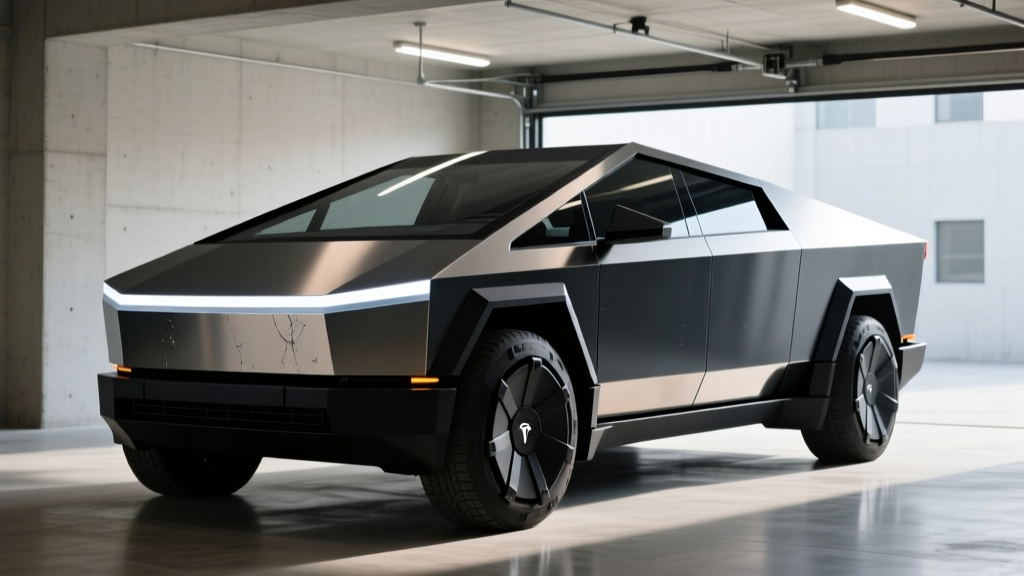
When Tesla's chief designer Franz von Holzhausen hurled a metal ball at the Cybertruck's window during the 2019 unveiling and the glass shattered, it became one of the most viral moments in automotive history. Years later, with the Cybertruck now a common sight on American roads, the question persists: are Cybertruck windows bulletproof? The short answer is no — but the full story involves Tesla's proprietary "armor glass," its actual ballistic and impact ratings, and how this unconventional electric truck stacks up in the real world across range, charging, and ownership costs.
What Is Tesla's Armor Glass, Really?
Tesla markets the Cybertruck's windows as "armor glass" — a multi-layered composite of glass and polyvinyl butyral (PVB) polymer. Unlike conventional laminated automotive glass, which sandwiches a thin PVB interlayer between two glass sheets, Tesla's armor glass uses a thicker polymer core designed to absorb and distribute impact energy across a wider area. The result is a window that resists shattering far better than standard auto glass, but it is not rated as bulletproof under any NIJ (National Institute of Justice) ballistic certification standard.
In practical terms, the armor glass will withstand impacts that would destroy a normal truck window — rocks kicked up at highway speed, hail, minor collisions with branches or debris. It will not, however, stop a handgun or rifle round. Tesla has never claimed NIJ ballistic certification for the Cybertruck's glass, and independent testing by third-party ballistic labs has confirmed this distinction. If you need actual bullet-resistant glazing, upfitters like Alpine Armoring offer aftermarket B6-rated glass solutions, but these add significant weight and cost.
2026 Cybertruck Specs: Range, Battery, and Efficiency
| Specification | AWD | Cyberbeast |
|---|---|---|
| EPA Range | 340 miles | 320 miles |
| Battery Capacity | ~123 kWh usable (NMC) | ~123 kWh usable (NMC) |
| MPGe (Combined) | 70 MPGe | 67 MPGe |
| Efficiency | 48 kWh/100 mi | 50 kWh/100 mi |
| Drivetrain | Dual-motor AWD | Tri-motor AWD |
| Horsepower | 600 hp | 845 hp |
| 0-60 mph | 3.9 sec | 2.6 sec |
| Towing Capacity | 11,000 lbs | 11,000 lbs |
| Bed Length | 6 ft (72 in) | 6 ft (72 in) |
| Cargo Volume (Bed + Frunk) | ~67 cu ft bed + 7 cu ft frunk | ~67 cu ft bed + 7 cu ft frunk |
According to fueleconomy.gov, the Cybertruck AWD's combined efficiency of roughly 48 kWh per 100 miles makes it one of the least efficient EVs on the market — a direct consequence of its 6,800+ lb curb weight and brick-like aerodynamics. For comparison, the Rivian R1T achieves around 42 kWh/100 mi, and the Ford F-150 Lightning sits near 47 kWh/100 mi.
Charging Speed: DC Fast and Home Level 2
| Charge Level | Power | Speed | Notes |
|---|---|---|---|
| Level 1 (120V) | ~1.4 kW | ~3 mi/hr | Emergency/trickle only |
| Level 2 (240V/48A) | 11.5 kW | ~25 mi/hr | Overnight home charging (~14 hr full charge) |
| DC Fast Charge | Peak 250 kW (NACS) | 10–80% in ~28 min | Sustains ~170 kW average; taper above 80% |
The Cybertruck uses the NACS (North American Charging Standard) connector natively, meaning it has seamless access to Tesla's Supercharger network — the most reliable DC fast-charging infrastructure in the U.S. At a V3 or V4 Supercharger, the Cybertruck peaks at approximately 250 kW, though the sustained charge rate through a 10–80% session averages closer to 170 kW due to the charge curve taper. Expect a 10–80% session to take roughly 28 minutes under optimal conditions (battery preconditioned via navigation routing to a Supercharger).
For home charging, the Cybertruck's onboard charger accepts up to 11.5 kW on a 240V/48A Level 2 circuit (such as a Tesla Wall Connector). With the 123 kWh battery, a full 10–100% home charge takes approximately 12–14 hours. Most owners charging overnight from 20–80% will wake up to a full daily supply. Installation of a 60A dedicated circuit for Level 2 charging typically costs $500–$2,000 depending on your electrical panel's capacity and proximity to the charging location — a licensed electrician should evaluate your 200A panel headroom before installation.
Pricing, Trims, and Federal Tax Credit Eligibility
| Trim | Base MSRP | §30D Credit Eligible? | Est. Net Price* |
|---|---|---|---|
| AWD | $79,990 | No (MSRP over $80K cap) | $79,990 |
| Cyberbeast | $99,990 | No (MSRP over $80K cap) | $99,990 |
*Net price before state/local incentives, dealer fees, or destination charges. Prices reflect 2026 MSRP as listed by Tesla.
Here's where the Cybertruck hits a wall for bargain-seeking buyers: neither trim qualifies for the federal §30D EV tax credit. The IRS caps eligible trucks, SUVs, and vans at an $80,000 MSRP ceiling (per irs.gov), and the Cybertruck AWD starts at $79,990 — which technically sits just under the cap, but any added options, destination charges, or paint/trim packages push it over. The Cyberbeast at $99,990 is well above the threshold.
- MSRP cap: Trucks/SUVs/vans must be ≤$80,000 — Cybertruck borderline or exceeds
- Buyer income cap: AGI ≤$300K (joint), $225K (head of household), $150K (single)
- Battery sourcing: Critical minerals and battery components must meet escalating domestic-content thresholds (2026: 80% critical minerals, 100% battery components from U.S. or FTA partners)
- Point-of-sale transfer: If eligible, the credit can be applied at purchase rather than waiting for tax filing
Some buyers in states like California, Colorado, or New York may qualify for additional state rebates that aren't subject to the same MSRP caps, but these vary by jurisdiction and change frequently. Consult your state's energy office or a tax professional for current local incentive availability.
Cybertruck vs. R1T vs. F-150 Lightning: Is It Worth Buying?
The Cybertruck competes in a small but growing segment of electric pickups. Here's how it measures up against the Rivian R1T and Ford F-150 Lightning on the metrics that matter:
| Metric | Tesla Cybertruck AWD | Rivian R1T Dual-Motor | Ford F-150 Lightning Lariat |
|---|---|---|---|
| EPA Range | 340 mi | 352 mi (Max Pack: 420 mi) | 320 mi (Extended Range) |
| Base MSRP | $79,990 | $69,900 | $62,995 |
| Max DC Charge | 250 kW | 220 kW | 150 kW |
| 10–80% Time | ~28 min | ~30 min | ~41 min |
| Towing Capacity | 11,000 lbs | 11,000 lbs | 10,000 lbs |
| §30D Credit | Unlikely | Eligible (select configs) | Eligible (select configs) |
| Bed Length | 6 ft | 4.5 ft (+ Gear Tunnel) | 5.5 ft |
Choose the Rivian R1T if: You want a more refined interior, better off-road capability (quad-motor available), the innovative Gear Tunnel for secure storage, and potential §30D credit eligibility on lower trims. Best for outdoor-adventure families.
Choose the F-150 Lightning if: You need a traditional truck experience, the lowest entry price, widest dealer service network, and full §30D credit eligibility on most trims. Best for fleet buyers, contractors, and value-conscious truck shoppers.
Interior, Tech, and Standout Features
The Cybertruck's cabin is aggressively minimalist — a single 18.5-inch touchscreen dominates the dash, with no physical buttons or instrument cluster. Rear passengers get a secondary 9.4-inch screen. The front trunk (frunk) offers 7 cubic feet of lockable storage, and the 6-foot bed includes a motorized tonneau cover and built-in ramps. Tesla's steer-by-wire system eliminates the mechanical connection between the yoke-style steering control and the wheels, enabling a variable ratio that requires less than one full turn lock-to-lock.
On the driver-assistance front, the Cybertruck ships with Tesla's Autopilot suite (SAE Level 2) including adaptive cruise control and lane-centering. Full Self-Driving (Supervised) is available as a $8,000 add-on or $99/month subscription — but despite the name, this remains a Level 2 system requiring constant driver attention and hands-on-wheel monitoring. It is not autonomous driving.
Notable drawbacks include the yoke steering's learning curve (especially at low speeds and in parking lots), limited rear visibility due to the bed sail design, and panel-gap inconsistencies that have been widely documented by early owners. The stainless-steel body, while dent-resistant, shows fingerprints and smudges readily and requires specific cleaning products.
Warranty, Ownership Costs, and Longevity
Tesla covers the Cybertruck with a 4-year/50,000-mile basic vehicle warranty and an 8-year/120,000-mile battery and drive unit warranty — with a capacity retention threshold of 70% during the warranty period. This means if the 123 kWh NMC pack degrades below ~86 kWh within 8 years or 120,000 miles, Tesla will repair or replace it at no cost.
NMC chemistry offers higher energy density than LFP (lithium iron phosphate), which is why Tesla chose it for the Cybertruck's range requirements, but NMC is more sensitive to sustained high states of charge. Tesla recommends daily charging to 80–90% and only charging to 100% for long trips — a practice that significantly extends long-term battery health. Based on degradation data from Tesla's existing NMC fleet, owners can expect approximately 8–12% capacity loss over 150,000 miles of mixed use.
Insurance costs for the Cybertruck run significantly higher than conventional trucks — early owner reports and insurance aggregator data suggest annual premiums in the $3,500–$5,500 range depending on location and driving record, driven by the vehicle's high repair costs (stainless-steel body panels require specialized repair procedures) and performance classification.
Pros, Cons, and Verdict
Pros
- Class-leading 0-60 acceleration (Cyberbeast: 2.6 sec)
- Supercharger network access (most reliable DC charging in U.S.)
- Stainless-steel exoskeleton resists dents and corrosion
- 11,000-lb towing capacity matches full-size gas trucks
- Steer-by-wire enables extremely quick steering ratio
- Armor glass offers superior impact resistance vs. standard auto glass
- Vehicle-to-load (V2L) capability for powering tools and appliances
Cons
- Not bulletproof despite "armor glass" branding
- Real-world highway range ~260 mi — well below 340 mi EPA sticker
- No federal §30D tax credit (MSRP cap exceeded)
- Poor rear visibility; reliance on cameras for backing up
- Yoke steering has a steep learning curve
- Insurance premiums 50–100% higher than comparable trucks
- Panel gap quality inconsistent across early production units
- Heavy: 6,800+ lbs hurts efficiency (48–50 kWh/100 mi)
Frequently Asked Questions
Are Cybertruck windows bulletproof?
No. Tesla's "armor glass" is an impact-resistant laminated composite that outperforms standard automotive glass against rocks, hail, and debris, but it does not carry any NIJ ballistic certification and will not stop bullets. Tesla has never marketed it as bulletproof under any formal standard.
What is the real-world range of the Cybertruck?
The EPA rates the AWD at 340 miles and the Cyberbeast at 320 miles. In real-world highway driving at 70–75 mph, expect 260–290 miles (AWD) and 240–270 miles (Cyberbeast). Cold weather and towing reduce range significantly — plan for 140–170 miles when towing a mid-weight trailer.
How fast does the Cybertruck charge?
On a Tesla V3/V4 Supercharger, the Cybertruck peaks at 250 kW DC and charges from 10–80% in approximately 28 minutes. At home on a 240V/48A Level 2 charger, it adds roughly 25 miles of range per hour, with a full charge taking 12–14 hours.
Does the Cybertruck qualify for the $7,500 federal EV tax credit?
Most configurations do not. The IRS §30D credit caps eligible trucks at $80,000 MSRP. The Cybertruck AWD starts at $79,990 but any options push it over, and the Cyberbeast at $99,990 is well above the cap. Always verify current eligibility on irs.gov and consult a tax professional.
Is the Cybertruck worth buying over the Rivian R1T or F-150 Lightning?
It depends on your priorities. The Cybertruck wins on acceleration and Supercharger access but loses on price, tax credit eligibility, and practical cargo space. The R1T offers better off-road capability and interior refinement; the Lightning offers the lowest entry price and broadest dealer support. If the Cybertruck's design and Tesla ecosystem appeal to you and budget isn't the primary constraint, it's a compelling — if polarizing — choice.
How much does it cost to charge a Cybertruck at home?
At the U.S. average residential electricity rate of ~$0.16/kWh, charging the Cybertruck's 123 kWh battery from 10–80% (roughly 86 kWh) costs about $13.75. A full 0–100% charge costs approximately $19.70. This translates to roughly $0.077 per mile driven — significantly less than a comparable gas truck at $0.18–$0.22 per mile.