The 2026 Tesla Cybertruck With White Interior: Quick Verdict
The Tesla Cybertruck remains one of the most polarizing vehicles on the road — and the available white interior amplifies that divide. While the minimalist "vegan leather" white cabin creates a striking visual contrast against the stainless-steel exoskeleton, it demands careful maintenance and isn't for everyone. Beyond aesthetics, the 2026 Cybertruck delivers serious capability: a 123 kWh battery pack, up to 340 miles of EPA-estimated range (AWD trim), and peak DC fast-charging at 350 kW. But with a starting MSRP that pushes past the federal §30D tax credit cap for trucks, buyers need to understand the real numbers before signing.
This review breaks down the Cybertruck's range, charging behavior, interior practicality, and total ownership cost — with the specific data you need to decide whether this electric truck fits your use case.
Range, Efficiency, and Real-World Expectations
EPA Estimate: 340 miles (AWD) / 320 miles (Cyberbeast)
Real-World Highway (70 mph): ~260–285 miles
Cold Weather (below 32°F): ~220–250 miles with cabin heating
City / Mixed Driving: ~295–320 miles
The Cybertruck's angular, flat-panel stainless-steel body creates significantly more aerodynamic drag than a rounded crossover like the Model Y or Rivian R1T. Tesla's 123 kWh (usable) battery pack is one of the largest in any production consumer vehicle, but that capacity is necessary to offset the truck's 6,800+ lb curb weight and brick-like drag coefficient.
According to fueleconomy.gov, the AWD Cybertruck achieves approximately 67 MPGe combined, translating to roughly 50 kWh per 100 miles driven. That's notably less efficient than the Rivian R1T (Dual-Motor, ~48 kWh/100mi) and far behind lighter EVs. In practical terms, highway road trips at 75+ mph will see range drop to 250–270 miles due to aerodynamic losses, and cold weather compounds this with battery thermal management and cabin heating demands.
| Specification | AWD | Cyberbeast |
|---|---|---|
| EPA Range | 340 mi | 320 mi |
| Battery (usable) | ~123 kWh, NMC | ~123 kWh, NMC |
| Efficiency (combined) | 67 MPGe (~50 kWh/100mi) | 64 MPGe (~53 kWh/100mi) |
| 0–60 mph | 4.1 sec | 2.6 sec |
| Horsepower | 600 hp | 845 hp |
| Drivetrain | Dual-Motor AWD | Tri-Motor AWD |
| Max Tow Capacity | 11,000 lbs | 11,000 lbs |
| Curb Weight | ~6,800 lbs | ~6,900 lbs |
Charging Speed: DC Fast, Level 2, and the Charge Curve
The Cybertruck uses the NACS (North American Charging Standard) connector natively — it's a Tesla, after all — and supports peak DC fast-charging at up to 350 kW on V4 Supercharger stalls. However, as with all large-battery EVs, peak rate is not sustained rate.
| Charge Level | Power (kW) | Speed (mi/hr added) | Notes |
|---|---|---|---|
| Level 1 (120V, 12A) | ~1.4 kW | ~2–3 mi/hr | Emergency/trickle only |
| Level 2 (240V, 48A) | 11.5 kW | ~20–23 mi/hr | Home Wall Connector; full charge in ~11 hrs |
| Level 2 (240V, 80A) | 19.2 kW | ~34–38 mi/hr | Requires upgraded Wall Connector + 100A circuit |
| DC Fast (V4 Supercharger) | Peak 350 kW | ~150+ mi in 15 min | 10–80% in ~18–20 min (with preconditioning) |
| DC Fast (above 80%) | Tapers to ~50–80 kW | Varies | Charge curve slows significantly past 80% |
Preconditioning matters. The Cybertruck's battery thermal management system must warm the pack to optimal temperature before it will accept peak charge rates. Use the in-dash navigation to route to a Supercharger and the truck will automatically precondition. Arriving at a charger without preconditioning — especially in cold weather — can cut peak charge rates by 40–60%.
For home charging, Tesla's Wall Connector at 48 amps (11.5 kW) adds roughly 20–23 miles of range per hour, meaning a full 10–100% charge takes approximately 11 hours. This is adequate for overnight charging but means you can't fully replenish the massive pack during a short stop. Owners with 200-amp electrical panels may need an upgrade to support an 80-amp circuit for the faster 19.2 kW Level 2 rate — budget $1,500–$4,000 for panel work if needed.
Interior: The White Cabin, Space, and Daily Practicality
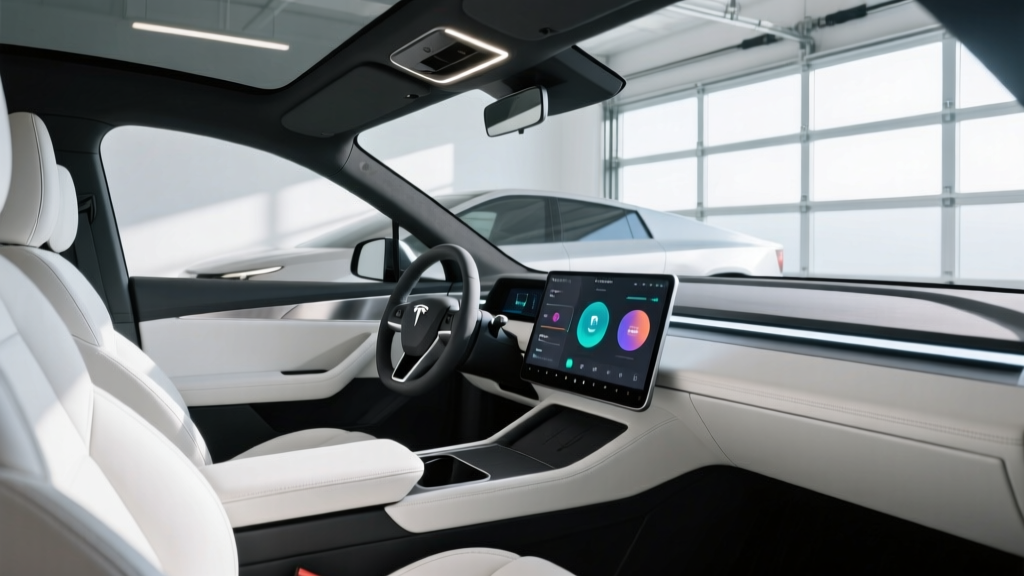
The Cybertruck's interior is aggressively minimalist, and the optional white "vegan leather" (synthetic polyurethane) seats and dashboard surfaces define the cabin experience. Here's what ownership actually looks like:
The White Interior Reality: Tesla's white synthetic material is more stain-resistant than traditional leather and can be wiped clean with a damp microfiber cloth. However, denim dye transfer is a documented issue — new dark jeans will leave blue marks on white seats during the first several wears. Owners report that isopropyl alcohol or dedicated interior cleaners resolve this, but it requires proactive maintenance. The white surfaces also show scuffs and abrasion more readily than black, particularly on seat bolsters where entry/exit friction concentrates.
Space and Dimensions:
- Front legroom: 41.5 inches
- Rear legroom: 38.2 inches (tight for a full-size truck — comparable to a midsize SUV)
- Bed length: 6 feet (with tailgate down, extends to ~8 feet)
- Bed volume: ~67 cu ft (bed) + ~34 cu ft (frunk/vault)
- Seating: 5 passengers (bench rear, no 6th seat option)
Tech and Standout Features:
- 18.5-inch central touchscreen with Tesla's latest UI (no physical buttons for climate, mirrors, or glovebox — all screen-controlled)
- 9.4-inch rear touchscreen for passengers
- Steer-by-wire with yoke or round wheel option (no mechanical linkage)
- 48-volt electrical architecture (first in a production vehicle — reduces wiring harness weight)
- Standard Autopilot (SAE Level 2) with traffic-aware cruise and lane centering; Full Self-Driving (Supervised) available as a $8,000 add-on or subscription
- Bioweapon Defense Mode (HEPA cabin filtration)
- Exterior: stainless-steel exoskeleton, armored glass, adaptive air suspension with up to 17 inches of ground clearance
Pricing, Trims, and Federal Tax Credit Eligibility
| Trim | Base MSRP | Federal §30D Credit | Effective Price* |
|---|---|---|---|
| AWD | $79,990 | Not eligible (over MSRP cap) | $79,990 |
| Cyberbeast | $99,990 | Not eligible (over MSRP cap) | $99,990 |
The §30D tax credit problem: Under current IRS rules, the federal EV tax credit caps eligible trucks (including pickups) at an $80,000 MSRP. The Cybertruck AWD at $79,990 sits right at the threshold, but destination fees, the white interior option (~$2,000), and any other add-ons push the as-tested MSRP above $80,000 — disqualifying it. The Cyberbeast at $99,990 is well over the cap.
Even if you spec a bare-bones AWD at exactly $79,990, additional §30D requirements apply:
- Buyer income caps: AGI must not exceed $300,000 (joint), $225,000 (head of household), or $150,000 (single)
- Battery sourcing: Critical minerals and battery components must meet escalating domestic-sourcing thresholds per IRS §30D guidelines — Tesla's supply chain may or may not satisfy 2026 requirements; verify with your tax professional
- Point-of-sale transfer: Eligible credits can be transferred to the dealer at purchase for an immediate price reduction, but only if all criteria are met
- Final assembly: Must occur in North America (Cybertruck is built in Austin, TX — this requirement is met)
*Effective price assumes no credit. Consult a tax professional for your specific eligibility. State and local incentives may apply separately — check AFDC's state incentive database for your jurisdiction.
Warranty, Battery Longevity, and Ownership Costs
Tesla covers the Cybertruck with the following warranty terms:
- Basic vehicle: 4 years / 50,000 miles
- Battery and drive units: 8 years / 120,000 miles (with a minimum 70% capacity retention threshold)
- Corrosion: 12 years / unlimited miles (relevant for the stainless-steel body)
The 123 kWh NMC (nickel-manganese-cobalt) pack is a high-energy-density chemistry optimized for range and performance, but NMC degrades slightly faster than LFP (lithium iron phosphate) over thousands of charge cycles. Tesla's thermal management system is among the best in the industry, and real-world data from Model S/X fleets suggests 10–15% degradation over 150,000 miles is typical for NMC packs. The 70% retention warranty threshold is standard for the industry but means a warranty claim requires significant capacity loss.
Insurance: Cybertruck insurance premiums run 30–50% higher than comparable trucks (Ford F-150 Lightning, Rivian R1T) due to the stainless-steel body's repair complexity, high parts costs, and Tesla's limited collision-center network. Expect $250–$400/month depending on your profile and state.
Charging cost: At the national average electricity rate of ~$0.16/kWh and the Cybertruck's ~50 kWh/100mi consumption, fueling costs approximately $0.08 per mile at home. DC fast-charging at Supercharger rates (~$0.30–$0.40/kWh) pushes that to $0.15–$0.20 per mile — still below gasoline at $3.50/gal in a comparable F-150 (~$0.22/mi).
Cybertruck vs. the Competition
| Spec | Tesla Cybertruck AWD | Rivian R1T Dual-Motor | Ford F-150 Lightning Lariat |
|---|---|---|---|
| EPA Range | 340 mi | 352 mi (Max Pack) | 320 mi (Ext. Range) |
| Battery | 123 kWh NMC | 149 kWh NMC | 131 kWh NMC |
| Peak DC Charge | 350 kW | 220 kW | 150 kW |
| 10–80% Time | ~18 min | ~30 min | ~41 min |
| 0–60 mph | 4.1 sec | 4.5 sec | ~5.0 sec |
| Max Tow | 11,000 lbs | 11,000 lbs | 10,000 lbs |
| Base MSRP | $79,990 | $75,900 | $69,995 |
| §30D Eligible | Borderline/No | Yes (under $80K cap) | Yes (under $80K cap) |
Pros and Cons
Pros
- Class-leading DC fast-charging at 350 kW with ~18-min 10–80%
- Massive 123 kWh battery delivers usable 300+ mile real-world range
- 11,000-lb towing capacity matches conventional heavy-duty trucks
- Stainless-steel exoskeleton is dent- and corrosion-resistant
- Steer-by-wire and 48V architecture are engineering firsts
- Tesla Supercharger network remains the most reliable DC charging infrastructure
- White interior is visually striking and wipeable (not traditional leather)
Cons
- MSRP exceeds §30D tax credit cap — no $7,500 federal credit for most buyers
- White interior requires active maintenance (denim dye transfer, scuff visibility)
- Real-world highway range drops to ~260 mi due to aerodynamic drag
- Rear legroom (38.2") is tight for a full-size truck
- Insurance premiums 30–50% above segment average
- All-screen controls (no physical buttons) frustrate some drivers
- Steer-by-wire learning curve — no mechanical feedback
- Build quality inconsistencies reported in early production units
Who Should Buy the Cybertruck (and Who Shouldn't)
Choose the Cybertruck if:
- You need best-in-class DC fast-charging for frequent road trips
- You value the Supercharger network's reliability over lowest MSRP
- You want maximum towing (11,000 lbs) with instant electric torque
- The stainless-steel, armored aesthetic is a priority
- You accept higher insurance and no federal tax credit as part of the cost
Choose a competitor if:
- You need the $7,500 §30D credit — the F-150 Lightning or R1T (under $80K MSRP) qualify
- Rear-seat passenger comfort is critical — R1T offers more legroom
- You prefer physical controls and a traditional truck interior layout
- You want a proven dealer service network — Ford's is vastly larger than Tesla's
- Your budget is under $70,000 — Lightning XLT starts at ~$55,000
Frequently Asked Questions
What is the real-world range of the Cybertruck?
The EPA rates the AWD at 340 miles and the Cyberbeast at 320 miles. In real-world highway driving at 70–75 mph, expect 260–285 miles. Cold weather (below freezing) with cabin heating reduces this further to 220–250 miles. The massive 123 kWh battery compensates for the truck's weight and drag, but aerodynamics are the limiting factor at speed.
How fast does the Cybertruck charge at home and on the road?
On a Level 2 home charger (Tesla Wall Connector, 48A/11.5 kW), the Cybertruck gains ~20–23 miles per hour, with a full charge taking ~11 hours. At a V4 Supercharger, it peaks at 350 kW and charges from 10–80% in approximately 18–20 minutes — but only with battery preconditioning. Without it, expect 25–35 minutes.
Does the Cybertruck qualify for the federal EV tax credit?
Likely not. The §30D credit caps truck MSRP at $80,000. The Cybertruck AWD starts at $79,990, but destination fees and options (including the white interior) push it over. The Cyberbeast at $99,990 is well above the cap. Even at the threshold, battery-sourcing rules and buyer income limits apply. Verify with a tax professional and consult the IRS §30D guidance.
Is the white interior worth it?
The white vegan leather is visually striking and easier to wipe clean than porous traditional leather, but it demands maintenance. Denim dye transfer is common in the first months, and seat bolster scuffs are more visible than on black. If you're willing to clean seats regularly with isopropyl alcohol or a dedicated interior cleaner, it holds up well. If you want a low-maintenance cabin, stick with black.
Is the Cybertruck worth buying vs. the F-150 Lightning or Rivian R1T?
It depends on your priorities. The Cybertruck wins on charging speed (350 kW vs. 150–220 kW) and performance (Cyberbeast's 2.6-sec 0–60). The F-150 Lightning wins on value (lower MSRP, §30D eligible, massive dealer network). The Rivian R1T wins on interior practicality and off-road capability. If fast-charging road trips and Tesla's ecosystem matter most, the Cybertruck has the edge. If budget and tax credits drive your decision, the Lightning or R1T are stronger choices.
How much does it cost to charge a Cybertruck?
At home (~$0.16/kWh), charging the 123 kWh pack from 10–90% costs approximately $16–$18, yielding ~300 miles for about $0.05–$0.08 per mile. At Superchargers (~$0.32/kWh), that same charge costs $35–$40, or about $0.12–$0.15 per mile. Both are cheaper than gasoline in a comparable F-150 at ~$0.20–$0.25 per mile.
What is the Cybertruck's towing range impact?
Towing at max capacity (11,000 lbs) cuts range roughly in half — expect 150–170 miles in ideal conditions, less in wind or hills. This is consistent with all electric trucks and is a physics reality of moving heavy loads. Plan charging stops accordingly.