Quick Verdict: Why the Cybertruck Wheel Matters More Than You Think
When Tesla launched the Cybertruck, the angular stainless-steel exoskeleton dominated headlines. But for buyers and owners, the Cybertruck wheel and tire configuration is where the rubber literally meets the road — and where real-world range, ride comfort, charging efficiency, and replacement costs are decided. The Cybertruck ships in two primary wheel diameters (20-inch and 22-inch), and the choice between them isn't cosmetic. It changes your EPA-estimated range by up to 40 miles, alters your ride quality on rough pavement, and determines whether you'll pay $350 or $650 per tire at replacement time.
This review covers the 2025–2026 Tesla Cybertruck lineup through the lens of its wheel and tire packages, while delivering the full EV-buyer spec sheet: range, charging, performance, pricing, tax credit eligibility, and ownership economics. Whether you're spec'ing a new order or evaluating a used Cybertruck, the wheel setup should be one of your first questions — not an afterthought.
Cybertruck Trim Levels, Wheel Packages, and Pricing
Tesla currently offers the Cybertruck in three trims, each with a default wheel package and optional upgrades. Pricing reflects the post-price-cut structure Tesla adopted in mid-2025, which remains in effect for 2026 model-year orders.
| Trim | Drivetrain | Standard Wheel | Optional Wheel | Base MSRP | As-Tested (w/ 22") |
|---|---|---|---|---|---|
| Long Range AWD | Dual-Motor AWD | 20" All-Season | 22" Sport | $79,990 | $83,990 |
| Cyberbeast | Tri-Motor AWD | 20" All-Season | 22" Sport | $99,990 | $103,990 |
| Rear-Wheel Drive | Single-Motor RWD | 20" All-Season | N/A | $60,990 | $60,990 |
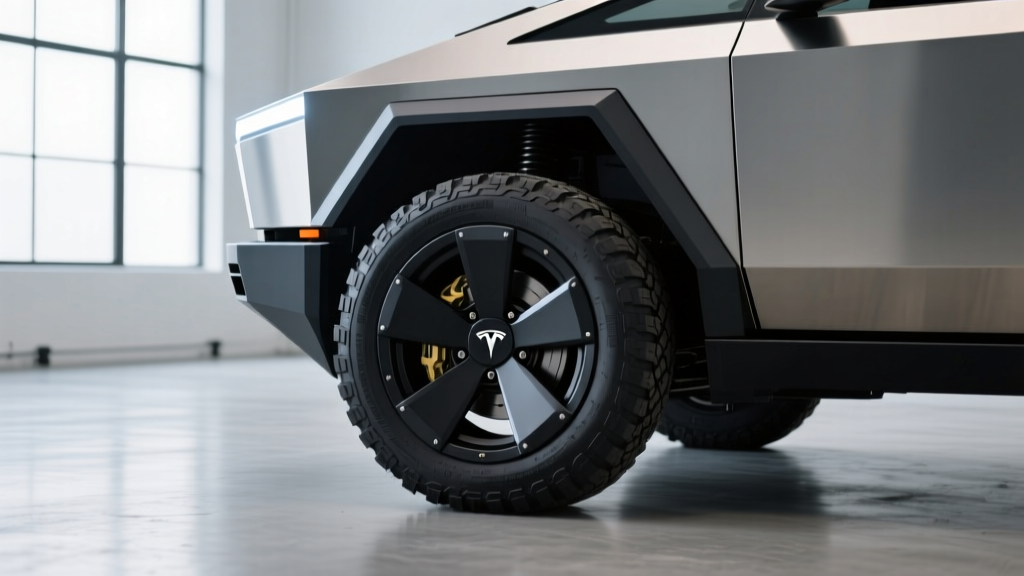
The 22-inch Sport wheel package adds $4,000 to either AWD trim. It includes wider, lower-profile tires (285/45R22 rear, 265/45R22 front) that improve cornering grip but reduce range and ride compliance. The standard 20-inch wheels use a 285/65R20 all-terrain tire that prioritizes durability and comfort.
Range and Efficiency: The Wheel-Size Trade-Off
Wheel diameter and tire rolling resistance are the single biggest non-driving-style variables affecting EV range. Larger wheels are heavier, carry lower-profile tires with stiffer sidewalls, and often use stickier rubber compounds — all of which increase energy consumption.
EPA-estimated range (20" wheels): 340 miles
EPA-estimated range (22" wheels): 320 miles
Real-world highway (70 mph, 72°F, 20"): ~280–300 miles
Real-world highway (70 mph, 32°F, 20"): ~235–260 miles
Real-world highway (70 mph, 72°F, 22"): ~260–280 miles
Combined efficiency (20"): 56 MPGe / 60 kWh/100mi
Combined efficiency (22"): 52 MPGe / 64 kWh/100mi
Source: EPA fueleconomy.gov. Real-world estimates based on owner-reported data and independent testing. Cold-weather range loss of 15–25% is typical for large lithium-ion packs without consistent preconditioning.
The 20-mile EPA gap between 20-inch and 22-inch wheels translates to roughly 5–6% less range. On a road trip from Denver to Moab (350 miles), that's the difference between arriving with a 40-mile buffer or needing a 15-minute fast-charge stop in Grand Junction. For daily commuting under 80 miles round-trip, the difference is negligible.
The Cyberbeast trim, with its tri-motor powertrain and heavier curb weight (~6,800 lbs), drops to an EPA-estimated 320 miles on 20-inch wheels and approximately 300 miles on 22s. Efficiency falls to roughly 50 MPGe combined.
Battery Chemistry, Capacity, and Longevity
The Cybertruck Long Range AWD and Cyberbeast use a structural battery pack with an estimated ~123 kWh usable capacity (approximately 130 kWh gross). Tesla has not officially published the exact usable figure, but teardown analysis and EPA test-cycle extrapolations place it in this range. The chemistry is NMC (nickel manganese cobalt), which offers higher energy density than LFP but requires more careful state-of-charge management for long-term health.
The base Rear-Wheel Drive model is expected to use a smaller pack (estimated ~100 kWh usable), potentially with LFP chemistry, though Tesla has not confirmed this as of early 2026. LFP batteries tolerate regular 100% charging without accelerated degradation, making them better suited for owners who need maximum daily range without babying the charge limit.
- Daily charge limit: 80% (set in the Tesla app)
- 100% charge: reserve for road trips; depart shortly after reaching full
- Avoid sustained storage below 20% or above 90%
- Precondition the battery before DC fast charging in cold weather (navigate to a Supercharger and the car does this automatically)
Battery and powertrain warranty: 8 years / 120,000 miles (whichever comes first), with Tesla guaranteeing a minimum 70% capacity retention over that period. This is competitive with the industry standard, though some competitors like Rivian offer 8 years / 175,000 miles on their battery packs.
Charging Speed: DC Fast, Level 2, and the 800V Advantage
The Cybertruck uses an 800-volt electrical architecture, which enables higher DC fast-charge power without excessive current (and therefore thinner, lighter cables). This matters most on road trips.
| Charging Level | Max Power (kW) | Miles Added per Hour | 10–80% Time | Connector |
|---|---|---|---|---|
| Level 1 (120V household) | ~1.4 kW | ~3–4 mi/hr | N/A (days) | NACS (native) |
| Level 2 (240V, 48A home) | 11.5 kW | ~30–34 mi/hr | ~10 hours | NACS (native) |
| DC Fast Charge (V4 Supercharger) | Peak ~350 kW | ~200+ mi in 15 min | ~15–18 min | NACS (native) |
| DC Fast Charge (3rd-party CCS w/ adapter) | Up to ~250 kW | Varies | ~20–25 min | CCS1 via adapter |
Charging curve reality: The Cybertruck peaks near 350 kW only between approximately 10–25% state of charge on a V4 Supercharger with preconditioning. Power tapers to ~200 kW by 50% SoC and drops below 100 kW above 80%. This is why the 10–80% metric matters more than peak kW. In cold weather without preconditioning, peak power may be limited to 150–200 kW until the battery warms.
For home charging, a 48-amp Level 2 wall connector on a 60-amp circuit adds roughly 30–34 miles of range per hour. A full overnight charge (10 hours) replenishes about 320 miles — sufficient for nearly all daily driving. Home installation typically costs $800–$2,500 depending on panel capacity and run length, per Tesla's certified installer network. Owners with older 100-amp electrical panels may need a $2,000–$4,000 panel upgrade to support a dedicated 60-amp circuit.
Performance and Drivetrain by Trim
| Spec | RWD | Long Range AWD | Cyberbeast |
|---|---|---|---|
| 0–60 mph | ~6.2 sec | 3.9 sec | 2.6 sec |
| Horsepower | ~400 hp | ~600 hp | ~845 hp |
| Top Speed | 112 mph | 130 mph | 130 mph |
| Drivetrain | Single-motor RWD | Dual-motor AWD | Tri-motor AWD |
| Towing Capacity | 7,500 lbs | 11,000 lbs | 11,000 lbs |
| Payload | ~2,500 lbs | ~2,500 lbs | ~2,500 lbs |
The Cyberbeast's 2.6-second 0–60 time makes it one of the quickest production vehicles on the planet, but that performance comes with a range and tire-wear penalty. Aggressive acceleration generates significant heat in both the battery and tires, and owners who regularly launch the Cyberbeast report faster tire wear — especially on the 22-inch sport tires, which use a softer compound.
For towing, note that range drops dramatically under load. Expect a 40–55% range reduction when towing near the 11,000-lb maximum, bringing effective highway range to approximately 140–180 miles on the Long Range AWD with 20-inch wheels. The 22-inch wheel package is not recommended for max towing due to lower sidewall height and reduced load-margin on rough surfaces.
Cargo Space, Interior Dimensions, and Practicality
The Cybertruck's 6-foot bed (72 inches long, 48 inches wide between wheel wells) offers ~67 cubic feet of cargo volume with the tonneau cover closed. The vault-style bed is lockable and weather-sealed, but the sloped bed floor and angular sides limit traditional rectangular cargo compared to a conventional pickup.
Interior passenger space is generous in the front (41.5 inches of legroom) but tighter in the rear (38.2 inches) compared to a full-size Ford F-150 Lightning (43.5 inches rear legroom). The rear bench fits three adults for short trips but is better suited for two on longer drives. Behind the rear seats, there's minimal enclosed storage — the frunk (front trunk) offers approximately 7 cubic feet and is useful for charging cables and groceries.
The stainless-steel exoskeleton eliminates traditional paint, which means no paint chips but also no easy repair for dents. The sharp body creases and narrow window openings reduce outward visibility compared to conventional trucks, making the surround-view camera system essential for parking.
Federal Tax Credit Eligibility and True Cost
The Cybertruck's eligibility for the §30D federal EV tax credit depends on trim, buyer income, and battery-component sourcing — all of which are subject to change under current IRS rules.
- MSRP cap: Trucks must be ≤$80,000 MSRP. The RWD ($60,990) qualifies on price. The Long Range AWD ($79,990) qualifies at base but NOT with the $4,000 22" wheel option ($83,990 exceeds cap). The Cyberbeast ($99,990) does NOT qualify.
- Buyer income cap: Modified AGI ≤$150,000 (single), ≤$225,000 (head of household), ≤$300,000 (joint). Exceeding these thresholds eliminates eligibility regardless of vehicle.
- Battery sourcing: Must meet critical-mineral and battery-component requirements that phase in annually. Tesla has progressively increased North American sourcing, but buyers should verify current-year compliance on the fueleconomy.gov tax credit lookup before purchasing.
- Point-of-sale transfer: Eligible buyers can transfer the credit to the dealer at purchase, reducing the out-of-pocket price immediately rather than waiting for a tax refund.
- One vehicle per VIN, one credit per buyer per year.
| Trim | MSRP | Max §30D Credit | Effective Price (if eligible) |
|---|---|---|---|
| RWD (20") | $60,990 | Up to $7,500 | ~$53,490 |
| Long Range AWD (20") | $79,990 | Up to $7,500 | ~$72,490 |
| Long Range AWD (22") | $83,990 | $0 (exceeds MSRP cap) | $83,990 |
| Cyberbeast (20") | $99,990 | $0 (exceeds MSRP cap) | $99,990 |
The MSRP-cap interaction with the 22-inch wheel option is a critical ordering trap: adding $4,000 wheels to the Long Range AWD pushes it over the $80,000 truck cap, eliminating up to $7,500 in credit. Net cost of the 22-inch upgrade is effectively $11,500 when the lost credit is factored in. Consult a tax professional to confirm your personal eligibility — state incentives (California, Colorado, etc.) may provide additional savings independent of federal rules.
Tech, Driver Assistance, and Standout Features
The Cybertruck runs Tesla's latest vehicle software on an 18.5-inch center touchscreen with a secondary 9.4-inch rear display. Key technology includes:
- Autopilot (standard): Adaptive cruise control, lane centering, automatic emergency braking — SAE Level 2 driver assistance requiring full driver engagement
- Full Self-Driving (Supervised) ($8,000 option or $99/mo): Enhanced lane changes, intersection handling, and parking — still SAE Level 2, not autonomous
- Steer-by-wire: No mechanical connection between the steering yoke and wheels, enabling variable ratio steering (less than one full turn lock-to-lock)
- 48-volt electrical architecture: Reduces wiring harness weight and enables higher-power accessories
- Armor glass: Laminated composite glass designed for impact resistance (though early production units reported cracking under extreme thermal stress)
- Powered tonneau cover: Retractible bed cover integrated with the vehicle's locking system
- Bioweapon Defense Mode: HEPA-grade cabin air filtration
- Vehicle-to-load (V2L): Powers external devices and tools from bed outlets (up to 9.6 kW)
Tesla Autopilot and FSD (Supervised) are SAE Level 2 driver-assistance systems. They do NOT make the Cybertruck self-driving. The driver must remain fully attentive, keep hands on the yoke, and be prepared to take over instantly. NHTSA continues to investigate Autopilot-involved incidents. Never use these systems while fatigued, distracted, or in conditions exceeding their design limits (construction zones, unmapped roads, heavy snow).
Notable drawbacks include the yoke steering's learning curve (especially for roundabouts and three-point turns), the lack of Apple CarPlay/Android Auto, limited rear visibility, and the polarizing design that attracts attention — both positive and negative — in parking lots and on the road.
Cybertruck Wheel and Tire Replacement: What Owners Should Budget
The Cybertruck wheel and tire combination is proprietary in fitment, and replacement costs vary significantly by size:
- 20-inch all-terrain tire: ~$300–$400 per tire; typically 30,000–40,000 mile lifespan
- 22-inch sport tire: ~$500–$700 per tire; typically 20,000–30,000 mile lifespan (softer compound, heavier vehicle)
- Wheel replacement (bent or cracked): $800–$1,500 per wheel depending on size and finish
The Cybertruck's ~6,800-lb curb weight (Cyberbeast) accelerates tire wear compared to lighter EVs. Owners who rotate tires every 5,000–6,000 miles and maintain proper inflation (typically 42–50 psi cold, per door-jamb sticker) report significantly better tire life. The 20-inch all-terrain tires are more forgiving on potholes and rough roads; the 22-inch low-profile tires are more susceptible to sidewall damage from curb strikes and debris.
Who Should Buy the Cybertruck — and Who Shouldn't
- You need a lockable, weather-sealed bed for tools or gear with V2L capability for job-site power
- You want an EV truck with 11,000-lb towing and are willing to accept reduced range under load
- The stainless-steel, paint-free exterior appeals to you and you accept the visibility trade-offs
- You have access to home Level 2 charging and live near Supercharger corridors
- You value acceleration performance (Cyberbeast) or cutting-edge tech (steer-by-wire, 48V architecture)
- You need maximum rear-seat passenger space (Ford F-150 Lightning or Rivian R1T are roomier)
- You want a conventional steering wheel and proven ergonomics
- You plan to max-tow frequently (range under load is limiting; consider a diesel or PHEV truck)
- You're budget-sensitive and the $7,500 tax credit is essential to your purchase math (only the RWD and base Long Range AWD qualify)
- You prefer Apple CarPlay or a more traditional infotainment interface
Frequently Asked Questions
What is the real-world range of the Cybertruck?
The EPA rates the Long Range AWD at 340 miles (20" wheels) and 320 miles (22" wheels). In real-world highway driving at 70 mph and moderate temperatures, expect 280–300 miles on 20s and 260–280 on 22s. In freezing weather, drop those numbers by 15–25% unless you consistently precondition the battery.
How fast does the Cybertruck charge at home and on the road?
On a Level 2 home charger (11.5 kW / 48A), the Cybertruck adds roughly 30–34 miles of range per hour, fully recharging overnight in about 10 hours. On a V4 Tesla Supercharger, it peaks at ~350 kW and charges from 10–80% in approximately 15–18 minutes with proper preconditioning. Charging slows significantly above 80% SoC — plan your road-trip stops around the 10–80% window for efficiency.
Does the Cybertruck qualify for the $7,500 federal EV tax credit?
It depends on the trim and your income. The RWD ($60,990) and base Long Range AWD ($79,990 on 20" wheels) fall under the $80,000 truck MSRP cap and may qualify if you meet income limits (≤$150K single, ≤$300K joint) and the vehicle meets current battery-sourcing requirements. The Cyberbeast and Long Range AWD with 22" wheels exceed the MSRP cap and do not qualify. Always verify on fueleconomy.gov before purchasing, as sourcing rules update periodically.
Is the Cybertruck worth buying vs. the F-150 Lightning or Rivian R1T?
The Cybertruck offers the most distinctive design, the quickest acceleration (Cyberbeast), and the largest battery in the segment. However, the Ford F-150 Lightning provides more rear-seat room, a more conventional driving experience, and broader dealer-service coverage. The Rivian R1T (dual-motor or quad-motor) offers superior off-road capability, a more refined interior, and a longer battery warranty (8yr/175K mi). Choose the Cybertruck for tech and performance; choose the Lightning or R1T for practicality and proven service networks.
What are the biggest pros and cons of the Cybertruck?
- Up to 340 miles EPA range (20" LR AWD)
- 350 kW peak DC fast charging
- 11,000-lb towing, V2L capability
- Stainless-steel body resists dents and corrosion
- Cyberbeast: 2.6-sec 0–60, 845 hp
- Steer-by-wire reduces steering effort
- 22" wheels cost range, comfort, and tax credit
- Yoke steering has a steep learning curve
- Rear visibility is limited; relies heavily on cameras
- Expensive tire replacement ($500–$700 for 22")
- No Apple CarPlay / Android Auto
- Service-center availability still limited in many regions
Can I put 20-inch wheels on a Cybertruck that came with 22-inch?
Yes, the bolt pattern and brake clearance allow downsizing from 22" to 20". Many owners who initially chose 22-inch sport wheels for aesthetics switch to 20-inch all-terrain tires for improved ride comfort, better pothole resistance, and lower replacement cost. Ensure the replacement tire matches Tesla's specified load rating for the vehicle's GVWR.
How does the Cybertruck handle in snow and off-road?
The dual-motor and tri-motor AWD systems provide excellent traction, and the air suspension offers up to 16 inches of ground clearance in Extract mode. However, the standard all-season tires on the 20-inch wheels are not severe-snow rated (no Three-Peak Mountain Snowflake symbol). For regular winter driving or off-road use, dedicated all-terrain or winter tires in 20-inch fitment are strongly recommended. The 22-inch sport tires are unsuitable for snow or rock crawling.