The Tesla Cybertruck doesn't have a trunk in the traditional sense. Instead, it offers a lockable, stainless-steel-covered cargo bed Tesla calls the vault, plus a front trunk (frunk) and under-bed storage. For shoppers searching "cybertruck trunk" capacity, the answer depends on which compartment you mean — and how you plan to use this electric pickup. This review breaks down every storage zone with exact dimensions, then covers the full powertrain, range, charging, and pricing picture so you can decide whether the Cybertruck's utility matches its footprint.
Cybertruck Vault, Frunk & Total Cargo Dimensions
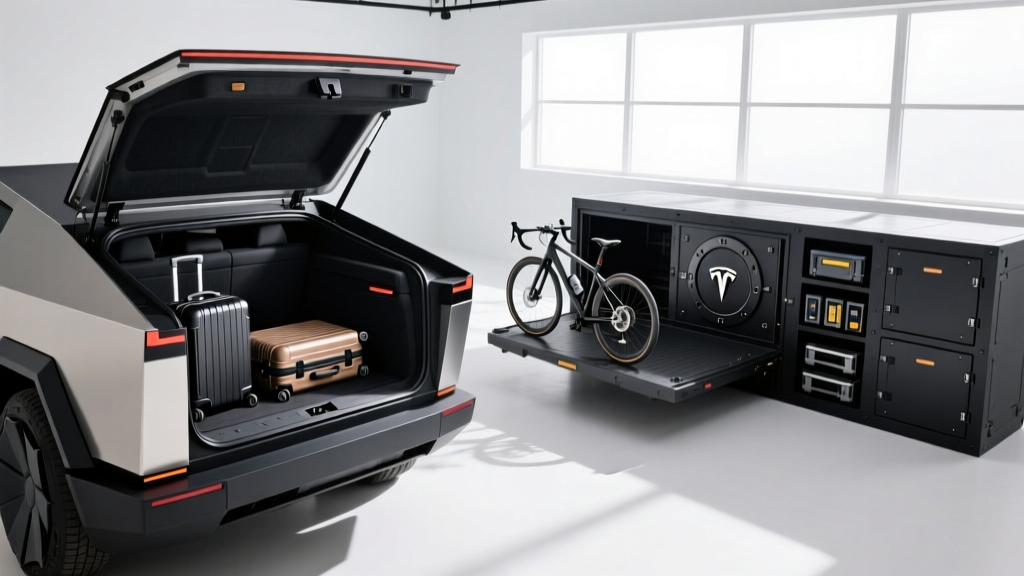
The Cybertruck's primary cargo area is the vault — a 6-foot-long, 4-foot-wide composite bed with a motorized retractable hardcover (the "tonneau"). Unlike a traditional open truck bed, the vault is fully enclosed when the cover is closed and locks with the vehicle, making it functionally closer to a massive trunk than an open pickup bed.
| Compartment | Volume (cu ft) | Key Dimensions | Notes |
|---|---|---|---|
| Vault (bed, cover closed) | 67 cu ft | 72" L × 48" W (between wheel wells) × ~28" H | Lockable, weather-sealed; cover supports ~300 lbs dynamic load |
| Vault (cover open / full height) | ~120 cu ft (est.) | 72" L × 48" W × ~50" H to top of bed rails | Useful for tall items; no weather protection when open |
| Frunk (front trunk) | 7.1 cu ft | Deep well between front suspension towers | Lockable, drainable; good for charging cables or wet gear |
| Under-bed "sail pillar" storage | ~1.5 cu ft per side | Hidden compartments behind rear wheel arches | Best for tools, emergency kit, small accessories |
| Rear cabin floor (behind front seats) | Not rated | Flat floor, fold-up rear seat cushion | Rear seat bottom folds up to create additional interior cargo shelf |
| Total enclosed (vault + frunk) | ~74 cu ft | — | All lockable from the key fob or app |
For comparison, a Ford F-150 Lightning with its Mega Power Frunk offers 14.1 cu ft up front and a 5.5-foot bed with roughly 52 cu ft under a hard tonneau. The Rivian R1T's gear tunnel (11 cu ft) plus its 4.5-foot bed (~42 cu ft enclosed) trails the Cybertruck in total lockable volume. The Cybertruck's vault advantage is length: at 72 inches, it swallows full sheets of plywood flat — something the R1T cannot do without the tailgate down.
EPA Range, Battery & Real-World Efficiency
EPA Estimated Range: 340 miles (AWD Dual-Motor) / 320 miles (Cyberbeast) / 460 miles (RWD, when available)
Real-World Expectation: Plan on ~280–310 miles for mixed highway driving at 70–75 mph. In freezing weather (below 32°F), expect a 20–30% reduction, dropping effective range to roughly 220–250 miles for AWD trims. The Cybertruck's angular stainless-steel body generates substantial aerodynamic drag at highway speeds, which disproportionately reduces range compared to sleeker EVs.
The AWD and Cyberbeast trims use a ~123 kWh usable battery pack with NMC (nickel manganese cobalt) chemistry, chosen for its high energy density to offset the truck's 6,600+ lb curb weight. Tesla has not released an LFP variant of the Cybertruck — the chemistry requires energy density that LFP cannot yet deliver at this vehicle mass. Efficiency is rated at 56 MPGe combined (AWD) per fueleconomy.gov, translating to roughly 60–65 kWh per 100 miles driven. That's thirsty by EV standards — comparable to the GMC Hummer EV and significantly less efficient than a Rivian R1T (~65 MPGe) or Ford F-150 Lightning (~70 MPGe).
| Trim | Battery (kWh usable) | Chemistry | EPA Range (mi) | MPGe (combined) | kWh/100 mi |
|---|---|---|---|---|---|
| RWD (announced, limited availability) | ~123 | NMC | 460 (est. w/ range extender) | TBD | TBD |
| AWD Dual-Motor | ~123 | NMC | 340 | 56 | ~60 |
| Cyberbeast (Tri-Motor) | ~123 | NMC | 320 | 54 | ~62 |
Tesla has announced a "Range Extender" battery pack that mounts in the vault, adding ~130+ miles of range. As of early 2026, this accessory remains limited in availability and is priced at approximately $16,000 installed. It sacrifices roughly 25% of vault floor space.
Charging Speed: DC Fast, Level 2 & Architecture
The Cybertruck uses an 800-volt electrical architecture, enabling strong DC fast-charging performance. It ships with the NACS (North American Charging Standard) connector natively — the same connector used across Tesla's Supercharger network, which now exceeds 25,000 stalls in North America.
| Charging Level | Power (kW) | Speed (mi/hr added) | Time / Notes |
|---|---|---|---|
| Level 1 (120V household) | ~1.4 kW | ~3 mi/hr | Emergency/trickle only; full charge in 80+ hours |
| Level 2 (240V home, 48A) | 11.5 kW | ~25 mi/hr | Full 0–100% in ~12 hours; ideal overnight solution |
| Level 2 (240V, 80A w/ Wall Connector) | 19.2 kW | ~42 mi/hr | Requires 100A dedicated circuit; full charge in ~7 hours |
| DC Fast Charge (V4 Supercharger) | Peak 250 kW | ~200 mi in 15 min | 10–80% in ~28 minutes; tapers significantly above 80% |
| DC Fast Charge (V3 Supercharger) | Peak 250 kW | ~180 mi in 15 min | Same peak rate; older stalls may share power with adjacent vehicle |
Real-world charging caveat: The Cybertruck's 250 kW peak rate is not sustained. Expect the charge curve to taper from ~250 kW down to ~150 kW by 50% SoC, and below 50 kW once you pass 80%. On a road trip, plan 25–30 minute stops for 10–80% charges. Preconditioning — where the truck warms the battery before arrival at a Supercharger — is essential for hitting peak rates. Navigate to a Supercharger using the built-in navigation and the truck will automatically precondition; arriving at a charger without preconditioning can double your charge time in cold weather.
Non-Tesla DC fast chargers (Electrify America, EVgo, ChargePoint) now support NACS natively or via adapter. The Cybertruck can also use CCS1 stations with a Tesla-approved CCS adapter (included with newer deliveries, ~$175 if purchased separately).
Performance: 0-60, Horsepower & Drivetrain
The Cybertruck's stainless-steel exoskeleton and 6,600–6,800 lb curb weight suggest sluggishness, but the powertrain tells a different story:
| Trim | Drivetrain | Horsepower | Torque (lb-ft) | 0-60 mph | Top Speed |
|---|---|---|---|---|---|
| AWD Dual-Motor | Dual-motor AWD | 600 hp | 740 | 4.1 sec | 130 mph |
| Cyberbeast (Tri-Motor) | Tri-motor AWD | 845 hp | 740 | 2.6 sec | 130 mph |
The Cyberbeast's 2.6-second 0-60 time makes it one of the quickest production trucks ever built, rivaling supercars. The AWD trim's 4.1 seconds is still comfortably quicker than any F-150 or Silverado variant short of the Raptor R. All trims feature rear-wheel steering (up to 10 degrees), which shrinks the turning circle to 37.4 feet — tighter than many midsize SUVs despite the Cybertruck's 223.7-inch overall length.
Towing: Rated at 11,000 lbs maximum (AWD and Cyberbeast). Real-world towing at this capacity will cut range roughly in half — plan on 150–170 miles between charges when towing near max. A 6,000-lb trailer drops range to approximately 200–220 miles.
Pricing, Trim Levels & Federal Tax Credit Eligibility
| Trim | Base MSRP | As-Tested (typical config) | §30D Federal Credit | Effective Price (after credit) |
|---|---|---|---|---|
| RWD (when available) | ~$60,990 | ~$60,990 | $0 (exceeds $80K truck MSRP cap if options added; see rules below) | ~$60,990 |
| AWD Dual-Motor | $79,990 | $82,000–$86,000 | $0 (exceeds $80,000 MSRP cap for trucks/vans) | $79,990+ |
| Cyberbeast | $99,990 | $102,000–$115,000 | $0 (far exceeds $80,000 MSRP cap) | $99,990+ |
Critical tax credit note: Under IRS §30D rules, the federal EV tax credit caps eligible MSRP at $80,000 for trucks, vans, and SUVs (and $55,000 for sedans). The Cybertruck AWD at $79,990 base technically falls under this cap, but any dealer-installed options, destination fees, or package upgrades that push the MSRP above $80,000 disqualify it. Additionally, buyer income limits apply ($300K joint / $225K head of household / $150K single for modified AGI), and the vehicle's battery must meet critical-mineral and battery-component sourcing requirements that shift annually. Tesla's own incentives page and the IRS §30D guidance are the authoritative sources — consult a tax professional before relying on credit eligibility for the AWD trim at the MSRP margin.
As of 2026, most Cybertruck buyers should budget the full MSRP without counting on the federal credit. State-level incentives (California's CVRP, Colorado's $5,000 credit, etc.) may still apply — check your state energy office for current programs.
Interior, Tech & Driver Assistance
The Cybertruck cabin seats five across two rows. Rear legroom measures approximately 38.5 inches — adequate for adults but tighter than an F-150 Lightning's rear seat. The 18.5-inch front touchscreen runs Tesla's latest software with navigation, streaming, and vehicle controls. A 9.4-inch rear touchscreen gives back-seat passengers climate and media control.
Standout tech:
- Steer-by-wire: No mechanical connection between the yoke and wheels. Enables variable steering ratio — fewer than one full turn lock-to-lock. Takes adaptation but offers go-kart responsiveness at low speeds.
- 48-volt electrical architecture: First in a mass-production vehicle. Reduces wiring harness weight by ~70% and enables higher-power accessories.
- Bioweapon Defense Mode: HEPA-grade cabin air filtration with positive pressurization.
- Powershare (V2L/V2H): Up to 11.5 kW of bidirectional power output — enough to run power tools at a job site or provide limited home backup during outages.
- Autopilot / FSD (Supervised): Tesla's driver-assistance suite. This is SAE Level 2 — the driver must remain fully attentive and keep hands ready to intervene at all times. It is not self-driving.
Notable drawbacks:
- Stainless-steel body panels are prone to fingerprint smudges and cannot be repaired with conventional paintless dent techniques — collision repair costs are higher than average.
- The yoke steering wheel (standard) obstructs the instrument cluster for some drivers; a round wheel is available as a no-cost option.
- No Apple CarPlay or Android Auto — Tesla's ecosystem is the only option.
- Panel gap consistency and early-build quality issues have been widely documented, though 2025–2026 production units show improvement.
- Insurance premiums run 20–40% higher than comparable trucks due to repair costs and performance.
Battery Warranty & Ownership Costs
Tesla covers the Cybertruck battery and drive units with an 8-year / 120,000-mile warranty (whichever comes first), with a minimum 70% capacity retention threshold. The limited vehicle warranty is 4 years / 50,000 miles.
Long-term battery degradation data specific to the Cybertruck is still maturing given its late-2023 launch. However, Tesla's NMC packs in the Model S and Model X historically show ~10–12% degradation over 150,000 miles, with the degradation curve flattening significantly after the first 30,000 miles. The Cybertruck's 800V architecture and active thermal management are expected to deliver similar or better longevity.
Cost to charge vs. fuel: At a national average of $0.16/kWh for home electricity and the Cybertruck's ~60 kWh/100 mi consumption, home charging costs roughly $0.096 per mile. A comparable gas F-150 at 20 MPG combined with $3.40/gallon fuel costs $0.17 per mile. Over 15,000 annual miles, that's approximately $1,440 for electricity vs. $2,550 for gas — a $1,110/year fuel savings. DC fast charging on road trips costs more ($0.30–$0.50/kWh), narrowing the gap.
Who the Cybertruck Suits — And Who Should Look Elsewhere
- You need a lockable, weather-sealed 6-foot cargo bed and value the vault's security over a traditional open truck bed
- You want tri-motor performance (Cyberbeast) that no other truck offers
- You tow moderately (up to ~7,000 lbs regularly) and can charge at home
- You're already in the Tesla/Supercharger ecosystem and want NACS-native charging
- You need V2L/V2H capability for job-site power or home backup
❌ Look elsewhere if:
- You need maximum highway range — the Rivian R1T (Dual-Motor Max: ~410 mi EPA) and F-150 Lightning (Extended Range: ~320 mi) offer more range efficiency per dollar
- You frequently tow near 11,000 lbs — range drops severely and the Lightning's larger battery option handles heavy towing better
- You need affordable pricing — the base AWD at ~$80K is $15–20K more than a well-equipped F-150 Lightning XLT
- You rely on Apple CarPlay or prefer conventional controls
- You live in a region with limited Supercharger coverage and need CCS-native charging flexibility
Cybertruck Trunk & Ownership FAQ
What is the real-world range of the Cybertruck?
The AWD Dual-Motor is EPA-rated at 340 miles, but real-world highway driving at 70–75 mph typically yields 280–310 miles. In sub-freezing temperatures, plan on 220–250 miles. The Cyberbeast's tri-motor powertrain is slightly less efficient at 320 miles EPA, with similar real-world reductions.
How fast does the Cybertruck charge at home and on the road?
At home on a 240V/48A Level 2 circuit, the Cybertruck adds ~25 miles of range per hour, reaching a full charge overnight in ~12 hours. On a V4 Supercharger at 250 kW peak, a 10–80% charge takes approximately 28 minutes, though the rate tapers significantly above 80% SoC.
Does the Cybertruck qualify for the $7,500 federal EV tax credit?
It depends on the trim and configuration. The §30D credit caps eligible trucks at $80,000 MSRP. The AWD at $79,990 base is borderline — any options pushing it above $80K disqualify it. The Cyberbeast at $99,990+ does not qualify. Buyer income limits and battery sourcing rules also apply. Always verify current eligibility on IRS.gov and consult a tax professional.
Is the Cybertruck worth buying vs. the F-150 Lightning or Rivian R1T?
The Cybertruck wins on vault security (lockable, enclosed, 6-foot bed), raw performance (Cyberbeast's 2.6s 0-60), and Supercharger network access. The F-150 Lightning wins on price ($55K–$70K for comparable trims), conventional controls, and proven fleet-service infrastructure. The R1T wins on range efficiency, interior refinement, and adventure-oriented features like the gear tunnel. Your priority — performance, value, or adventure utility — determines the best fit.
What are the biggest Cybertruck pros and cons?
Pros: Encrypted-lockable vault with 67 cu ft enclosed cargo, 11,000-lb towing, 845 hp (Cyberbeast), 48V architecture, NACS native charging, V2L powershare, stainless-steel durability. Cons: Poor efficiency (~56 MPGe), high base price, no federal credit on most trims, steer-by-wire learning curve, elevated insurance costs, no CarPlay, panel repair complexity.
Can you fit a full sheet of plywood in the Cybertruck vault?
Yes. The vault is 72 inches long and 48 inches wide between the wheel wells — a standard 4×8-foot sheet of plywood lays flat with the tailgate (vault gate) closed. This is a genuine advantage over the Rivian R1T's shorter 54-inch bed.