Quick Verdict: The Cybertruck's Vault Changes the Truck Cargo Game
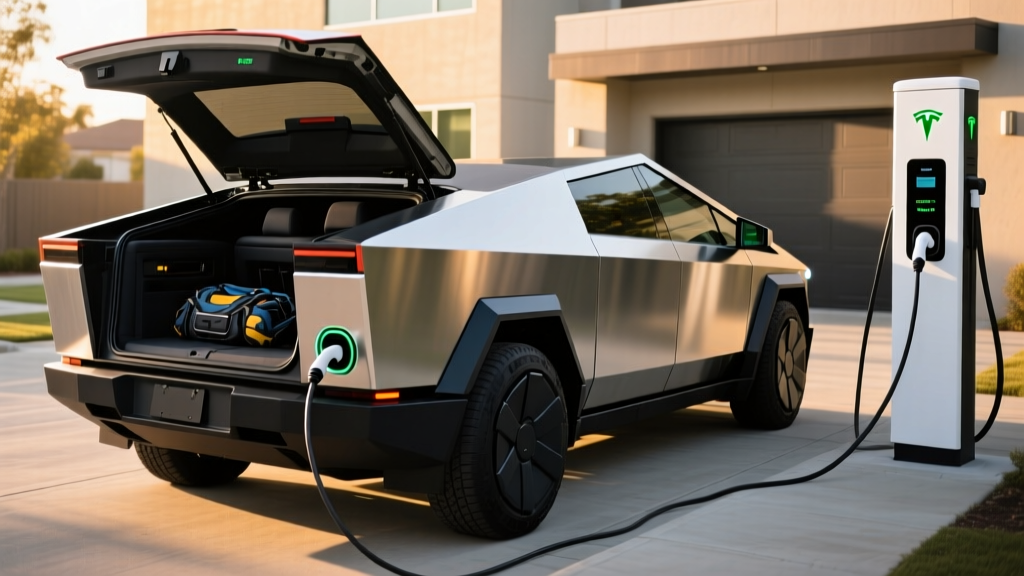
If you've searched "cybertruck trunk space" expecting a simple answer, you're in for a surprise. The Tesla Cybertruck doesn't have a traditional trunk — it has what Tesla calls the Vault, a 6.5-foot lockable bed with a powered tonneau cover that transforms the entire cargo area into a sealed, weatherproof storage compartment. Combined with a front trunk (frunk) and sail-pillar storage, the Cybertruck offers one of the most versatile cargo setups in the electric truck segment. But cargo is only part of the story. Below, we break down the 2026 Cybertruck's real-world range, charging performance, pricing after tax credits, and whether its unique architecture actually works for daily truck duty.
Range Reality Check
EPA Estimated Range: 340 miles (AWD) / 320 miles (Cyberbeast)
Real-World Expectation: Expect 280–310 miles in mixed highway driving at 70 mph. Cold-weather (below 32°F) highway range drops to approximately 220–250 miles. City/regenerative driving can push closer to the EPA sticker. The stainless-steel exoskeleton and angular design create more aerodynamic drag than sleeker EVs, which hits highway efficiency hard.
Cybertruck Trunk Space, Vault, and Cargo Dimensions
The Cybertruck's cargo system is fundamentally different from any conventional pickup. Here's the complete breakdown of every storage area:
| Cargo Area | Volume / Dimensions | Key Details |
|---|---|---|
| Vault (bed) | 6.5 ft long × 4 ft wide (between wheel wells); ~43 cu ft with tonneau closed | Lockable powered tonneau, 120V/240V outlets, integrated LED lighting, composite bed liner |
| Front Trunk (Frunk) | ~7 cu ft | Lockable, weather-sealed, fits a carry-on bag or charging cables |
| Sail Pillar Storage | ~3 cu ft (combined left + right) | Small compartments behind rear doors — good for tools, first-aid, or emergency gear |
| Rear Cabin Storage | Under-seat + behind-seat | Limited — no traditional under-seat bin; rear seat folds 60/40 |
| Total Enclosed Cargo | ~53 cu ft (all sealed areas) | With tonneau open, vault accepts items up to ~6.5 ft long; tailgate supports up to 8 ft items with extender |
What Actually Fits in the Cybertruck Vault?
The vault's 4-foot width between the wheel wells is the Cybertruck's most debated dimension. Full-size 4×8 sheets of plywood do not fit flat between the wells — they must ride on top of the wheel wells or angle in. Here's what does fit comfortably:
- Two full-size dirt bikes or mountain bikes (with front wheel removed or angled)
- A standard ATV or side-by-side (tight fit, measure before committing)
- Four large suitcases stacked two-high with the tonneau closed
- Camping gear for a family of four (tent, sleeping bags, cooler, stove)
- Home Depot runs: mulch bags, lumber up to 6.5 ft, power tools
- With tailgate extender: kayaks, ladders, or 8-ft lumber
The powered tonneau cover is the real differentiator. Unlike a traditional truck bed, your cargo stays dry and locked. The cover supports up to 300 lbs of distributed weight, so you can stand on it or stack lighter items on top. The integrated 120V and 240V outlets in the bed let you power job-site tools, a tailgate grill, or even back up a home via Tesla's PowerShare system (up to 11.5 kW continuous).
How Does Cybertruck Cargo Compare to Rivals?
| Truck | Bed Length | Bed Width (between wells) | Sealed/lockable? | Frunk? |
|---|---|---|---|---|
| Tesla Cybertruck | 6.5 ft | 48 in | Yes (powered tonneau) | ~7 cu ft |
| Ford F-150 Lightning | 5.5 ft (Std) / 6.5 ft (Ext) | 50.6 in | Optional tonneau | ~14.1 cu ft (Mega Power Frunk) |
| Rivian R1T | 4.5 ft (bed) + Gear Tunnel | 50 in | Gear Tunnel is lockable | ~11 cu ft |
| Chevy Silverado EV | 5.11 ft (Std) / Multi-Flex up to 10+ ft | ~50 in | Optional cover | ~10.7 cu ft (eTrunk) |
The Cybertruck sacrifices bed width and length for the sealed vault concept. If your primary use case is hauling 4×8 sheets or towing-heavy work, the F-150 Lightning's wider bed or the Silverado EV's Multi-Flex tailgate may be more practical. If security and weather protection are paramount — think expensive camera gear, tools, or outdoor equipment — the Cybertruck's vault is genuinely superior.
Range, Battery, and Efficiency
The 2026 Tesla Cybertruck uses an estimated 123 kWh usable battery pack with NMC (nickel manganese cobalt) chemistry — the same high-energy-density approach Tesla uses in its long-range vehicles. This is not an LFP pack; Tesla reserves LFP for lower-cost, standard-range models where weight and energy density are less critical.
| Spec | AWD (Dual Motor) | Cyberbeast (Tri-Motor) |
|---|---|---|
| EPA Range | 340 miles | 320 miles |
| Battery (usable) | ~123 kWh (NMC) | ~123 kWh (NMC) |
| MPGe (combined) | ~72 MPGe | ~69 MPGe |
| Energy Consumption | ~47 kWh/100 mi | ~49 kWh/100 mi |
| 0–60 mph | 4.1 seconds | 2.6 seconds |
| Horsepower | 600 hp | 845 hp |
| Drivetrain | Dual-motor AWD | Tri-motor AWD (torque vectoring) |
| Top Speed | 130 mph | 130 mph |
| Towing Capacity | 11,000 lbs | 11,000 lbs |
Real-World Range: What to Actually Expect
The Cybertruck's stainless-steel body and angular geometry create a higher drag coefficient than a rounded EV. Combined with its ~6,800 lb curb weight, efficiency suffers on the highway. Based on owner data and third-party testing:
- City / suburban (under 50 mph): 310–340 miles achievable with strong regenerative braking
- Highway (70–75 mph): 270–300 miles; plan charging stops around 250 miles for comfort
- Cold weather (below 32°F, highway): 210–250 miles — battery preconditioning helps but the thermal load is significant
- Towing (loaded trailer): 130–170 miles depending on trailer weight and aerodynamics
If you regularly drive 250+ mile highway stretches in winter or tow frequently, the Cybertruck's real-world range demands careful route planning. For commuters and city-heavy drivers, the EPA sticker is more achievable.
Charging Speed: DC Fast Charging and Home Level 2
The Cybertruck uses the NACS (North American Charging Standard) connector natively — no adapter needed for Tesla Superchargers. It supports 800V architecture, enabling strong DC fast-charging performance.
| Charging Level | Power | Speed | Notes |
|---|---|---|---|
| Level 1 (120V) | ~1.4 kW | ~3 miles/hour | Emergency/trickle only; a full charge takes ~88 hours |
| Level 2 (240V, 48A) | 11.5 kW | ~29 miles/hour | Full charge in ~11 hours; standard home setup with Tesla Wall Connector |
| Level 2 (240V, 80A) | 19.2 kW | ~48 miles/hour | Requires upgraded 100A circuit; full charge in ~7 hours |
| DC Fast (Supercharger V4) | Peak ~350 kW | 10–80% in ~18–22 min | Peak rate only sustained briefly; expect 150–200 kW average through the curve |
Understanding the Charge Curve
Tesla's peak 350 kW rate is a headline number, not a sustained rate. Like all EVs, the Cybertruck charges fastest between 10–40% SoC, then tapers progressively. From 80–100%, charging slows dramatically to protect the NMC battery. On a road trip, plan to charge from 10–80% and move on — the last 20% can take as long as the first 70%.
At home, a Level 2 Tesla Wall Connector on a 60A circuit (48A continuous) adds roughly 29 miles of range per hour. For most owners charging overnight, this means a full battery every morning. Installation typically costs $500–$2,000 depending on panel capacity and conduit runs — factor in a potential $1,500–$3,000 panel upgrade if your home has a 100A service.
Pricing, Trims, and Federal Tax Credit Eligibility
The Cybertruck's pricing has been a moving target since its 2023 reveal. Here's where the 2026 model year stands:
| Trim | MSRP | Key Features | §30D Credit Eligibility |
|---|---|---|---|
| AWD (Dual Motor) | $79,990 | 340-mi range, 600 hp, 11,000-lb tow, Autopilot | Not eligible — exceeds $80,000 truck MSRP cap |
| Cyberbeast (Tri-Motor) | $99,990 | 320-mi range, 845 hp, torque vectoring, premium interior | Not eligible — exceeds $80,000 truck MSRP cap |
The Tax Credit Reality
Under IRS §30D rules, new clean trucks must have an MSRP at or below $80,000 to qualify for the federal tax credit (up to $7,500). The Cybertruck AWD sits at $79,990 — technically under the cap — but buyers must also meet income limits ($300,000 joint / $150,000 single filer MAGI) and the vehicle must satisfy critical minerals and battery component sourcing requirements that shift annually.
As of 2026, Tesla has been working to qualify more of its supply chain under the domestic-content rules, but the Cybertruck's specific battery sourcing may limit or eliminate credit eligibility in practice. The Cyberbeast at $99,990 is definitively excluded by the MSRP cap.
Bottom line: Do not count on the $7,500 credit when budgeting. Consult a tax professional and check the fueleconomy.gov credit lookup tool for the specific VIN you're considering before signing paperwork. Point-of-sale transfer is available if the vehicle qualifies, reducing the purchase price at the dealer — but only if all §30D criteria are met.
Interior, Technology, and Driver Assistance
The Cybertruck's interior is minimalist in the extreme — a single 18.5-inch touchscreen dominates the dash, with no physical instrument cluster. A rear 9.4-inch touchscreen serves second-row passengers. The steering yoke (standard) takes significant adaptation; a round wheel is available as an option.
Standout Tech Features
- Steer-by-wire: No physical connection between the yoke and wheels — enables variable steering ratio (fewer turns lock-to-lock at low speed, more stability at highway speed). A genuine engineering achievement, though it draws mixed reactions from drivers accustomed to traditional steering feel.
- 48-volt electrical architecture: Reduces wiring harness weight by ~70% compared to conventional 12V systems; enables higher-power accessories and more efficient thermal management.
- PowerShare: Up to 11.5 kW of bidirectional power — run job-site tools, power a campsite, or back up your home during an outage (requires Tesla Gateway integration).
- Autopilot (standard): Adaptive cruise + lane centering (SAE Level 2). Full Self-Driving (Supervised) is an optional add-on but remains a Level 2 system requiring constant driver attention — it is not autonomous.
- Armor glass: Ultra-hard stainless-steel body panels and laminated glass; impressively resistant to dents and scratches but expensive to repair if damaged.
Notable Drawbacks
- Visibility: The thick A-pillars, high beltline, and small rear window create significant blind spots. The camera-based rear view helps but doesn't fully compensate.
- Ride quality: The adaptive air suspension smooths most bumps, but the truck's mass and stiff structure transmit sharp impacts more than an F-150 Lightning or Rivian R1T.
- Yoke learning curve: Three-point turns, parking maneuvers, and roundabouts require re-learning with the yoke and steer-by-wire system.
- Repair costs: Stainless-steel panels cannot be traditionally repaired — dents often require full panel replacement. Insurance premiums reflect this reality.
- Bed width limitation: 48 inches between wheel wells excludes standard 4×8 sheet goods laid flat.
Pros
- Sealed, lockable vault with powered tonneau — best-in-class cargo security
- Tri-motor Cyberbeast performance: 2.6-second 0–60 in a 6,800-lb truck
- 11.5 kW PowerShare bidirectional capability
- Stainless-steel exterior resists dents, scratches, and corrosion
- NACS native — full Supercharger network access, no adapter
- Steer-by-wire reduces effort at low speeds
- Strong off-road geometry: 17 inches ground clearance, approach/departure angles rival body-on-frame trucks
Cons
- Bed width (48 in between wells) won't fit 4×8 plywood flat
- Highway range drops significantly in cold weather (210–250 mi)
- Federal tax credit eligibility uncertain due to sourcing rules and MSRP cap
- Insurance premiums run 20–40% higher than comparable trucks
- Yoke steering demands adaptation; not intuitive for all drivers
- Rear-seat legroom is tight for adults over 6 ft
- Repair costs for stainless panels and armor glass are high
Who Should Buy the Cybertruck?
The Cybertruck is not a universal truck. It excels for specific buyers and frustrates others.
Choose the Cybertruck If:
- You need secure, weatherproof cargo storage for expensive gear (tools, camera equipment, bikes) without buying a separate topper
- You want bidsirectional power for job-site tools, camping, or home backup
- You value performance — the Cyberbeast's 2.6-second 0–60 is supercar territory in a truck
- You have home Level 2 charging and mostly drive under 250 miles between stops
- You live in an area with good Supercharger coverage for road trips
Look Elsewhere If:
- You regularly haul 4×8 sheets, pallets, or wide cargo — the F-150 Lightning or Silverado EV fits those better
- You need long cold-weather highway range — consider the Rivian R1T (Dual-Motor Max, ~410 mi EPA) or wait for next-gen battery options
- Your budget requires the federal tax credit — the Cybertruck's eligibility is uncertain
- You want a conventional driving feel — the yoke and steer-by-wire divide opinion
Warranty and Long-Term Ownership
Tesla provides the following warranty coverage for the 2026 Cybertruck:
- Basic Vehicle Limited Warranty: 4 years / 50,000 miles
- Battery & Drive Unit Warranty: 8 years / 120,000 miles (whichever comes first), with a minimum 70% capacity retention threshold
- Restraint System: 5 years / 60,000 miles
- Corrosion: 12 years with no mileage limit (stainless steel body)
The 8-year/120,000-mile battery warranty is competitive with the F-150 Lightning (8/100,000) and Rivian R1T (8/175,000). Tesla's NMC packs historically show 10–15% degradation over 150,000 miles based on fleet data from Model S/X vehicles. The Cybertruck's heavier weight and higher energy consumption may accelerate wear slightly — long-term data is still accumulating.
One ownership cost to factor: insurance. Multiple owners report annual premiums 20–40% higher than comparable full-size trucks, driven by repair complexity (stainless panels, armor glass, steer-by-wire components). Get a quote before committing.
Frequently Asked Questions
What is the real-world range of the Tesla Cybertruck?
The EPA rates the AWD at 340 miles and the Cyberbeast at 320 miles. In real-world highway driving at 70 mph, expect 270–300 miles. Cold weather (below freezing) cuts that to 210–250 miles. City driving with regenerative braking can approach the EPA sticker.
How fast does the Cybertruck charge at home and on the road?
On a Level 2 home charger (48A/11.5 kW), the Cybertruck adds about 29 miles of range per hour — a full charge takes roughly 11 hours. At a V4 Supercharger, peak rate is ~350 kW, achieving a 10–80% charge in approximately 18–22 minutes, though the average rate through the curve is closer to 150–200 kW.
Does the Cybertruck qualify for the $7,500 federal EV tax credit?
The AWD trim at $79,990 is technically under the $80,000 truck MSRP cap, but eligibility also depends on buyer income limits ($300K joint / $150K single), battery component sourcing, and critical mineral requirements that change annually. The Cyberbeast at $99,990 is excluded by the MSRP cap. Always verify with the fueleconomy.gov tool and a tax professional before relying on the credit.
Is the Cybertruck worth buying vs. the F-150 Lightning or Rivian R1T?
It depends on your priorities. The Cybertruck wins on cargo security (sealed vault), bidirectional power (11.5 kW), and performance (Cyberbeast). The F-150 Lightning wins on bed width, Mega Power Frunk space, and established dealer service. The Rivian R1T wins on range (Max pack ~410 mi), off-road sophistication, and Gear Tunnel versatility. Test-drive all three.
Can you fit a sheet of plywood in the Cybertruck bed?
Not flat between the wheel wells — the vault is 48 inches wide between the wells, and a standard sheet is 48 inches wide. It can ride on top of the wheel wells or be angled, but it's not the clean drop-in fit you get with an F-150 or Silverado. If plywood hauling is routine, this is a genuine limitation.
How much does it cost to insure a Cybertruck?
Insurance varies by driver, location, and coverage level, but multiple owners report premiums 20–40% higher than comparable trucks. The stainless-steel body, armor glass, and steer-by-wire system are expensive to repair. Get a personalized quote before purchase.
Does the Cybertruck have Autopilot or Full Self-Driving?
Autopilot (adaptive cruise + lane centering) is standard. Full Self-Driving (Supervised) is an optional add-on. Both are SAE Level 2 driver-assist systems — the driver must remain fully attentive with hands on the yoke at all times. These are not autonomous driving systems.
Sources: fueleconomy.gov for EPA range and efficiency data; irs.gov for §30D tax credit rules; Tesla official specifications. Always verify current pricing and credit eligibility before purchase.