Quick Verdict: The Cybertruck's Performance Ceiling
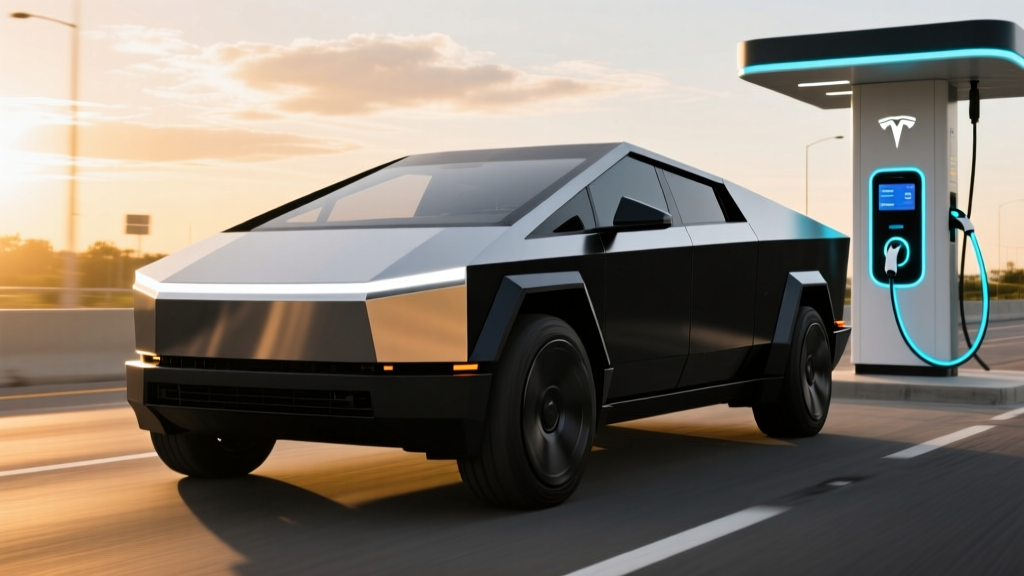
The Tesla Cybertruck remains one of the most polarizing electric vehicles on the road, but behind the angular stainless-steel exoskeleton lies a genuinely capable performance machine. The Cybertruck top speed is electronically limited to 130 mph on the Dual Motor AWD and 112 mph on the Long Range AWD trim, figures that belie its 6,800-pound curb weight. This review breaks down every spec that matters to real buyers — from EPA range to DC fast-charging curves — using 2026 model-year data.
For a vehicle that Tesla originally promised at $39,900, the current Cybertruck lineup starts at $79,990 and climbs to $99,990 for the Cyberbeast. That pricing shift fundamentally changes who this truck is for, and whether the performance numbers justify the premium over rivals like the Ford F-150 Lightning and Rivian R1T.
Range, Efficiency, and Real-World Expectations
EPA Estimated Range:
- Dual Motor AWD: 340 miles (EPA)
- Long Range AWD: 362 miles (EPA)
- Cyberbeast: 320 miles (EPA)
Real-World Caveat: Expect 260–290 miles at sustained 75 mph highway speeds. In cold weather (below 32°F), plan for a 20–30% reduction, bringing effective range to roughly 220–250 miles on the Dual Motor. The Cybertruck's slab-side aerodynamics and heavy mass work against highway efficiency, even with the tonneau cover sealed.
According to fueleconomy.gov, the Dual Motor AWD achieves 67 MPGe combined (51 kWh/100 mi), while the Cyberbeast drops to 58 MPGe combined (58 kWh/100 mi) due to its tri-motor powertrain and more aggressive performance tuning.
Efficiency in mixed city driving is noticeably better — regenerative braking recovers meaningful energy in stop-and-go traffic, and the Cybertruck's one-pedal driving mode is among the strongest in the segment. Owners report 300+ miles easily in suburban commuting patterns, but cross-country road trippers should plan Supercharger stops every 220–250 miles to maintain a comfort buffer.
Battery Chemistry and Capacity
The 2026 Cybertruck uses an estimated 123 kWh usable battery pack built on Tesla's 4680 cell architecture. The cells employ a high-nickel NMC (nickel-manganese-cobalt) chemistry optimized for energy density rather than the LFP (lithium iron phosphate) chemistry found in the Model 3 RWD. This choice makes sense given the Cybertruck's mass — the pack needs to deliver both range and the instantaneous current required for 845 horsepower in Cyberbeast trim.
The 4680 structural battery pack serves as a stressed member of the chassis, reducing overall vehicle weight compared to a conventional pack-in-tray design. However, the trade-off is that individual cell replacement is not practical — a failure would likely require a full pack swap under warranty.
| Spec | Dual Motor AWD | Long Range AWD | Cyberbeast |
|---|---|---|---|
| EPA Range | 340 mi | 362 mi | 320 mi |
| Battery (usable) | ~123 kWh (NMC, 4680) | ~123 kWh (NMC, 4680) | ~123 kWh (NMC, 4680) |
| Drivetrain | Dual Motor AWD | Dual Motor AWD | Tri-Motor AWD |
| Horsepower | 600 hp | 600 hp | 845 hp |
| 0–60 mph | 3.9 sec | 4.1 sec | 2.6 sec |
| Top Speed | 130 mph | 112 mph | 130 mph |
| MPGe (combined) | 67 MPGe | 70 MPGe | 58 MPGe |
| Max Tow Capacity | 11,000 lb | 11,000 lb | 11,000 lb |
| Payload | 2,500 lb | 2,500 lb | 2,500 lb |
| Base MSRP | $79,990 | $84,990 | $99,990 |
Charging Speed: DC Fast Charge and Home Level 2
The Cybertruck's 800-volt-class architecture enables DC fast-charging speeds that rank among the fastest in Tesla's lineup. Tesla rates the peak charge rate at approximately 350 kW at a V4 Supercharger, with a 10–80% time of roughly 18–22 minutes depending on battery preconditioning and ambient temperature.
| Charging Level | Power (kW) | Speed / Time |
|---|---|---|
| Level 1 (120V outlet) | ~1.4 kW | ~3 miles per hour |
| Level 2 (240V, 48A Wall Connector) | 11.5 kW | ~29 miles per hour |
| DC Fast Charge (V4 Supercharger) | Up to 350 kW peak | 10–80% in ~18–22 min |
| DC Fast Charge (250 kW V3 Supercharger) | Up to 250 kW peak | 10–80% in ~25–28 min |
Charging curve reality check: The Cybertruck does not sustain its peak 350 kW rate for the entire session. The charge curve ramps quickly to peak between 10–30% State of Charge (SoC), then progressively tapers. From 50–80%, expect sustained rates closer to 150–180 kW. Above 80%, charging slows dramatically to protect battery health — plan to unplug at 80% on road trips unless you specifically need the last 20%.
For home charging, Tesla's Wall Connector at 48 amps (11.5 kW) adds approximately 29 miles of range per hour. A full overnight charge from 20% to 100% takes roughly 10–12 hours. Owners with a 60-amp dedicated circuit can install the Wall Connector for $500–$1,500 depending on panel proximity, though homes with older 100-amp electrical panels may need a $2,000–$4,000 panel upgrade to support continuous 48A draw.
The Cybertruck uses the NACS (North American Charging Standard) connector natively, giving it direct access to Tesla's Supercharger network — the most reliable DC fast-charging network in the U.S. with over 25,000 stalls as of 2026. Non-Tesla chargers with CCS connectors require an adapter (included with some trims, sold separately for ~$200 otherwise).
Performance: Top Speed, Acceleration, and Drivetrain
The headline question for performance-oriented buyers: what is the Cybertruck top speed? The answer depends on trim:
- Cyberbeast (Tri-Motor): 130 mph (electronically limited)
- Dual Motor AWD: 130 mph (electronically limited)
- Long Range AWD: 112 mph (electronically limited)
Why the Long Range is governed lower likely relates to its tire specification and efficiency optimization — the Long Range trim uses all-season tires tuned for range rather than the performance-rated rubber on the Cyberbeast and Dual Motor.
Acceleration is where the Cybertruck truly distinguishes itself. The Cyberbeast's 2.6-second 0–60 mph time places it in supercar territory despite weighing nearly three tons. The Dual Motor's 3.9-second time is still quicker than most sports sedans. Tesla achieves this through instant electric torque delivery and sophisticated torque vectoring across the front and rear motors.
The steer-by-wire system — a first for a production vehicle sold in the U.S. — eliminates the mechanical connection between the steering wheel and the front wheels. This enables the Cybertruck's variable-ratio steering rack (fewer turns lock-to-lock at low speeds, more stability at highway speed) and contributes to the angular fender design since no steering column penetrates the firewall. The system has drawn mixed reviews: some drivers appreciate the precision, while others report a disconnected feel at higher speeds that takes weeks to adjust to.
Off-road capability includes up to 16 inches of ground clearance in Extraction Mode (adaptive air suspension), approach and departure angles competitive with body-on-frame trucks, and a stainless-steel underbody armor plate. However, the Cybertruck's 6,800-lb curb weight and lack of traditional locking differentials (it uses brake-based torque vectoring instead) mean it trails the Rivian R1T and Ford F-150 Lightning on technical trails.
Pricing, Tax Credit Eligibility, and Total Cost
| Trim | Base MSRP | Destination | Federal Credit (§30D) | Effective Price (if eligible) |
|---|---|---|---|---|
| Dual Motor AWD | $79,990 | $1,995 | Not eligible* | $81,985 |
| Long Range AWD | $84,990 | $1,995 | Not eligible* | $86,985 |
| Cyberbeast | $99,990 | $$1,995 | Not eligible* | $101,985 |
*Tax Credit Ineligibility: Under current IRS §30D rules, the Cybertruck does not qualify for the $7,500 federal EV tax credit for new vehicles. The reason is the MSRP cap: §30D limits the credit to trucks, SUVs, and vans with an MSRP of $80,000 or less. The Dual Motor AWD at $79,990 technically sits at the threshold, but with destination and any options, the as-delivered price exceeds the cap. The Long Range and Cyberbeast are well above it.
§30D Federal EV Tax Credit Requirements (2026):
- Vehicle MSRP must be ≤ $80,000 (trucks/SUVs/vans) or ≤ $55,000 (sedans)
- Buyer AGI must not exceed $150,000 (single) / $300,000 (joint filing)
- Battery minerals and components must meet critical-mineral and North American sourcing thresholds
- Credit can be transferred to the dealer at point of sale for an instant discount
- Full rules at IRS.gov §30D — consult a tax professional for your specific situation
For buyers who can itemize and have sufficient tax liability, the lack of a federal credit is a significant cost adder compared to the Ford F-150 Lightning (which qualifies for the full $7,500 on several trims). Some states offer additional rebates — check your local DMV or energy office for specifics, as these vary widely by jurisdiction.
Cargo, Interior Space, and Practicality
The Cybertruck offers a 6-foot bed (6.5 feet with the tailgate down) and a lockable powered tonneau cover that Tesla rates to support 300 lbs of distributed weight. The vault-style bed provides 67 cubic feet of cargo volume, and the under-bed storage (where a spare tire would traditionally sit) adds additional hidden capacity.
The front trunk (frunk) offers approximately 7 cubic feet of lockable storage — useful for charging cables or a small bag, though smaller than the F-150 Lightning's 14.1 cu ft mega power frunk.
Interior passenger space is adequate but not class-leading:
- Front legroom: 41.0 inches
- Rear legroom: 37.2 inches
- Seating capacity: 5 passengers (bench front seat with fold-down center armrest)
The cabin is minimalist even by Tesla standards: a single 18.5-inch front touchscreen handles nearly all vehicle controls, with a 9.4-inch rear touchscreen for back-seat passengers. There are no physical buttons for climate or audio — everything is screen-based, which draws criticism from traditional truck buyers. The yoke-style steering wheel (standard) takes significant adjustment for daily driving, particularly during low-speed maneuvers and parking.
Driver Assistance, Safety, and Notable Tech
SAE Automation Level: Level 2
Tesla's Autopilot and Full Self-Driving (Supervised) are Level 2 driver-assistance systems, not self-driving. The driver must remain actively engaged, keep hands on the wheel (or demonstrate attention via the cabin camera), and be prepared to take over at any moment. SAE Level 4 (true driverless operation in defined areas) is currently only offered by commercial robotaxi services like Waymo — not available in any consumer vehicle.
The Cybertruck ships with Tesla's Autopilot as standard, which includes Traffic-Aware Cruise Control and Autosteer (lane centering). Full Self-Driving (Supervised) is available as an $8,000 one-time purchase or $99/month subscription and adds automatic lane changes, Navigate on Autopilot (highway on-ramp to off-ramp), and Autopark.
Standout technology features include:
- Steer-by-wire: No mechanical steering column — variable ratio adjusts with speed
- 48-volt electrical architecture: Reduces wiring harness weight, enables higher-power accessories
- Bioweapon Defense Mode: HEPA air filtration system
- Powershare: Up to 11.5 kW of vehicle-to-home (V2H) and vehicle-to-load (V2L) capability — can run power tools at a job site or back up essential home circuits during an outage
- Sentry Mode & Dashcam: Continuous recording from multiple cameras
Known Drawbacks:
- Stainless-steel panels show fingerprints, smudges, and can dent from hail (no traditional paint to absorb impacts)
- Steer-by-wire feels artificial to many drivers; not all find it intuitive even after weeks of use
- Single-pane windows on early builds led to cabin noise; 2025+ acoustic glass improved this but it's still louder than an F-150 Lightning at highway speed
- Rear visibility is compromised by the bed design — the rear camera is essential for backing up
- Build quality inconsistencies reported by early owners (panel gaps, trim alignment) — Tesla has improved this on 2026 builds but variability remains
Warranty Coverage
Tesla provides the following warranty coverage for the 2026 Cybertruck:
- Basic Vehicle: 4 years / 50,000 miles
- Battery & Drive Unit: 8 years / 120,000 miles (with minimum 70% battery capacity retention during the warranty period)
- Roadside Assistance: 4 years / 50,000 miles
The 120,000-mile battery warranty is competitive with the segment, though some buyers note that Tesla's definition of "defect" versus "normal degradation" can be a friction point in claims. The 70% retention threshold is standard across the industry — if your battery degrades to 69% of original capacity within the warranty window, Tesla will repair or replace it.
Who Should Buy the Cybertruck — and Who Shouldn't
Choose the Cybertruck if:
- You want a high-performance electric truck that doubles as a statement vehicle
- You need 11,000-lb towing capacity with V2H/V2L powershare for job-site or emergency backup use
- You're already invested in the Tesla Supercharger ecosystem
- You value over-the-air updates and Tesla's software integration
Look elsewhere if:
- You need the $7,500 federal tax credit to make the math work — consider the F-150 Lightning or Rivian R1T
- You prioritize ride comfort and cabin quietness — the Lightning and Silverado EV ride more smoothly
- You need a proven work truck with a dealer service network in rural areas — Tesla's service center footprint is still urban-centric
- You want a traditional steering feel and physical controls
Pros
- Cyberbeast's 2.6-sec 0–60 is the quickest of any production truck ever made
- 350 kW peak DC charging is among the fastest available
- 11,000-lb tow rating matches full-size ICE trucks
- Stainless-steel body needs no paint — resists scratches and UV fading
- Powershare V2H/V2L adds genuine utility for job sites and outages
- NACS connector gives native Supercharger access — best charging network in the U.S.
Cons
- Does not qualify for the $7,500 federal EV tax credit (MSRP cap)
- Real-world highway range drops to ~250–270 mi, below EPA sticker
- Steer-by-wire is polarizing and takes significant adjustment
- Rear visibility is poor without relying on cameras
- Higher insurance premiums than comparable trucks (average 20–30% more)
- Service center availability limited outside major metro areas
Frequently Asked Questions
What is the Tesla Cybertruck top speed?
The Cyberbeast and Dual Motor AWD are electronically limited to 130 mph. The Long Range AWD is limited to 112 mph. These limits are software-governed, not hardware-constrained — Tesla caps speed to manage tire wear, energy consumption, and stability given the Cybertruck's mass and aerodynamic profile.
What is the real-world range of the Cybertruck on a road trip?
Expect 260–290 miles at 75 mph in mild weather on the Dual Motor AWD (EPA rated at 340 mi). In cold weather (below freezing), plan for 220–250 miles. The Cyberbeast's more aggressive powertrain and stickier tires reduce real-world range to approximately 240–260 miles highway.
How fast does the Cybertruck charge at home?
On a Level 2 Tesla Wall Connector at 48 amps (11.5 kW), the Cybertruck adds roughly 29 miles of range per hour. A full charge from 20% to 100% takes approximately 10–12 hours, making overnight charging practical for most daily driving needs.
Does the Cybertruck qualify for the $7,500 federal EV tax credit?
No. Under current IRS §30D rules, the new-vehicle credit is capped at trucks and SUVs with an MSRP of $80,000 or less. Even the base Dual Motor AWD at $79,990 exceeds the cap once destination fees are included. The Long Range and Cyberbeast are well above the limit. Check IRS.gov for the latest rules, and consult a tax professional for your situation.
Is the Cybertruck worth buying over the Ford F-150 Lightning?
It depends on your priorities. The Cybertruck wins on performance (0–60 times, top speed), DC charging speed (350 kW vs. Lightning's ~150 kW peak on extended range), and Supercharger network access. The F-150 Lightning wins on tax credit eligibility ($7,500 on several trims), cabin comfort, dealer service access, and starting price (~$55,000 vs. ~$80,000). For a work truck, the Lightning is more practical. For a performance statement, the Cybertruck stands alone.
What is the Cybertruck's battery warranty?
Tesla covers the battery and drive unit for 8 years or 120,000 miles, whichever comes first, with a minimum 70% capacity retention guarantee. If the battery degrades below 70% of its original capacity within that window, Tesla will repair or replace it at no charge.
Can the Cybertruck power my home during an outage?
Yes. Tesla's Powershare feature supports up to 11.5 kW of vehicle-to-home (V2H) output when paired with a compatible Tesla Wall Connector and Powerwall gateway. This can sustain essential home circuits (refrigerator, lights, HVAC fan) for multiple days depending on usage and the Cybertruck's remaining charge.