The Tesla Cybertruck remains one of the most polarizing electric vehicles on the road, and much of the debate centers on a single interface point: the Cybertruck steering wheel. Tesla replaced the conventional round wheel with a yoke-style control that fundamentally changes how drivers interact with a full-size pickup. Beyond that controversial design choice, the Cybertruck delivers serious EV capability — 800-volt architecture, rapid DC fast charging, and a stainless-steel exoskeleton that shrugs off minor impacts. But does the package hold up under real-world ownership scrutiny? This review breaks down range, charging, pricing, and daily usability with the exact numbers buyers need.
Cybertruck Steering Wheel: The Yoke Explained
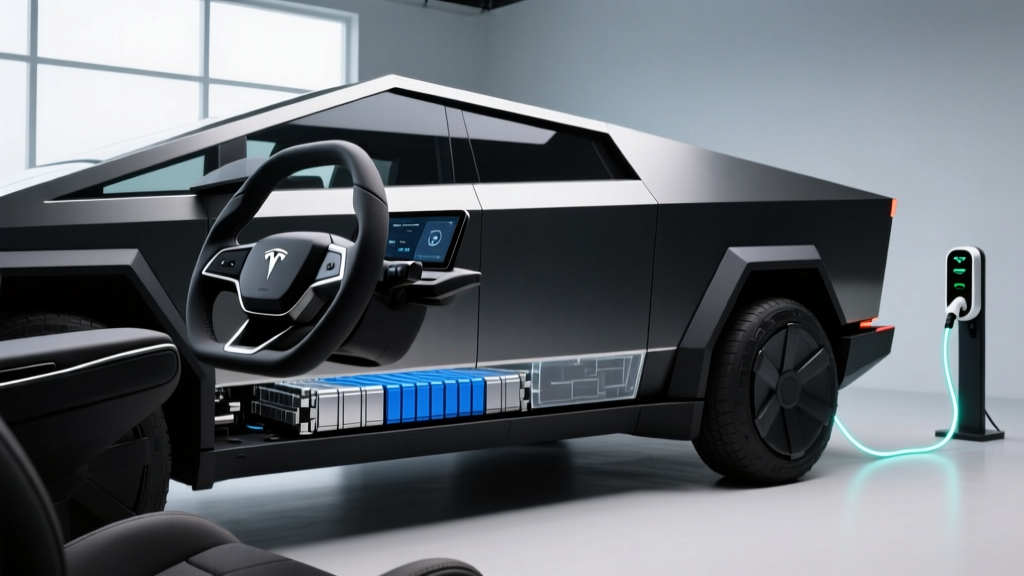
The Cybertruck steering wheel is not a traditional round wheel. Tesla equips every Cybertruck with a yoke-style steer-by-wire control that eliminates the mechanical linkage between the driver's hands and the front wheels. Instead, electronic sensors translate yoke input into steering commands executed by electric actuators at the rack.
This steer-by-wire system enables a variable steering ratio. At low speeds — parking lots, tight trails — the Cybertruck requires only about 340 degrees of total yoke rotation from lock to lock, meaning you never need to hand-over-hand. At highway speeds, the ratio firms up for stability. The yoke itself is a flattened, roughly trapezoidal shape with grip zones at 9 and 3 o'clock, plus two scroll wheels and capacitive touch buttons for media, Autopilot, and voice commands.
The practical upside: unobstructed view of the 18.5-inch central touchscreen and the front windshield, plus easier entry and exit since there's no upper wheel rim to duck under. The downside is real, too. Three-point turns and low-speed maneuvers that would normally involve spinning a round wheel require a brief adaptation period with the yoke. Most owners report adjusting within a week, but it remains a dealbreaker for some. There is no round-wheel option available from the factory as of the 2026 model year.
Range, Battery, and Real-World Efficiency
Tesla offers the Cybertruck in three trims for 2026: Long Range AWD, Cyberbeast (tri-motor AWD), and a base Rear-Wheel Drive variant that began limited deliveries in late 2025. The volume sellers remain the dual- and tri-motor AWD configurations.
| Spec | Long Range AWD | Cyberbeast (Tri-Motor) |
|---|---|---|
| EPA Range | 340 miles | 320 miles |
| Battery Capacity (usable) | ~123 kWh | ~123 kWh |
| Battery Chemistry | NMC (Nickel Manganese Cobalt) | NMC |
| Efficiency (EPA) | 56 MPGe (2.0 kWh/mi) | 52 MPGe (2.2 kWh/mi) |
| 0-60 mph | 3.9 seconds | 2.6 seconds |
| Horsepower | 600 hp | 845 hp |
| Drivetrain | Dual-Motor AWD | Tri-Motor AWD |
| Towing Capacity | 11,000 lbs | 11,000 lbs |
The Cybertruck uses an NMC (nickel manganese cobalt) lithium-ion pack, chosen for its high energy density — necessary to push a 6,800-pound stainless-steel truck past 300 miles. NMC chemistry performs well in cold weather compared to LFP, but Tesla recommends keeping daily charge limits around 80% for long-term battery health, reserving 100% charges for road trips.
Charging Speed: 800V Architecture in Practice
The Cybertruck's 800-volt electrical architecture is its charging headline. Higher voltage allows faster energy transfer without excessive current, reducing heat and cable weight. Here's what that means at the plug:
| Charging Level | Power / Voltage | Speed | Notes |
|---|---|---|---|
| DC Fast Charge (Tesla V4 Supercharger) | Up to 350 kW peak | 10–80% in ~22 minutes | Peak rate sustained to ~50% SoC, then tapers |
| DC Fast Charge (CCS via adapter) | Up to 250 kW | 10–80% in ~30 minutes | Depends on station; Electrify America, EVgo compatible |
| Level 2 Home (Tesla Wall Connector) | 11.5 kW (48A) | ~37 miles per hour of charging | Full charge from 10% in ~11 hours |
| Level 1 (120V household) | ~1.4 kW | ~4 miles per hour | Emergency/trickle only; not practical for daily use |
The charging curve matters more than the peak number. At a V4 Supercharger, the Cybertruck pulls close to 350 kW from roughly 10% to 50% state of charge, then progressively tapers. From 80% to 100%, charging slows dramatically — adding the final 20% can take as long as the first 70%. For road trips, the practical strategy is charging to 80% and driving on, which minimizes total trip time.
At home, a 48-amp Level 2 Tesla Wall Connector on a 60-amp circuit adds roughly 37 miles of range per hour. Most owners who plug in overnight start each morning with a full charge. Installation typically requires a NEMA 14-60 outlet or hardwired connection; budget $800–$2,000 for professional installation depending on panel proximity, according to typical electrician rates. A 200-amp panel upgrade may be necessary in older homes, adding $1,500–$3,000.
Pricing, Tax Credits, and Ownership Cost
The Cybertruck's pricing has shifted since its late-2023 launch, and 2026 model-year MSRPs reflect Tesla's current positioning:
| Trim | Base MSRP | Federal §30D Credit | Effective Price |
|---|---|---|---|
| Rear-Wheel Drive | $60,990 | $0 (exceeds MSRP cap) | $60,990 |
| Long Range AWD | $79,990 | $0 (exceeds MSRP cap) | $79,990 |
| Cyberbeast | $99,990 | $0 (exceeds MSRP cap) | $99,990 |
Tax credit reality check: Under current IRS §30D rules, the federal EV tax credit caps eligible pickup trucks at an $80,000 MSRP. The Long Range AWD at $79,990 sits right at the threshold, but once any mandatory destination or delivery fees push the total above $80,000, it loses eligibility. The Cyberbeast and any Long Range with options exceed the cap. The RWD base model clears the MSRP cap but buyers must also meet income limits ($150,000 single / $300,000 joint AGI) and the vehicle must satisfy critical-mineral and battery-component sourcing requirements. Always verify current-year eligibility on the IRS website or with a tax professional before counting on the credit.
The Cybertruck's 8-year/120,000-mile battery and drive unit warranty is competitive for the segment. Tesla guarantees the battery will retain at least 70% of its original capacity during the warranty period. The limited vehicle warranty covers 4 years or 50,000 miles.
Interior, Cargo, and Daily Usability
The Cybertruck's cabin is minimalist in the extreme. The 18.5-inch landscape touchscreen handles virtually all vehicle controls — there are no physical buttons for climate, mirrors, or glovebox. A secondary 9.4-inch rear touchscreen serves back-seat passengers. The yoke steering wheel, as discussed, dominates the driver's sightline and interaction model.
Dimensions and cargo:
- Bed length: 6 feet (72 inches) with the tonneau cover closed; the vault-style bed is fully enclosed and lockable
- Bed payload: 2,500 lbs
- Frunk volume: ~7 cu ft (front trunk, lockable)
- Rear-seat legroom: 41.3 inches — adequate for adults on shorter trips
- Seating: 5 passengers (3-across front bench in some trims, 2+3 in others)
- Ground clearance: Up to 16 inches (adaptive air suspension in Extract Mode)
The powered tonneau cover is a standout feature — it retracts electrically and supports up to 300 lbs of distributed weight when closed. However, the angled bed walls and wheel-well intrusion reduce usable width compared to a conventional F-150 Lightning or Rivian R1T bed. Loading pallets or wide cargo is more constrained than the Cybertruck's size might suggest.
Driver Assistance and Standout Tech
Every Cybertruck ships with Tesla's basic Autopilot suite (Traffic-Aware Cruise Control and Autosteer), which is a SAE Level 2 driver-assistance system. The driver must keep hands on the yoke and eyes on the road at all times. Tesla's steer-by-wire system uses torque sensors on the yoke to detect driver engagement.
FSD (Supervised) is available as a $8,000 one-time purchase or $99/month subscription and adds automatic lane changes, traffic-light and stop-sign recognition, and city-street navigation. Real-world performance varies significantly by geography and road complexity — it excels on well-marked highways but can struggle with construction zones, faded lane markings, and unprotected left turns.
Other notable tech includes the adaptive air suspension (adjustable ride height from 9 to 16 inches of ground clearance), a 48-volt electrical architecture (a first for a production vehicle at this scale, reducing wiring harness weight), rear-wheel steering for a tighter turning circle of 37.1 feet, and integrated 120V/240V bed outlets capable of powering tools or a campsite.
Cybertruck vs. the Competition
The Cybertruck competes primarily with the Ford F-150 Lightning, Rivian R1T, and Chevrolet Silverado EV. Here's how it stacks up on the metrics that matter:
| Spec | Cybertruck LR AWD | F-150 Lightning Ext. Range | Rivian R1T Dual-Motor Max |
|---|---|---|---|
| EPA Range | 340 mi | 320 mi | 410 mi |
| Max DC Charge | 350 kW | 150 kW | 220 kW |
| 10–80% Time | ~22 min | ~41 min | ~30 min |
| 0-60 mph | 3.9 sec | ~5.0 sec | ~3.5 sec |
| Towing | 11,000 lbs | 10,000 lbs | 11,000 lbs |
| Base MSRP | $79,990 | ~$73,000 | ~$89,000 |
| Bed Length | 6 ft | 5.5 ft | 4.5 ft (+ Gear Tunnel) |
The Cybertruck's advantages are charging speed (by a wide margin), the lockable vault-style bed, and the stainless-steel exterior that resists dents and eliminates paint maintenance. Its disadvantages include the polarizing yoke, narrower effective bed width, limited rear-seat comfort on long drives, and no federal tax credit at most trim levels. The F-150 Lightning wins on conventional usability and fleet-familiar ergonomics; the R1T wins on range and adventure-oriented design with the Gear Tunnel.
Who Should Buy the Cybertruck?
- You want the fastest DC charging in the electric truck segment and road-trip frequently
- You value a lockable, weather-sealed bed vault for gear and tools
- You're comfortable adapting to a yoke-style steering interface
- You need 11,000-lb towing and 240V bed outlets for job-site or campsite power
- You prefer a conventional steering wheel and traditional truck ergonomics
- Federal tax credit eligibility is a key part of your purchase math
- You regularly carry wide palletized cargo or need a full 8-foot bed
- Rear-seat passenger comfort on long trips is a priority
- 350 kW peak DC fast charging — fastest in the EV truck class
- Stainless-steel exoskeleton — dent-resistant, no paint to maintain
- Lockable powered tonneau with 300-lb load rating
- 48V architecture and 120V/240V bed power outlets
- Rear-wheel steering yields a surprisingly tight turning radius
- Yoke steering wheel is polarizing with no round-wheel option
- Exceeds $80K MSRP cap on most trims — no federal tax credit
- Highway range drops significantly above 70 mph due to aerodynamics
- Bed width constrained by wheel wells and angular design
- Touchscreen-only controls for mirrors, glovebox, and wipers frustrate some drivers
Frequently Asked Questions
What is the real-world range of the Cybertruck?
The EPA rates the Long Range AWD at 340 miles and the Cyberbeast at 320 miles. In real-world highway driving at 75 mph, expect 275–295 miles. In cold weather below freezing, that can drop to 220–240 miles. City driving with regenerative braking often matches or slightly exceeds the EPA sticker.
How fast does the Cybertruck charge?
On a Tesla V4 Supercharger, the Cybertruck peaks at 350 kW and charges from 10% to 80% in approximately 22 minutes. On a CCS station with an adapter, it pulls up to 250 kW for a 10–80% time of roughly 30 minutes. At home on a Level 2 Wall Connector (11.5 kW), it adds about 37 miles of range per hour.
Does the Cybertruck qualify for the federal EV tax credit?
Most trims do not. Under IRS §30D rules, pickup trucks must have an MSRP at or below $80,000 to qualify. The Cybertruck Long Range AWD at $79,990 is borderline, and any options or destination charges that push the total above $80,000 eliminate eligibility. The Cyberbeast and RWD trims with options also exceed the cap. Buyers must also meet income limits and the vehicle must satisfy battery-sourcing requirements. Consult a tax professional before relying on the credit.
Can I get a round steering wheel instead of the yoke?
No. Tesla does not offer a conventional round steering wheel as a factory option on any Cybertruck trim. The yoke is standard and integral to the steer-by-wire system. Some aftermarket companies have explored round-wheel conversions, but these may interfere with the torque-sensing driver-monitoring system and could void warranty coverage.
Is the Cybertruck good for towing?
The Cybertruck is rated for 11,000 lbs of towing, matching the Rivian R1T and exceeding the F-150 Lightning. However, towing at or near maximum capacity will cut range roughly in half — expect 150–170 miles on a full charge when towing a heavy trailer. The integrated trailer brake controller and rear-view camera system with hitch-assist are well-implemented.
What is the Cybertruck's warranty?
Tesla covers the battery and drive units for 8 years or 120,000 miles, whichever comes first, with a guaranteed minimum 70% capacity retention. The limited vehicle warranty is 4 years or 50,000 miles. The stainless-steel body panels carry the same corrosion warranty as the rest of the vehicle structure.
How does the steer-by-wire system affect safety?
Tesla's steer-by-wire system includes redundant electronic controllers and backup power systems. If the primary steering system fails, a backup system can maintain steering control. The NHTSA has not issued any recalls specific to the Cybertruck's steer-by-wire system as of early 2026, but long-term reliability data is still limited given the vehicle's relatively recent launch.