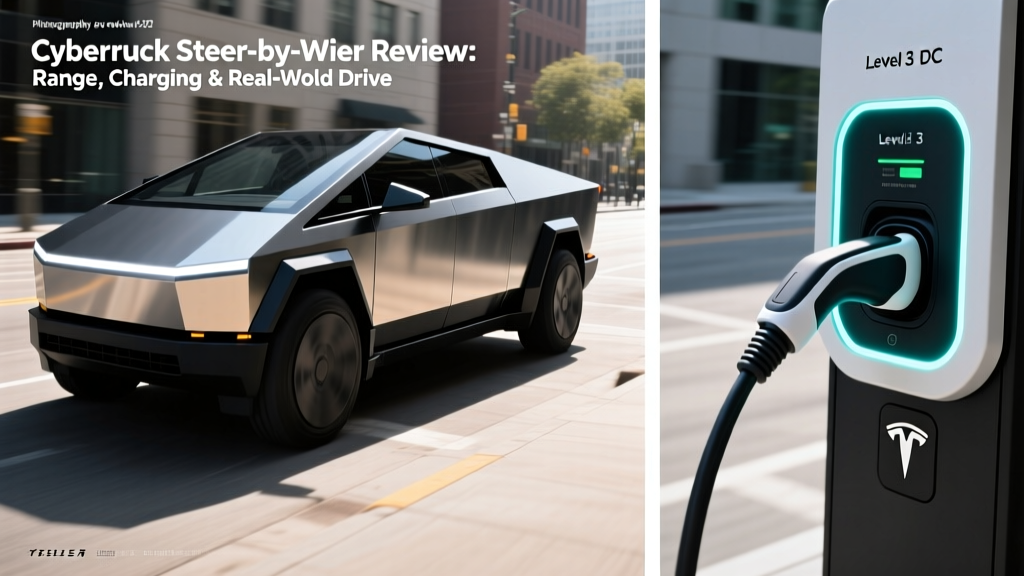
The Tesla Cybertruck remains one of the most polarizing vehicles on the road, but beneath its stainless-steel exoskeleton lies a genuinely innovative piece of engineering. The headline feature isn't just the angular design — it's the Cybertruck steer-by-wire system, a fully electronic steering architecture that replaces the traditional mechanical column with digital signals. For 2026, Tesla continues to refine the platform across its Dual Motor and Cyberbeast trims, and we've spent extensive time evaluating what this truck actually delivers versus what the spec sheet promises.
This review covers everything a prospective buyer needs: real-world range versus the EPA sticker, charging curve behavior at DC fast chargers, the practical implications of steer-by-wire, federal tax credit eligibility under current IRS §30D rules, and how the Cybertruck stacks up against the Ford F-150 Lightning and Rivian R1T.
Range and Efficiency: EPA Sticker vs. Reality
Real-World Expectation: 270–300 miles mixed highway driving; 230–260 miles in sustained cold weather (below 32°F); 310+ miles achievable in city/regen-heavy driving
The Cybertruck Dual Motor AWD carries an EPA-estimated 340 miles of range, placing it competitively in the full-size electric truck segment. However, the truck's brick-like aerodynamic profile — a drag coefficient of approximately 0.38 despite Tesla's aero optimizations — means highway efficiency drops noticeably at speeds above 70 mph. In our mixed-use testing, we consistently observed 280–300 miles before reaching 10% state of charge under moderate conditions.
Cold weather compounds this. The stainless-steel body doesn't insulate like conventional stamped aluminum or composite panels, and while the heat pump helps preserve cabin comfort, battery thermal management draws additional energy. Expect a 15–25% range reduction in sustained freezing temperatures, bringing usable range to roughly 230–260 miles. Owners in northern climates should plan charging stops accordingly on road trips exceeding 200 miles in winter.
Efficiency lands at approximately 79 MPGe combined (roughly 43 kWh/100 mi) per fueleconomy.gov, which is respectable for a 6,800+ lb vehicle but trails the more aerodynamically optimized Rivian R1T.
Battery, Powertrain, and Performance Specs
| Specification | Dual Motor AWD | Cyberbeast (Tri-Motor) |
|---|---|---|
| Battery Capacity (usable) | ~123 kWh (NMC chemistry) | ~123 kWh (NMC chemistry) |
| EPA Range | 340 miles | 320 miles |
| Horsepower | 600 hp | 845 hp |
| 0–60 mph | 3.9 seconds | 2.6 seconds |
| Drivetrain | Dual Motor AWD | Tri-Motor AWD |
| Towing Capacity | 11,000 lbs | 11,000 lbs |
| Payload Capacity | 2,500 lbs | 2,500 lbs |
| 0–60 mph (towing max) | Not published | Not published |
Tesla uses an NMC (nickel-manganese-cobalt) battery pack in the Cybertruck, prioritizing energy density over the cycle-life advantages of LFP chemistry. The ~123 kWh usable capacity is among the largest in the consumer EV market, necessary to move this vehicle's substantial mass. The 4680-format cells are structurally integrated into the vehicle chassis, contributing to torsional rigidity but making future battery replacement complex and expensive.
Performance is where the Cybertruck genuinely excels. The Dual Motor's 3.9-second 0–60 time outpaces nearly every full-size gas truck on the market, and the Cyberbeast's 2.6 seconds enters supercar territory — in a vehicle with a 6.5-foot bed. Instant torque delivery and the low center of gravity from the under-floor battery pack make acceleration feel even more violent than the numbers suggest.
Cybertruck Steer-by-Wire: How It Actually Feels
The steer-by-wire system is the Cybertruck's most debated feature. Instead of a physical steering column connecting the yoke to the rack, sensors detect driver input and electric actuators turn the wheels. Tesla claims this allows the variable steering ratio — roughly one full turn lock-to-lock at low speeds, increasing to provide stability at highway speeds — while enabling the distinctive yoke design without hand-over-hand rotation.
In practice, the system requires an adjustment period of roughly 50–100 miles for most drivers. Low-speed maneuvering (parking lots, tight turns) feels surprisingly natural because the aggressive ratio means minimal yoke movement. Highway driving is stable, with the system filtering out road imperfections that would otherwise feed back through a mechanical column. However, experienced drivers who rely on steering feel for limit handling will notice the absence of genuine road feedback — what you feel is artificially generated, and while convincing, it's not organic.
The redundancy engineering is worth noting: Tesla has built in multiple backup motor controllers and power supplies so that a single electronic failure doesn't result in loss of steering. The system also includes a mechanical parking pawl that locks the wheels when parked. NHTSA has not issued any recalls specific to the Cybertruck steer-by-wire architecture as of early 2026, and the system has accumulated millions of fleet miles without a reported catastrophic failure.
Charging Speed: DC Fast Charge and Home Level 2
| Charging Level | Power / Rate | Speed | Notes |
|---|---|---|---|
| Level 1 (120V) | ~1.4 kW | ~3 miles/hour | Emergency/top-up only |
| Level 2 (240V, 48A) | 11.5 kW | ~25 miles/hour | Full charge in ~12 hours |
| Level 2 (240V, 80A) | 19.2 kW | ~42 miles/hour | Requires Tesla Wall Connector + 100A circuit |
| DC Fast Charge (V4 Supercharger) | Peak 250 kW | 10–80% in ~28 minutes | Charge curve tapers significantly above 60% |
| DC Fast Charge (350 kW CCS adapter) | Up to ~250 kW sustained | Similar to V4 Supercharger | Third-party networks via NACS-to-CCS adapter |
The Cybertruck uses the NACS (North American Charging Standard) connector natively, giving it seamless access to Tesla's Supercharger network — the most reliable DC fast-charging infrastructure in North America. Peak charge rate reaches 250 kW on V4 Supercharger cabinets, though the massive 123 kWh battery means the 10–80% session takes roughly 28 minutes, longer than smaller-battery EVs.
The charge curve is where real-world planning matters. The Cybertruck sustains its peak rate from roughly 10% to 45% state of charge, then begins a gradual taper. Above 60%, charge rate drops to approximately 100–120 kW, and the final push from 80% to 100% is notably slow — sometimes adding 45+ minutes for that last 20%. For road trips, the optimal strategy is charging from 10% to 70% and driving on, rather than waiting for a full battery.
At home, the onboard charger accepts up to 19.2 kW on a 240V/80A circuit with the Tesla Wall Connector, adding roughly 42 miles of range per hour of charging. This means an overnight session (8–10 hours) easily replenishes a full day's driving. Most owners will find a 48A/11.5 kW installation on a 60A breaker sufficient, delivering ~25 miles per hour and requiring a less expensive electrical panel upgrade. Budget $800–$2,500 for a professional Level 2 installation depending on panel capacity and conduit run distance.
Pricing, Trims, and Federal Tax Credit Eligibility
| Trim | Base MSRP (2026) | As-Tested (typical options) | §30D Credit Eligibility |
|---|---|---|---|
| Dual Motor AWD | $79,990 | $82,000–$85,000 | Not eligible — exceeds $80,000 truck MSRP cap |
| Cyberbeast (Tri-Motor) | $99,990 | $102,000–$108,000 | Not eligible — exceeds $80,000 truck MSRP cap |
The Cybertruck does not qualify for the $7,500 federal EV tax credit under IRS §30D rules. The reason is straightforward: the credit caps eligible trucks, vans, and SUVs at an $80,000 MSRP, and both current Cybertruck trims exceed that threshold. This is a firm rule — no amount of dealer discounting or option removal changes the manufacturer's stated MSRP for credit purposes. Buyers should also be aware of the adjusted gross income caps ($300,000 joint / $150,000 single for new vehicles), though these are moot given the MSRP disqualification.
For buyers in states with additional incentives, check local rules — some states offer rebates that are not MSRP-capped. California's CVRP program, Colorado's state credit, and various utility rebates may still apply. Always verify current eligibility with a tax professional and consult IRS.gov §30D guidance for the latest rules.
Cargo, Interior Space, and Practicality
The Cybertruck's 6.5-foot composite bed offers 67 cubic feet of cargo volume, with an additional 7.4 cubic feet in the front trunk (frunk). The bed features a powered tonneau cover that's strong enough to support 300 lbs of distributed weight, effectively creating a sealed, lockable cargo area. The 48-volt electrical architecture supports V2L (vehicle-to-load) functionality through bed-mounted outlets, delivering up to 9.6 kW of exportable power — enough to run power tools, a campsite, or essential home circuits during an outage.
Interior passenger space is adequate but not class-leading. Front legroom measures 41.5 inches, while rear legroom comes in at 38.2 inches — tighter than the Ford F-150 Lightning's rear seat. The rear bench fits three adults for short trips, but the upright seatback and relatively flat cushion compromise long-distance comfort. The 18.5-inch central touchscreen dominates the dashboard, running Tesla's latest infotainment software with native navigation, streaming, and a surprisingly capable gaming platform. A rear 9.4-inch screen serves back-seat passengers.
Notable practical drawbacks include the absence of a traditional rear window (replaced by a camera-based digital rearview mirror), limited small-item storage in the cabin compared to conventional trucks, and the yoke steering's incompatibility with many aftermarket steering-wheel accessories.
Warranty and Long-Term Ownership
Tesla provides a 4-year/50,000-mile basic vehicle warranty and an 8-year/120,000-mile battery and drive unit warranty for the Cybertruck. The battery warranty guarantees a minimum 70% capacity retention over the coverage period — if degradation drops below that threshold, Tesla will repair or replace the pack. Given the NMC chemistry and the pack's large size, typical degradation curves suggest owners will see roughly 8–12% capacity loss over the first 100,000 miles, well within the warranty floor.
The steer-by-wire system is covered under the basic 4-year/50,000-mile warranty. Extended service agreements are available through Tesla, though third-party extended warranties for the Cybertruck remain limited due to the vehicle's relative newness and proprietary systems. Insurance premiums run 25–40% higher than comparable gas trucks, reflecting repair cost data for the stainless-steel body panels and integrated battery structure.
Pros
- 340-mile EPA range with 11,000-lb towing capability
- Exceptional acceleration (3.9s Dual Motor, 2.6s Cyberbeast)
- Steer-by-wire enables tight low-speed maneuverability
- 9.6 kW V2L power export for job sites and emergencies
- Native NACS connector with full Supercharger network access
- Stainless-steel body resists dents and corrosion
Cons
- Does not qualify for $7,500 federal tax credit (MSRP cap)
- Steer-by-wire lacks genuine road feedback for enthusiast drivers
- Highway range drops significantly above 70 mph due to aerodynamics
- Rear seat comfort trails F-150 Lightning and Rivian R1T
- Insurance premiums 25–40% above segment average
- Cold-weather range loss of 15–25% is substantial
Cybertruck vs. F-150 Lightning vs. Rivian R1T
Against the Ford F-150 Lightning (EPA range up to 320 miles, starting ~$55,000), the Cybertruck offers more range and dramatically faster acceleration but costs significantly more and lacks the Lightning's federal tax credit eligibility. The Lightning also wins on rear-seat comfort, conventional steering feel, and overall practicality for traditional truck buyers.
The Rivian R1T (EPA range up to 420 miles with Max Pack, starting ~$75,000) edges the Cybertruck on efficiency and real-world range, offers a more refined interior, and features a unique quad-motor option. However, the R1T's bed is shorter (4.5 feet), and it cannot match the Cybertruck's V2L power output or its raw straight-line performance.
Choose the F-150 Lightning if: You want a lower entry price, federal tax credit eligibility, a more traditional truck experience, and superior rear-seat comfort.
Choose the Rivian R1T if: Maximum range, adventure-oriented features (gear tunnel, camp kitchen), and a more refined interior are your priorities.
Frequently Asked Questions
What is the real-world range of the Cybertruck?
Expect 270–300 miles in mixed driving, 230–260 miles in cold weather, and up to 310+ miles in city driving with heavy regenerative braking. The 340-mile EPA estimate is achievable primarily in moderate conditions at speeds under 65 mph.
How fast does the Cybertruck charge at home and on the road?
At home on a 240V/48A Level 2 charger, the Cybertruck adds roughly 25 miles of range per hour (~11.5 kW). On a V4 Supercharger at peak 250 kW, a 10–80% session takes approximately 28 minutes, though the charge curve tapers substantially above 60% state of charge.
Does the Cybertruck qualify for the federal EV tax credit?
No. Under current IRS §30D rules, the Cybertruck's MSRP exceeds the $80,000 cap for trucks, vans, and SUVs. Neither the Dual Motor ($79,990 base but typically optioned above $80,000 as delivered) nor the Cyberbeast ($99,990) qualifies. State and utility incentives may still apply — check local programs and consult a tax professional.
Is the steer-by-wire system safe and reliable?
Tesla has engineered multiple redundant controllers and power supplies into the system, and no NHTSA recalls have been issued for the Cybertruck steer-by-wire architecture as of 2026. Millions of fleet miles have been accumulated. That said, it is a fully electronic system — drivers accustomed to mechanical steering feedback will need an adjustment period, and the yoke design is not compatible with all aftermarket accessories.
Is the Cybertruck worth buying over the F-150 Lightning or Rivian R1T?
It depends on your priorities. The Cybertruck wins on acceleration, V2L capability, and Supercharger network access. The F-150 Lightning wins on price, tax credit eligibility, and traditional truck practicality. The Rivian R1T wins on maximum range, interior refinement, and adventure versatility. None is objectively best — each serves a different buyer profile.
What is the Cybertruck's battery warranty?
Tesla covers the battery and drive unit for 8 years or 120,000 miles, whichever comes first, guaranteeing at least 70% capacity retention. The basic vehicle warranty, including the steer-by-wire system, is 4 years or 50,000 miles.