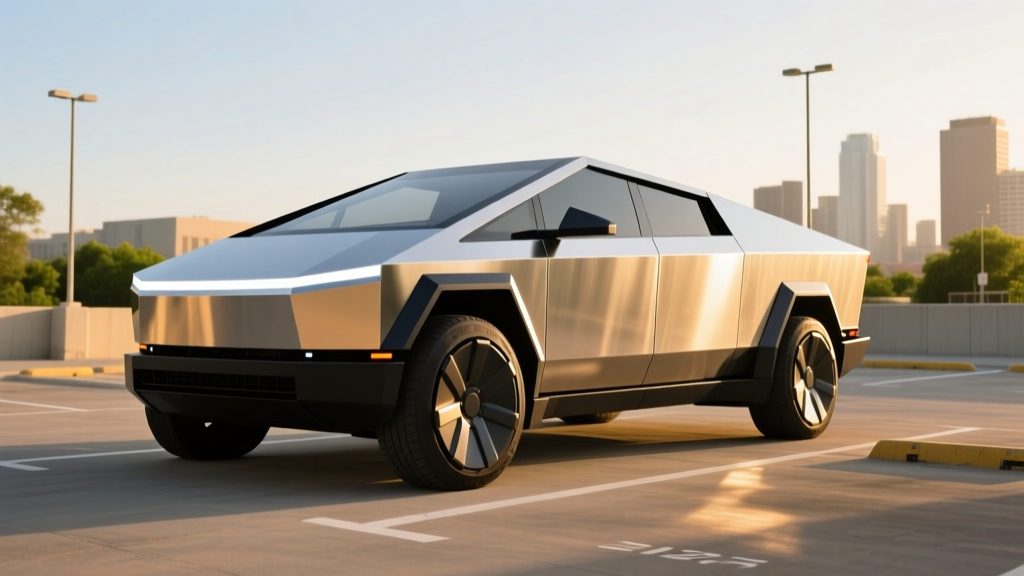
The Tesla Cybertruck polarizes on looks alone, but for buyers evaluating a full-size electric pickup, the practical questions go deeper than stainless steel panels. How big is it really? Can you park it? Will it fit in a standard garage? And once you're past the dimensions, how does its range, charging speed, and total cost stack up against the Ford F-150 Lightning and Rivian R1T?
This guide breaks down the Cybertruck's size inside and out — exterior footprint, cabin room, bed volume, and the frunk — then layers in the exact EPA range, battery specs, DC fast-charging curves, and 2026 pricing with federal tax credit context. Whether you're cross-shopping electric trucks or trying to figure out if the Cybertruck physically fits your life, here are the numbers that matter.
Cybertruck Exterior Dimensions: Bigger Than You Think, Smaller Than an F-150
Tesla markets the Cybertruck as a full-size pickup, but its footprint lands closer to a midsize truck in length while carrying full-size width and weight. Understanding these dimensions is critical before you commit — especially if you have a compact garage or tight urban parking.
| Dimension | Cybertruck AWD | Ford F-150 Lightning (Std Bed) | Rivian R1T |
|---|---|---|---|
| Length | 223.6 in | 232.7 in | 217.1 in |
| Width (w/ mirrors) | 95.0 in | 96.8 in | 81.8 in |
| Width (mirrors folded) | 84.0 in | 83.5 in | 81.8 in |
| Height | 70.5 in | 78.3 in | 73.0 in |
| Wheelbase | 143.5 in | 145.5 in | 135.9 in |
| Curb Weight | ~6,600 lbs | ~6,171 lbs | ~7,148 lbs |
| Ground Clearance (max) | 17.4 in (Extract Mode) | 13.1 in | 14.9 in |
The Cybertruck is roughly 9 inches shorter than the F-150 Lightning, which helps in parking structures and garages. However, its 84-inch width (mirrors folded) is the widest of any truck in its class — you'll feel it in narrow construction zones and older parking garages. At 70.5 inches tall, it clears most 7-foot garage doors, but only just, and only if your door opener track doesn't intrude. Measure your garage before ordering.
The 17.4-inch ground clearance in Extract Mode (adaptive air suspension fully raised) exceeds both the Lightning and R1T, making it genuinely capable on rough trails. In standard ride height, expect around 12 inches — still generous for a unibody truck.
Cargo, Bed, and Frunk: Where the Cybertruck's Size Shows Its Limits
The Cybertruck's angular sail-pillar design creates a 6-foot bed that's shorter and narrower than traditional full-size pickups. This is the single biggest trade-off of the truck's size.
| Area | Cybertruck | F-150 Lightning | Rivian R1T |
|---|---|---|---|
| Bed Length | 72.0 in (6 ft) | 67.1 in (5.5 ft std) / 78.9 in (6.5 ft) | 54.0 in (4.5 ft) |
| Bed Width (between wheel wells) | 48.9 in | 50.6 in | 50.0 in |
| Bed Volume | ~34 cu ft | ~52.8 cu ft (std bed) | ~27 cu ft |
| Max Payload | 2,500 lbs | 2,235 lbs | 1,760 lbs |
| Max Towing | 11,000 lbs | 10,000 lbs | 11,000 lbs |
| Front Trunk (Frunk) | 7.1 cu ft | 14.1 cu ft | 11.0 cu ft |
| Gear Tunnel / Vault | None | None | 11.7 cu ft (Gear Tunnel) |
| Cabin Rear Storage (seats folded) | ~38 cu ft | ~52 cu ft | ~34 cu ft |
The 6-foot bed fits a standard pallet lengthwise but not between the wheel wells — you'll need to stack or use the motorized tonneau cover's rated 300 lb load for overflow. The power-operated stainless-steel tonneau is a genuine advantage: it seals weather-tight and supports standing weight, effectively extending your flat-load area.
The 7.1-cu-ft frunk is the smallest among electric truck competitors — the F-150 Lightning's 14.1-cu-ft Mega Power Frunk is nearly double and includes drain plugs and 12V power. If you rely on a frunk for tools or groceries, the Cybertruck will feel cramped.
On the towing front, the Cybertruck's 11,000-lb max rating (AWD and Cyberbeast trims) matches the Rivian R1T and beats the Lightning. But remember: towing at max capacity cuts range roughly in half, and the Cybertruck's already modest range makes this a real constraint for long-distance hauling.
Cybertruck Range, Battery, and Efficiency
Tesla offers the Cybertruck in three trims — Rear-Wheel Drive (RWD), All-Wheel Drive (AWD), and Cyberbeast — each with different battery configurations and EPA ratings.
| Spec | RWD (Long Range) | AWD | Cyberbeast |
|---|---|---|---|
| EPA Range | ~340 mi (est.) | 340 mi | 320 mi |
| Battery Capacity (usable) | ~123 kWh (est.) | ~123 kWh | ~123 kWh |
| Battery Chemistry | NMC (est.) | NMC (est.) | NMC (est.) |
| Drivetrain | Single Motor RWD | Dual Motor AWD | Tri-Motor AWD |
| Horsepower | ~315 hp (est.) | 600 hp | 845 hp |
| 0-60 mph | ~6.5 sec (est.) | 4.1 sec | 2.6 sec |
| Efficiency (MPGe) | TBD | ~70 MPGe (est.) | ~66 MPGe (est.) |
| Efficiency (kWh/100 mi) | TBD | ~48 kWh/100mi | ~51 kWh/100mi |
Tesla has not officially confirmed the Cybertruck's exact battery chemistry in public spec sheets, but the pack's energy density and capacity point to an NMC (nickel manganese cobalt) formulation rather than LFP. NMC cells offer higher energy density — critical in a truck this heavy — but are less tolerant of sustained 100% state-of-charge storage. Daily charging to 80-90% is recommended for longevity, which effectively gives you a usable daily range of about 270-300 miles on the AWD.
At roughly 48 kWh per 100 miles (AWD), the Cybertruck is among the least efficient EVs on the market. For comparison, a Tesla Model Y uses about 26 kWh/100mi. This inefficiency is the direct cost of the Cybertruck's size, weight (6,600 lbs), and slab-sided aerodynamics. It also means you'll pay more per mile to charge than in any Tesla sedan or crossover.
Charging Speed: DC Fast Charging and Home Level 2
Charging a 123 kWh battery is a time-intensive proposition, even at high power. Here's what the Cybertruck supports:
| Charging Level | Max Power | Speed / Time | Connector |
|---|---|---|---|
| Level 1 (120V household) | ~1.4 kW | ~3 mi/hr added | NACS (native) |
| Level 2 (240V home, 48A) | 11.5 kW | ~23 mi/hr added (~11 hr 0-100%) | NACS (native) |
| Level 2 (240V, 80A Wall Connector) | 19.2 kW | ~38 mi/hr added (~6.5 hr 0-100%) | NACS (native) |
| DC Fast Charge (peak) | 250 kW (V3 Supercharger) | 10-80% in ~35 min | NACS (native) |
| DC Fast Charge (V4 Supercharger) | Up to 350 kW (est.) | 10-80% in ~28 min (est.) | NACS (native) |
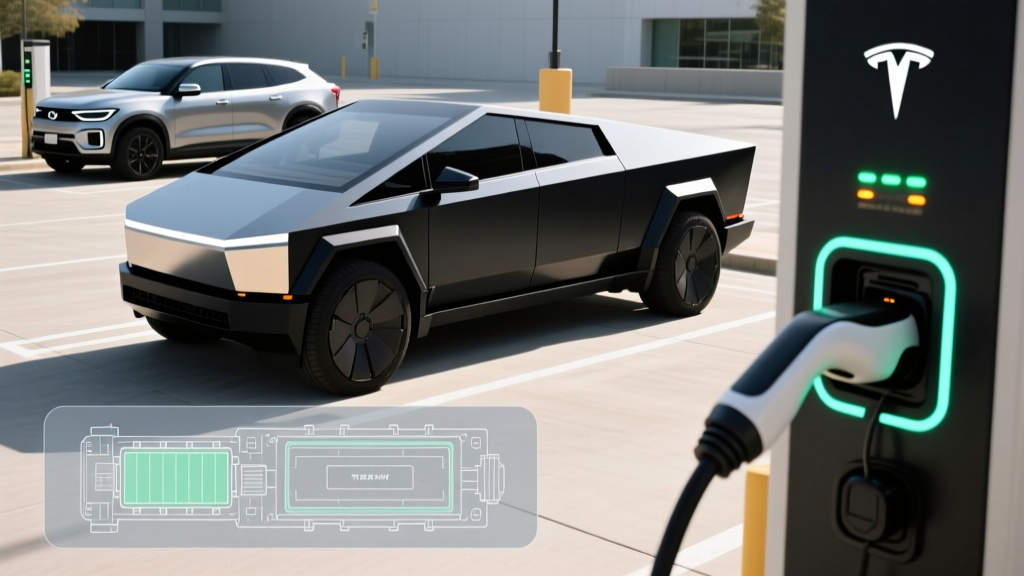
The Cybertruck uses the NACS (North American Charging Standard) connector natively — no adapter needed at Tesla Superchargers. For non-Tesla DC fast-charging networks (Electrify America, EVgo), you'll need a NACS-to-CCS adapter, which Tesla sells separately or includes depending on model year.
At a V3 Supercharger, the Cybertruck peaks around 250 kW but doesn't sustain it. The massive 123 kWh pack means the charging curve stays relatively flat through the mid-state-of-charge range, but above 80%, tapering is aggressive — going from 80-100% can add another 25-30 minutes. This is a physics constraint of large NMC packs at high SoC.
For home charging, the 11.5 kW onboard charger (standard) means a full charge from empty takes roughly 11 hours on a 48-amp Level 2 circuit. If you install Tesla's Wall Connector on an 80-amp circuit, you can push 19.2 kW and cut that to about 6.5 hours — practical for overnight top-ups. Most owners will never charge from 0% at home; a typical daily top-up from 50-80% takes about 3-4 hours on Level 2.
Home charging installation cost: Expect $1,200-$3,500 for a Level 2 hardwired install (240V/60A circuit, NEMA 14-50 or hardwired Wall Connector) if your electrical panel has capacity. A 200-amp panel upgrade, if needed, adds $1,500-$4,000. Always get a licensed electrician's assessment first.
Pricing, Trims, and Federal Tax Credit Eligibility
The Cybertruck's pricing has shifted multiple times since its late-2023 launch. Here are the 2026 model-year figures:
| Trim | Base MSRP | As-Tested (typical) | Federal §30D Credit Eligible? |
|---|---|---|---|
| Rear-Wheel Drive | ~$60,990 | ~$62,500 | Partial — see rules below |
| All-Wheel Drive | ~$79,990 | ~$84,000 | Partial — see rules below |
| Cyberbeast | ~$99,990 | ~$105,000 | Partial — see rules below |
Federal EV tax credit eligibility for the Cybertruck is not guaranteed and depends on multiple IRS rules under §30D:
- MSRP Cap: Pickup trucks qualify under the $80,000 MSRP ceiling for trucks/vans/SUVs. The RWD trim qualifies on price; the AWD at ~$79,990 is at the threshold (options may push it over); the Cyberbeast at ~$99,990 does not qualify on price.
- Buyer Income Cap: Modified AGI must not exceed $150,000 (single), $225,000 (head of household), or $300,000 (married filing jointly).
- Battery Sourcing: The $7,500 credit splits into two halves — $3,750 for critical minerals sourcing and $3,750 for battery component manufacturing, both with escalating domestic-content requirements through 2026. Tesla's supply chain has shifted to meet many of these thresholds, but exact eligibility varies by production batch. Check the IRS qualified vehicle list at irs.gov before purchasing.
- Point-of-Sale Transfer: As of 2024, you can transfer the credit to the dealer at purchase, reducing your out-of-pocket cost immediately rather than waiting for tax filing. This applies to the Cybertruck if eligible.
Bottom line on price: The RWD Cybertruck, if you qualify for the full $7,500 credit, effectively starts around $53,490. The AWD may qualify for a partial credit ($3,750) depending on options and sourcing. The Cyberbeast is too expensive for §30D. Consult a tax professional for your specific situation.
Driver Assistance, Tech, and Interior
The Cybertruck's cabin is spartan by traditional truck standards — a single 18.5-inch front touchscreen dominates the dash, with a smaller 9.4-inch rear screen for passengers. There are no physical buttons; climate, mirrors, and glovebox are all controlled via the screen.
Autopilot and FSD (Supervised): The Cybertruck ships with Tesla's basic Autopilot (traffic-aware cruise control and lane centering). Full Self-Driving (Supervised) is an optional upgrade (~$8,000 or $99/month as of 2026). FSD adds automatic lane changes, navigate-on-autopilot, traffic light/stop sign recognition, and city street driving. However, this remains a SAE Level 2 system — the driver must remain fully engaged, hands on the wheel (or torque-sensing equivalent), and eyes on the road at all times.
Notable tech features:
- Steer-by-wire with variable ratio (no mechanical link between yoke/steering wheel and wheels) — fewer than 340° lock-to-lock, no hand-over-hand needed
- 48-volt electrical architecture (industry-first for a production vehicle at this scale)
- Adaptive air suspension with 12 inches of travel and Extract Mode
- Bioweapon Defense Mode (HEPA cabin filtration)
- Powershare: up to 11.5 kW vehicle-to-home (V2H) and 120V/240V bed outlets for job-site or emergency backup power
- Armor glass (laminated) — improved over the 2019 demo, but still prone to cracking on hard impacts
Drawbacks to note: The yoke-style steering base model and steer-by-wire system takes significant adaptation and has drawn criticism from reviewers for lacking road feel. Visibility is compromised by the thick A-pillars and sloped rear glass. The bed's short length and narrow width between wheel wells limit utility compared to conventional trucks. And the stainless-steel exterior, while dent-resistant, shows fingerprints and is difficult to repair if dented — panel replacement rather than paintless dent repair is often required.
Warranty and Battery Longevity
| Coverage | Term |
|---|---|
| Basic Vehicle Limited Warranty | 4 years / 50,000 miles |
| Battery & Drive Unit Warranty | 8 years / 120,000 miles |
| Battery Retention Threshold | 70% minimum capacity over warranty period |
Tesla's 8-year/120,000-mile battery warranty is competitive with the industry standard (most EVs offer 8yr/100,000mi). The 70% capacity retention threshold means Tesla will repair or replace the battery if it degrades below 70% of original capacity within the warranty window. Based on data from Tesla's Model 3/Y fleet, NMC packs typically lose 10-15% capacity over the first 100,000 miles, then degradation slows considerably. The Cybertruck's larger pack should experience less stress per cycle (lower C-rate for equivalent range), which bodes well for longevity.
If out-of-warranty battery replacement becomes necessary, expect costs in the $15,000-$25,000 range based on current Tesla pack pricing — though this is likely to decrease as battery costs continue falling through 2026 and beyond.
Cybertruck vs. F-150 Lightning vs. Rivian R1T: Who Should Buy What
Choose the Cybertruck if:
- You want maximum towing (11,000 lbs) with tri-motor performance
- You value Tesla's Supercharger network and software ecosystem
- Ground clearance and air suspension matter for off-road use
- You need V2H backup power (Powershare at 11.5 kW)
- Steer-by-wire and yoke driving appeal to you
Choose the F-150 Lightning or R1T if:
- You need a larger bed (Lightning) or gear tunnel (R1T)
- Proven truck ergonomics and physical controls matter
- You want a bigger frunk (Lightning's 14.1 cu ft)
- Rear-seat comfort and cabin width are priorities (both are wider inside)
- You prefer CCS charging without adapters (R1T/Lightning)
Pros
- 340-mile EPA range (AWD) — best in electric truck class
- 250 kW DC fast charging with NACS native connector
- 11,000-lb towing capacity and 2,500-lb payload
- 17.4" ground clearance in Extract Mode
- Stainless-steel exoskeleton — dent and corrosion resistant
- 11.5 kW Powershare V2H capability
- 2.6-sec 0-60 mph (Cyberbeast)
Cons
- Short 6-foot bed, narrow between wheel wells
- Tiny 7.1 cu-ft frunk vs. competitors
- Steer-by-wire and yoke polarizing; lacks road feel
- 84" width (mirrors folded) — tight in garages and lanes
- Poor efficiency (~48 kWh/100mi) = higher charging cost
- Cyberbeast exceeds $80K MSRP cap for tax credit
- Real-world highway range ~270-290 mi, worse in cold
Frequently Asked Questions
What is the real-world range of the Tesla Cybertruck?
The AWD Cybertruck carries an EPA-estimated 340 miles, but real-world highway driving at 70-75 mph typically yields 270-290 miles. In freezing weather, expect 210-240 miles on the highway. The Cyberbeast trims these figures by roughly 20 miles due to tri-motor energy draw.
How fast does the Cybertruck charge?
On a Tesla V3 Supercharger (250 kW peak), the Cybertruck charges from 10-80% in approximately 35 minutes. Above 80%, charging tapers sharply — plan for 25+ additional minutes if you need a full charge. At home on a 48-amp Level 2 charger (11.5 kW), expect roughly 23 miles of range added per hour, or about 11 hours for a full charge from empty.
Does the Cybertruck qualify for the $7,500 federal EV tax credit?
Partially. The RWD and base AWD trims fall under the $80,000 MSRP cap for trucks, making them potentially eligible. The Cyberbeast (~$99,990) does not qualify. Buyer income limits ($150K single / $300K joint), battery critical-mineral sourcing, and component manufacturing requirements all apply. Check the IRS qualified vehicles list and consult a tax professional before relying on the credit.
Will the Cybertruck fit in a standard garage?
Most standard two-car garages (20-22 feet deep, 7-8 feet tall) will accommodate the Cybertruck's 223.6-inch length and 70.5-inch height — but barely. The 84-inch width with mirrors folded is the bigger issue in tight single-car garages or parking structures. Measure your space before ordering.
Is the Cybertruck good for towing?
The Cybertruck's 11,000-lb max tow rating is best-in-class for electric pickups. However, towing at or near max capacity cuts range roughly in half — expect 150-170 miles per charge when pulling a heavy trailer. For long-distance towing, plan frequent Supercharger stops.
How does the Cybertruck's size compare to a Ford F-150?
The Cybertruck is about 9 inches shorter than the F-150 Lightning, roughly the same width, and 8 inches lower in height. It's closer to a midsize truck in footprint while carrying full-size weight (6,600 lbs). The bed is shorter (6 ft vs. 5.5-6.5 ft on Lightning) and narrower between the wheel wells.
Sources: Tesla Cybertruck specifications (tesla.com/cybertruck), fueleconomy.gov (EPA range/efficiency data), IRS §30D qualified vehicles.