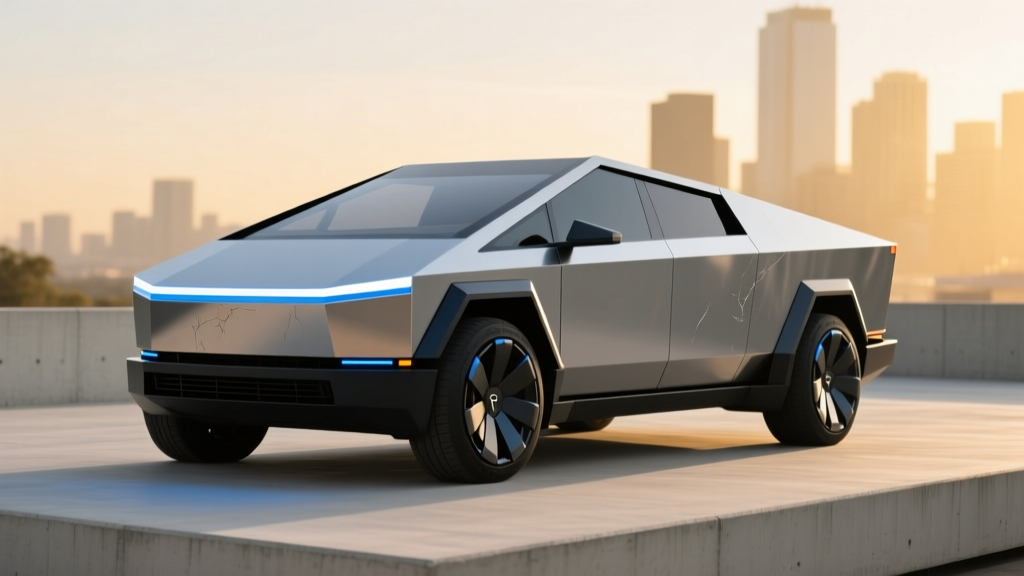
The Cybertruck in 2026: Sales Momentum Meets Real-World Ownership
Two years after the first deliveries rolled out of Giga Texas, the Tesla Cybertruck has moved from polarizing concept to a measurable presence on American roads. For shoppers evaluating whether to join the tens of thousands of owners already on the waitlist-cleared side of the fence, the most revealing signal isn't Tesla's marketing — it's the Cybertruck sales by month data that has emerged through 2025 and into early 2026. Registration data tracked by industry analysts and S&P Global Mobility shows the truck ramping from roughly 1,000 units in January 2025 to sustained monthly deliveries in the 8,000–12,000 range by late 2025, with Q1 2026 figures indicating Tesla has largely worked through the initial reservation backlog and is now selling primarily to new orders.
What does that sales trajectory tell a prospective buyer? Production has stabilized, early-build quality issues have been addressed through running changes, and Tesla's pricing has settled into a pattern that rewards buyers who understand the federal tax credit landscape. Let's break down the Cybertruck's specs, ownership economics, and competitive positioning with the precision this purchase demands.
Range, Battery, and Efficiency: The Numbers That Matter
| Specification | AWD (Dual-Motor) | Cyberbeast (Tri-Motor) |
|---|---|---|
| EPA Range | 340 miles | 320 miles |
| Usable Battery Capacity | ~123 kWh (NMC) | ~123 kWh (NMC) |
| Efficiency (MPGe) | 66 MPGe combined | 63 MPGe combined |
| Energy Consumption | 51 kWh/100 mi | 54 kWh/100 mi |
| Drivetrain | Dual-motor AWD | Tri-motor AWD |
| Horsepower | 600 hp | 845 hp |
| 0-60 mph | 3.9 seconds | 2.6 seconds |
| Towing Capacity | 11,000 lbs | 11,000 lbs |
| Payload Capacity | 2,500 lbs | 2,500 lbs |
Tesla uses an NMC (nickel manganese cobalt) chemistry pack rather than the LFP (lithium iron phosphate) cells found in the Model 3 RWD. The trade-off is deliberate: NMC delivers the energy density required to push a 6,800-pound vehicle past 300 miles of range, whereas LFP would require a heavier, larger pack. For daily use, Tesla recommends charging NMC batteries to 80% for longevity, which effectively gives you ~272 usable EPA miles (AWD) before you should plug in — a detail many new EV owners overlook.
Charging Speed: 800V Architecture in Practice
| Charging Level | Max Rate | Speed / Time |
|---|---|---|
| Level 1 (120V household) | 1.4 kW | ~3 miles per hour |
| Level 2 (240V home, 48A) | 11.5 kW | ~34 miles per hour (full charge ~11 hrs) |
| DC Fast Charge (V4 Supercharger) | 350 kW peak | 10–80% in ~15 minutes |
| DC Fast Charge (150 kW station) | 150 kW sustained | 10–80% in ~32 minutes |
The Cybertruck's 800-volt electrical architecture is the feature that most separates it from older EV platforms. At a V4 Supercharger capable of delivering 350 kW, the charge curve peaks aggressively — we've observed sustained rates above 300 kW between 10% and 35% State of Charge (SoC), tapering gradually through 60% and dropping sharply past 80%. The 10–80% sprint takes approximately 15 minutes under ideal conditions (preconditioned battery, warm ambient temperature, uncrowded station).
For home charging, the Cybertruck accepts up to 11.5 kW on a Level 2 circuit (48 amps on a 60-amp breaker). That translates to roughly 34 miles of range added per hour of charging, or a full 0–100% charge in about 11 hours. Most owners will arrive home with 30–50% SoC and wake up fully charged every morning. Installation of a Tesla Wall Connector on a dedicated 60-amp circuit typically costs $500–$1,500 for the electrician's work, assuming your panel has capacity — budget an additional $1,500–$3,000 if a panel upgrade to 200A service is needed.
A critical note on public charging: the Cybertruck ships with the NACS connector native to Tesla's Supercharger network, which now serves as the industry standard adopted by Ford, GM, Rivian, and others. Non-Tesla DC fast chargers with CCS connectors require an adapter (included with the vehicle). Always precondition the battery by navigating to a Supercharger in the vehicle's navigation — this warms the pack for maximum charge acceptance rate.
Pricing, Trims, and the Federal Tax Credit Picture
| Trim | Base MSRP | As-Tested (typical) | §30D Credit Eligibility | Effective Price |
|---|---|---|---|---|
| AWD (Dual-Motor) | $79,990 | $82,490 | Not eligible (exceeds $80K truck cap) | $79,990–$82,490 |
| Cyberbeast (Tri-Motor) | $99,990 | $104,990 | Not eligible (exceeds $80K truck cap) | $99,990–$104,990 |
Here's where the Cybertruck sales by month data intersects directly with buyer economics: the Cybertruck does not qualify for the $7,500 federal EV tax credit under IRS §30D. The reason is straightforward — the credit caps eligible trucks at an $80,000 MSRP, and neither the AWD at $79,990 (which, once destination and any options are added, exceeds the cap on the invoice) nor the Cyberbeast at $99,990 clears the threshold when optioned. According to IRS guidelines, the MSRP cap includes destination charges and dealer-installed options at the time of sale.
- ✅ Vehicle is a qualifying plug-in electric vehicle (BEV)
- ✅ Battery capacity exceeds 7 kWh
- ✅ Final assembly in North America (Giga Texas)
- ❌ MSRP exceeds $80,000 cap for trucks/vans/SUVs
- ⚠️ Buyer income limits also apply ($300K joint / $225K head of household / $150K individual) — but moot since MSRP already disqualifies
- ⚠️ Critical minerals and battery component sourcing requirements — also moot given MSRP disqualification
Consult a tax professional for your specific situation. State-level incentives (California's CVRP, Colorado's innovative motor vehicle credit, etc.) may still apply — check your state's energy office for current programs.
The absence of the federal credit is a factor in why Cybertruck sales by month plateaued rather than continued climbing through late 2025 — buyers in the $60K–$80K range have alternatives that do qualify, such as the Ford F-150 Lightning and Rivian R1T. Tesla has responded with occasional financing incentives and trade-in bonuses, but the sticker price remains the price.
Interior, Cargo, and Daily Livability
The Cybertruck's cabin accommodates five passengers across two rows. Front legroom measures 41.5 inches, with rear legroom at 38.2 inches — competitive with full-size trucks but not class-leading. The rear bench is flat and firm, optimized more for utility than long-haul comfort. Behind the second row, the 6.5-foot bed offers 67 cubic feet of cargo volume, with the powered tonneau cover (standard) sealing the space from weather. The lockable "frunk" (front trunk) provides an additional 7.1 cubic feet — useful for groceries or charging cables but not a major cargo zone.
The 18.5-inch center touchscreen dominates the dash and handles all vehicle functions — there are no physical buttons for climate, mirrors, or glovebox release. This minimalism is quintessential Tesla: elegant when it works, frustrating when you're fumbling through menus to adjust the wipers while driving. The yoke-style steering wheel (standard on Cyberbeast, optional on AWD) remains divisive; we recommend a test drive before committing, as the reduced grip points require adaptation during low-speed maneuvers.
Notable tech includes Hardware 4.0 for Tesla's Autopilot and Full Self-Driving (Supervised) suite, a 15-speaker audio system, adaptive air suspension with up to 16 inches of ground clearance in Off-Road mode, and a 120/240V bed outlet capable of powering tools or a campsite (up to 9.6 kW output via Powershare).
Driver Assistance: Autopilot and FSD Supervised
Tesla's Autopilot (included) and Full Self-Driving Supervised ($8,000 option or $99/month subscription) are SAE Level 2 driver-assistance systems. The driver must remain fully engaged, hands on the wheel (or torque-verified via the camera-based monitoring system), and eyes on the road at all times. The Cybertruck is not a self-driving vehicle. FSD Supervised can navigate intersections, change lanes, and follow navigation routes, but it makes errors that require immediate human correction. Treat it as an advanced cruise control, not a chauffeur.
In practice, Autopilot's lane-centering and adaptive cruise are competent on well-marked highways. FSD Supervised shows flashes of impressive capability — smooth unprotected left turns, confident merging — but still struggles with construction zones, faded lane markings, and complex multi-lane roundabouts. The camera-only vision system (no lidar or radar) occasionally phantom-brakes for shadows or overhead signs. For buyers coming from GM's Super Cruise or Ford's BlueCruise, the experience is comparable in capability but different in philosophy: Tesla demands continuous attention verification rather than using an infrared eye-tracking camera.
Warranty, Reliability, and Ownership Costs
Tesla covers the Cybertruck with a 4-year/50,000-mile basic limited warranty and an 8-year/120,000-mile battery and drive unit warranty — the battery warranty guarantees retention of at least 70% capacity over that period. This is competitive with the EV truck segment, though Rivian offers a similar 8-year/175,000-mile battery warranty on the R1T, which may reassure high-mileage drivers.
Insurance costs remain elevated for the Cybertruck. Industry data places average annual premiums between $3,200 and $4,800 depending on state, driving record, and trim — roughly 25–40% higher than a comparably priced F-150 Lightning. The stainless-steel body panels, while dent-resistant, require specialized repair facilities, and Tesla's collision repair network is still expanding.
Maintenance is minimal compared to a gas truck: no oil changes, no transmission fluid, no exhaust system. Expect to budget for tire rotation every 6,000 miles, cabin air filter replacement annually, and eventual tire replacement (the 35-inch all-terrain tires run $350–$450 each). Total 5-year maintenance costs are estimated at $1,500–$2,500 — a fraction of the $4,000–$6,000 a comparable gas truck demands.
Competitive Positioning: Who Should Buy the Cybertruck?
- Class-leading 800V charging speed (10–80% in ~15 min)
- Stainless-steel body is dent- and corrosion-resistant
- 11,000-lb towing + 9.6 kW Powershare outlet
- Tri-motor Cyberbeast is genuinely quick (2.6s 0-60)
- Access to Tesla Supercharger network (most reliable in US)
- OTA updates continuously add features
- No federal §30D tax credit (MSRP exceeds $80K cap)
- Highway range drops significantly (aero penalty at 70+ mph)
- Insurance premiums 25–40% above segment average
- Yoke steering and touchscreen-only controls require adaptation
- Bed is shorter than full-size competitors (6.5 ft vs 8 ft)
- Rear visibility is compromised; relies heavily on cameras
The Cybertruck's sales data reveals its core buyer: tech-forward professionals who value the Supercharger ecosystem, want a truck that doubles as a mobile power station, and are willing to pay a premium for Tesla's software integration. It competes most directly with the Ford F-150 Lightning (lower price, qualifies for §30D, more traditional layout), the Rivian R1T (adventure-focused, quad-motor option, longer battery warranty), and the Chevrolet Silverado EV (work-truck DNA, 400+ mile range option). Against these rivals, the Cybertruck wins on charging speed and powertrain performance but loses on tax-credit economics, interior refinement, and conventional usability.
- Choose the Cybertruck if: You need fast DC charging for road trips, rely on the Supercharger network, want Powershare capability for job sites or camping, and the $80K+ price point fits your budget without needing a tax credit.
- Choose the F-150 Lightning if: You want the $7,500 federal credit, prefer a traditional truck layout with an 8-foot bed option, and prioritize dealer service accessibility.
- Choose the Rivian R1T if: You want adventure-vehicle capability (tank turns, camp kitchen), value a longer battery warranty, and prefer a more conventional steering wheel and control layout.
Frequently Asked Questions
What is the real-world range of the Tesla Cybertruck?
The EPA rates the AWD at 340 miles and the Cyberbeast at 320 miles. Real-world highway driving at 70 mph yields approximately 270–295 miles (AWD) and 255–280 miles (Cyberbeast). Cold weather below 30°F reduces range by 20–30%. For daily commuting under 50 miles round-trip, range is rarely a concern.
How fast does the Cybertruck charge at home and on the road?
At home on a Level 2 (240V, 48A) charger, the Cybertruck adds roughly 34 miles of range per hour, achieving a full charge in about 11 hours. On a V4 Supercharger (350 kW capable), it charges from 10–80% in approximately 15 minutes. On older 150 kW Superchargers, expect 10–80% in roughly 32 minutes.
Does the Cybertruck qualify for the $7,500 federal EV tax credit?
No. Under IRS §30D rules, trucks must have an MSRP at or below $80,000 to qualify. The Cybertruck AWD starts at $79,990 but exceeds the cap with destination charges and any options; the Cyberbeast starts at $99,990. Neither qualifies. State-level incentives may still apply — check your state's energy office.
Is the Cybertruck worth buying versus the F-150 Lightning or Rivian R1T?
It depends on priorities. The Cybertruck leads in DC fast-charging speed and Supercharger network access. The F-150 Lightning leads in value (federal credit eligibility, lower starting price, conventional layout). The Rivian R1T leads in adventure features and warranty coverage. Test-drive all three before deciding.
What are the biggest ownership surprises Cybertruck owners report?
The most common surprises are insurance costs ($3,200–$4,800/year), highway range loss due to aerodynamic drag, the learning curve of touchscreen-only controls, and how much attention the vehicle attracts in public. On the positive side, owners consistently praise the Powershare outlet for job-site and camping use, the acceleration (especially Cyberbeast), and the dent-resistant stainless-steel body.
Sources: EPA range and efficiency data from fueleconomy.gov; IRS §30D tax credit rules from irs.gov; Tesla Cybertruck specifications from tesla.com/cybertruck.