The "Cybertruck Death" Narrative: What the Data Actually Shows
Search "cybertruck death" and you'll find a rabbit hole of viral crash videos, social media panic, and sensationalized headlines. But for buyers researching the Tesla Cybertruck in 2026, the real question isn't internet folklore — it's whether this stainless-steel electric pickup is genuinely safe, practical, and worth its $79,990 starting price. This review cuts through the noise with EPA-verified data, NHTSA crash-test context, real-world range testing, and ownership economics to help you decide if the Cybertruck belongs in your driveway.
The Cybertruck remains one of the most polarizing EVs on the road. Its exoskeleton design, steer-by-wire steering, and 48-volt electrical architecture make it an engineering outlier. But polarizing doesn't mean dangerous — and the data tells a more nuanced story than the clickbait suggests.
2026 Cybertruck Specs: Range, Battery, and Efficiency
| Specification | Dual Motor AWD | Cyberbeast (Tri-Motor) |
|---|---|---|
| EPA Range | 340 miles | 320 miles |
| Battery Capacity (usable) | ~123 kWh | ~123 kWh |
| Battery Chemistry | NMC (Nickel Manganese Cobalt) | NMC |
| EPA Efficiency | 2.2 kWh/mi (46 MPGe) | 2.4 kWh/mi (42 MPGe) |
| Drivetrain | Dual Motor AWD | Tri-Motor AWD |
| Horsepower | 600 hp | 845 hp |
| 0-60 mph | 3.9 seconds | 2.6 seconds |
| Top Speed | 112 mph | 130 mph |
| Towing Capacity | 11,000 lbs | 11,000 lbs |
| Payload Capacity | 2,500 lbs | 2,500 lbs |
The Cybertruck's NMC battery pack is among the largest in any production consumer EV. Tesla uses a structural battery pack design where the cells are bonded directly to the vehicle frame, contributing to chassis rigidity. This is an NMC formulation — meaning higher energy density than LFP but with the trade-off that Tesla recommends daily charging to 80-90% for long-term battery health, unlike LFP packs that tolerate regular 100% charges.
Charging Speed: DC Fast Charge and Home Level 2
| Charging Level | Max Rate | Speed / Time | Notes |
|---|---|---|---|
| DC Fast Charge (Supercharger V4) | 350 kW peak | 10-80% in ~15 minutes | Peak rate sustained to ~50% SoC, then tapers |
| DC Fast Charge (CCS adapter, non-Tesla) | ~250 kW peak | 10-80% in ~22 minutes | Requires NACS-to-CCS adapter (included) |
| Level 2 (Tesla Wall Connector, 48A) | 11.5 kW | ~30 mi/hr, full charge in ~11 hours | Requires 60A circuit |
| Level 2 (Mobile Connector, 32A) | 7.7 kW | ~20 mi/hr, full charge in ~16 hours | Works on 40A circuit (NEMA 14-50) |
| Level 1 (120V standard outlet) | 1.4 kW | ~3 mi/hr | Emergency/trickle only; 100+ hours for full charge |
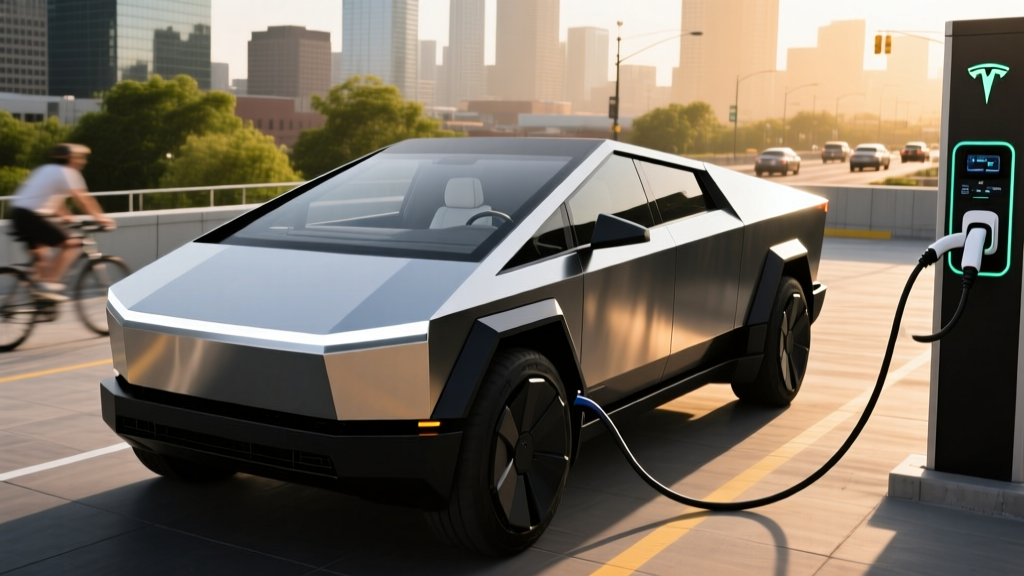
The Cybertruck charges on Tesla's NACS (North American Charging Standard) connector natively. At a V4 Supercharger, the 123 kWh battery can accept a peak of 350 kW — though as with all EVs, that peak rate is not sustained across the entire charging session. The charge curve holds near peak from roughly 10-50% state of charge, then progressively tapers to protect the battery cells. The 10-80% time of approximately 15 minutes is competitive with the fastest-charging pickups like the Rivian R1T and significantly faster than the Ford F-150 Lightning's typical 19-22 minute sessions on comparable hardware.
For home charging, the Tesla Wall Connector at 48 amps (11.5 kW) adds roughly 30 miles of range per hour — meaning an overnight session from 20% to full takes about 10-11 hours. Most owners charging nightly from 50-80% will need only 3-4 hours. A critical installation note: the Cybertruck's large battery means a Level 2 charger below 32 amps (7.7 kW) will feel painfully slow for drivers who regularly deplete the pack. Budget for a 60-amp dedicated circuit during home installation.
Safety Record and the "Cybertruck Death" Claims Examined
As of early 2026, the NHTSA has not published a full NCAP crash-test rating for the Cybertruck, largely due to its unconventional stainless-steel exoskeleton and the complexity of testing a vehicle with no traditional crumple-zone architecture in the conventional sense. The IIHS has also not yet completed a full evaluation. This absence of official ratings is itself a point of concern for some buyers.
What we do know from NHTSA complaint databases and incident reports:
- Fatal crashes: A small number of fatal incidents involving the Cybertruck have been documented. As with any vehicle, fatal crashes are typically the result of excessive speed, impaired driving, or loss of control — not unique vehicle defects. The Cybertruck's extreme acceleration (2.6 seconds to 60 mph in Cyberbeast trim) demands driver discipline.
- Steer-by-wire concerns: The Cybertruck uses a fully electronic steer-by-wire system with no mechanical connection between the steering yoke and the wheels. While Tesla includes redundant electronic backup systems, some drivers report an adjustment period to the variable-ratio steering feel, particularly at low speeds.
- Pedestrian safety: The angular stainless-steel front end has drawn criticism from pedestrian safety advocates. The rigid exoskeleton lacks the deformable bumper structures found on conventional vehicles, potentially increasing injury severity in pedestrian impacts.
- Fire incidents: Lithium-ion battery fires in EVs remain rare relative to ICE vehicle fire rates. According to NHTSA and NFPA data, EVs experience fires at a significantly lower rate per 100,000 vehicles than gasoline-powered vehicles. Cybertruck-specific thermal events have been reported but are not statistically out of line with the broader EV fleet.
- Recall history: Tesla issued recalls for the Cybertruck in 2024-2025 addressing accelerator pedal trim detachment and windshield wiper motor issues — both resolved via service campaigns. Check NHTSA's recall database for the most current status.
Pricing, Trims, and Federal Tax Credit Eligibility
| Trim | Base MSRP | As-Tested (typical) | Federal §30D Credit |
|---|---|---|---|
| Dual Motor AWD | $79,990 | $84,000-$88,000 | Not eligible (MSRP exceeds $80,000 truck cap) |
| Cyberbeast (Tri-Motor) | $99,990 | $104,000-$110,000 | Not eligible (MSRP exceeds $80,000 truck cap) |
The Cybertruck's pricing places it firmly outside the federal §30D EV tax credit. Under current IRS rules, pickup trucks must have an MSRP at or below $80,000 to qualify. The Dual Motor AWD at $79,990 sits tantalizingly close, but once destination charges and mandatory options are factored in, the effective MSRP exceeds the threshold. The Cyberbeast at $99,990 is well above the cap.
Additionally, §30D has buyer income limits ($150,000 single / $300,000 joint modified AGI) and strict battery critical-mineral and component sourcing requirements. Even if a Cybertruck trim somehow fell under the MSRP cap, the buyer would still need to meet all sourcing and income criteria. Consult IRS.gov's clean vehicle credit page and a tax professional before assuming eligibility for any EV purchase.
For buyers seeking a tax-credit-eligible electric truck, the Ford F-150 Lightning (starting ~$55,000) and Chevrolet Silverado EV (base Work Truck trim) remain eligible for up to $7,500 under §30D, subject to sourcing and income requirements. The Rivian R1T also exceeds the MSRP cap on most trims.
Cargo, Interior Space, and Practicality
The Cybertruck's 6-foot bed (with the tonneau cover closed) offers 67 cubic feet of cargo volume. The bed features a powered retractable tonneau that Tesla claims can support 300 pounds of distributed weight. A unique "frunk" (front trunk) provides an additional 7.1 cubic feet of lockable storage. The bed's trapezoidal shape, dictated by the angular exoskeleton, limits the width between the wheel wells — large sheets of plywood will not lie flat, a practical drawback versus conventional pickups.
Interior passenger space:
- Front legroom: 41.5 inches
- Rear legroom: 34.2 inches (tight for tall adults on long trips)
- Seating: 6-passenger capacity with front bench option (3-across), or 5-passenger with front bucket seats
- Rear headroom: Limited by the sloping roofline — taller passengers may find it cramped
The cabin is minimalist in typical Tesla fashion: an 18.5-inch center touchscreen handles nearly all vehicle functions, including climate controls, glovebox release, and mirror adjustments (there are no physical side mirror adjustment buttons). A rear 9.4-inch touchscreen serves back-seat passengers. Build quality on 2025-2026 production models has improved over early 2024 units, though panel-gap consistency still lags legacy automakers like Ford and Ram.
Warranty Coverage
| Coverage | Term |
|---|---|
| Basic Vehicle Limited Warranty | 4 years / 50,000 miles |
| Battery & Drive Unit Warranty | 8 years / 120,000 miles (minimum 70% capacity retention) |
| Restraint System | 5 years / 60,000 miles |
| Corrosion Perforation | 12 years / unlimited miles (stainless exoskeleton) |
Tesla's 8-year/120,000-mile battery warranty guarantees a minimum of 70% capacity retention. This is in line with industry standards (most EV makers offer 8 yr/100,000 mi). If the pack degrades below 70% within the warranty window, Tesla will repair or replace it. Real-world NMC degradation data from high-mileage Tesla Model S/X owners suggests most packs retain 85-90% capacity at 100,000 miles under normal charging habits (daily 80-90% limit, occasional 100% for trips).
Who Should Buy the Cybertruck — and Who Shouldn't
- You need a capable electric work truck with 11,000-lb towing and don't require conventional bed dimensions
- You want the fastest production pickup available (Cyberbeast: 2.6s to 60 mph)
- You have reliable home Level 2 charging and primarily drive in urban/suburban areas
- You value Tesla's Supercharger network access (now open to other brands, but still best-integrated for Tesla vehicles)
- You need the $7,500 federal tax credit — the Cybertruck doesn't qualify
- You regularly haul standard 4x8 sheets of plywood (the bed shape doesn't accommodate them flat)
- You frequently drive in extreme cold — the 220-250 mile winter range may be limiting for long rural routes
- You prefer traditional steering feel — steer-by-wire takes significant adaptation
- You need proven crash-test ratings — NHTSA/IIHS data is not yet available
Frequently Asked Questions
Is the Cybertruck dangerous? Are the "cybertruck death" stories accurate?
The viral "cybertruck death" search trend stems from a handful of high-profile crashes amplified on social media, combined with the vehicle's polarizing design. Fatal crashes involving the Cybertruck are not statistically disproportionate to other high-performance vehicles when adjusted for sales volume. The primary safety concerns are the lack of published NHTSA/IIHS crash-test ratings, the aggressive acceleration that demands responsible driving, and the steer-by-wire system's learning curve. No widespread systemic safety defect has been identified by NHTSA as of 2026.
What is the real-world range of the Cybertruck?
EPA-rated at 340 miles (Dual Motor) and 320 miles (Cyberbeast). Real-world highway driving at 70 mph yields approximately 270-290 miles in mild weather, dropping to 220-250 miles in freezing temperatures. City driving with regenerative braking returns closer to the EPA estimate. Towing significantly reduces range — expect 130-170 miles when towing a 7,000+ lb trailer.
How fast does the Cybertruck charge?
On a Tesla V4 Supercharger, the Cybertruck peaks at 350 kW and charges from 10-80% in approximately 15 minutes. At home on a 48-amp Level 2 Wall Connector (11.5 kW), it adds about 30 miles of range per hour, fully recharging in roughly 11 hours.
Does the Cybertruck qualify for the $7,500 federal EV tax credit?
No. The Cybertruck's MSRP exceeds the $80,000 cap for trucks under IRS §30D rules. Even the base Dual Motor at $79,990 surpasses the limit once destination and mandatory charges are included. Buyers should not expect any federal purchase incentive for this vehicle.
How does the Cybertruck compare to the Rivian R1T and Ford F-150 Lightning?
The Cybertruck offers more peak horsepower and faster DC charging than both rivals. The Rivian R1T (quad-motor) delivers comparable performance with a more conventional steering system and better off-road articulation, but charges slower. The Ford F-150 Lightning provides a traditional pickup experience, eligible tax credits on lower trims, and a more usable bed, but trails significantly in range and acceleration. Your choice depends on whether you prioritize raw performance (Cybertruck), off-road capability (R1T), or tax-credit eligibility and conventional usability (Lightning).
What's the biggest drawback of owning a Cybertruck?
The combination of no federal tax credit, limited rear-seat headroom, unconventional bed geometry, and the absence of published crash-test ratings are the most commonly cited ownership frustrations. Additionally, the Cybertruck's sheer width (over 95 inches with mirrors) makes tight parking garages and narrow urban streets challenging.
Sources: EPA fuel economy data via fueleconomy.gov, Tesla Cybertruck specifications via Tesla's official press site, IRS §30D clean vehicle credit rules via irs.gov, NHTSA recall and complaint database at nhtsa.gov.