The Rust Question That Won't Go Away
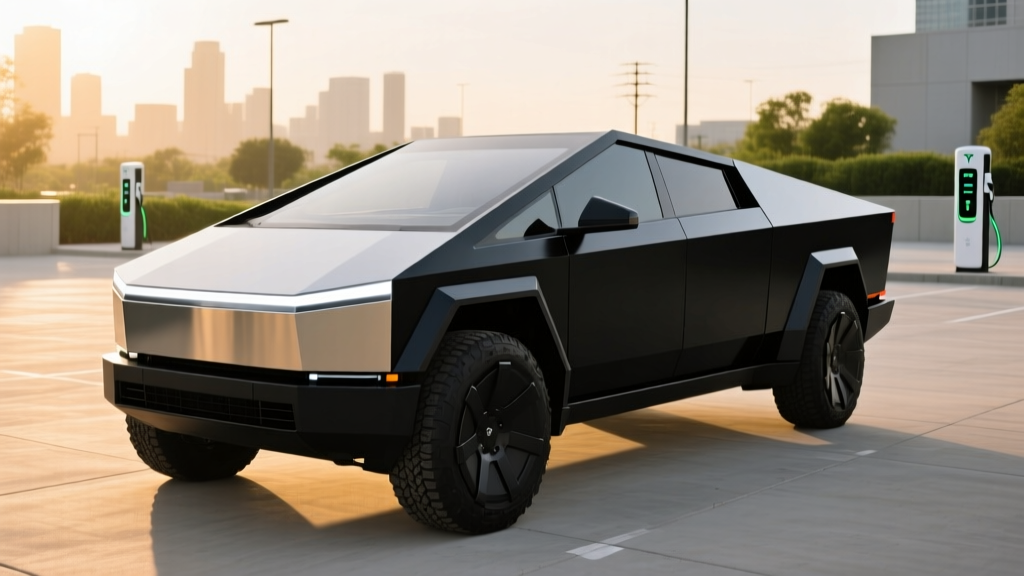
Since deliveries began in late 2023, the Tesla Cybertruck has drawn polarized reactions — but few topics generate as much anxiety as Cybertruck rust. The truck's ultra-hard 30X cold-rolled stainless steel exoskeleton is marketed as nearly indestructible, yet owners and critics alike have scrutinized surface discoloration, water spotting, and early corrosion reports. Now well into the 2026 model year, we have enough real-world ownership data to separate fact from internet hysteria.
This review covers the Cybertruck's corrosion reality alongside the specs that matter: EPA range, charging speed, pricing, tax credit eligibility, and whether this angular EV pickup actually earns its place in your driveway versus a Rivian R1T or Ford F-150 Lightning.
Stainless Steel Body: Corrosion Science vs. Owner Reports
The Cybertruck uses a 300-series stainless steel alloy — similar to what you'd find in commercial kitchen equipment or marine applications. Unlike conventional stamped steel with paint and clear coat, the Cybertruck's body panels are bare, uncoated metal. This is both its greatest strength and its most misunderstood vulnerability.
What Stainless Steel Actually Resists
Stainless steel earns its name from chromium content (typically 10.5% or higher), which forms a passive chromium-oxide layer on the surface. This layer self-repairs in the presence of oxygen, making the metal highly resistant to the deep, structural corrosion (iron oxide / red rust) that eats through conventional carbon-steel truck bodies. A 15-year-old Ford F-150 with bubbling quarter panels is the exact failure mode the Cybertruck's exoskeleton is designed to avoid.
What Stainless Steel Does NOT Resist
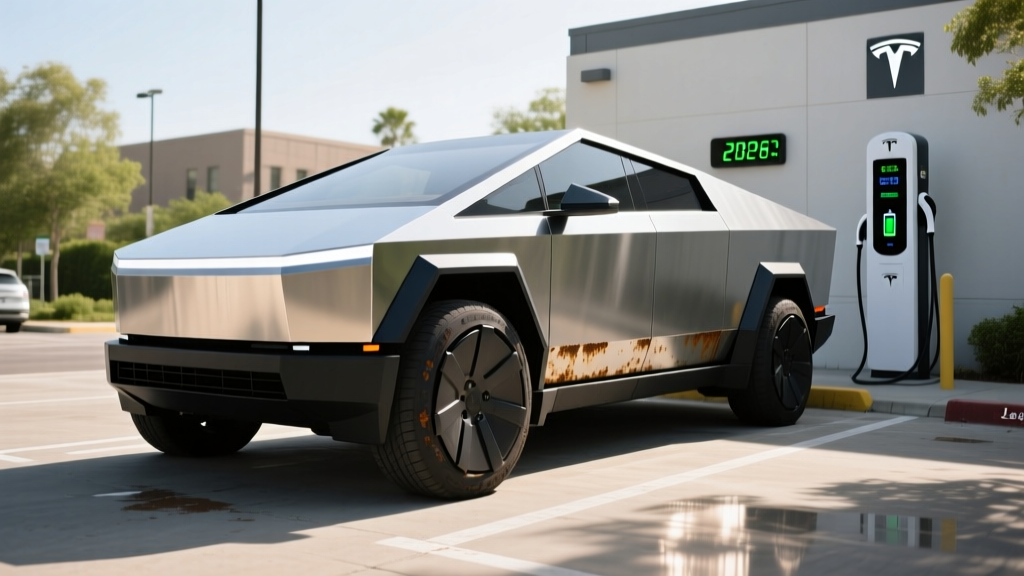
Here's where Cybertruck rust concerns get legitimate. Stainless steel is not stain-proof. Owners in hard-water regions, coastal salt-air environments, and areas that use magnesium chloride road de-icers have reported:
- Surface staining and water spotting — mineral deposits etch into the passive layer if not rinsed promptly
- Tea-staining — a superficial brownish discoloration that resembles rust but is typically surface contamination, not base-metal corrosion
- Rail dust and embedded iron particles — microscopic ferrous debris from trains, construction, or brake dust can embed in the surface and oxidize, creating small rust-colored spots
- Galvanic corrosion at joints — where stainless contacts dissimilar metals (aluminum, carbon steel fasteners), electrolytic reactions can cause localized corrosion if moisture is trapped
Tesla's own care guide recommends regular rinsing, avoiding harsh chlorinated cleaners, and using specific stainless steel cleaning products. Owners who neglect this maintenance — particularly those parking near ocean spray or driving through winter road salt without undercarriage washes — are the ones posting alarming photos online.
2026 Cybertruck Specifications: Range, Battery, and Charging
Corrosion concerns aside, the Cybertruck is first and foremost an electric pickup. Here are the hard numbers for the current 2026 model year lineup.
| Spec | AWD (Dual Motor) | Cyberbeast (Tri Motor) |
|---|---|---|
| EPA Estimated Range | 340 miles | 320 miles |
| Battery Capacity (usable) | ~123 kWh (NMC) | ~123 kWh (NMC) |
| Battery Chemistry | NMC (Nickel Manganese Cobalt) | NMC (Nickel Manganese Cobalt) |
| Peak DC Fast Charge Rate | ~250 kW | ~250 kW |
| 10–80% DC Fast Charge Time | ~28 minutes | ~28 minutes |
| Level 2 Home Charging Rate | 11.5 kW (~37 mi/hr) | 11.5 kW (~37 mi/hr) |
| 0–60 mph | 3.9 seconds | 2.6 seconds |
| Horsepower | 600 hp | 845 hp |
| Drivetrain | Dual Motor AWD | Tri Motor AWD |
| MPGe (combined) | ~70 MPGe | ~65 MPGe |
| Efficiency (kWh/100 mi) | ~48 kWh/100 mi | ~52 kWh/100 mi |
| Max Towing Capacity | 11,000 lbs | 11,000 lbs |
| Cargo Bed Length | 6 ft (72 in) | 6 ft (72 in) |
| Cargo Volume (bed + frunk) | ~67 cu ft bed + ~7 cu ft frunk | ~67 cu ft bed + ~7 cu ft frunk |
| Rear Legroom | ~38.4 inches | ~38.4 inches |
| Base MSRP | $79,990 | $99,990 |
| Battery & Drive Unit Warranty | 8 years / 120,000 miles | 8 years / 120,000 miles |
| Basic Vehicle Warranty | 4 years / 50,000 miles | 4 years / 50,000 miles |
Sources: EPA / fueleconomy.gov, Tesla Cybertruck specs page
Charging the Cybertruck: Home and Public Infrastructure
The Cybertruck uses the NACS (North American Charging Standard) connector — now the dominant Tesla and industry standard. Here's what charging looks like in practice.
| Charging Level | Power (kW) | Miles Added per Hour | Use Case |
|---|---|---|---|
| Level 1 (120V household) | ~1.4 kW | ~3–4 mi/hr | Emergency / trickle |
| Level 2 (240V home / public) | 11.5 kW | ~37 mi/hr | Daily home charging |
| DC Fast Charge (V4 Supercharger) | Up to ~250 kW | ~150–180 mi in 15 min | Road trips |
A full Level 2 home charge from 10% to 100% takes roughly 10–12 hours. Most owners charging overnight on a 48-amp Level 2 circuit (like the Tesla Wall Connector) wake up to a full battery every morning. For road trips, Tesla's Supercharger network — now the most reliable DC fast-charging network in the U.S. — delivers peak charging speeds up to ~250 kW at V3 and V4 stations.
However, as with all large-battery EVs, the Cybertruck's charge curve tapers significantly above 80% state of charge. The 10–80% sprint takes approximately 28 minutes, but 80–100% can add another 20+ minutes. For road trips, plan to charge in the 10–80% window and skip topping off unless it's your final destination.
Pricing, Trims, and Federal Tax Credit Eligibility
The Cybertruck's pricing has shifted since its originally announced (and famously broken) 2019 promises. Here is the 2026 lineup:
| Trim | Base MSRP | §30D Tax Credit Eligible? | Effective Price (with credit) |
|---|---|---|---|
| AWD (Dual Motor) | $79,990 | Yes (meets truck MSRP cap of $80,000) | ~$72,490* |
| Cyberbeast (Tri Motor) | $99,990 | No (exceeds $80,000 truck MSRP cap) | $99,990 |
*Effective price assumes full $7,500 §30D credit. Eligibility depends on buyer income limits (AGI ≤ $300,000 joint / $225,000 head of household / $150,000 individual), battery component and critical mineral sourcing requirements, and point-of-sale transfer availability. Consult IRS.gov §30D guidance and a tax professional before purchasing.
The AWD trim squeaks under the IRS §30D MSRP cap for trucks and vans ($80,000), making it potentially eligible for the full $7,500 federal credit — provided the buyer meets income thresholds and the vehicle's battery sourcing satisfies current-year critical mineral and component requirements. The Cyberbeast, at $99,990, is categorically ineligible regardless of buyer income.
Notably, the Cybertruck is assembled in Austin, Texas, which satisfies the North American final-assembly requirement. Battery sourcing compliance has been a moving target under evolving Department of Energy guidance on foreign entities of concern (FEOC) — verify current-year compliance on the fueleconomy.gov credit lookup tool before signing paperwork.
Performance, Tech, and the Ownership Experience
The Cybertruck delivers on the performance side with little controversy. The Cyberbeast's 2.6-second 0–60 mph time makes it one of the quickest production pickups ever built, and the AWD's 3.9-second run is hardly slow. The 48-volt electrical architecture (a first for a production vehicle at this scale) enables steer-by-wire steering and four-wheel steering, giving the 20-foot-long truck a surprisingly tight 35-foot turning circle.
Standout Technology
- Steer-by-wire: No mechanical linkage between the yoke and the wheels. Enables variable steering ratios — fewer hand movements lock-to-lock than any conventional truck.
- 48-volt architecture: Reduces wiring harness weight by roughly 70% compared to a conventional 12V system. Powers the steer-by-wire and high-force actuators.
- Adaptive air suspension: Up to 16 inches of ground clearance in Extract Mode; lowers for highway efficiency.
- 18.5-inch front touchscreen: Runs Tesla's latest infotainment stack with integrated navigation, streaming, and climate controls (no physical buttons).
- Autopilot (standard) / FSD Supervised (optional): Tesla's Level 2 driver-assistance system. Requires full driver attention at all times — this is not self-driving.
- Powershare (V2L/V2H): Vehicle-to-load capability lets the Cybertruck power tools, appliances, or a home during outages up to 11.5 kW.
Notable Drawbacks
- Visibility: The angular design, thick A-pillars, and lack of a rear window (replaced by a camera feed) create significant blind spots.
- Bed practicality: The 6-foot bed is shorter than most full-size truck beds. The motorized tonneau cover, while slick, limits roof-rack-style cargo stacking.
- Ride quality: The heavy curb weight and stiff stainless structure transmit more road imperfections than the F-150 Lightning or R1T, particularly on rough pavement.
- Stainless steel maintenance: As discussed, the body requires more active cleaning than a painted truck to prevent cosmetic staining — especially in coastal or road-salt environments.
- Yoke steering learning curve: The steer-by-wire system is innovative but polarizing. Some drivers adapt quickly; others find it unintuitive, particularly at low speeds and during parking maneuvers.
✅ Pros
- Stainless exoskeleton resists structural corrosion (no body-panel rust-through)
- Blistering acceleration (2.6s Cyberbeast, 3.9s AWD)
- Up to 340 miles EPA range (AWD)
- Tesla Supercharger network access (NACS standard)
- Steer-by-wire + 4-wheel steering for tight maneuvering
- V2L / Powershare for job-site or emergency home backup
- 11,000-lb towing capacity
❌ Cons
- Stainless surface requires active maintenance to prevent cosmetic staining
- Efficiency is poor (~48–52 kWh/100 mi) — high charging cost per mile
- Cyberbeast ineligible for §30D tax credit (over MSRP cap)
- Short 6-foot bed limits traditional truck utility
- No rear windshield — camera-only rear visibility
- Heavy curb weight reduces real-world highway range
- Premium price vs. F-150 Lightning and Rivian R1T
Cybertruck vs. Rivian R1T vs. F-150 Lightning: Which Electric Truck Wins?
The Cybertruck doesn't exist in a vacuum. Here's how it stacks up against its two main electric-pickup rivals on the metrics that matter most.
| Metric | Tesla Cybertruck AWD | Rivian R1T (Dual Max) | Ford F-150 Lightning (Extended Range) |
|---|---|---|---|
| EPA Range | 340 mi | ~352 mi | ~320 mi |
| Base MSRP | $79,990 | ~$87,000 | ~$69,995 |
| 0–60 mph | 3.9s | ~3.5s | ~3.8s |
| Max Towing | 11,000 lbs | 11,000 lbs | 10,000 lbs |
| Bed Length | 6 ft | 4.5 ft (+ Gear Tunnel) | 5.5 ft |
| §30D Credit Eligible? | Yes (AWD trim) | Yes (select trims) | Yes (select trims) |
| Body Material | Stainless Steel (bare) | Aluminum / Composite | Painted Steel / Aluminum |
The F-150 Lightning wins on value and traditional truck practicality — it's the cheapest entry point and looks like a normal truck. The Rivian R1T excels at adventure-oriented versatility with its Gear Tunnel and more refined interior. The Cybertruck wins on raw range (AWD), acceleration, and the Supercharger network advantage, but demands the highest maintenance vigilance for its stainless body and the most tolerance for unconventional design choices.
Who Should Buy the Cybertruck (And Who Shouldn't)?
🎯 Choose the Cybertruck if:
- You want maximum EPA range in an electric pickup (340 mi AWD)
- You rely on the Tesla Supercharger network for road trips
- Acceleration and performance are priorities (Cyberbeast is supercar-quick)
- You value V2L/Powershare for job-site power or home backup
- You're willing to maintain a bare stainless steel body proactively
- You want a conversation piece that doubles as a capable truck
❌ Skip the Cybertruck if:
- You need a full-size 8-foot bed for work hauling
- You live in a coastal or heavy road-salt area and don't want to rinse your truck weekly
- Traditional truck visibility and controls are important to you
- Budget is a primary concern (the Lightning is ~$10,000 less)
- You need proven long-term reliability data before committing (Cybertruck is still early in its lifecycle)
Frequently Asked Questions
Does the Tesla Cybertruck actually rust?
The Cybertruck's 300-series stainless steel body is highly resistant to structural, penetrating rust (iron oxide). However, the surface is susceptible to cosmetic staining — tea-staining, water spots, rail dust deposits, and discoloration from road salt or hard water. These are not true corrosion of the base metal but require regular cleaning to prevent. As of 2026, no widespread structural rust failures have been documented.
What is the real-world range of the Cybertruck?
The EPA rates the AWD at 340 miles and the Cyberbeast at 320 miles. Real-world highway driving at 70+ mph typically yields 270–295 miles (AWD). In cold weather below freezing, expect a 15–25% reduction, bringing winter range to roughly 220–250 miles. The truck's heavy weight and poor aerodynamic efficiency hurt highway range more than city driving, where regenerative braking helps.
How fast does the Cybertruck charge at home and on the road?
On a Level 2 home charger at 11.5 kW, the Cybertruck adds approximately 37 miles of range per hour, with a full charge taking 10–12 hours. On a Tesla V3 or V4 Supercharger, it peaks at approximately 250 kW and charges from 10% to 80% in about 28 minutes. Charging slows substantially above 80% SoC to protect battery health.
Does the Cybertruck qualify for the $7,500 federal EV tax credit?
The AWD trim at $79,990 MSRP falls under the IRS §30D cap of $80,000 for trucks/vans and is potentially eligible for the full $7,500 credit — subject to buyer income limits (≤$300,000 joint AGI), battery component and critical mineral sourcing requirements, and North American final assembly (which the Cybertruck satisfies via Austin production). The Cyberbeast at $99,990 exceeds the MSRP cap and is ineligible. Always verify current-year eligibility on IRS.gov and fueleconomy.gov.
Is the Cybertruck worth buying over the Rivian R1T or F-150 Lightning?
It depends on priorities. The Cybertruck AWD offers the longest EPA range (340 mi) and best Supercharger network access, making it the strongest road-trip truck. The F-150 Lightning offers the lowest price and most conventional truck experience. The Rivian R1T provides the best adventure versatility with its Gear Tunnel and refined ride. If you value performance and range over traditional truck utility, the Cybertruck has a strong case. If you need a workhorse or budget-friendly option, the Lightning wins.
How should I maintain the Cybertruck's stainless steel body to prevent staining?
Tesla recommends regular rinsing with clean water, avoiding chlorinated or abrasive cleaners, and promptly removing road salt, bird droppings, tree sap, and hard water deposits. For stubborn stains, a citric-acid-based cleaner or a product like Bar Keepers Friend (used gently, with the grain) can remove tea-staining and surface deposits. In coastal or road-salt environments, weekly rinsing is strongly recommended. Applying a ceramic coating designed for bare stainless steel can also reduce staining frequency.
What is the Cybertruck's battery warranty?
Tesla covers the Cybertruck's battery and drive units for 8 years or 120,000 miles, whichever comes first, with a minimum 70% capacity retention guarantee during that period. The basic vehicle limited warranty covers 4 years or 50,000 miles. This is competitive with the Rivian R1T (8 yr / 175,000 mi battery) and F-150 Lightning (8 yr / 100,000 mi battery), though Rivian's mileage coverage is more generous.