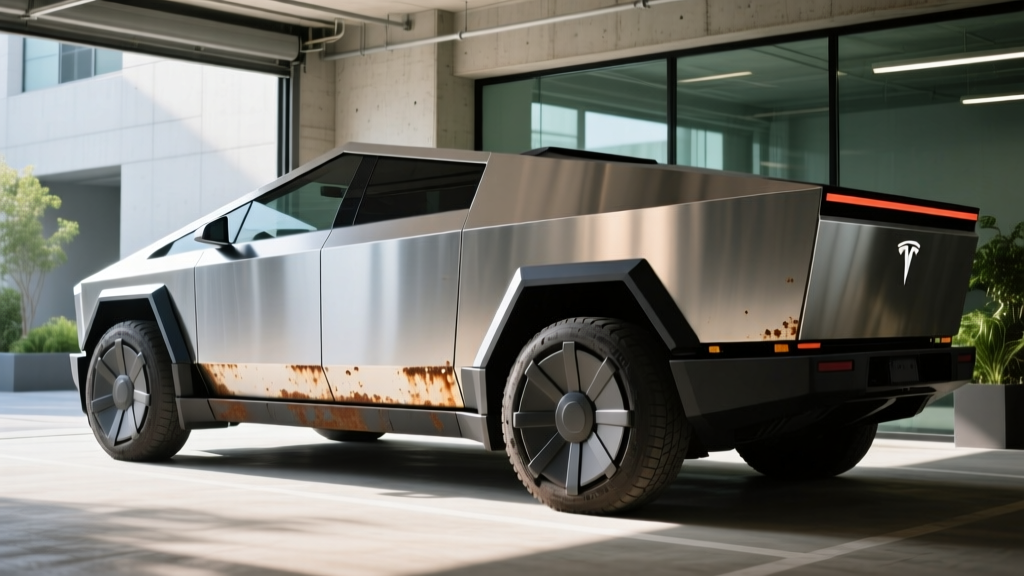
If you've spent time in Cybertruck owner forums or scrolled through EV social media feeds in 2025 and 2026, you've likely encountered photos of small orange-brown spots appearing on the stainless steel body panels of Tesla's polarizing electric pickup. For a vehicle marketed with an aerospace-grade exoskeleton, the sight of Cybertruck rust spots is alarming to prospective buyers and frustrating to current owners.
But before you write off the Cybertruck's stainless steel body as a failure, it's essential to understand what's actually happening, why it happens, and how to address it. This guide breaks down the metallurgy behind those spots, provides practical remediation steps, and delivers a full 2026 Tesla Cybertruck review covering range, charging, pricing, and tax credit eligibility.
Why Does Stainless Steel Show Rust Spots?
The Tesla Cybertruck uses a cold-rolled, ultra-hard 300-series stainless steel alloy for its exterior panels. Unlike traditional automotive steel, stainless steel contains chromium (typically 10.5% or more), which forms a thin, invisible passive oxide layer on the surface. This layer is what makes stainless steel "stainless" — it self-repairs in the presence of oxygen and prevents the kind of structural corrosion that eats through conventional mild-steel body panels.
However, "stainless" does not mean "stain-proof." Here's what causes the surface spots owners report:
- Iron particle contamination: Microscopic iron or mild-steel particles from brake dust, road debris, rail transport, or nearby industrial processes can embed in the stainless surface. These foreign iron particles oxidize (rust) when exposed to moisture, creating small orange spots on the surface. The stainless steel itself is not corroding — the contaminant on top of it is.
- Chloride exposure: Road salt (sodium chloride, calcium chloride) used in winter states can attack the passive oxide layer, particularly in crevices or where the surface has been scratched. This can lead to localized pitting if not rinsed off regularly.
- Water spotting and mineral deposits: Hard water left to dry on panels can leave mineral deposits that trap moisture against the surface, potentially leading to superficial discoloration.
- Manufacturing residue: Some early-delivery Cybertrucks (late 2023 through mid-2024) reportedly had iron contamination from the factory or transport process, leading to surface rust appearing within weeks of delivery.
How to Remove and Prevent Cybertruck Rust Spots
If you own a Cybertruck and are seeing spots, or you're a prospective buyer evaluating whether this is a dealbreaker, here's the practical remediation playbook that experienced owners and detailers recommend:
Removal Methods
- Bar Keepers Friend (liquid or powder): This oxalic-acid-based cleaner is the go-to product in the Cybertruck community. Apply with a soft microfiber cloth, rub gently in the direction of the grain (the steel has a visible brushed finish), and rinse thoroughly. This dissolves iron contamination without damaging the passive layer.
- Iron-dissolver sprays (CarPro IronX, Sonax Wheel Cleaner): These pH-neutral iron-fallout removers chemically react with embedded iron particles, turning them purple as they dissolve. Spray on, wait 3-5 minutes, rinse. Safe for stainless steel.
- White vinegar for light spots: For mild discoloration, a 50/50 white vinegar and water solution can lift mineral deposits and light surface oxidation. Rinse after application.
- Clay bar treatment: A detailing clay bar with lubricant can physically pull embedded contaminants from the surface. Follow with a stainless steel cleaner to restore the passive layer.
Prevention Strategies
- Wash frequently in salt states: If you drive in areas that use road salt, rinse the undercarriage and body panels every 7-10 days during winter months. Salt accumulation is the primary risk for actual pitting corrosion.
- Apply a ceramic coating: A professional-grade ceramic coating (Gtechniq, Ceramic Pro, or similar) creates a hydrophobic barrier that reduces contamination adherence and makes routine cleaning easier. Multiple Cybertruck owners report good results with ceramic coatings specifically formulated for bare metal.
- Avoid automatic car washes with harsh chemicals: Some touchless car washes use highly acidic or alkaline solutions that can degrade the passive oxide layer. Stick to pH-neutral hand washes or touchless washes with known chemistry.
- Park away from industrial fallout: If you live near steel fabrication shops, rail yards, or construction sites, airborne iron particles are more likely to settle on your vehicle.
2026 Cybertruck: Full EV Specifications and Performance
With the rust-spot question addressed, here's a complete look at what the 2026 Tesla Cybertruck delivers as an electric vehicle. Tesla has streamlined the lineup for the 2026 model year, with the AWD dual-motor and Cyberbeast tri-motor variants continuing as the primary options.
| Specification | AWD (Dual-Motor) | Cyberbeast (Tri-Motor) |
|---|---|---|
| EPA Range | 340 miles | 320 miles |
| Battery Capacity | ~123 kWh usable (NMC) | ~123 kWh usable (NMC) |
| Horsepower | 600 hp | 845 hp |
| 0-60 mph | 4.1 seconds | 2.6 seconds |
| Max DC Fast Charge | 250 kW (peak) | 250 kW (peak) |
| 10-80% DC Charge | ~28 minutes | ~28 minutes |
| Level 2 Home Charging | 11.5 kW (~37 mi/hr) | 11.5 kW (~37 mi/hr) |
| Efficiency | ~68 MPGe / 50 kWh/100mi | ~65 MPGe / 52 kWh/100mi |
| Drivetrain | Dual-motor AWD | Tri-motor AWD |
| Towing Capacity | 11,000 lbs | 11,000 lbs |
| Base MSRP | $79,990 | $99,990 |
| Battery Warranty | 8 years / 120,000 miles | 8 years / 120,000 miles |
Source: Tesla Cybertruck Specifications, EPA fueleconomy.gov
Charging Performance: DC Fast and Home Level 2
The Cybertruck supports the North American Charging Standard (NACS) connector natively — unsurprising given that Tesla developed the standard. On Tesla's V4 Supercharger stalls and compatible third-party DC fast chargers, the Cybertruck can accept up to 250 kW peak.
However, as with all EVs, peak charge rate is not sustained charge rate. Here's what the charging curve actually looks like:
| Charging Level | Power | Speed (Approx.) | Notes |
|---|---|---|---|
| Level 1 (120V outlet) | ~1.4 kW | ~4-5 mi/hr | Emergency/trickle only; full charge takes days |
| Level 2 (240V home) | 11.5 kW (48A) | ~37 mi/hr | Full charge in ~10-11 hours; ideal for overnight |
| DC Fast (V3 Supercharger) | Up to 250 kW | 10-80% in ~28 min | Peak rate from 10-35% SoC; tapers above 60% |
| DC Fast (V4 Supercharger) | Up to 250 kW | 10-80% in ~28 min | Similar curve; cable-cooled connector |
The Cybertruck's 123 kWh battery is large, which means even at 250 kW, filling from 10% to 80% takes roughly 28 minutes. Above 60% state of charge (SoC), the charge rate tapers significantly — expect to see rates drop to 80-100 kW in the 60-80% window, and below 40 kW above 80%. This is normal lithium-ion charge-curve behavior, not a Cybertruck-specific deficiency.
For home charging, you'll want a Level 2 wall connector on a 60-amp circuit (delivering 48 amps continuous to the vehicle). At 11.5 kW, overnight charging easily replenishes a full day's driving. A typical home Level 2 installation runs $800-$2,000 including equipment, electrician labor, and permitting, though a panel upgrade to 200A service can add $1,500-$3,000 if your home needs it.
Pricing, Trim Levels, and Federal Tax Credit Eligibility
The 2026 Cybertruck lineup has been simplified compared to the initial launch period. Here's how pricing breaks down:
| Trim | Base MSRP | Est. As-Tested | §30D Credit Eligible? |
|---|---|---|---|
| AWD (Dual-Motor) | $79,990 | $83,000-$88,000 | No — exceeds $80,000 truck MSRP cap |
| Cyberbeast (Tri-Motor) | $99,990 | $103,000-$110,000 | No — exceeds $80,000 truck MSRP cap |
The Cybertruck is positioned as a premium electric truck, and its pricing reflects that. Without the federal credit, buyers are paying full MSRP plus destination and any options. For context, the Ford F-150 Lightning Lariat starts around $62,000 and the Rivian R1T Dual-Motor starts around $73,000 — both of which may qualify for partial or full credits depending on trim and sourcing.
Interior, Technology, and Driver Assistance
The Cybertruck's interior is minimalist in the extreme — a single 18.5-inch central touchscreen dominates the dash, with a smaller rear touchscreen for back-seat passengers. There are no physical buttons; everything from glovebox release to mirror adjustment lives in the touchscreen interface.
Notable Tech Features
- Steer-by-wire: The Cybertruck uses a fully electronic steer-by-wire system with no mechanical connection between the yoke and the wheels. This enables the variable-ratio steering rack (fewer turns lock-to-lock at low speeds) and the unconventional yoke-style steering wheel.
- 48-volt electrical architecture: A first for a production vehicle, the Cybertruck runs on a 48V low-voltage system instead of the industry-standard 12V. This reduces wiring harness weight and enables higher-power accessories.
- Bioweapon Defense Mode: A HEPA-grade cabin air filtration system with positive cabin pressure, carried over from the Model S/X.
- Powershare (V2L/V2H): Vehicle-to-load capability allows the Cybertruck to power tools, appliances, or a home circuit. Tesla rates the onboard outlets at up to 9.6 kW continuous output through the bed and cabin outlets (with a Tesla Powershare home integration kit for V2H).
- Autopilot / FSD (Supervised): Tesla's Autopilot (standard) provides adaptive cruise control and lane centering. Full Self-Driving (Supervised) is an optional upgrade that adds automated lane changes, intersection handling, and parking maneuvers.
Cargo and Passenger Space
The Cybertruck seats five across two rows. Rear legroom is adequate but not generous — approximately 36 inches — due to the raised floor necessitated by the underfloor battery pack. Cargo dimensions:
- Bed length: 6 feet (72 inches) with the tonneau closed; extends to ~8 feet with the midgate folded down
- Bed width: ~47 inches between wheel wells
- Bed volume: ~67 cubic feet (bed only)
- Frunk (front trunk): ~7.1 cubic feet, lockable
- Gear locker: Under-bed lockable storage compartment behind the rear axle
Warranty Coverage and Long-Term Durability
Tesla provides the following warranty coverage for the 2026 Cybertruck:
- Basic Vehicle Limited Warranty: 4 years / 50,000 miles (whichever comes first)
- Battery & Drive Unit Warranty: 8 years / 120,000 miles, with minimum 70% battery capacity retention over the warranty period
- Restraint System: 5 years / 60,000 miles
- Corrosion (perforation): 12 years / unlimited miles — this covers through-and-through body panel perforation, not surface discoloration or contamination rust
Regarding the stainless steel body and corrosion warranty: Tesla's corrosion warranty covers perforation (holes rusting through the metal), not surface staining or contamination spots. Given that stainless steel is highly resistant to perforation corrosion in normal automotive environments, this warranty is unlikely to be triggered by the type of surface spots owners are reporting. However, if you observe actual pitting or material loss, that's a different conversation with Tesla Service.
How Does the Cybertruck Compare to Competitors?
For buyers weighing the Cybertruck against alternatives, here's how the competitive landscape looks in 2026:
| Attribute | Tesla Cybertruck AWD | Rivian R1T Dual-Motor | Ford F-150 Lightning Lariat |
|---|---|---|---|
| EPA Range | 340 mi | ~352 mi (Max Pack) | ~320 mi (Ext. Range) |
| 0-60 mph | 4.1 sec | 4.5 sec | ~5.0 sec |
| Towing | 11,000 lbs | 11,000 lbs | 10,000 lbs |
| Starting MSRP | $79,990 | ~$73,000 | ~$62,000 |
| §30D Credit | No (MSRP cap) | Partial — varies by sourcing | Partial — varies by sourcing |
| Body Material | Stainless steel | Aluminum/steel | Aluminum/steel |
Choose the Cybertruck if: You value maximum range, Tesla's Supercharger network access, steer-by-wire novelty, Powershare V2L capability, and you don't mind the premium price or the surface-maintenance requirements of bare stainless steel.
Choose the Rivian R1T if: You want a more refined interior, a conventional steering wheel, the Gear Tunnel for creative storage, and a potentially lower net price after incentives.
Choose the F-150 Lightning if: You need a traditional truck form factor, the lowest entry price, Pro Power Onboard, and Ford dealer service accessibility in rural areas.
Frequently Asked Questions
Are Cybertruck rust spots covered under warranty?
Generally, no. Surface rust spots caused by iron contamination or environmental deposits are considered cosmetic and are not covered under Tesla's corrosion warranty, which only covers perforation (through-and-through rust holes). However, if the spots appeared immediately after delivery due to factory contamination, some owners have successfully had Tesla Service address them under the new-vehicle delivery condition policy. Document with photos and contact Tesla Service promptly.
Will the stainless steel body eventually rust through like a regular truck?
This is extremely unlikely in normal use. The 300-series stainless steel used in the Cybertruck is highly resistant to structural corrosion. The surface spots owners report are contamination rust, not the stainless steel itself corroding. In coastal or heavy road-salt environments, pitting corrosion is theoretically possible over many years if the vehicle is never washed — but this is preventable with regular rinsing.
How often should I wash my Cybertruck to prevent spots?
In dry, mild climates, a rinse every 2-3 weeks is sufficient. In road-salt states or near industrial areas, rinse weekly or biweekly during exposure periods. A ceramic coating reduces the frequency needed and makes each wash easier.
Does the Cybertruck qualify for any state or local EV incentives?
While the Cybertruck does not qualify for the federal §30D credit due to its MSRP, some states offer their own EV rebates or tax credits with different price caps. States like Colorado, California (CVRP has been restructured), and others may have programs applicable to higher-priced EVs. Check your state's energy or environmental agency for current programs — these vary widely by jurisdiction and change frequently.
What's the real cost to charge a Cybertruck at home?
With a ~123 kWh battery and a national average electricity rate of ~$0.16/kWh (as of early 2026), a full charge from near-empty costs approximately $19.68. For a typical daily commute using 30-40 kWh, expect to spend $5-$7 per day on electricity. Compared to a gas truck getting 18 MPG at $3.40/gallon, the per-mile fuel cost is roughly 60-70% lower with home charging.
Is the Cybertruck a practical daily driver or just a statement vehicle?
It's genuinely capable as a daily driver if you can accommodate its size (231.7 inches long, ~80 inches wide including mirrors — it will not fit in many parking garages). The range is strong, home charging makes fueling convenient, the ride quality is surprisingly compliant thanks to the adaptive air suspension, and the V2L capability is useful for job sites and camping. The main practical compromises are rear-seat space, rear visibility (no rear window; camera only), and the learning curve of steer-by-wire.