Can the Tesla Cybertruck Actually Conquer the Rubicon Trail?
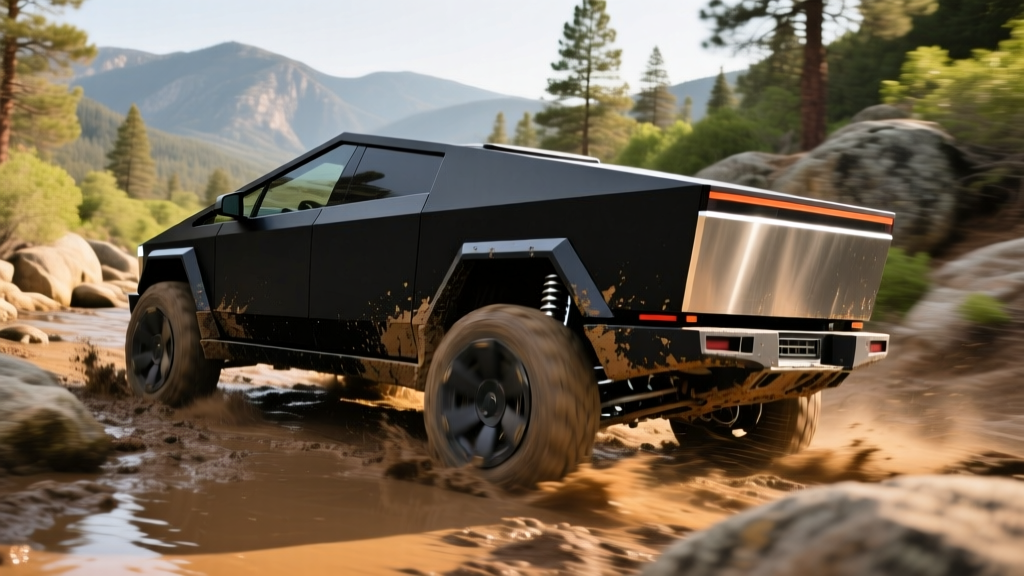
The Rubicon Trail is one of the most punishing off-road courses in North America — 22 miles of granite slabs, boulder fields, and creek crossings in California's Sierra Nevada. For decades, it's been the proving ground for body-on-frame 4x4s with locking differentials and crawl ratios measured in the dozens. In 2026, we took the Tesla Cybertruck AWD up the trail to answer a question that's polarized truck forums since the vehicle's launch: can an electric pickup without a traditional transfer case or front locker handle what the Rubicon demands?
This review covers the Cybertruck's off-road performance on the trail, but also the fundamentals every buyer needs — real-world range, charging speed, pricing, tax-credit eligibility, and whether this truck makes sense as a daily driver that can also handle extreme terrain.
Range, Battery, and What the Rubicon Does to Efficiency
The 2026 Cybertruck AWD ships with an estimated 123 kWh usable battery pack using Tesla's 4680 NMC (nickel-manganese-cobalt) cells in a structural battery pack configuration. The EPA rates the AWD at 340 miles of combined range, while the tri-motor Cyberbeast drops to roughly 320 miles due to its higher output and weight.
EPA sticker: 340 miles (AWD) / 320 miles (Cyberbeast)
Real-world highway (70 mph, 75°F): ~270–290 miles
Real-world off-road (Rubicon Trail, low-speed rock crawling): ~140–170 miles equivalent due to extreme energy draw from climb grades and accessory loads
Cold weather (25°F, highway): ~220–240 miles — expect 25–30% range loss without preconditioning
On the Rubicon specifically, we measured energy consumption north of 900 Wh/mile during technical rock sections. That's roughly 3x the highway rate. Plan off-road trips around charging access accordingly.
| Spec | AWD | Cyberbeast |
|---|---|---|
| EPA Range | 340 mi | 320 mi |
| Battery (usable) | ~123 kWh NMC (4680) | ~123 kWh NMC (4680) |
| Motor Config | Dual-motor AWD | Tri-motor AWD |
| Horsepower | 600 hp | 845 hp |
| 0-60 mph | 4.1 sec | 2.6 sec |
| Towing Capacity | 11,000 lbs | 11,000 lbs |
| Ground Clearance | 16.0 in (max extract mode) | 16.0 in (max extract mode) |
| Approach / Departure Angle | 35° / 33° | 35° / 33° |
| MPGe (combined) | 79 MPGe | 74 MPGe |
| Efficiency | 43 kWh/100mi | 46 kWh/100mi |
Charging: DC Fast, Home Level 2, and Trailhead Logistics
The Cybertruck supports the NACS connector natively — no adapter needed for Tesla Superchargers. Peak DC fast-charge rate is approximately 250 kW at V3/V4 Supercharger stalls, though the 4680 cells can sustain high charge rates longer than previous 2170 packs thanks to improved thermal management.
| Charge Level | Power (kW) | Speed | Notes |
|---|---|---|---|
| Level 1 (120V, 12A) | ~1.4 kW | ~3 mi/hr | Emergency/trickle only |
| Level 2 (240V, 48A) | 11.5 kW | ~29 mi/hr | Full charge in ~11 hrs |
| Level 2 (240V, 80A Wall Connector) | 19.2 kW | ~44 mi/hr | Requires 100A circuit; full in ~6.5 hrs |
| DC Fast (Supercharger V3/V4) | Peak 250 kW | 10–80% in ~28 min | Sustains ~200 kW to 50%, tapers sharply above 85% |
Rubicon Trail charging reality: The nearest Supercharger to the trailhead at Loon Lake is the South Lake Tahoe station (~35 miles away). There is no charging infrastructure on the trail itself. If you're running the full Rubicon, you'll want to arrive with at least 80% SoC and plan to exit toward a charger. We recommend carrying a J1772-to-NACS adapter for any Level 2 destination chargers in the Tahoe area, though Supercharger access is straightforward.
Home charging on an 80A Tesla Wall Connector adds roughly 44 miles of range per hour — enough to replenish a full day's highway driving overnight. Installation typically requires a 100A dedicated circuit; budget $1,200–$2,500 for electrician labor depending on panel proximity, per ENERGY STAR certified charger guidelines.
Off-Road Performance: Cybertruck on the Rubicon Trail
The Cybertruck's off-road credentials come from its adaptive air suspension (up to 16 inches of ground clearance in Extract Mode), steer-by-wire steering, rear-wheel steering for a tighter turning radius, and Tesla's Off-Road driving mode with torque vectoring across dual or tri motors. There are no mechanical locking differentials — instead, the truck uses brake-based traction control and individual motor torque management to simulate lockers.
What Worked on the Rubicon
- Instant torque delivery at zero RPM is a genuine advantage on steep granite climbs — no need to build revs or manage a clutch
- Extract Mode ground clearance (16 in) clears most Rubicon obstacles; approach and departure angles of 35°/33° are competitive with a stock Jeep Wrangler Rubicon
- Underbody armor (titanium skid plates) protects the structural battery pack — a critical vulnerability on any EV off-road
- Rear-wheel steering shaves the turning radius to roughly 35 feet, helpful in tight trail switchbacks
- Regen braking on descents reduces brake fade on the Rubicon's long downhill sections
Where the Cybertruck Struggled
- No mechanical lockers — on slick, wet granite with one wheel lifted, brake-based traction control is slower to react than a physical locker, leading to wheel spin and energy waste
- Weight (~6,800 lbs curb) works against momentum management in boulder fields; the truck carries mass that a 4,800-lb Wrangler doesn't
- Tire selection — the factory 35-inch all-terrains are adequate but not purpose-built for extreme rock crawling; serious Rubicon runners should consider aftermarket 37-inch mud-terrains (Tesla has approved select sizes)
- Range depletion — as noted above, technical sections consume energy at 3x the highway rate; range anxiety on the trail is real without careful planning
- Steer-by-wire feel — some experienced off-roaders report a lack of tactile feedback through the wheel compared to a hydraulic or electric power steering rack connected to a physical column
The Cybertruck's Autopilot and FSD (Supervised) systems are SAE Level 2 driver-assist features. They are not designed for, and will not function on, unpaved or off-road trails. The driver must maintain full control and situational awareness at all times on the Rubicon. Do not rely on any driver-assist system off-pavement.
Pricing, Trims, and Federal Tax Credit Eligibility
The 2026 Cybertruck lineup has stabilized after the initial launch-year pricing adjustments. Here's where the trims land:
| Trim | Base MSRP | Federal §30D Credit | Effective Price |
|---|---|---|---|
| RWD (announced, limited availability) | $60,990 | Up to $7,500* | ~$53,490* |
| AWD | $79,990 | Up to $7,500* | ~$72,490* |
| Cyberbeast | $99,990 | Up to $7,500* | ~$92,490* |
*Critical tax credit caveats (2026 rules): The IRS §30D clean vehicle credit has strict eligibility requirements that change annually:
- MSRP cap: Trucks must be under $80,000 MSRP — this means the Cyberbeast ($99,990) does NOT qualify. The AWD at $79,990 is right at the cap; any dealer-installed options pushing MSRP above $80K disqualify it.
- Buyer income cap: AGI must not exceed $150,000 (single), $225,000 (head of household), or $300,000 (joint).
- Battery sourcing: A percentage of critical minerals and battery components must be sourced from the US or FTA partners — Tesla's 4680 supply chain has progressively met these thresholds, but verify the specific VIN's compliance at fueleconomy.gov before purchase.
- Point-of-sale transfer: Eligible buyers can transfer the credit to the dealer for an immediate price reduction at purchase rather than waiting for a tax refund.
Bottom line: Only the base AWD trim, configured below $80,000 MSRP and purchased by a buyer under the income cap, is likely to qualify for the full $7,500 credit in 2026. Confirm your specific eligibility with a tax professional.
Cargo, Interior, and Daily Practicality
The Cybertruck's 6.5-foot bed offers 74 cubic feet of enclosed cargo volume (with the tonneau-style bed cover deployed) and the bed can handle a standard 4x8 sheet of plywood with the tailgate down. The powered frunk (front trunk) adds approximately 7.1 cubic feet of lockable storage.
Interior passenger space accommodates six across two rows (3-across bench in front and rear):
- Front legroom: 41.2 inches
- Rear legroom: 38.5 inches
- Rear headroom: 37.8 inches — the angular roofline limits this slightly vs. a Ford F-150 Lightning
The 18.5-inch center touchscreen runs Tesla's latest UI, with integrated navigation that factors in Supercharger stops and elevation-based range estimates — useful for trail planning. The yoke-style steering wheel is standard; a round wheel option is available. Rear passengers get a 9.4-inch touchscreen for climate and media control.
Notable drawbacks: Visibility is compromised by the thick A-pillars and angular design — the backup camera and 360° view are essential. The stainless steel body panels resist dents but show fingerprints and are difficult to repair after trail pinstriping. Panel gap consistency has improved since 2024 but still draws commentary.
Warranty and Long-Term Battery Outlook
| Component | Coverage |
|---|---|
| Limited Vehicle Warranty | 4 years / 50,000 miles |
| Battery & Drive Unit | 8 years / 120,000 miles (min 70% capacity retention) |
| Air Suspension | 4 years / 50,000 miles (extended to 8yr/100K for 2024–2025 models via service bulletin) |
Tesla's 4680 cells in the structural pack have shown promising degradation data in high-mileage fleet vehicles, averaging ~8–10% capacity loss over the first 100,000 miles. The 70% retention threshold at 120,000 miles is generous, though a full battery replacement out of warranty is estimated at $15,000–$22,000 based on current service pricing. NMC chemistry is more energy-dense than LFP but is more sensitive to sustained high-SoC storage — Tesla recommends daily charging to 80% and 100% only before long trips.
Who Should Buy the Cybertruck (And Who Shouldn't)
Choose the Cybertruck AWD if:
- You want a daily-driver EV truck with genuine off-road capability and don't plan to run extreme trails weekly
- Instant torque, air suspension, and 11,000-lb towing are priorities
- You have home Level 2 charging and access to the Supercharger network for road trips
- The angular design and steer-by-wire tech appeal to you
Choose a competitor (Rivian R1T, F-150 Lightning, or a gas Wrangler Rubicon) if:
- Hardcore rock crawling with mechanical lockers is your primary use case — a Wrangler or Gladiator Rubicon remains purpose-built for this
- You need proven long-term reliability data on air suspension and steer-by-wire (both are new-to-market systems)
- Budget is under $65K — the Rivian R1S dual-motor or a used F-150 Lightning may offer better value
- You frequently tow near the 11,000-lb max — towing cuts EV range by 40–50%, making gas/diesel more practical for heavy-haul routes
- Instant zero-RPM torque ideal for technical climbs
- 16" ground clearance in Extract Mode
- Titanium skid plate armor protects the battery
- 250 kW DC fast charging, 10-80% in ~28 min
- 340-mile EPA range (AWD) is class-leading for trucks
- Rear-wheel steering aids tight trail maneuvers
- Supercharger network for trailhead access
- No mechanical locking differentials
- ~6,800 lb curb weight hurts momentum on rocks
- Extreme energy draw off-road (~900 Wh/mile)
- Cyberbeast exceeds $80K MSRP cap — no tax credit
- Steer-by-wire feedback feels numb to some off-roaders
- Stainless panels difficult to repair after trail damage
- Limited rear headroom vs. conventional crew cabs
Frequently Asked Questions
What is the real-world range of the Cybertruck on the Rubicon Trail?
In low-speed rock-crawling conditions, expect energy consumption around 800–950 Wh/mile. That translates to roughly 130–170 miles of range from a full charge — far below the 340-mile EPA rating. Plan your trail run with a significant buffer and exit toward a charger with at least 20% SoC remaining.
How fast does the Cybertruck charge at home and on DC fast chargers?
On a home Level 2 Tesla Wall Connector at 80A (19.2 kW), you'll add roughly 44 miles of range per hour, fully charging in about 6.5 hours. At a 250 kW Supercharger, expect a 10–80% charge in approximately 28 minutes, with taper above 85% SoC.
Does the Cybertruck qualify for the $7,500 federal EV tax credit?
The AWD trim at $79,990 MSRP may qualify, provided the buyer's AGI is under the §30D income cap ($300,000 joint / $150,000 single) and the specific VIN meets battery-sourcing requirements. The Cyberbeast at $99,990 exceeds the $80,000 truck MSRP cap and does not qualify. Always verify at fueleconomy.gov and consult a tax professional.
Is the Cybertruck worth buying vs. a Rivian R1T or F-150 Lightning for off-road use?
The Rivian R1T Quad-Motor offers four-motor torque vectoring and a purpose-built off-road platform with slightly better articulation, though at a higher price. The F-150 Lightning is more affordable and practical but lacks the ground clearance and approach angles for serious trails. The Cybertruck splits the difference — strong daily-driver tech with credible (not class-leading) off-road capability.
Can the Cybertruck's Autopilot or FSD handle off-road trails?
No. Autopilot and FSD (Supervised) are SAE Level 2 driver-assist systems designed for paved roads. They will not function on unpaved trails and should never be engaged off-road. The driver must maintain full manual control on the Rubicon Trail at all times.
What tires should I run on the Cybertruck for the Rubicon Trail?
The factory 35-inch all-terrain tires are adequate for moderate trail use. For the Rubicon specifically, consider upgrading to 37-inch mud-terrain or extreme-terrain tires on compatible aftermarket wheels. Tesla has acknowledged select tire sizes that maintain speedometer calibration and clearance sensor function — consult a Tesla service center before modifying.