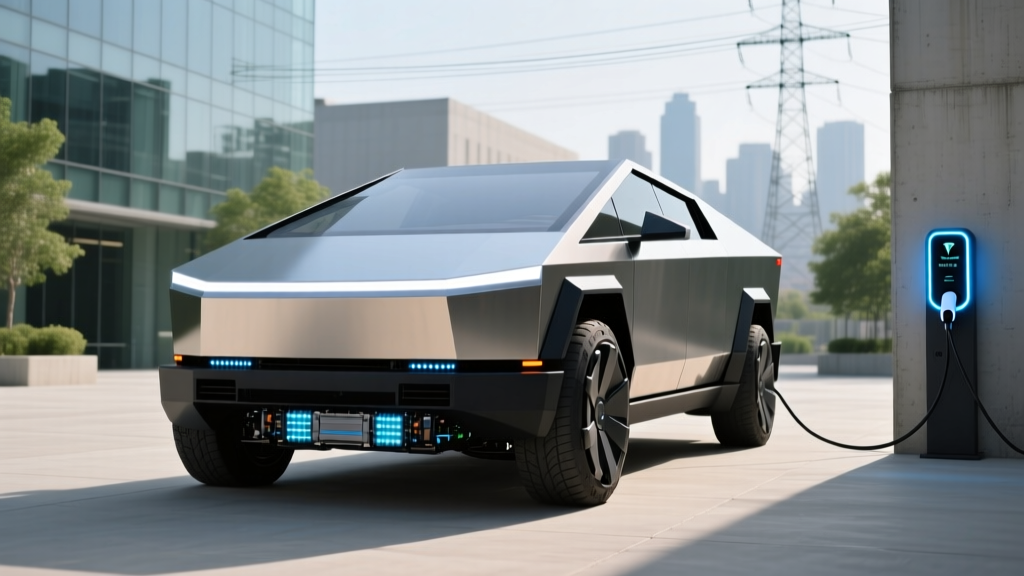
Since its polarizing launch, the Tesla Cybertruck has been less a traditional pickup and more a rolling provocation. For 2026, Tesla has executed a meaningful Cybertruck redesign that addresses the most common owner complaints — specifically charging speed, range efficiency, and interior material quality — while preserving the stainless-steel exoskeleton aesthetic that defines the truck. This review covers the updated AWD and Cyberbeast trims with exact EPA data, real-world range expectations, charging-curve realities, and a clear-eyed look at whether this truck earns its price tag.
2026 Cybertruck Redesign: What Actually Changed
The 2026 Cybertruck redesign is not a ground-up re-engineering but a targeted mid-cycle refresh. The most consequential update is the migration to an 800-volt electrical architecture (up from 400V), enabling substantially faster DC fast charging. Tesla has also revised the rear drive unit for improved efficiency, added a standard heat pump across all trims (previously optional on base models), and updated the bed composite liner for better scratch and dent resistance.
Inside, the 2026 Cybertruck gets a redesigned center console with physical HVAC controls (a frequent complaint on 2024–2025 models was touchscreen-only climate adjustment), improved acoustic glass reducing cabin noise by a claimed 3 dB at highway speed, and a new "Saddle" interior trim option with synthetic leather that replaces the earlier matte vinyl. The 18.5-inch front touchscreen and 9.4-inch rear touchscreen carry over, as does the yoke-style steering wheel (a conventional round wheel remains a no-cost option).
Externally, the changes are subtle: a revised front light bar with adaptive matrix LEDs, slightly reshaped fender flares to accommodate the standard 35-inch all-terrain tires, and a new "Foundation Series" badging scheme that replaces the earlier Launch Edition branding. The stainless-steel body panels remain cold-rolled 304-series, unchanged in thickness.
Range, Battery, and Efficiency
The 2026 Cybertruck AWD retains a usable battery capacity of approximately 123 kWh using Tesla's latest-generation NMC (nickel manganese cobalt) cells in a structural 4680 format. The Cyberbeast trim uses the same pack. Tesla does not offer an LFP option in the Cybertruck lineup — the weight and energy-density demands of a 6,800+ lb truck require NMC chemistry.
| Spec | AWD Trim | Cyberbeast Trim |
|---|---|---|
| EPA Est. Range | 340 miles | 320 miles |
| Battery (Usable) | 123 kWh, NMC 4680 | 123 kWh, NMC 4680 |
| Drivetrain | Dual-Motor AWD | Tri-Motor AWD |
| Horsepower | 600 hp | 845 hp |
| 0–60 mph | 4.1 seconds | 2.6 seconds |
| MPGe (Combined) | 67 MPGe | 62 MPGe |
| Efficiency (kWh/100mi) | 50 kWh/100mi | 54 kWh/100mi |
| Towing Capacity | 11,000 lbs | 11,000 lbs |
| Payload | 2,500 lbs | 2,500 lbs |
| Base MSRP | $79,990 | $99,990 |
Efficiency remains the Cybertruck's weak point relative to lighter EVs. At 50 kWh per 100 miles (AWD), it consumes roughly 40% more energy per mile than a Tesla Model Y Long Range (approximately 34 kWh/100mi). The slab-sided, angular design creates significant aerodynamic drag at highway speeds — a physics problem no software update can fix. For buyers who prioritize efficiency, the Rivian R1T (47 kWh/100mi) holds a modest advantage.
Charging: The 800V Upgrade Makes a Real Difference
The headline improvement in the 2026 Cybertruck redesign is the shift to an 800V architecture, enabling peak DC fast-charge rates of 350 kW at compatible V4 Supercharger stalls and third-party 800V stations. This is a substantial jump from the 2025 model's ~250 kW peak.
| Charging Method | Power (kW) | Speed | Notes |
|---|---|---|---|
| DC Fast Charge (800V) | Up to 350 kW peak | 10–80% in ~17 min | Requires V4 Supercharger or 800V station; sustained rate ~200 kW average |
| DC Fast Charge (400V) | Up to 175 kW peak | 10–80% in ~32 min | At older V3 Superchargers or CCS stations via adapter |
| Level 2 Home (48A) | 11.5 kW | ~34 mi/hr | Full charge in ~11 hours; requires 60A circuit |
| Level 2 Home (32A) | 7.7 kW | ~23 mi/hr | Full charge in ~16 hours; 40A circuit |
| Level 1 (120V) | ~1.4 kW | ~4 mi/hr | Emergency/trickle only; impractical for daily use |
The charging curve tells the full story. At an 800V V4 Supercharger, the Cybertruck will sustain approximately 300+ kW from 10% to about 35% State of Charge (SoC), then taper progressively. Between 50–80% SoC, expect sustained rates of 150–200 kW. The 10–80% time of approximately 17 minutes is achievable only with battery preconditioning enabled (the truck automatically preconditions when a Supercharger is set as your navigation destination). Without preconditioning, add 5–8 minutes to that figure, particularly in cold weather.
At home on a 48-amp Level 2 charger (the Tesla Wall Connector on a 60-amp dedicated circuit), the Cybertruck recovers about 34 miles of range per hour of charging. For a truck with a 123 kWh battery, a full 10–100% charge takes roughly 11 hours — plan accordingly if you're on a time-of-use electricity plan and want to charge during off-peak overnight hours.
The Cybertruck uses the NACS (North American Charging Standard) connector natively, meaning direct access to Tesla's Supercharger network (now over 25,000 stalls in North America) without an adapter. For Electrify America or other CCS networks, you'll still need a NACS-to-CCS adapter, though Tesla includes one in the 2026 model year.
Performance and Driving Dynamics
The dual-motor AWD Cybertruck produces 600 horsepower and hits 0–60 mph in 4.1 seconds — quick for a truck with a curb weight near 6,800 lbs. The tri-motor Cyberbeast pushes 845 horsepower and a 2.6-second 0–60 time, making it one of the quickest production vehicles of any kind. Both trims feature adaptive air suspension with up to 16 inches of ground clearance in Off-Road mode and 12.3 inches in standard ride height.
The 2026 redesign includes a revised rear-axle steering calibration that reduces the truck's turning circle to 40.2 feet (curb-to-curb), down from 42.4 feet on the 2024–2025 models. This makes urban maneuvering noticeably less taxing, though the Cybertruck's 231-inch overall length and 82-inch width (excluding mirrors) still demand wide lanes and careful parking-lot navigation.
Towing capacity remains rated at 11,000 lbs across both trims. The integrated bed camera system and trailer-light-check feature carry over, and the 2026 model adds an updated trailer sway control algorithm that intervenes more smoothly at highway speed. Payload capacity is 2,500 lbs, with a 6-foot bed (74.8 inches long, 49.5 inches wide between wheel wells) that accommodates a standard pallet.
Interior, Cargo, and Technology
The Cybertruck seats five, with front legroom of 41.5 inches and rear legroom of 38.2 inches. The rear seat is a three-person bench with a 60/40 split-fold function. Behind the rear seats, the bed offers 67 cubic feet of cargo volume (with the tonneau cover deployed). The front trunk (frunk) provides approximately 7.1 cubic feet of lockable storage — enough for a large charging cable bag and a few grocery bags, but not a full suitcase.
The infotainment system runs Tesla's proprietary OS on the 18.5-inch front display. Apple CarPlay and Android Auto remain unsupported — a persistent frustration for buyers who prefer phone-mirroring navigation and media. The 2026 model adds native integration with Spotify, Apple Music, and Tidal (streaming over the truck's built-in LTE connection), partially mitigating the CarPlay omission.
Driver assistance is provided by Tesla's Enhanced Autopilot (standard) and optional Full Self-Driving (Supervised) at $8,000 one-time or $99/month. Both remain SAE Level 2 systems, meaning the driver must keep hands on the wheel and eyes on the road at all times. The Cybertruck is not self-driving. FSD Supervised adds features like automatic lane changes, traffic-light recognition, and city-street navigation, but NHTSA continues to investigate Tesla's Autopilot/FSD safety record, and drivers should treat these as convenience features, not autonomous capability.
Pricing, Tax Credits, and Ownership Costs
The 2026 Cybertruck AWD starts at $79,990 (including destination), while the Cyberbeast starts at $99,990. A fully loaded Cyberbeast with FSD, the Foundation Series package, and 22-inch wheels can approach $112,000.
| Trim | Base MSRP | Federal §30D Credit | Effective Price (if eligible) |
|---|---|---|---|
| AWD | $79,990 | Up to $7,500* | ~$72,490* |
| Cyberbeast | $99,990 | Up to $7,500* | ~$92,490* |
*Federal tax credit eligibility under IRS §30D is subject to multiple requirements:
- MSRP Cap: Vans, SUVs, and pickup trucks must have an MSRP at or below $80,000. The Cybertruck AWD ($79,990) qualifies; the Cyberbeast ($99,990) does not.
- Buyer Income Cap: Modified adjusted gross income must not exceed $150,000 (single), $225,000 (head of household), or $300,000 (joint filers).
- Battery Sourcing: The full $7,500 requires meeting both critical-mineral and battery-component sourcing requirements set by the IRS. Partial credits ($3,750) may apply if only one requirement is met. Check the latest IRS eligible vehicle list for current-year status, as sourcing rules change frequently.
- Point-of-Sale Transfer: As of 2024, eligible buyers can transfer the credit to the dealer at purchase, reducing the upfront cost rather than waiting for a tax refund.
For the Cybertruck AWD, the effective price after a full $7,500 credit is approximately $72,490 — competitive with a well-equipped Ford F-150 Lightning Lariat or Rivian R1T Dual-Motor. The Cyberbeast, at $99,990, exceeds the $80,000 MSRP cap and is ineligible for the federal credit; buyers are paying full price plus applicable state incentives.
Warranty and Long-Term Ownership
Tesla covers the 2026 Cybertruck with a 4-year/50,000-mile limited vehicle warranty and an 8-year/150,000-mile battery and drive unit warranty. The battery warranty guarantees a minimum of 70% capacity retention over the 8-year/150,000-mile period. If the pack degrades below 70% within that window, Tesla will repair or replace it at no cost.
Long-term battery degradation data for Tesla's 4680 structural cells is still accumulating. Early data from 2024–2025 Cybertruck owners (analyzed by independent EV data aggregators) suggests approximately 5–7% degradation over the first 30,000 miles, with the curve expected to flatten significantly after the initial break-in period. The 4680 cells use a tabless design intended to reduce thermal stress, which should support long cycle life, but buyers planning 200,000+ miles of ownership should monitor State of Health (SoH) through the truck's built-in battery health display.
Insurance costs are a notable ownership factor. The Cybertruck carries higher-than-average insurance premiums due to its stainless-steel body (expensive to repair), high performance, and limited aftermarket parts availability. Expect annual premiums 25–40% above a comparable F-150 Lightning, depending on your state and driving record. Always obtain insurance quotes before purchasing.
Pros, Cons, and the Competition
Pros
- 350 kW peak DC fast charging (800V) — best-in-class for pickups
- 340-mile EPA range (AWD) — longest among electric trucks
- 11,000-lb towing capacity with integrated trailer tech
- Stainless-steel body resists dents and corrosion
- Access to Tesla Supercharger network (25,000+ stalls)
- Rear-axle steering improves maneuverability vs prior model years
Cons
- Cyberbeast exceeds $80K MSRP cap — no federal tax credit
- Poor efficiency (50 kWh/100mi) means higher charging costs
- No Apple CarPlay or Android Auto support
- Polarizing design limits resale appeal for some buyers
- High insurance premiums relative to competitors
- Real-world highway range ~280–300 mi, well below EPA sticker
Against the Rivian R1T (starting ~$69,900, EPA 352 mi on Max Pack, 220 kW peak charging), the Cybertruck offers faster charging and more towing capacity but trails in efficiency and interior practicality (the R1T's gear tunnel is a standout feature). Against the Ford F-150 Lightning (starting ~$54,990, EPA 320 mi on Extended Range, 150 kW peak charging), the Cybertruck is far more expensive and less conventional, but offers substantially faster charging and a longer-range battery. The Lightning wins on value, traditional truck ergonomics, and Pro Power Onboard for job-site use.
Who Should Buy the 2026 Cybertruck?
Choose the Cybertruck AWD if: You need 340+ miles of EPA range, want the fastest-charging electric pickup available, regularly tow heavy loads, and value access to the Supercharger network for road trips. At ~$72,490 after the federal credit, it's a compelling (if unconventional) work-and-travel truck.
Choose the Cyberbeast if: You want supercar-rivaling acceleration in a truck, plan to use it primarily as a performance/lifestyle vehicle, and the $99,990+ price (with no federal credit) doesn't deter you.
Look elsewhere if: You prioritize efficiency and low charging costs (consider the Rivian R1T), want traditional truck ergonomics and CarPlay (consider the F-150 Lightning), or need a truck primarily for fleet/commercial use where conventional styling and serviceability matter.
Frequently Asked Questions
What is the real-world range of the 2026 Cybertruck?
The EPA rates the AWD at 340 miles and the Cyberbeast at 320 miles. Real-world highway driving at 70–75 mph yields approximately 280–300 miles (AWD) and 265–285 miles (Cyberbeast). In cold weather below 32°F, expect 230–260 miles for the AWD. Towing near max capacity cuts range roughly in half.
How fast does the 2026 Cybertruck charge?
On an 800V DC fast charger (like a Tesla V4 Supercharger), the Cybertruck peaks at 350 kW and charges from 10–80% in approximately 17 minutes with battery preconditioning. On older 400V chargers, the peak drops to ~175 kW and 10–80% takes about 32 minutes. At home on a 48-amp Level 2 charger, it recovers roughly 34 miles of range per hour.
Does the 2026 Cybertruck qualify for the $7,500 federal EV tax credit?
The Cybertruck AWD ($79,990 MSRP) falls under the $80,000 MSRP cap for trucks and may qualify for up to $7,500 under IRS §30D, provided the buyer meets income requirements and the battery meets critical-mineral and component-sourcing rules. The Cyberbeast ($99,990 MSRP) exceeds the cap and does not qualify. Always verify current eligibility on the IRS clean vehicle list and consult a tax professional.
Is the Cybertruck worth buying vs. the Rivian R1T or F-150 Lightning?
The Cybertruck wins on charging speed (350 kW peak vs. 220 kW for Rivian and 150 kW for Ford) and towing capacity (11,000 lbs). The R1T is more efficient, has a more practical interior (gear tunnel, camp kitchen option), and starts lower. The F-150 Lightning is the most affordable, most conventional in design, and best for fleet/commercial use. Your choice depends on whether you prioritize charging performance (Cybertruck), versatility and adventure features (R1T), or value and familiarity (Lightning).
What battery does the 2026 Cybertruck use?
The Cybertruck uses a 123 kWh (usable) structural battery pack composed of Tesla's 4680-format NMC (nickel manganese cobalt) cells. Tesla does not offer an LFP option for the Cybertruck. The pack is covered by an 8-year/150,000-mile warranty with a 70% capacity-retention guarantee.
Can I charge the Cybertruck at non-Tesla charging stations?
Yes. The Cybertruck uses the NACS connector natively and can charge at any NACS-equipped station. For CCS stations (like Electrify America), Tesla includes a NACS-to-CCS adapter with the 2026 model. Note that charging speeds at non-Tesla 400V stations will be limited to approximately 175 kW peak.
Sources: EPA Fuel Economy, IRS §30D Eligible Vehicles, Tesla Cybertruck Specifications.