The Cybertruck Rear: Form, Function, and the Vault
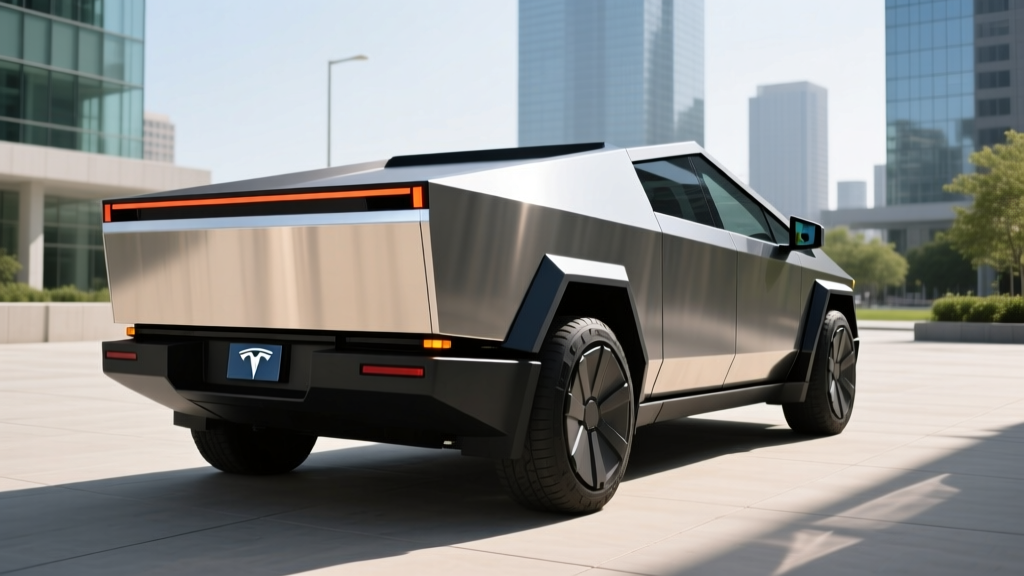
The Tesla Cybertruck's rear profile is arguably the most debated design element in modern automotive history. The angular stainless-steel exoskeleton terminates in a powered tonneau cover that seals a 6-foot lockable bed Tesla calls "the Vault." For 2026, the Cybertruck continues to polarize, but the rear-end engineering tells a story of genuine utility married to uncompromising EV architecture. This review examines what the Cybertruck's rear design means for real-world cargo hauling, towing, and daily ownership — alongside the full range, charging, and pricing picture buyers need.
| Spec | AWD | Cyberbeast |
|---|---|---|
| EPA Range | 340 mi | 320 mi |
| Battery (usable, est.) | ~123 kWh, NMC | ~123 kWh, NMC |
| Peak DC Fast Charge | ~250 kW (800V arch) | ~250 kW (800V arch) |
| 10–80% DCFC Time | ~28 min | ~28 min |
| Level 2 Charge Rate | 11.5 kW (~34 mi/hr) | 11.5 kW (~34 mi/hr) |
| 0–60 mph | 4.1 sec | 2.6 sec |
| Horsepower | 600 hp | 845 hp |
| Drivetrain | Dual-Motor AWD | Tri-Motor AWD |
| Towing Capacity | 11,000 lbs | 11,000 lbs |
| MPGe (combined) | ~70 MPGe | ~65 MPGe |
| Base MSRP | $79,990 | $99,990 |
Real-World Range vs. EPA Estimates
EPA Sticker: 340 miles (AWD) / 320 miles (Cyberbeast)
Real-World Expectation: Expect 270–300 miles on mixed highway driving at 70+ mph. In cold weather (below 32°F), plan for 220–260 miles due to battery resistance, cabin heating demand, and the Cybertruck's poor aerodynamic drag coefficient (~0.34 Cd despite its shape). City/regenerative driving can push closer to the EPA number.
The Cybertruck's massive ~123 kWh usable battery pack (NMC chemistry) gives it a raw energy advantage, but the truck's 6,600+ lb curb weight and brick-wall aerodynamics consume that energy quickly at highway speeds. Per fueleconomy.gov, efficiency hovers around 48–52 kWh/100 mi depending on trim — meaning every mile at 75 mph costs roughly half a kilowatt-hour. For road trippers, this translates to DC fast-charging stops every 200–240 miles to keep a comfortable 15% buffer.
Charging Speed: 800V Architecture in Practice
| Level | Power | Miles Added/Hour | Notes |
|---|---|---|---|
| Level 1 (120V) | ~1.4 kW | ~3 mi/hr | Emergency/top-up only |
| Level 2 (240V, 48A) | 11.5 kW | ~34 mi/hr | Full charge in ~11 hours |
| DC Fast (Tesla Supercharger V4) | Peak ~250 kW | ~150 mi in 15 min | 10–80% in ~28 min |
The Cybertruck uses an 800-volt electrical architecture, which enables higher charge power with less current and less heat. At a V3 or V4 Tesla Supercharger, the truck peaks near 250 kW but sustains that rate only up to roughly 40–50% State of Charge (SoC). After that, the charge curve tapers progressively: by 80%, you're pulling closer to 80–100 kW. This is normal lithium-ion behavior to protect cell longevity, but it means the advertised "15 minutes for 150 miles" only holds true when arriving at a low SoC.
For home charging, Tesla's Wall Connector at 48 amps delivers 11.5 kW — adequate to replenish a depleted pack overnight. Most owners who plug in nightly never visit a public charger for daily use. The NACS connector is native, giving the Cybertruck seamless access to the entire Tesla Supercharger network, which now exceeds 30,000 stalls in North America.
Rear Cargo, the Vault, and Utility Details
The Cybertruck rear bed measures 6 feet long and 4 feet wide between the wheel wells, yielding approximately 74 cubic feet of cargo volume with the tonneau closed. The powered roll-up cover is a standout feature: it retracts electrically, locks automatically, and supports up to 300 lbs of distributed weight on top — useful for rooftop tent mounting or gear staging.
Key rear-utility features include:
- Motorized tonneau (the Vault): Weather-sealed, lockable, opens via touchscreen or app.
- Built-in ramp: A deployable ramp slides out from the rear lip, rated for loading ATVs and motorcycles (up to 1,500 lbs dynamic).
- 120V/240V bed outlets: Power tools, job-site equipment, or camping gear directly from the traction battery.
- Bioweapon Defense Mode & HEPA filtration: Standard across trims.
- Rear steering: The Cybertruck features rear-wheel steering (up to ~10°), shrinking its turning circle to a surprisingly manageable 47 feet — critical given its 231-inch overall length.
However, the rear design has genuine drawbacks. The stainless-steel bed is heavy and prone to fingerprint smudging. There is no traditional tailgate that folds flat for loading from the sides. The Vault's tonneau mechanism, while slick, adds mechanical complexity and has been a source of early-owner warranty claims. And the sharp rear fender edges, while striking, have drawn scrutiny in low-speed parking environments.
Performance and Driving Dynamics
The AWD dual-motor Cybertruck delivers 600 hp and a 4.1-second 0–60 mph time — blistering for a truck this heavy. The Cyberbeast's tri-motor setup pushes 845 hp and 2.6 seconds, placing it in supercar territory. Both trims feature adaptive air suspension with up to 16 inches of ground clearance in Off-Road mode and 12 inches on the highway.
Regenerative braking is aggressive and enables near one-pedal driving in most conditions. The steer-by-wire system (no physical steering column connection) takes adaptation but offers variable ratios that reduce hand movement at low speeds. Rear-wheel steering complements this, making the Cybertruck feel smaller than its dimensions suggest in parking lots and tight trails.
Towing capacity is rated at 11,000 lbs, but real-world towing range drops sharply — expect a 40–50% range reduction when pulling a loaded trailer at highway speeds. Tesla's integrated trailer brake controller and camera-based trailer monitoring help, but the physics of moving 15,000+ combined lbs through air cannot be overcome by software.
Pricing, Trims, and Federal Tax Credit Eligibility
| Trim | Base MSRP | Est. After §30D Credit* | Federal Credit Eligible? |
|---|---|---|---|
| AWD | $79,990 | $72,490 | Yes (if sourcing rules met) |
| Cyberbeast | $99,990 | $92,490 | Yes (if sourcing rules met) |
*Federal tax credit eligibility under IRS §30D requires: buyer AGI below $150K single / $300K joint; vehicle MSRP under $80,000 (trucks); critical minerals and battery component sourcing thresholds. The Cybertruck AWD at $79,990 qualifies on MSRP; the Cyberbeast at $99,990 exceeds the truck MSRP cap and does NOT qualify. Credit can be transferred to the dealer as a point-of-sale discount. Always verify current-year rules at irs.gov and consult a tax professional.
The Cyberbeast's exclusion from the §30D credit is a critical detail many buyers miss. Because the IRS caps eligible trucks at $80,000 MSRP, only the AWD trim qualifies. That makes the effective price gap between trims closer to $27,500 rather than the $20,000 sticker difference — a factor worth weighing if you're cross-shopping performance against value.
Warranty, Battery Longevity, and Ownership Costs
Tesla covers the Cybertruck with a 4-year/50,000-mile limited vehicle warranty and an 8-year/120,000-mile battery and drive unit warranty. The battery warranty guarantees at least 70% capacity retention over that period. The NMC chemistry in the Cybertruck is energy-dense and proven across Tesla's fleet, but it is more sensitive to sustained 100% SoC storage than LFP cells. Best practice: charge to 80% daily, reserve 100% for road trips, and precondition the battery before DC fast charging in cold weather.
Insurance premiums for the Cybertruck run 25–45% higher than comparable trucks like the Ford F-150 Lightning, driven by repair costs for the stainless-steel body panels and steer-by-wire components. Tesla Insurance is available in many states and may offer competitive rates, but shop around.
Total cost of ownership over 5 years benefits from zero fuel costs (at home charging rates of ~$0.13/kWh, a full charge costs roughly $16), minimal maintenance (no oil changes, fewer brake replacements thanks to regen), and — for AWD buyers — the $7,500 federal credit. Depreciation remains uncertain given the vehicle's polarizing design and niche appeal.
Pros and Cons
Pros
- Lockable, weather-sealed Vault with powered tonneau is best-in-class for secure cargo
- 11,000-lb towing and onboard 120V/240V power for job-site use
- Tri-motor Cyberbeast delivers supercar acceleration in a truck
- Rear-wheel steering makes a massive truck surprisingly maneuverable
- Native NACS connector with full Supercharger network access
- 800V architecture enables strong DC fast-charge speeds
Cons
- Real-world highway range drops to 270–300 mi; towing cuts range in half
- Cyberbeast exceeds $80K MSRP cap — no federal tax credit
- Stainless-steel body panels are expensive to repair; insurance is costly
- No flat-folding tailgate limits side-loading flexibility
- Steer-by-wire requires adaptation and raises long-term serviceability questions
- Tonneau mechanism has generated warranty claims among early owners
Who Should Buy the Cybertruck?
The Cybertruck rear design and overall package suit a specific buyer: someone who wants a full-size electric truck with secure, lockable bed storage, serious towing capability, and the performance envelope of a sports sedan — and who is willing to accept the trade-offs of a polarizing design, higher insurance costs, and range limitations under load. It's a strong fit for tech-forward professionals, job-site users who need onboard power, and enthusiasts who want the most distinctive EV on the road.
If you prioritize maximum range, proven long-term reliability data, or traditional truck ergonomics (flat-folding tailgate, easy side access), the Ford F-150 Lightning or Rivian R1T may serve you better. If you want the Vault's secure storage, the Tesla Supercharger network, and acceleration that defies physics, the Cybertruck stands alone.
Frequently Asked Questions
What is the real-world range of the Cybertruck?
The EPA rates the AWD at 340 miles and the Cyberbeast at 320 miles. In real-world highway driving at 70–75 mph, expect 270–300 miles. Cold weather (below freezing) can reduce that to 220–260 miles. Towing a loaded trailer may cut range to 170–200 miles.
How fast does the Cybertruck charge at home and on the road?
At home on a Level 2 Tesla Wall Connector (11.5 kW), the Cybertruck adds about 34 miles per hour, fully charging in roughly 11 hours. On a Tesla Supercharger V3/V4, it peaks near 250 kW and charges from 10–80% in approximately 28 minutes, adding about 150 miles in 15 minutes at optimal SoC.
Does the Cybertruck qualify for the federal EV tax credit?
The AWD trim at $79,990 MSRP qualifies for the $7,500 §30D credit, provided the buyer meets IRS income caps ($150K single / $300K joint) and the vehicle meets critical-mineral and battery-component sourcing thresholds. The Cyberbeast at $99,990 exceeds the $80,000 truck MSRP cap and does not qualify. Verify current rules at irs.gov.
How much cargo space does the Cybertruck rear bed hold?
The bed (the Vault) measures 6 feet long by 4 feet wide, offering approximately 74 cubic feet with the powered tonneau closed. The tonneau supports 300 lbs on top. A built-in deployable ramp handles up to 1,500 lbs for loading ATVs or motorcycles.
Is the Cybertruck worth buying vs. the F-150 Lightning or Rivian R1T?
The Cybertruck wins on secure lockable storage, Supercharger network access, and raw performance (especially Cyberbeast). The F-150 Lightning offers more traditional truck utility, a lower starting price, and broader dealer service. The R1T excels in off-road capability, build quality, and a more conventional truck form factor. Choose the Cybertruck if the Vault, Tesla's charging ecosystem, and acceleration are your top priorities.
What battery chemistry does the Cybertruck use?
The Cybertruck uses NMC (nickel manganese cobalt) lithium-ion cells, chosen for their high energy density to support the truck's large battery pack (~123 kWh usable). NMC cells perform best when charged to 80% for daily use and preconditioned before fast charging.