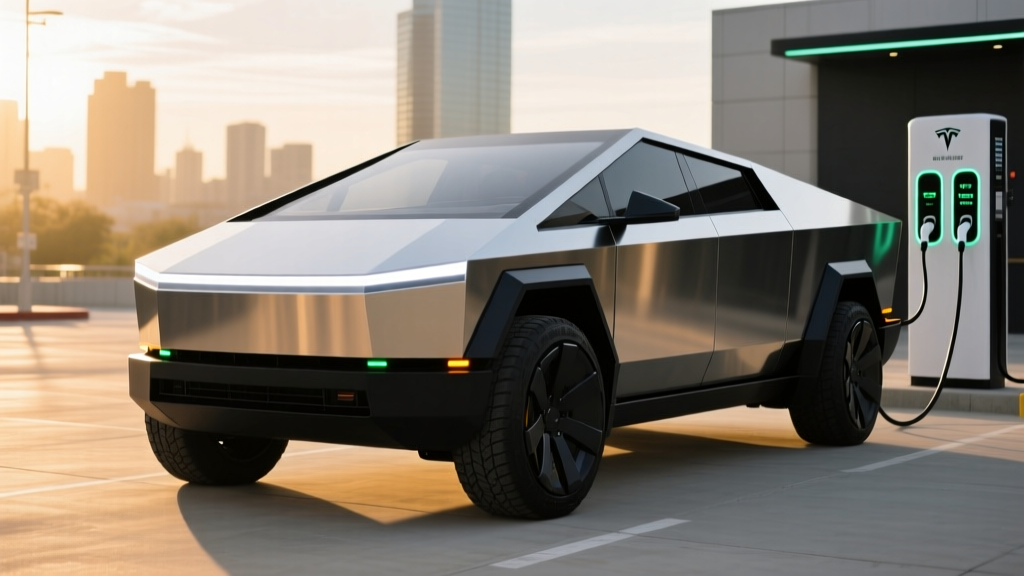
The Tesla Cybertruck Quad Motor — officially badged as the Cyberbeast — is the range-topping variant of Tesla's polarizing electric pickup. With four independent motors, 845 horsepower, and a stainless-steel exoskeleton, it occupies a category of one. But beyond the spectacle, buyers need hard numbers: what's the real highway range, how fast does it actually charge on a road trip, and does it still qualify for federal tax incentives in 2026? This review breaks down every spec that matters.
Cybertruck Quad Motor: Quick Verdict
The Cyberbeast is a performance truck first and a utility vehicle second. Its 320-mile EPA range (with the optional range extender battery pack) and 250 kW peak DC fast-charging make it viable for road trips, while its 845 hp and 2.6-second 0-60 time embarrass most sports cars. However, its bed is shorter than a full-size F-150 Lightning's, its payload and towing capacities trail traditional pickups, and its $99,990 base price (before incentives) puts it firmly in luxury territory. If you need maximum towing or a six-foot bed, look at the Rivian R1T or F-150 Lightning. If you want a head-turning daily driver that happens to haul gear on weekends, the Cyberbeast delivers.
Range, Battery, and Efficiency
Real-World Expectation: ~265–285 miles on highway trips at 70–75 mph; ~220–240 miles in freezing weather (below 32°F). Without the range extender, expect ~300 miles EPA and ~245–260 real-world highway.
The Cybertruck Quad Motor uses a ~123 kWh usable battery pack (estimated; Tesla does not publish exact usable capacity) with NMC (nickel manganese cobalt) chemistry. NMC cells offer higher energy density than LFP, which is necessary given the Cybertruck's massive weight (~6,800 lbs curb) and angular, high-drag profile.
Efficiency is the Cybertruck's weak point. According to EPA data on fueleconomy.gov, the Cybertruck AWD models achieve approximately 58 MPGe combined, translating to roughly 56–60 kWh per 100 miles. That's considerably worse than the Rivian R1T (~70 MPGe) and the Ford F-150 Lightning (~66 MPGe). The culprit is aerodynamic drag — the Cybertruck's flat stainless-steel panels and blunt nose create a drag coefficient around 0.34–0.38, far worse than most modern EVs.
| Spec | Value |
|---|---|
| EPA Range | 320 mi (w/ range extender) |
| Battery (usable, est.) | ~123 kWh, NMC |
| Efficiency | 58 MPGe / ~58 kWh/100mi |
| 0-60 mph | 2.6 seconds |
| Horsepower | 845 hp |
| Drivetrain | Quad-motor AWD |
| Max Towing | 11,000 lbs |
| Payload | 2,500 lbs |
| Base MSRP | $99,990 |
Charging Speed: DC Fast and Level 2
The Cybertruck Quad Motor supports a peak DC fast-charge rate of 250 kW on Tesla Supercharger V3/V4 stalls (NACS connector native — no adapter needed). In practice, the charge curve is aggressive: Tesla claims 10–80% in approximately 25 minutes, adding up to 152 miles of range in 15 minutes under optimal conditions.
However, real-world charging curves taper significantly above 80%. Expect 80–100% to take an additional 20–25 minutes — a common trait of large NMC packs. Preconditioning the battery (automatic when navigating to a Supercharger) is essential; cold-soaked batteries without preconditioning can see peak rates cut in half.
| Level | Power | Miles Added per Hour | Notes |
|---|---|---|---|
| Level 1 (120V) | ~1.4 kW | ~2–3 mi/hr | Emergency trickle only |
| Level 2 (240V, 48A) | 11.5 kW | ~19–21 mi/hr | Home standard; full charge ~11–12 hrs |
| Level 2 (240V, 80A) | 19.2 kW | ~32–35 mi/hr | Requires Tesla Wall Connector + 100A circuit |
| DC Fast (Supercharger) | 250 kW peak | ~600+ mi/hr (peak) | 10–80% in ~25 min |
For home charging, the Cybertruck's onboard charger accepts up to 19.2 kW (80A) on Level 2, but this requires a Tesla Wall Connector hardwired to a 100-amp breaker. Most homes will need a panel upgrade (common in older builds with 100A or 150A main service). Budget $1,500–$3,500 for a full Level 2 installation including electrician labor, permit, and potential panel work.
Performance and Drivetrain
Four independent motors — one at each wheel — produce a combined 845 horsepower and launch the 6,800-lb Cybertruck to 60 mph in 2.6 seconds. That's supercar territory in a stainless-steel truck. Each motor is individually torque-vectorable, giving the Cyberbeast exceptional traction control in off-road and low-grip conditions.
The quad-motor setup also enables crab walk (diagonal movement at low speed) and tank turns (360° pivot in place) — features shared with the Rivian R1T's quad-motor variant. Tesla's steer-by-wire system (no physical connection between steering wheel and rack) provides a variable ratio: very quick at low speeds, stable at highway speed. It takes adjustment but works well once acclimated.
Top speed is electronically limited to 130 mph. Towing capacity maxes at 11,000 lbs, though real-world range while towing drops dramatically — expect a 50–60% range reduction when pulling near max capacity.
Interior, Cargo, and Technology
The Cybertruck seats five across two rows. Rear legroom is ~37 inches — adequate but not generous for a vehicle this large. The cabin is minimalist in classic Tesla fashion: an 18.5-inch central touchscreen handles nearly all vehicle controls, with no traditional instrument cluster. A rear 9.4-inch touchscreen serves second-row passengers.
Cargo: The bed measures 6 feet long (72 inches) with the tailgate closed, extending to ~8 feet with the tailgate down (which functions as a ramp). The motorized tonneau cover is standard. Total bed volume is approximately 67 cu ft. The front trunk (frunk) adds ~7 cu ft of lockable storage — useful for charging cables and small gear.
Tech highlights:
- Tesla Autopilot (Level 2 driver-assist) standard; FSD (Supervised) available as a $8,000 option or $99/month subscription
- 48-volt electrical architecture (industry-first for a production vehicle) — enables thinner wiring harnesses and more efficient accessories
- Powered frunk and tonneau, air suspension with adjustable ride height (up to 17 inches of ground clearance)
- Built-in air compressor and 120V/240V bed outlets (up to 11.5 kW V2L capability for job-site power)
Notable drawbacks: The stainless-steel body is prone to fingerprints and shows scratches differently than painted steel. Panel gaps remain inconsistent across production units. Visibility is compromised by the thick A-pillars and small rear window. The steer-by-wire system, while innovative, lacks the tactile feedback some drivers prefer. And at nearly 7,000 lbs, tire wear is accelerated — expect replacement every 25,000–35,000 miles at significant cost.
Pricing, Trims, and Federal Tax Credit
| Trim | Base MSRP | §30D Credit Eligible? | Est. After Credit |
|---|---|---|---|
| AWD (Dual Motor) | $79,990 | No (MSRP cap $80,000 for trucks)* | $79,990 |
| Cyberbeast (Quad Motor) | $99,990 | No (exceeds MSRP cap) | $99,990 |
*Under IRS §30D rules, the new EV tax credit has an MSRP cap of $80,000 for trucks, vans, and SUVs. The Cybertruck AWD at $79,990 sits at the razor's edge — however, adding any factory option or destination charge can push it over. The Cyberbeast at $99,990 far exceeds the cap and does not qualify for the $7,500 federal credit regardless of buyer income. Consult IRS §30D guidelines and a tax professional for your specific situation.
Additional §30D requirements that apply to all EVs include buyer income caps ($150,000 single / $300,000 joint MAGI), battery critical-mineral sourcing thresholds, and North American final assembly. Even the dual-motor AWD trim faces sourcing hurdles that may reduce or eliminate its credit in 2026.
As-tested pricing: A Cyberbeast with FSD ($8,000), the range-extender battery pack (~$10,000 when available), and premium interior pushes the out-the-door price past $120,000 before taxes and fees.
Warranty and Long-Term Ownership
Tesla provides the following warranty coverage for the Cybertruck:
- Basic vehicle: 4 years / 50,000 miles
- Battery and drive units: 8 years / 120,000 miles (with minimum 70% capacity retention)
- Rust-through (body): 4 years / 50,000 miles (limited — stainless steel doesn't rust traditionally)
The 8-year/120,000-mile battery warranty is competitive with the F-150 Lightning (8/100,000) and slightly better than Rivian (8/175,000 on the battery, but 5/60,000 on the vehicle). Replacement cost for the Cybertruck's large NMC pack is estimated at $20,000–$30,000 out of warranty, though degradation data on the Cybertruck specifically is still accumulating given its late-2023 production start.
Insurance costs are a real consideration: the Cybertruck's repair costs (specialized stainless-steel body panels, steer-by-wire components) push premiums significantly above average. Expect $3,500–$5,500/year depending on location and driving record — get quotes before committing.
Cybertruck Quad Motor vs. the Competition
The Cyberbeast competes in a narrow slice of the market — high-performance electric trucks over $90,000. Here's how it stacks up:
- Rivian R1T Quad Motor: ~1,025 hp, 352-mi EPA range (Max Pack), ~$99,000. Better range, more traditional pickup utility, but less brand cachet and a smaller service network.
- Ford F-150 Lightning Platinum: 580 hp, 320-mi EPA range (extended range), ~$96,875. Better towing utility, Pro Power Onboard, conventional styling. Far less performance.
- GMC Hummer EV Pickup: 1,000 hp, 329-mi EPA range, ~$104,500. Comparable performance and price; larger and heavier; less efficient.
Choose the Rivian R1T Quad Motor if: You need real-world range over 340 miles, prefer a more conventional truck bed, and value off-road capability with proven software.
Choose the F-150 Lightning if: You need maximum towing/payload, want lower pricing, and prefer a familiar truck experience.
Pros and Cons
- 2.6-second 0-60 — fastest production pickup ever built
- Native NACS Supercharger network access (most reliable public charging)
- Stainless-steel body eliminates paint maintenance
- 11.5 kW V2L output for job-site or camping power
- 48V architecture is ahead of the industry
- Air suspension with adaptive ride height
- 58 MPGe — among the least efficient EVs on sale
- Does not qualify for $7,500 federal tax credit (MSRP cap)
- Short 6-foot bed limits utility vs. full-size trucks
- Panel gaps and build quality still inconsistent
- Steer-by-wire lacks feel for some drivers
- High insurance premiums ($3,500–$5,500/yr)
- Heavy tire wear due to ~6,800-lb curb weight
Frequently Asked Questions
What is the real-world range of the Cybertruck Quad Motor?
The EPA rates it at 320 miles with the range extender. In real-world highway driving at 70–75 mph, expect 265–285 miles. In freezing temperatures, that drops to 220–240 miles due to battery resistance and cabin heating demands.
How fast does the Cybertruck Cyberbeast charge?
Peak DC fast charging is 250 kW on Tesla Superchargers, achieving 10–80% in approximately 25 minutes. At home on a 48A Level 2 charger, it adds about 20 miles per hour, requiring 11–12 hours for a full charge from empty.
Does the Cybertruck qualify for the federal EV tax credit?
The Cyberbeast at $99,990 exceeds the §30D MSRP cap of $80,000 for trucks and does not qualify. The dual-motor AWD at $79,990 is at the limit, but any added options or destination charges may push it over. Battery sourcing rules may further restrict eligibility. Check IRS guidelines for current-year rules.
Is the Cybertruck worth it vs. the Rivian R1T?
Depends on priorities. The Cyberbeast wins on acceleration (2.6s vs. ~3.0s), Supercharger network access, and novelty. The R1T Quad Motor wins on real-world range (352 mi vs. ~280 mi highway), bed utility, and build consistency. Both are ~$100,000 and neither qualifies for the federal credit.
What's the biggest Cybertruck drawback for daily ownership?
Efficiency. At ~58 kWh/100mi, the Cybertruck consumes significantly more electricity per mile than competitors, raising home-charging costs and reducing real-world range. Combined with high insurance and tire costs, total cost of ownership is steep even without fuel expenses.
Can the Cybertruck tow a camper or boat?
Yes — its 11,000-lb max towing rating handles most travel trailers and boats. However, towing near max capacity cuts range by 50–60%, reducing effective range to 130–160 miles between charges. Plan routes around Supercharger stops accordingly.