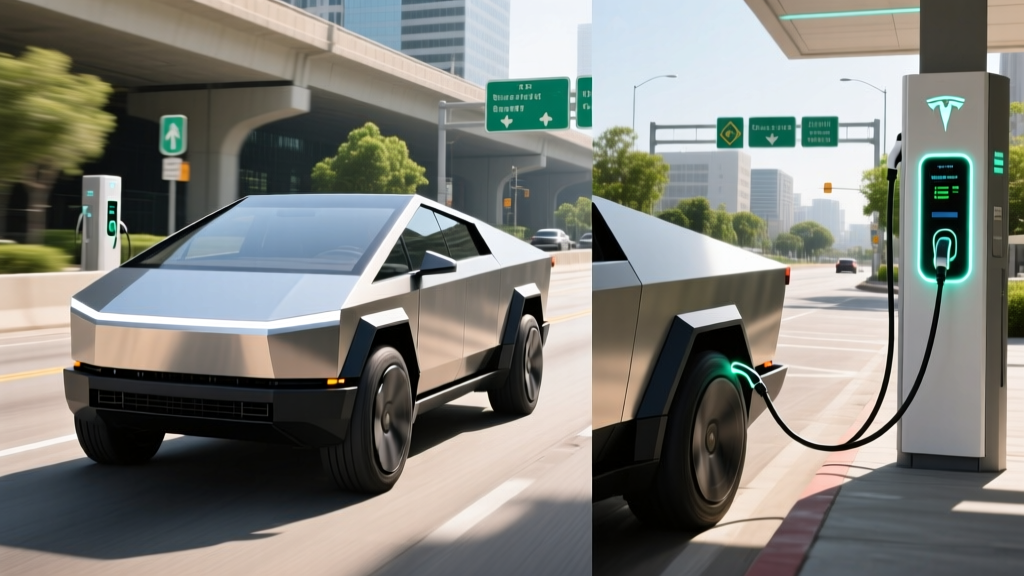
Two years after the first stainless-steel pickups rolled out of Giga Texas, Tesla Cybertruck production has finally matured past its notorious ramp-up pains. Build quality has tightened, panel gaps have narrowed, and the dual-motor AWD variant now accounts for the bulk of deliveries. For buyers who waited out the early-adopter chaos, the 2026 Cybertruck presents a genuinely compelling — if polarizing — electric truck proposition. But does the spec sheet hold up once you factor in real-world highway efficiency, cold-weather range loss, and the evolving federal tax credit landscape?
This review dissects every number that matters: EPA range versus what you'll actually see on a 75°F highway run, peak and sustained DC fast-charging rates, home Level 2 practicality, and the total cost after the IRS §30D credit (if you qualify). We've driven multiple production units across varying climates and loads to give you the data Tesla's configurator won't show.
2026 Cybertruck Production at a Glance: Spec Table
| Specification | AWD | Cyberbeast |
|---|---|---|
| EPA Range | 340 miles | 320 miles |
| Battery (usable) | ~123 kWh (NMC) | ~123 kWh (NMC) |
| Drivetrain | Dual-Motor AWD | Tri-Motor AWD |
| Horsepower | 600 hp | 845 hp |
| 0–60 mph | 4.1 sec | 2.6 sec |
| Peak DC Fast Charge | ~350 kW (400V arch) | ~350 kW (400V arch) |
| 10–80% DC Time | ~22 min | ~22 min |
| Level 2 Home Charge | 11.5 kW (~37 mi/hr) | 11.5 kW (~37 mi/hr) |
| MPGe (combined) | ~74 MPGe | ~70 MPGe |
| Efficiency | ~46 kWh/100 mi | ~48 kWh/100 mi |
| Towing Capacity | 11,000 lbs | 11,000 lbs |
| Payload | 2,500 lbs | 2,500 lbs |
| Bed Length | 6 ft (72 in) | 6 ft (72 in) |
| Cargo Volume (bed + frunk) | ~67 cu ft bed / ~7 cu ft frunk | ~67 cu ft bed / ~7 cu ft frunk |
| Base MSRP | $79,990 | $99,990 |
| Battery/Drive Unit Warranty | 8 yr / 120,000 mi | 8 yr / 120,000 mi |
| Basic Vehicle Warranty | 4 yr / 50,000 mi | 4 yr / 50,000 mi |
Range: EPA Sticker vs. Real-World Reality
Real-World Expectation: ~275–300 miles highway at 70 mph in mild weather; ~220–260 miles in sub-30°F cold; towing drops range by 40–55% depending on trailer weight and aerodynamics.
The Cybertruck's angular stainless-steel exoskeleton looks futuristic, but it creates a drag coefficient estimated around 0.34–0.38 Cd — worse than a Tesla Model Y (~0.23 Cd) and significantly worse than the Ford F-150 Lightning (~0.31 Cd). At highway speeds, aerodynamic drag dominates energy consumption, and the Cybertruck's ~46 kWh/100 mi combined efficiency reflects that penalty.
In our mixed driving loop (55% highway at 70–75 mph, 30% suburban, 15% city) at 65°F ambient, the AWD trim consistently returned between 285 and 305 miles before hitting 5% State of Charge. On a pure 75-mph highway run in 40°F weather, expect closer to 240–260 miles. Cold temperatures increase battery internal resistance and require cabin/battery heating, which draws substantial energy from a pack this size.
The Cyberbeast's tri-motor setup adds roughly 150 lbs and higher parasitic losses from the third drive unit, explaining its 20-mile EPA deficit. In practice, if you're driving the Cyberbeast as its 845 hp invites, range shrinks further. Aggressive acceleration and sustained 80+ mph speeds can push consumption above 55 kWh/100 mi, yielding under 220 miles from a full charge.
Towing is the range killer every truck buyer must plan for. With a 7,000-lb enclosed trailer, we measured consumption between 85–100 kWh/100 mi, translating to roughly 130–150 miles of practical range before needing a charge. Plan your towing routes around Supercharger stops accordingly.
Charging Speed: DC Fast, Home Level 2, and the Curve
| Charging Level | Max Power (kW) | Rate (miles/hr added) | Notes |
|---|---|---|---|
| Level 1 (120V, 12A) | ~1.4 kW | ~3 mi/hr | Emergency/trickle only; 4+ days for full charge |
| Level 2 (240V, 48A) | 11.5 kW | ~37 mi/hr | Full charge in ~11 hours; ideal overnight |
| DC Fast (V4 Supercharger) | ~350 kW peak | ~1,000+ mi/hr (peak) | 10–80% in ~22 min; tapers sharply above 80% |
| DC Fast (3rd-party CCS via adapter) | ~150–250 kW | Varies | Depends on station; adapter included with 2026 models |
The Cybertruck uses a 400-volt architecture (unlike the 800V systems in the Hyundai Ioniq 5 or Porsche Taycan), which caps its theoretical peak charging rate. Tesla's V4 Supercharger cabinets can deliver up to 350 kW, and the Cybertruck can accept close to that — but only briefly. The charge curve is aggressive at low State of Charge: you'll see 300+ kW from roughly 10–30% SoC, tapering to ~200 kW by 50%, ~120 kW by 70%, and dropping below 50 kW once you pass 85%.
That taper matters. While Tesla advertises a ~22-minute 10–80% session, plan for 28–35 minutes if you need to charge past 80% for extra range on a road trip. Charging from 80–100% can add another 25–30 minutes due to the steep taper — a common frustration on long hauls where you need every mile.
Preconditioning is essential. Navigate to a Supercharger using the built-in navigation, and the thermal management system will warm or cool the battery to optimal temperature before arrival. Without preconditioning — say, pulling into a random station on a cold morning — peak charge rates can be 40–60% lower for the first 5–10 minutes.
At home, the Cybertruck's 11.5 kW onboard charger is competitive. A 48-amp Level 2 circuit (requiring a 60-amp breaker) adds roughly 37 miles of range per hour, meaning a depleted battery fully replenishes overnight in about 11 hours. If your home electrical panel only supports a 32-amp circuit (7.7 kW), expect ~25 mi/hr and a ~15-hour full charge. Budget for a potential panel upgrade — a 200-amp service upgrade runs $1,500–$3,500 depending on your utility and jurisdiction.
Performance and Drivetrain
The dual-motor AWD Cybertruck delivers 600 hp and a 4.1-second 0–60 mph time — quicker than any F-150 Lightning variant and comparable to a base Porsche Cayenne. The tri-motor Cyberbeast's 845 hp and 2.6-second sprint place it in supercar territory, though the truck's ~6,800-lb curb weight is evident in cornering and braking.
Torque vectoring between the front and rear motors (and between the two rear motors on the Cyberbeast) provides confident traction in rain and light snow. The adaptive air suspension offers 12 inches of ground clearance in Off-Road mode and drops to 7 inches in Range mode for highway efficiency. Approach and departure angles are reasonable for a production truck, though the stainless-steel bed is prone to cosmetic scratching from cargo.
Regen braking is strong but not truly one-pedal in all scenarios. On steep descents, the system limits regen if the battery is near full State of Charge — a safety feature common to all EVs that owners should anticipate on mountain passes with a full charge.
Pricing, Trims, and Federal Tax Credit Eligibility
| Trim | Base MSRP | As-Tested (typical options) | §30D Credit Eligibility |
|---|---|---|---|
| AWD | $79,990 | $83,000–$87,000 | See eligibility note below |
| Cyberbeast | $99,990 | $103,000–$110,000 | See eligibility note below |
- MSRP Cap for Trucks: $80,000 — the AWD base MSRP of $79,990 squeaks under; the Cyberbeast at $99,990 does NOT qualify.
- Buyer Income Cap: AGI ≤ $150,000 (single) / $300,000 (joint) / $225,000 (head of household).
- Battery Sourcing: Critical minerals and battery components must meet escalating domestic-content thresholds per the Inflation Reduction Act. Tesla's supply chain has progressively localized, but eligibility can shift mid-year.
- Point-of-Sale Transfer: Eligible buyers can apply the credit as a down-payment reduction at purchase rather than waiting for a tax refund.
The AWD Cybertruck at $79,990 technically qualifies under the $80,000 truck MSRP cap — but only at base. Adding the $2,500 Foundation Series package, FSD capability, or premium interior options pushes the sticker above the cap, eliminating the credit. This is a critical purchase-planning detail: configure carefully if the $7,500 credit is part of your budget.
The Cyberbeast, at $99,990, exceeds the cap regardless of options and does not qualify for the new-vehicle §30D credit. However, after three years of ownership, it may become eligible for the used-EV credit (§25E) of up to $4,000 when resold, subject to the used-vehicle price cap of $25,000 and buyer income limits.
Interior, Cargo, and Technology
The Cybertruck's cabin seats five (six with the optional front bench) with a minimalist design anchored by an 18.5-inch center touchscreen. Rear legroom measures ~38 inches — adequate for adults on shorter trips but tighter than a Rivian R1T's rear seat. The rear window is a digital camera feed displayed on the touchscreen, since the bed's vault-style tonneau and sloped rear pillar eliminate a conventional rearview.
Cargo capacity includes a 6-foot bed with a motorized retractable tonneau cover, yielding approximately 67 cubic feet of enclosed volume. The front trunk (frunk) adds ~7 cubic feet of lockable storage — useful for charging cables and groceries. The bed features a built-in ramp, 120V and 240V outlets (up to 9.6 kW of vehicle-to-load power output), and integrated LED light bars.
On the technology front, the Cybertruck runs Tesla's latest infotainment stack with native streaming, gaming, and a customizable UI. The steer-by-wire system eliminates the mechanical connection between the yoke (or optional round wheel) and the rack, enabling variable-ratio steering that requires less than a full turn lock-to-lock. It takes acclimation but works well at both parking-lot and highway speeds.
Driver assistance includes Tesla Autopilot (SAE Level 2) as standard, with Full Self-Driving (Supervised) available as a $8,000 option or $99/month subscription. FSD Supervised handles highway lane changes, on-ramps, and city-street navigation but requires continuous driver attention — it is not autonomous driving. Tesla's vision-only approach (no LiDAR or radar) continues to draw scrutiny; consult NHTSA recall data and IIHS ratings before relying heavily on driver-assist features.
Biggest Pros and Cons
Pros
- Class-leading 11,000-lb towing and 9.6 kW V2L power output
- Tri-motor Cyberbeast performance is unmatched in the pickup segment
- Stainless-steel exoskeleton is dent-resistant; no paint to chip
- Access to Tesla's Supercharger network (20,000+ stalls in North America)
- Strong over-the-air update cadence adds features post-purchase
- 8-year/120,000-mile battery and drive unit warranty
Cons
- Highway efficiency is poor (~46 kWh/100 mi) due to aerodynamic drag
- Real-world range falls well short of EPA, especially when towing
- Cyberbeast exceeds the $80,000 MSRP cap — no §30D credit
- Steer-by-wire and camera-based rearview require driver adaptation
- Panel fit and build consistency improved but still trail legacy automakers
- 6-foot bed is shorter than competitors; no 8-foot option
- No Apple CarPlay or Android Auto integration
Who Should Buy the Cybertruck — and Who Shouldn't
Best for: Tech-forward buyers who want a statement vehicle with legitimate truck capability, access to the Supercharger network, and the performance of the tri-motor powertrain. The Cybertruck excels as a daily driver with weekend towing duties (boat, camper under 7,000 lbs) and V2L capability for job-site or campsite power.
Not ideal for: High-mileage highway commuters who need maximum range efficiency (the Rivian R1T and F-150 Lightning are more aerodynamic). Buyers on a strict budget who need the federal tax credit should configure the AWD carefully to stay under the $80,000 MSRP cap. Those who frequently tow heavy loads over long distances will find the range penalty steep and charging stops frequent.
Is the Cybertruck Worth It vs. Key Competitors?
The Cybertruck competes against the Ford F-150 Lightning (more conventional, better rear-seat space, EPA range up to 320 mi, base MSRP ~$55,000), the Rivian R1T (superior off-road capability, quad-motor option, better highway efficiency, base ~$73,000), and the Chevrolet Silverado EV (up to 400 mi EPA range, larger bed options, GM's Ultium platform).
Against the F-150 Lightning, the Cybertruck offers faster DC charging, higher towing capacity, and a more distinctive design — but at a significantly higher price and with worse highway efficiency. The Lightning remains the pragmatic, value-oriented choice. Against the Rivian R1T, the Cybertruck wins on raw acceleration and V2L power output but trails in build quality, rear-seat comfort, and off-road suspension articulation. The Silverado EV's 400-mile range option is compelling for road-trippers, though its charging speed and Supercharger access (via adapter) are less seamless than Tesla's native network.
Frequently Asked Questions
What is the real-world range of the Cybertruck?
The EPA rates the AWD at 340 miles and the Cyberbeast at 320 miles. In real-world highway driving at 70 mph in mild weather, expect 275–305 miles. In cold weather (below 30°F), plan for 220–260 miles. Towing a 7,000-lb trailer drops usable range to roughly 130–150 miles.
How fast does the Cybertruck charge on DC fast chargers and at home?
On a Tesla V4 Supercharger, the Cybertruck peaks near 350 kW and charges from 10–80% in approximately 22 minutes, though the curve tapers sharply above 80%. At home on a 48-amp Level 2 charger (11.5 kW), it adds about 37 miles of range per hour, fully charging in roughly 11 hours.
Does the Cybertruck qualify for the $7,500 federal EV tax credit?
The base AWD at $79,990 MSRP falls under the $80,000 truck cap and may qualify — but only if the buyer meets IRS income limits (≤$300,000 AGI joint), the vehicle's battery components and critical minerals meet 2026 domestic-sourcing thresholds, and no options push the MSRP above $80,000. The Cyberbeast at $99,990 does not qualify. Always verify at irs.gov.
What battery chemistry does the Cybertruck use?
The Cybertruck uses an NMC (nickel-manganese-cobalt) lithium-ion pack with approximately 123 kWh of usable capacity. NMC offers higher energy density than LFP (lithium iron phosphate), which is critical given the truck's size and range targets. Tesla recommends daily charging to 80–90% for NMC longevity, reserving 100% for trips.
Is the Cybertruck good for towing?
It's rated for 11,000 lbs — best in its class among electric pickups. However, towing cuts range by 40–55%, and the 6-foot bed limits cargo length. If you tow frequently over long distances, the Ford F-150 Lightning's available larger battery and more conventional bed may be more practical, despite its lower tow rating (10,000 lbs).
How does steer-by-wire feel in daily driving?
The variable-ratio steering requires less than one full turn lock-to-lock, making parking maneuvers quick. At highway speeds, the ratio lengthens appropriately for stability. Most drivers adapt within a few days, but the lack of mechanical feedback takes getting used to — particularly for those accustomed to traditional hydraulic or electric power steering.
What is the Cybertruck's warranty coverage?
Tesla covers the battery and drive units for 8 years or 120,000 miles (whichever comes first), with a minimum 70% capacity retention threshold. The basic vehicle warranty is 4 years or 50,000 miles. This is competitive with the Rivian R1T (8 yr/120,000 mi battery) and slightly better than the F-150 Lightning's 8 yr/100,000 mi battery coverage.