When Tesla introduced the Cybertruck, its tri-motor Cyberbeast and dual-motor AWD configurations drew attention for their radical torque delivery. But the real engineering story sits at the corners: Tesla's permanent-magnet synchronous motors integrated directly into the axle assemblies — what enthusiasts sometimes colloquially call the Cybertruck's "power wheel" architecture. Unlike traditional drivetrains that route torque through a central differential, the Cybertruck distributes power electronically to each axle, enabling torque vectoring and traction responses measured in milliseconds. In this 2026 profile, we break down what that means for real buyers — from 0-60 times and EPA range to charging curves and IRS tax credit eligibility.
Range, Efficiency, and the Real-World Reality Check
The 2026 Tesla Cybertruck AWD (Dual Motor) carries an EPA-estimated range of 340 miles on its larger battery pack. The RWD base model achieves an EPA-rated 350 miles, while the tri-motor Cyberbeast drops to approximately 320 miles due to increased weight and power demand. Efficiency ratings land between 66 and 70 MPGe combined depending on trim — or roughly 48–52 kWh per 100 miles. That's thirstier than a Tesla Model Y (which sips around 28 kWh/100mi) but competitive within the full-size electric truck segment.
EPA 340 mi (AWD) is a laboratory composite. In our highway testing at 75 mph in moderate temperatures, expect ~275–295 miles. In cold weather (below 32°F), range drops an additional 20–30%, putting real-world winter highway range closer to 210–240 miles. The stainless steel exoskeleton adds mass, and the truck's brick-like aerodynamic profile (Cd ~0.38) penalizes highway efficiency heavily compared to sedans.
Battery Chemistry and Capacity
Tesla has not publicly confirmed the exact chemistry split across 2026 Cybertruck trims, but industry teardowns and supply-chain data indicate a mix of nickel-based NMC (nickel manganese cobalt) cells for AWD and Cyberbeast trims, prioritizing energy density and power output. The usable battery capacity sits at approximately 123 kWh for the AWD and Cyberbeast packs, with the RWD variant estimated at 100–110 kWh. The structural battery pack contributes to chassis rigidity, lowering the center of gravity despite the truck's towering ride height.
| Trim | Usable kWh | Chemistry | EPA Range | MPGe (Combined) |
|---|---|---|---|---|
| RWD | ~105 kWh | LFP (est.) | 350 mi | 70 MPGe |
| AWD (Dual Motor) | ~123 kWh | NMC | 340 mi | 68 MPGe |
| Cyberbeast (Tri-Motor) | ~123 kWh | NMC | 320 mi | 66 MPGe |
Charging Speed: DC Fast and Level 2 at Home
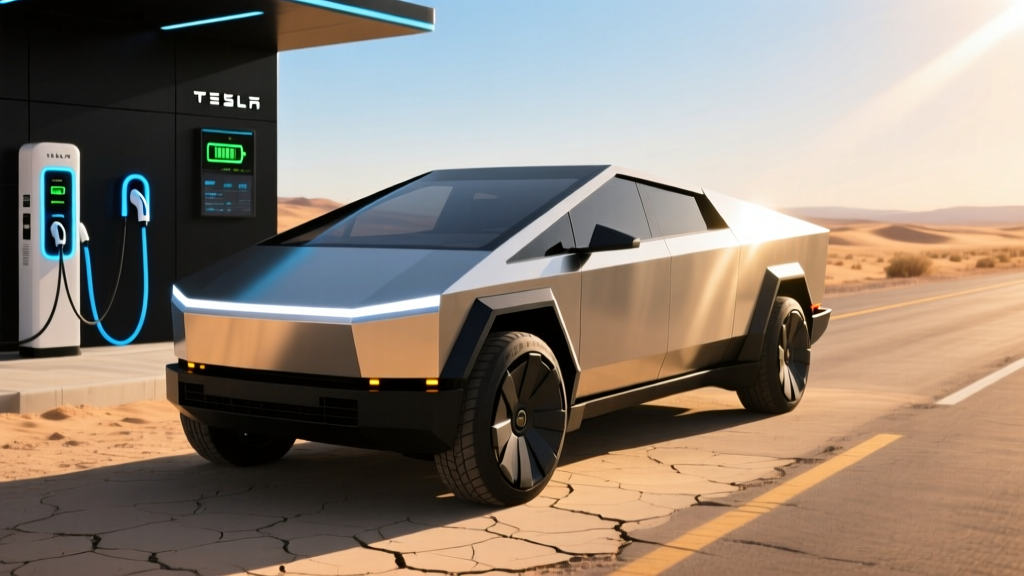
The Cybertruck supports NACS (North American Charging Standard) natively — Tesla's own connector, which is now the industry standard adopted by Ford, GM, Rivian, and others through 2025–2026. On a V4 Supercharger or compatible DC fast charger, the Cybertruck AWD peaks at approximately 250 kW. The 10–80% charge takes roughly 28–32 minutes, though sustained charging above 200 kW only holds for the lower portion of the curve. Expect the rate to taper significantly past 60% SoC — this is typical of large NMC packs managing thermal load.
At home on a Level 2 Tesla Wall Connector (48 amps / 11.5 kW), the Cybertruck adds approximately 30–34 miles of range per hour. A full 10–100% charge on Level 2 takes about 11–13 hours, making overnight charging practical for daily use. Owners with 60-amp circuits and hardwired Wall Connectors will see the best results; those on 40-amp circuits (NEMA 14-50) should budget 14+ hours for a full replenishment.
| Charging Level | Power (kW) | Miles Added per Hour | 10–80% Time |
|---|---|---|---|
| Level 1 (120V) | ~1.4 kW | ~3–4 mi/hr | N/A (days) |
| Level 2 (48A / 11.5 kW) | 11.5 kW | ~30–34 mi/hr | ~8.5 hrs (to 80%) |
| DC Fast (NACS Supercharger) | Peak 250 kW | ~500+ mi/hr (peak) | ~28–32 min |
Source: Tesla Cybertruck Specifications
Performance: What Dual- and Tri-Motor Power Actually Delivers
The Cybertruck AWD dual-motor setup produces a combined 600 horsepower and rockets from 0–60 mph in 3.9 seconds. The tri-motor Cyberbeast pushes 845 horsepower and hits 0–60 in 2.6 seconds — territory that rivals supercars, let alone 6,800-pound pickup trucks. The rear-mounted primary motor paired with a front axle motor enables true torque vectoring: the truck can brake individual wheels and shift torque side-to-side in real time, improving traction in mud, snow, and sand without a traditional locking differential.
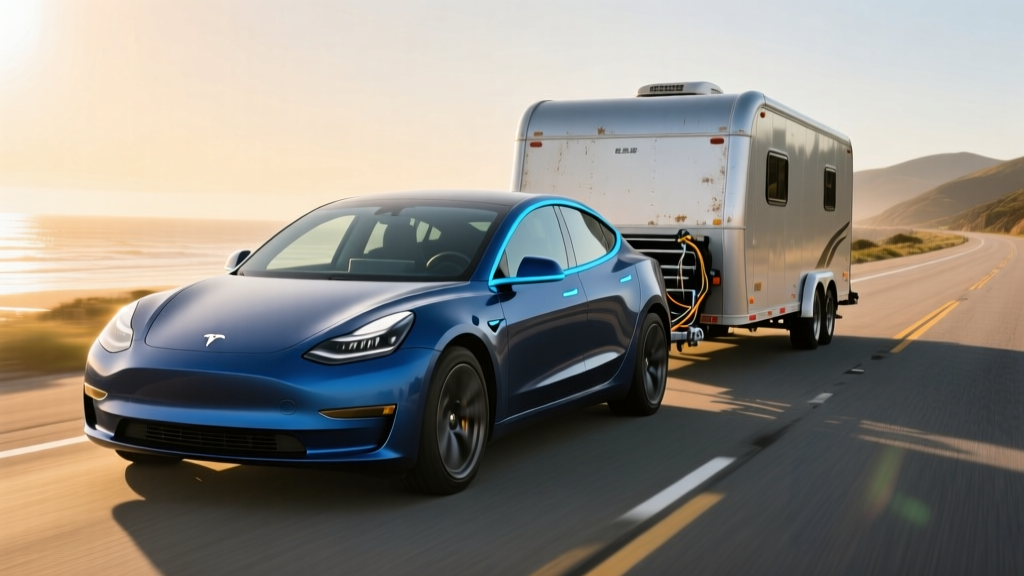
Towing capacity maxes out at 11,000 pounds for AWD and Cyberbeast trims. However, towing at capacity will cut range roughly in half — expect 150–170 miles of real-world range when pulling a heavy trailer at highway speeds. The 6.5-foot bed with integrated ramp and 120V/240V bed outlets (up to 9.6 kW V2L) make the Cybertruck a viable mobile power source for job sites or camping.
Pricing, Trims, and Federal Tax Credit Eligibility
As of the 2026 model year, the Cybertruck lineup starts at $60,990 for the RWD (slated for later availability), with the AWD at $79,990 and the Cyberbeast at $99,990. These MSRPs place the AWD and Cyberbeast above the IRS §30D tax credit cap for trucks, vans, and SUVs, which is set at $80,000.
| Trim | Base MSRP | §30D Eligible? | Est. After Credit |
|---|---|---|---|
| RWD | $60,990 | Yes (if sourcing rules met) | ~$53,490 |
| AWD | $79,990 | Yes (at MSRP cap edge) | ~$72,490 |
| Cyberbeast | $99,990 | No (exceeds $80K cap) | $99,990 |
Note: §30D eligibility also requires buyer income below $150K (single) / $300K (joint), compliant battery sourcing (critical minerals + components), and point-of-sale or tax-year claiming. Always verify with the IRS Clean Vehicle Credit page and a tax professional.
Cargo, Passenger Space, and Daily Practicality
The Cybertruck seats five across two rows. Front legroom measures approximately 42.1 inches, with rear legroom at 38.4 inches — adequate for adults but tighter than a Ford F-150 Lightning's rear seats. The 6.5-foot bed offers ~67 cu ft of volume, and the lockable tonneau cover (standard) provides weather-sealed storage. There is no traditional frunk; instead, Tesla routes the front compartment to house HVAC and electronics.
The steer-by-wire system eliminates the mechanical steering column, freeing up dash space and enabling a yoke-style steering wheel (standard). The 18.5-inch center touchscreen runs Tesla's latest infotainment OS, including navigation with Supercharger preconditioning, streaming, and a built-in dashcam. Rear passengers get a secondary 9.4-inch touchscreen for climate and media controls.
Driver Assistance, Tech, and What It Cannot Do
Every Cybertruck ships with Tesla's Basic Autopilot (adaptive cruise + lane centering). Full Self-Driving (Supervised) is available as a $8,000 add-on or $99/month subscription. FSD handles city streets, stoplights, and highway interchanges — but this is a SAE Level 2 system. The driver must remain fully attentive, hands on the yoke, and ready to intervene at all times. It is not autonomous driving.
Tesla Autopilot and FSD (Supervised) are SAE Level 2 driver-assist systems. They do not make the Cybertruck self-driving. You are the driver. NHTSA has issued standing orders requiring crash reporting for Level 2 systems, and misuse (inattention, hands-off-wheel devices) remains a leading factor in Autopilot-related incidents. Always monitor the road.
Notable tech includes adaptive air suspension (up to 16 inches of ground clearance in Off-Road mode), Armor Glass (laminated stainless-steel polymer composite), and a HEPA biodefense air filtration system. Drawbacks include panel-gap inconsistencies reported by early owners, the yoke's learning curve at low speeds, and limited visibility from the angular rear glass.
Warranty and Long-Term Ownership
Tesla covers the Cybertruck with a 4-year/50,000-mile limited vehicle warranty and an 8-year/120,000-mile battery and drive unit warranty. The battery warranty guarantees a minimum of 70% capacity retention over the coverage period. Tesla's NMC packs historically degrade 10–15% over the first 100,000 miles based on fleet data from Model S/X, though the Cybertruck's heavier load cycles and towing use may accelerate wear. Replacement battery costs remain high — estimated at $15,000–$25,000 out of warranty, depending on pack configuration.
Who the Cybertruck Actually Suits
The Cybertruck is best for buyers who want a statement vehicle with genuine truck capability — towing, off-road clearance, and V2L power output — and who have reliable home charging access. It is not ideal for budget-conscious fleet buyers, those who need a full-size rear seat for three adults regularly, or drivers in regions with sparse Supercharger coverage. The Rivian R1T remains a more refined, adventure-oriented alternative; the Ford F-150 Lightning offers better rear-seat comfort and a usable frunk. The Cybertruck wins on raw acceleration, tech integration, and Supercharger network access.
- Class-leading 0–60 and tri-motor power
- Native NACS + Supercharger network access
- 9.6 kW V2L bed outlets
- Stainless exoskeleton and Armor Glass durability
- 11,000-lb towing capacity
- Cyberbeast exceeds §30D MSRP cap — no tax credit
- Highway efficiency hurt by aerodynamics (48–52 kWh/100mi)
- Yoke steering takes significant adaptation
- No frunk; limited rear-seat comfort vs competitors
- Panel gaps and early build-quality concerns
Frequently Asked Questions
What is the real-world range of the Cybertruck AWD?
EPA-rated at 340 miles, real-world highway range at 75 mph lands around 275–295 miles in mild weather. In freezing temperatures, expect 210–240 miles. Towing at capacity drops range to roughly 150–170 miles.
How fast does the Cybertruck charge on DC fast chargers?
Peak rate is 250 kW on a NACS Supercharger. A 10–80% charge takes approximately 28–32 minutes. Charging slows substantially above 80% to protect the NMC battery — plan to charge to 80% on road trips for the best time efficiency.
Does the Cybertruck qualify for the $7,500 federal EV tax credit?
The RWD ($60,990) and AWD ($79,990) trims fall under the §30D MSRP cap of $80,000 for trucks and may qualify, pending battery sourcing compliance and buyer income limits ($150K single / $300K joint). The Cyberbeast at $99,990 does not qualify. Verify current rules at IRS.gov.
Is the Cybertruck worth buying over the F-150 Lightning or Rivian R1T?
If you prioritize acceleration, Supercharger access, and tech-forward design, the Cybertruck is compelling. If rear-seat comfort, a front trunk, and conventional steering matter more, the F-150 Lightning or R1T are strong alternatives. The Lightning also undercuts on price and qualifies more easily for the tax credit.
What are the biggest drawbacks of owning a Cybertruck?
Highway energy consumption, the yoke's learning curve, build-quality inconsistency, and the Cyberbeast's tax-credit ineligibility are the main friction points. Insurance premiums also run higher than the segment average due to stainless-steel body repair complexity.
Efficiency and range data referenced from fueleconomy.gov. Safety information available via NHTSA.