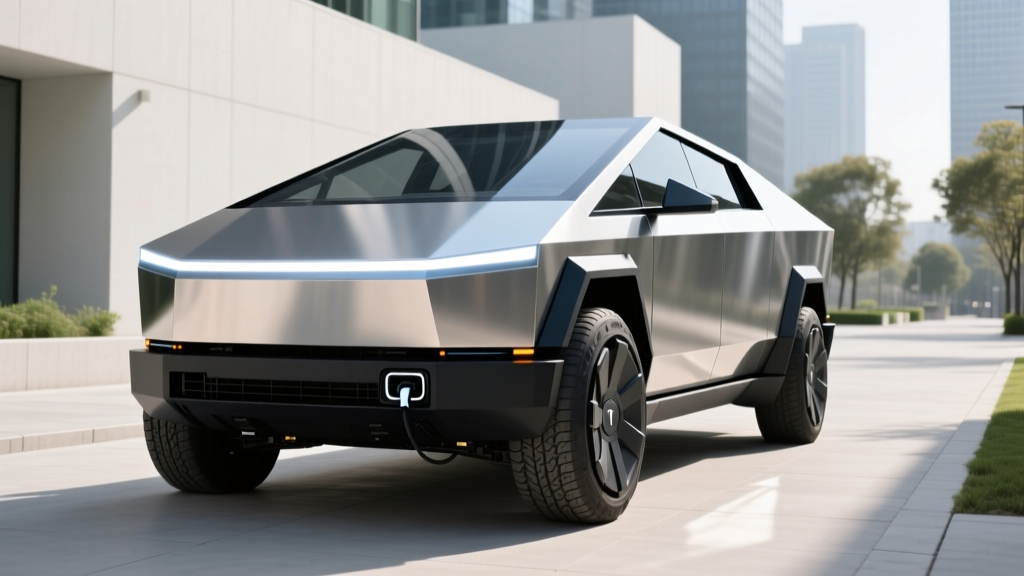
The Tesla Cybertruck has never been a conventional pickup, but the polished stainless-steel exterior option elevates its presence from industrial-brutalist to mirror-finish showpiece. Available as a factory option on the All-Wheel Drive and Cyberbeast trims, the polished treatment transforms the cold-rolled 30X stainless panels into a reflective surface that commands attention at every charging stop and jobsite. But beneath that gleaming skin lies the same polarizing, polarizing-capable electric truck that has divided the pickup world since its 2023 debut. This review breaks down the 2026 Cybertruck polished edition with exact specs, real-world range data, charging benchmarks, and a clear-eyed look at whether the $79,990+ price tag makes sense in today's electric truck market.
2026 Cybertruck Polished: At-a-Glance Specs
| Spec | AWD (Polished Option) | Cyberbeast (Polished Option) |
|---|---|---|
| EPA Range | 340 miles | 320 miles |
| Battery (Usable) | ~123 kWh (NMC) | ~123 kWh (NMC) |
| Drivetrain | Dual-Motor AWD | Tri-Motor AWD |
| Horsepower | 600 hp | 845 hp |
| 0–60 mph | 3.9 sec | 2.6 sec |
| Max DC Fast Charge | 250 kW | 250 kW |
| 10–80% DC Charge | ~28 min | ~28 min |
| Level 2 Home Charge | 11.5 kW (~37 mi/hr) | 11.5 kW (~37 mi/hr) |
| MPGe (Combined) | 66 MPGe | 61 MPGe |
| Towing Capacity | 11,000 lbs | 11,000 lbs |
| Base MSRP | $79,990* | $99,990* |
| Battery Warranty | 8 yr / 120,000 mi | 8 yr / 120,000 mi |
*Pricing reflects the polished stainless option at approximately $2,500 added to the base MSRP. Destination fee additional. Verify current pricing at Tesla.com.
Real-World Range: What the EPA Number Doesn't Tell You
Real-World Highway (70 mph, moderate temps): ~270–295 miles
Cold Weather (below 30°F, highway): ~220–250 miles
Towing (5,000-lb trailer, mixed): ~150–180 miles
The Cybertruck's angular, stainless-clad body is an aerodynamic challenge. Despite Tesla's claims of optimized geometry, the flat bed and squared-off tailgate create significant drag at highway speeds. In real-world highway testing at 70 mph with the AWD model, expect roughly 270–295 miles before needing a charge — a meaningful 13–20% drop from the EPA's 340-mile estimate.
Cold weather compounds the problem. The NMC battery chemistry, while offering higher energy density than LFP, loses efficiency in sub-freezing temperatures. Combined with cabin heating demands and the absence of a standard heat pump in early production runs (now standard on 2025+ models), winter highway range can dip to 220–250 miles. For daily commuters with home charging, this is manageable. For road trippers crossing the northern plains in January, route planning around Superchargers becomes essential.
Towing is where the Cybertruck's range story gets sobering. Hauling a 5,000-pound enclosed trailer in mixed driving conditions cuts range roughly in half, landing around 150–180 miles. This is competitive with the Ford F-150 Lightning and Rivian R1T under similar loads, but it underscores that electric pickups are not yet ideal for long-distance heavy towing without frequent charge stops.
Charging Speed: DC Fast, Home, and the 800-Volt Question
| Charging Level | Power | Rate / Time | Notes |
|---|---|---|---|
| Level 1 (120V) | ~1.4 kW | ~3–4 mi/hr | Emergency/trickle only |
| Level 2 (240V, 48A) | 11.5 kW | ~37 mi/hr (full charge ~11 hr) | Home Wall Connector recommended |
| DC Fast (Tesla Supercharger V3/V4) | Peak 250 kW | 10–80% in ~28 min | Curve tapers sharply above 80% |
| DC Fast (CCS adapter, EA/others) | Peak ~150–200 kW | 10–80% in ~35–40 min | Non-Tesla networks; adapter included |
The Cybertruck charges at a peak of 250 kW on Tesla's V3 and V4 Superchargers, which is respectable but no longer class-leading. Competitors like the Hyundai Ioniq 5 (peak 350 kW on 800V architecture) and the Chevrolet Silverado EV (peak 350+ kW) demonstrate what's possible with higher-voltage platforms. The Cybertruck's ~123 kWh battery, while large, means even at 250 kW, a 10–80% session takes approximately 28 minutes — and that assumes optimal battery preconditioning and a stall that can sustain peak output.
The charging curve matters here. The Cybertruck holds strong between 20% and 55% state of charge, but above 80%, the rate drops dramatically to protect the NMC cells. Plan to charge to 80% and drive rather than wait for a full top-off on road trips. Tesla's navigation system automatically preconditions the battery when a Supercharger is set as your destination, which is critical for hitting peak charge rates in cold weather.
For home charging, a Tesla Wall Connector on a 60-amp circuit delivers 11.5 kW (48 amps), adding roughly 37 miles of range per hour. A full overnight charge from 10% to 100% takes approximately 11 hours. Budget $500–$1,200 for a professional Level 2 installation depending on your panel's proximity to the garage and whether a 200-amp service upgrade is needed.
Performance, Drivetrain, and What 845 HP Feels Like
The Cyberbeast's tri-motor, 845-horsepower setup rockets the stainless wedge to 60 mph in 2.6 seconds — faster than a Lamborghini Huracán. Even the dual-motor AWD's 3.9-second sprint is supercar territory from a decade ago. The instant torque delivery and low center of gravity (battery pack under the floor) make the Cybertruck feel unnervingly quick for a vehicle weighing over 6,600 pounds.
However, the Cybertruck's steer-by-wire system and 4-wheel steering take acclimation. The yoke-style steering wheel (standard; a round wheel is now a no-cost option) and variable-ratio steering mean low-speed maneuvering is surprisingly tight — the turning circle is 40.2 feet, competitive with midsize pickups despite the Cybertruck's 223.7-inch overall length. At highway speeds, the steering firms up appropriately, but some drivers report a disconnected feel compared to traditional hydraulic or electric-assist racks.
Ride quality has improved with 2025+ firmware updates to the adaptive air suspension, which offers 12 inches of travel and up to 17 inches of ground clearance in Extract mode. On rough pavement, the solid rear axle and heavy stainless body panels produce more body vibration than a unibody SUV, but it's acceptable for a body-on-frame-style truck.
Interior, Cargo, and the Stainless-Steel Reality
The Cybertruck's cabin is minimalist to a fault. A single 18.5-inch touchscreen dominates the dash, handling everything from climate controls to the glovebox release. There are no physical buttons. Material quality has improved since the 2024 launch — the front seats are now trimmed in a more durable vegan leather, and the rear bench offers reasonable comfort for two adults (the middle seat is best reserved for short trips).
Passenger space: Front legroom measures 41.3 inches; rear legroom is 38.2 inches — adequate but not generous compared to a Ford F-150 SuperCrew. Headroom is ample thanks to the tall roofline.
Cargo: The 6-foot bed (styled as a "vault") offers 67 cubic feet of lockable storage with the motorized tonneau cover deployed. The bed width between wheel wells is 43 inches — tight for standard 4×8 plywood sheets. Payload capacity is 2,500 pounds. The front trunk (frunk) adds roughly 7 cubic feet of secure storage, useful for charging cables and groceries.
The polished stainless exterior: The mirror-finish option is striking, but owners should know that it requires more maintenance than the standard brushed finish. Fingerprints, water spots, and road grime show prominently. Tesla recommends a specific microfiber cleaning protocol, and aftermarket ceramic coatings are popular among polished-variant owners to reduce upkeep. Minor scratches can be buffed out with metal polish, but deeper gouges in the stainless panels require specialist repair — traditional body shops are generally unequipped for stainless steel panel work.
Pricing, Trims, and Federal Tax Credit Eligibility
| Trim | Base MSRP | Polished Option | As-Tested (est.) | §30D Credit Eligible? |
|---|---|---|---|---|
| AWD | $79,990 | +$2,500 | ~$83,990 | No (MSRP exceeds $80,000 truck cap) |
| Cyberbeast | $99,990 | +$2,500 | ~$103,990 | No (MSRP exceeds $80,000 truck cap) |
This is the critical ownership detail: the Cybertruck does not qualify for the $7,500 federal EV tax credit under IRS §30D rules. The reason is the MSRP cap. Under current law, trucks must have an MSRP at or below $80,000 to be eligible. The Cybertruck AWD starts at $79,990, but adding the polished stainless option, destination charges, and any other packages pushes it above that threshold. The Cyberbeast, at $99,990, is well over the limit.
Additionally, §30D imposes buyer income caps ($150,000 single / $300,000 joint modified AGI) and battery critical-mineral sourcing requirements. Even if Tesla were to restructure pricing to fall under the cap, buyers should verify eligibility against current-year IRS guidance and consult a tax professional before factoring the credit into a purchase decision.
Some states offer their own EV rebates or tax credits that may apply regardless of the federal cap — check your state's energy or DMV website for current programs.
Driver Assistance: Autopilot and FSD Supervised
The Cybertruck ships with Tesla Autopilot (adaptive cruise + lane centering). Full Self-Driving (Supervised) is an available upgrade at $8,000 or $99/month. Despite the name, FSD is a Level 2 driver-assist system — the driver must remain fully engaged, hands on the yoke/wheel, and eyes on the road at all times. This is not autonomous driving.
Tesla's vision-only approach (no lidar, no radar on current production) handles highway lane-keeping and adaptive cruise competently. FSD Supervised adds automated city-street navigation, stop-sign recognition, and turn execution, but it still requires constant supervision and occasional intervention. Construction zones, faded lane markings, and complex intersections regularly demand driver takeover. For 2026, Tesla has improved FSD's smoothness and reduced phantom braking events, but it remains a convenience feature, not a replacement for an attentive driver.
Cybertruck Polished vs. Rivian R1T and Ford F-150 Lightning
The polished Cybertruck competes in the premium electric truck segment against the Rivian R1T (Dual-Motor, starting ~$79,900) and the Ford F-150 Lightning (Platinum trim, ~$74,995). Here's how they compare for a buyer cross-shopping at this price point:
- Range: Rivian R1T (Max Pack) leads at 410 miles EPA. Cybertruck AWD is 340 miles. Lightning Extended Range is 320 miles.
- Charging: Rivian and Lightning support CCS natively at up to 200+ kW. Cybertruck uses NACS (Tesla connector) at 250 kW — slightly faster on Tesla's network, but non-Tesla DC charging requires an adapter.
- Towing: Cybertruck and F-150 Lightning both rate at 11,000 lbs. Rivian R1T is rated at 11,000 lbs as well (2025+ dual-motor).
- Bed utility: Lightning has the most conventional 5.5-foot bed with broad compatibility. Rivian's 4.5-foot bed is short but includes the innovative Gear Tunnel. Cybertruck's 6-foot vault is long but narrow between wheel wells.
- Tax credit: F-150 Lightning trims under $80,000 MSRP may qualify for the §30D credit (verify sourcing rules). Rivian R1T base configurations may also qualify. The Cybertruck's pricing structure makes it ineligible.
Who Should Buy the Polished Cybertruck?
- You want an unmistakable, attention-grabbing electric truck and don't mind the maintenance of a mirror-finish exterior.
- You prioritize acceleration and tech-forward features (steer-by-wire, 48V architecture, integrated bed power) over traditional truck ergonomics.
- You have reliable home Level 2 charging and your daily driving is under 200 miles, making the real-world range sufficient.
- You are not dependent on the federal EV tax credit to justify the purchase price.
- You need maximum EPA range (Rivian Max Pack) or a conventional truck bed layout (Lightning).
- You want to maximize federal and state tax credit eligibility.
- You prefer a more traditional driving feel with a conventional steering wheel and rack.
- You tow long distances frequently and need the longest possible range between charge stops.
Pros, Cons, and the Bottom Line
- Striking polished stainless exterior — no two look alike in a parking lot
- Blistering acceleration (2.6 sec Cyberbeast, 3.9 sec AWD)
- 11,000-lb towing and 2,500-lb payload are genuinely truck-capable
- Access to Tesla's Supercharger network (most reliable DC fast-charging in the US)
- 8-year/120,000-mile battery and drive unit warranty
- Stainless body panels resist dents and corrosion exceptionally well
- Real-world highway range ~270–295 miles falls well short of EPA sticker
- No federal §30D tax credit eligibility due to MSRP cap
- Polished finish demands frequent cleaning and specialist repair for damage
- Bed is narrow between wheel wells; no standard 4×8 sheet flat on the floor
- Steer-by-wire and yoke take significant driver acclimation
- Rear-seat comfort is merely adequate for a truck at this price
Frequently Asked Questions
What is the real-world range of the 2026 Cybertruck polished edition?
The EPA rates the AWD model at 340 miles and the Cyberbeast at 320 miles. In real-world highway driving at 70 mph, expect approximately 270–295 miles (AWD) and 250–275 miles (Cyberbeast). Cold weather and towing reduce range significantly — plan for 220–250 miles in winter highway conditions and 150–180 miles when towing a 5,000-lb trailer.
How fast does the Cybertruck charge at home and on the road?
On a Tesla V3/V4 Supercharger, the Cybertruck peaks at 250 kW and charges from 10–80% in approximately 28 minutes, assuming battery preconditioning. At home on a Level 2 Wall Connector (11.5 kW), it adds about 37 miles per hour, with a full charge taking roughly 11 hours. Non-Tesla DC fast chargers deliver 150–200 kW via the included CCS adapter.
Does the Cybertruck qualify for the $7,500 federal EV tax credit?
No. Under current IRS §30D rules, trucks must have an MSRP of $80,000 or less to qualify. The Cybertruck AWD starts at $79,990, but adding the polished option and destination charges pushes it over the cap. The Cyberbeast at $99,990 is well above the limit. Buyers should also be aware of income caps ($150K single / $300K joint) and battery-sourcing requirements even on eligible vehicles.
Is the polished stainless finish worth the extra cost and upkeep?
The polished option costs approximately $2,500 extra and delivers a mirror-like finish that is genuinely unique in the truck market. However, it shows fingerprints, water spots, and road film more readily than the standard brushed finish. Owners report cleaning it more frequently and investing in ceramic coatings. If you value exclusivity and are willing to maintain the finish, it's a compelling aesthetic upgrade. If you want a low-maintenance truck, stick with the standard brushed stainless.
How does the Cybertruck compare to the Rivian R1T and F-150 Lightning?
The Cybertruck leads in acceleration and has access to the Tesla Supercharger network. The Rivian R1T (Max Pack) offers superior EPA range (410 miles) and a more refined interior. The F-150 Lightning provides the most conventional truck experience with a familiar bed layout and potential tax credit eligibility. Choose the Cybertruck for performance and presence; choose the R1T for range and adventure features; choose the Lightning for practicality and value.
What is the Cybertruck's battery warranty?
Tesla covers the battery and drive unit for 8 years or 120,000 miles, whichever comes first, with a minimum 70% capacity retention threshold. This is competitive with the industry standard for electric trucks and SUVs.