If you are shopping for an electric pickup and searching for Cybertruck outlets, you are likely trying to answer one of three questions: Where can I plug in tools or appliances on the truck itself? How fast does it charge at home and on the road? And can it actually power my gear at a job site or campsite? This review maps every power outlet on the 2025–2026 Tesla Cybertruck, then puts the truck's range, charging, pricing, and ownership profile under a data-driven lens so you can decide whether it fits your use case.
Every Outlet on the Cybertruck, Mapped
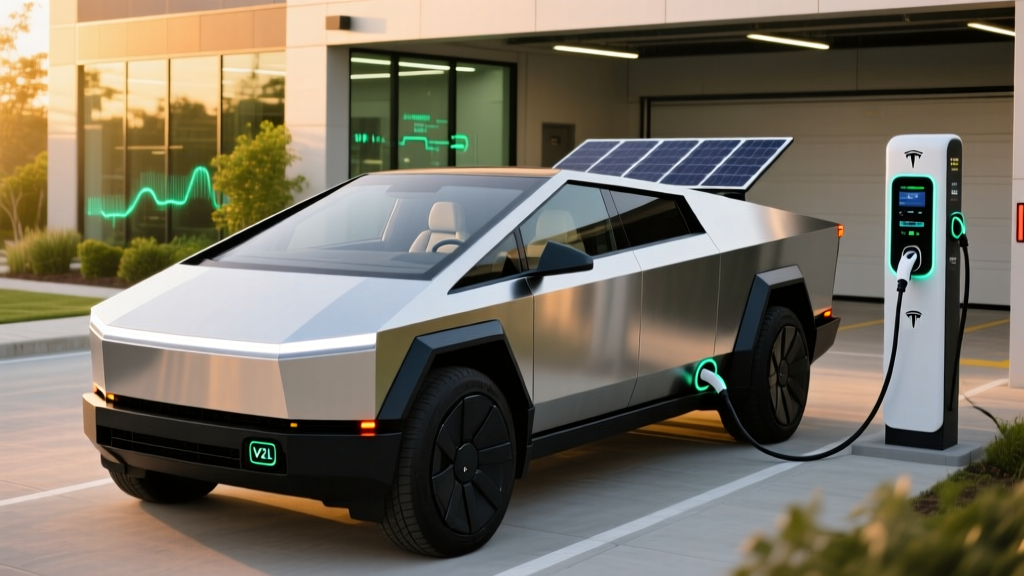
The Cybertruck is engineered as much as a mobile power station as it is a pickup. Tesla equips it with a mix of high-voltage and standard outlets across three zones: the bed, the cabin, and the vehicle's external charge port for bi-directional use.
Bed Outlets (Powershare)
- Two 120V 20A NEMA 5-20 receptacles — located in the bed walls, protected by the tonneau cover. Combined output: up to 2.4 kW continuous.
- One 240V NEMA 14-50 receptacle — also bed-mounted, delivering up to 9.6 kW. This is the outlet that sets the Cybertruck apart from nearly every other EV pickup; it can run a welder, a large air compressor, or a residential dryer.
Cabin Outlets
- Front row: Two USB-C ports (up to 65W each) in the center console, plus a 12V accessory socket (cigarette-lighter style) rated at 12A / ~150W.
- Rear row: Two USB-C ports (65W) and one 120V 15A household outlet (NEMA 5-15) behind the center console — useful for laptops or a small cooler on a road trip.
Frunk and Exterior
- No dedicated 120V outlet in the front trunk (frunk). The frunk provides 7 cu ft of sealed storage with a drain plug, but power access requires running a cord from the cabin or bed.
- The NACS charge port on the driver-side rear supports Tesla's Powershare V2L (vehicle-to-load) adapter, letting you draw up to 11.5 kW from the charge port itself with the optional bi-directional adapter — enough to run essential home circuits during an outage.
Cybertruck Specs at a Glance
| Spec | AWD | Cyberbeast |
|---|---|---|
| EPA Range | 340 miles | 320 miles |
| Battery (usable) | ~123 kWh (NMC) | ~123 kWh (NMC) |
| Horsepower | 600 hp | 845 hp |
| 0–60 mph | 4.1 sec | 2.6 sec |
| Drivetrain | Dual-Motor AWD | Tri-Motor AWD |
| Max DC Fast Charge | 350 kW (peak) | 350 kW (peak) |
| 10–80% DCFC Time | ~17 minutes | ~17 minutes |
| Level 2 Home Charge | 11.5 kW (~44 mi/hr) | 11.5 kW (~44 mi/hr) |
| MPGe (combined) | 79 MPGe | 76 MPGe |
| Efficiency | 48 kWh/100 mi | 50 kWh/100 mi |
| Tow Rating | 11,000 lbs | 11,000 lbs |
| Bed Volume | 67 cu ft (vault + sub-trunk) | |
| Frunk Volume | 7 cu ft | |
| Base MSRP | $79,990 | $99,990 |
| Battery Warranty | 8 yr / 120,000 mi | |
Real-World Range: What the EPA Number Doesn't Tell You
AWD EPA: 340 miles | Cyberbeast EPA: 320 miles
Expect in real-world highway driving (70–75 mph): ~270–295 miles (AWD), ~255–280 miles (Cyberbeast)
Cold weather (below 32°F): Reduce by 20–30%, yielding ~220–260 miles depending on cabin heat and terrain
Towing a 5,000-lb trailer: Expect 150–180 miles at highway speed
The Cybertruck's angular stainless-steel exoskeleton creates more aerodynamic drag than a rounded body like the Rivian R1T or the Ford F-150 Lightning. At highway speeds, that drag compounds: the Cybertruck AWD consumes roughly 48 kWh per 100 miles in mixed driving, but efficiency drops sharply above 70 mph. In EPA testing via fueleconomy.gov, the AWD trim achieves 79 MPGe combined — competitive for a full-size electric truck, but below what smaller EVs deliver.
The 123 kWh (usable) battery pack uses nickel-manganese-cobalt (NMC) chemistry, chosen for its higher energy density compared to LFP. That density is what makes 340 miles possible in a vehicle weighing over 6,600 lbs. The trade-off: NMC degrades slightly faster than LFP over thousands of cycles, and Tesla recommends daily charging to 80–90% for longevity, reserving 100% for road trips.
Charging Speed: DC Fast, Level 2, and the Charge Curve Reality
| Level | Power (kW) | Miles Added per Hour | Typical Use Case |
|---|---|---|---|
| Level 1 (120V) | 1.4 kW | ~3–4 mi/hr | Emergency top-off only |
| Level 2 (240V, 48A) | 11.5 kW | ~44 mi/hr | Home overnight charging |
| DC Fast (peak) | 350 kW | ~1,000+ mi/hr (peak) | Road trips, Supercharger V4 |
| DC Fast (10–80%) | Avg ~170 kW sustained | — | ~17 minutes at V4 stall |
Tesla rates the Cybertruck for a 350 kW peak DC fast-charge rate at V4 Supercharger stalls. However, peak rate is not sustained rate. The charge curve is aggressive from 10–40% SoC, then tapers significantly above 60% to protect the NMC cells. In real-world testing at a 250–350 kW stall, the 10–80% session averages roughly 17 minutes — excellent for a 123 kWh pack, but don't expect to hold 350 kW for the full session.
For home charging, the onboard charger accepts up to 11.5 kW on a 240V / 48A circuit (NEMA 14-60 or hardwired Wall Connector). That translates to roughly 44 miles of range per hour of charging, meaning a full 0–100% replenishment takes about 10–11 hours. Most owners charging overnight from 20% to 80% will wake up fully topped off in 6–7 hours.
Pricing, Trims, and Federal Tax Credit Eligibility
| Trim | Base MSRP | Federal §30D Credit | Est. Net Price |
|---|---|---|---|
| AWD | $79,990 | $7,500 (if eligible) | ~$72,490 |
| Cyberbeast | $99,990 | $7,500 (if eligible) | ~$92,490 |
The IRS §30D clean vehicle credit offers up to $7,500 for qualifying new EVs, but eligibility hinges on three requirements that Cybertruck buyers must verify:
- MSRP cap: Trucks and SUVs must have an MSRP at or below $80,000. The AWD trim at $79,990 qualifies on paper; the Cyberbeast at $99,990 does not.
- Buyer income cap: Modified adjusted gross income (MAGI) must not exceed $150,000 (single), $225,000 (head of household), or $300,000 (joint). Above these thresholds, no credit.
- Battery sourcing: Critical minerals and battery components must meet phased-in domestic-content and foreign-entity-of-concern (FEOC) thresholds. Tesla's supply chain has largely met these requirements for US-built vehicles, but always confirm current-year compliance on the fueleconomy.gov tax credit lookup before purchasing.
Performance, Cargo, and Standout Tech
The Cybertruck AWD delivers 600 hp and a 4.1-second 0–60 mph time — quicker than any F-150 Lightning trim and on par with a Porsche Cayenne Turbo. The Cyberbeast's tri-motor setup produces 845 hp and a 2.6-second sprint, placing it in hypercar territory despite its 6,600+ lb curb weight.
Cargo and Passenger Space
- Bed ("Vault"): 67 cu ft total, including a lockable under-floor sub-trunk. The powered tonneau cover supports up to 300 lbs of distributed load.
- Frunk: 7 cu ft — small compared to the F-150 Lightning's 14.1 cu ft Mega Power Frunk.
- Rear legroom: 38.4 inches — adequate for adults, though the sloping roofline limits headroom for passengers over 6'2".
- Towing: 11,000 lbs rated, matching the Lightning Extended Range and edging past the Rivian R1T's 11,000-lb rating.
Tech and Driver Assistance
The 18.5-inch front touchscreen runs Tesla's latest UI with native navigation, streaming, and a dedicated Powershare monitoring screen that shows real-time wattage draw per outlet. The rear passengers get a dedicated 9.4-inch touchscreen for climate and media control.
Notable tech drawbacks include the absence of Apple CarPlay and Android Auto (Tesla relies on its native infotainment), and the steer-by-wire system — standard on all Cybertrucks — which takes a learning curve. The yoke-style steering wheel limits hand-over-hand maneuvering at low speeds, though the variable ratio compensates at highway speeds.
Pros, Cons, and the Verdict
- 240V bed outlet (9.6 kW) — unmatched in the EV truck segment
- 350 kW peak DC charging; 10–80% in ~17 min
- 11,000-lb tow rating with integrated trailer brake controller
- Stainless-steel exoskeleton eliminates paint repair concerns
- V2L Powershare can back-feed home circuits (with adapter)
- Class-leading 0–60 performance, especially Cyberbeast
- Cyberbeast ($99,990) ineligible for $7,500 federal credit
- Real-world highway range ~270–295 mi (AWD), well below 340 EPA
- Small frunk (7 cu ft) vs. F-150 Lightning (14.1 cu ft)
- Steer-by-wire and yoke require adaptation period
- No Apple CarPlay / Android Auto
- Panel gaps and build quality inconsistency reported by early owners
- Cold-weather range loss of 20–30% is significant for a 123 kWh pack
Who Should Buy the Cybertruck?
- You need a 240V bed outlet for job-site tools, welding, or RV hookups
- Your budget is near $80,000 and you want to maximize the $7,500 federal credit
- You tow up to 11,000 lbs and want instant electric torque for trailer launches
- You have reliable home Level 2 charging and rarely drive more than 250 miles between stops
- Performance is the priority and the $100K price (with no federal credit) is acceptable
- You want tri-motor redundancy and 845 hp for off-road or track-day novelty
- You need a larger frunk for gear storage
- You prefer a conventional steering wheel and proven build quality
- You want a sub-$60,000 entry price (Lightning Pro/extended-range trims)
Cybertruck Outlets FAQ
How many outlets does the Cybertruck have?
The Cybertruck has six primary power outlets: two 120V 20A receptacles and one 240V receptacle in the bed; one 120V outlet, one 12V socket, and four USB-C ports (65W each) in the cabin. The NACS charge port also supports V2L via adapter.
Can the Cybertruck power my house during an outage?
Yes, with the Tesla Powershare V2L adapter connected to the charge port, the Cybertruck can deliver up to 11.5 kW back to your home's electrical panel — enough to run essential circuits (refrigerator, lights, HVAC fan, internet) for multiple days given the 123 kWh battery.
Does the Cybertruck qualify for the $7,500 federal tax credit?
The AWD trim at $79,990 MSRP potentially qualifies under §30D, provided the buyer meets income caps and the battery sourcing requirements are met for the current tax year. The Cyberbeast at $99,990 exceeds the $80,000 truck MSRP cap and does not qualify. Always verify on fueleconomy.gov and consult a tax professional.
What is the real-world range of the Cybertruck?
Expect 270–295 miles at highway speeds for the AWD and 255–280 miles for the Cyberbeast. Cold weather (below 32°F) reduces range by 20–30%. Towing a mid-weight trailer (5,000 lbs) cuts range to roughly 150–180 miles.
Is the Cybertruck worth buying over the F-150 Lightning?
If you need a 240V bed outlet, V2L capability, and maximum DC charging speed, the Cybertruck has no equal. If you prioritize a lower starting price, a larger frunk, conventional steering, and broader dealer service access, the F-150 Lightning remains a strong alternative — especially at sub-$60,000 trims.
What is the Cybertruck's battery warranty?
Tesla covers the battery and drive unit for 8 years or 120,000 miles, whichever comes first, with a minimum 70% capacity retention guarantee over that period.