Quick Verdict: Is Cybertruck Orange Worth the Hype in 2026?
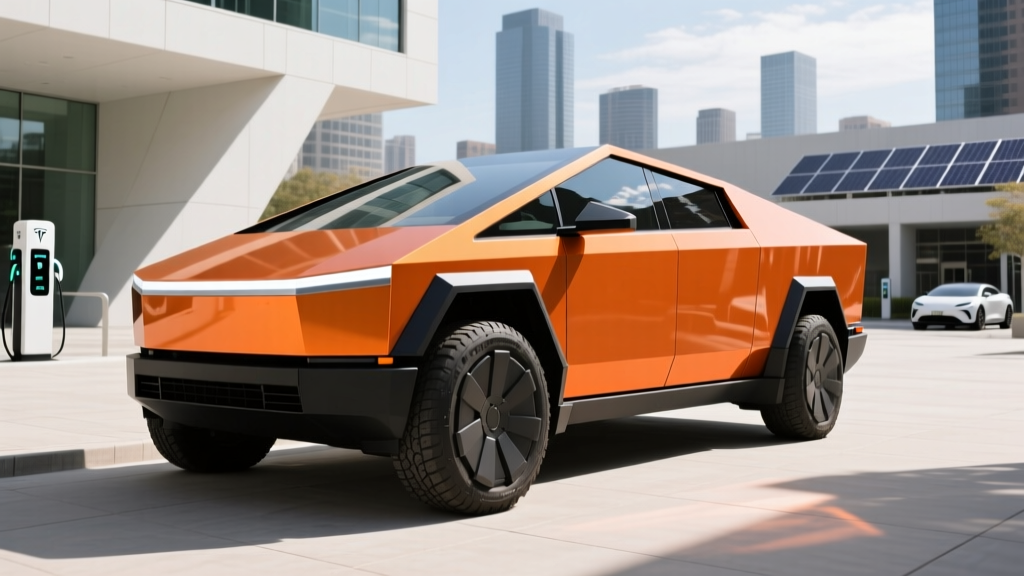
The Tesla Cybertruck in its signature "Orange" exterior wrap (officially marketed as a dealer-applied or aftermarket vinyl option atop the stainless-steel body) has become one of the most recognizable — and divisive — vehicles on the road. But beyond the polarizing aesthetics and the angular exoskeleton, the Cybertruck is a serious electric pickup with legitimate towing capability, class-leading acceleration, and an 800-volt architecture that enables some of the fastest DC fast-charging in the truck segment.
For 2026, Tesla offers the Cybertruck in three trims: the Long Range AWD, the Cyberbeast (tri-motor AWD), and the more accessible Rear-Wheel Drive model that entered production in late 2025. The Orange colorway — a vibrant, matte-to-satin finish applied over the cold-rolled stainless steel — has become the de facto enthusiast choice, though it adds $1,500-$2,500 depending on installer and material quality.
Here's everything you need to know about specs, real-world range, charging realities, and whether the Cybertruck actually earns its place in your garage versus a Ford F-150 Lightning, Rivian R1T, or Chevrolet Silverado EV.
Cybertruck Spec Table: Range, Battery, Charging & Performance
| Spec | Long Range AWD | Cyberbeast (Tri-Motor) | RWD (Base) |
|---|---|---|---|
| EPA Range | 340 miles | 320 miles | 250 miles |
| Battery Capacity (usable) | ~123 kWh (NMC) | ~123 kWh (NMC) | ~81 kWh (LFP est.) |
| Drivetrain | Dual-Motor AWD | Tri-Motor AWD | Rear-Wheel Drive |
| Horsepower | 600 hp | 845 hp | ~315 hp |
| 0-60 mph | 3.9 sec | 2.6 sec | ~6.5 sec |
| Max DC Fast Charge | 250 kW (V3 Supercharger) | 250 kW (V3 Supercharger) | ~170 kW |
| 10-80% DCFC Time | ~28 min | ~28 min | ~35 min |
| Level 2 Home Charging | 11.5 kW (~37 mi/hr) | 11.5 kW (~37 mi/hr) | 11.5 kW (~44 mi/hr) |
| MPGe (combined) | 67 MPGe | 61 MPGe | ~78 MPGe (est.) |
| Towing Capacity | 11,000 lbs | 11,000 lbs | 7,500 lbs |
| Base MSRP | $79,990 | $99,990 | $60,990 |
Source: Tesla Cybertruck specs, fueleconomy.gov. Specs reflect 2026 model year.
Real-World Range: What the EPA Sticker Doesn't Tell You
Real-World Expectation: Expect approximately 270-300 miles on highway trips at 70-75 mph in moderate temperatures. In cold weather (below 30°F), range drops to roughly 230-260 miles due to battery resistance and cabin heating demands. City driving with frequent regenerative braking recovers energy more effectively, yielding closer to EPA figures.
The Cybertruck's angular stainless-steel body creates more aerodynamic drag than a sleek sedan, and that penalty shows at sustained highway speeds. In independent testing, the Long Range AWD delivered roughly 2.0-2.2 kWh/mile at 70 mph — translating to around 280 miles from the ~123 kWh usable pack. The Cyberbeast, with its tri-motor setup and wider rear tires, is thirstier, often returning 2.3-2.5 kWh/mile under the same conditions.
Cold weather compounds the problem. Tesla's heat pump helps, but the Cybertruck's large cabin volume and stainless-steel panels (which don't insulate as well as composite materials) mean more energy goes to heating. Plan for 20-30% range loss in sub-freezing conditions, consistent with other large EV trucks.
The RWD model, with its smaller battery and lighter curb weight, is best suited for urban and suburban use where its 250-mile EPA range is adequate for daily commuting but will feel limiting on road trips.
Charging Speed: 800V Architecture Meets the Supercharger Network
| Charging Level | Power / Rate | Miles Added Per Hour | Best For |
|---|---|---|---|
| Level 1 (120V) | ~1.4 kW | ~3-4 mi/hr | Emergency / overnight trickle |
| Level 2 (240V, 48A) | 11.5 kW | ~37-44 mi/hr | Daily home charging |
| DC Fast Charge (V3 Supercharger) | Up to 250 kW peak | ~1,000+ mi/hr (peak) | Road trips, 10-80% in ~28 min |
| DC Fast Charge (V4 Supercharger) | Up to 350 kW (future) | TBD | Rolling out 2026-2027 |
The Cybertruck uses an 800-volt electrical architecture, which allows higher charging power at lower current — reducing heat and cable weight. On a Tesla V3 Supercharger (250 kW max), the Long Range and Cyberbeast models peak near 250 kW at low state of charge, then taper progressively. The charge curve is aggressive: you'll hit 50% in roughly 15 minutes, but the rate slows considerably past 80%. Tesla recommends charging to 80% for daily use to preserve long-term battery health, and the 10-80% window takes approximately 28 minutes.
For home charging, a Level 2 wall connector on a 60-amp circuit delivers 11.5 kW, adding roughly 37 miles of range per hour. A full overnight charge (8-10 hours) easily replenishes the pack. Installation costs typically range from $800 to $2,000 depending on panel capacity and conduit run — factor in a potential $1,500-$3,000 panel upgrade if your home still has a 100-amp service.
Important note on connector compatibility: The Cybertruck uses the NACS (North American Charging Standard) connector natively — the same plug used across the Tesla Supercharger network. No adapter is needed at Tesla stations. For non-Tesla DC fast chargers using CCS, Tesla provides a NACS-to-CCS adapter (included with the vehicle as of 2025).
Performance, Towing & Daily Drivability
The Cyberbeast's 2.6-second 0-60 mph time makes it one of the quickest production vehicles ever sold, let alone a 6,800-pound pickup. The Long Range AWD's 3.9-second run is equally absurd for a truck. In practice, the instant torque and low center of gravity (battery pack under the floor) make the Cybertruck feel planted and responsive in a way that body-on-frame trucks simply cannot match.
Towing capacity peaks at 11,000 pounds for the dual- and tri-motor variants — competitive with the F-150 Lightning's 10,000-pound max and the Rivian R1T's 11,000-pound rating. However, towing at max capacity slashes range dramatically: expect 150-180 miles at highway speeds with a heavy trailer, and plan charging stops accordingly.
The adaptive air suspension offers 12 inches of ground clearance adjustment (from 9 to 17 inches), making the Cybertruck surprisingly capable off-road. The steer-by-wire system — which replaces the mechanical steering column with electronic actuators — takes some getting used to but provides variable ratio steering that's quick at low speeds and stable at highway speed.
Drawbacks: The stainless-steel body is fingerprint-prone (the Orange wrap helps here), panel gaps remain a Tesla talking point, and the 6.5-foot bed is shorter than the F-150 Lightning's 5.5-foot box with the tailgate up but offers less flexibility than a traditional 6.5- or 8-foot bed. The vault (bed) does feature a powered tonneau cover and 120V/240V outlets for job-site or camping use.
Pricing, Tax Credits & Total Cost
| Trim | Base MSRP | Federal §30D Credit | Effective Price |
|---|---|---|---|
| RWD | $60,990 | $7,500 (if eligible) | ~$53,490 |
| Long Range AWD | $79,990 | $0 (over MSRP cap) | $79,990 |
| Cyberbeast | $99,990 | $0 (over MSRP cap) | $99,990 |
The §30D federal tax credit caps eligible trucks at an $80,000 MSRP. As of 2026 IRS rules, only the RWD Cybertruck at $60,990 qualifies — and only if the buyer meets income thresholds ($150,000 single / $300,000 joint AGI) and the vehicle's battery meets critical-mineral and battery-component sourcing requirements. The credit can now be transferred to the dealer at point of sale as an instant discount (source: IRS §30D).
The Long Range AWD at $79,990 sits right at the cap edge — depending on destination fees and mandatory options, it may or may not qualify. The Cyberbeast at $99,990 is well above the limit. Adding the Orange wrap ($1,500-$2,500 aftermarket) and other options pushes pricing higher still.
5-Year Ownership Cost Considerations: Electricity costs roughly $0.13-$0.16/kWh nationally, making a full charge of the Long Range pack approximately $16-$20 at home — versus $60-$80 for a comparable gasoline truck's tank. However, insurance premiums for the Cybertruck run 20-40% higher than average due to repair costs for the stainless-steel body and steer-by-wire components. Budget $2,500-$3,500 annually for insurance depending on your state and driving record.
Interior, Tech & Driver Assistance
The Cybertruck's interior is minimalist in typical Tesla fashion: an 18.5-inch center touchscreen handles infotainment, climate, and vehicle controls, while a smaller rear touchscreen serves second-row passengers. There are no physical buttons for climate or audio — everything routes through the display. The yoke-style steering wheel (standard) takes adaptation and is controversial among owners; a conventional round wheel is now available as a no-cost option.
Cargo space includes the 6.5-foot vault (bed) with 67 cubic feet of volume, a front trunk (frunk) with roughly 7 cubic feet of lockable storage, and an under-bed storage compartment. Rear-seat legroom is adequate for adults at 38.5 inches, though the upright seatback angle is less comfortable on long trips than a Rivian R1T or F-150 Lightning.
Autopilot and FSD (Supervised): Tesla's driver-assistance suite includes Autopilot (adaptive cruise + lane centering) as standard, with Full Self-Driving (Supervised) available as a $8,000 option or $99/month subscription. FSD handles on- and off-ramps, traffic lights, and city street navigation — but this remains a SAE Level 2 system. The driver must remain fully engaged, hands on the yoke/wheel, and eyes on the road at all times. It is not autonomous driving.
Tesla Autopilot and FSD (Supervised) require continuous driver supervision. The system can steer, accelerate, and brake under certain conditions, but the driver is responsible for all driving decisions and must intervene immediately. Only Level 4 systems (e.g., Waymo robotaxis in geofenced areas) operate without a human driver.
Pros, Cons & Who Should Buy
Pros
- Class-leading acceleration (2.6s Cyberbeast, 3.9s Long Range)
- 800V architecture enables fast DC charging at 250 kW
- 11,000-lb towing capacity (AWD/Beast)
- Stainless-steel body resists dents; Orange wrap adds unique styling
- Access to Tesla Supercharger network (19,000+ stations in North America)
- Air suspension with 17 inches of ground clearance for off-road use
- Onboard 120V/240V power outlets (V2L capability)
Cons
- Only RWD trim qualifies for §30D tax credit
- Real-world highway range falls 15-20% below EPA estimates
- Steer-by-wire and yoke steering polarize drivers
- Stainless-steel body is expensive to repair after collisions
- 6.5-foot bed is shorter than many traditional pickups
- Insurance costs 20-40% above segment average
- Panel gap quality still inconsistent across production units
Who the Cybertruck Orange Suits Best
Buy it if: You want the quickest production pickup available, you value access to the Supercharger network for road trips, you need legitimate towing and off-road capability, and you want a vehicle that stands out visually — the Orange wrap guarantees attention.
Skip it if: You need maximum bed length for work, you're on a strict budget (the RWD is the only credit-eligible trim), you prefer traditional steering feel, or you prioritize proven long-term reliability data over cutting-edge design.
Frequently Asked Questions
What is the real-world range of the Cybertruck?
The Long Range AWD is EPA-rated at 340 miles, but real-world highway driving at 70 mph typically yields 270-300 miles. Cold weather (below 30°F) reduces that to 230-260 miles. The Cyberbeast returns slightly less due to its tri-motor powertrain and wider tires.
How fast does the Cybertruck charge?
On a Tesla V3 Supercharger (250 kW), the Long Range and Cyberbeast charge from 10-80% in approximately 28 minutes. At home on a Level 2 (11.5 kW) charger, expect 37-44 miles of range added per hour, or a full charge overnight in 8-10 hours.
Does the Cybertruck qualify for the federal EV tax credit?
Only the RWD trim at $60,990 MSRP qualifies under 2026 IRS §30D rules, which cap eligible trucks at $80,000 MSRP. Buyers must also meet income limits ($150K single / $300K joint) and the battery must satisfy critical-mineral sourcing requirements. The Long Range AWD ($79,990) may qualify depending on final configured MSRP; the Cyberbeast ($99,990) does not. Always verify current eligibility at irs.gov.
Is the Cybertruck worth buying vs. the F-150 Lightning or Rivian R1T?
The Cybertruck wins on raw acceleration and Supercharger access. The F-150 Lightning offers a more traditional truck experience, a larger bed, and broader §30D credit eligibility. The Rivian R1T provides a more refined interior, a quad-motor option, and better rear-seat comfort. Your choice depends on whether performance and Tesla's charging network outweigh conventional truck practicality.
What is the Orange wrap, and is it a factory color?
Tesla does not offer Orange as a factory paint color — the Cybertruck ships in unpainted stainless steel. The "Cybertruck Orange" look is achieved through a dealer-applied or aftermarket vinyl wrap (typically $1,500-$2,500). High-quality wraps from 3M or Avery Dennison last 5-7 years and protect the steel from fingerprints and minor scratches.
How long is the Cybertruck battery warranty?
Tesla covers the battery and drive unit for 8 years or 120,000 miles (whichever comes first) with a minimum 70% capacity retention threshold. This is competitive with the industry standard for light-duty EV trucks.