Tesla Cybertruck in 2026: Stock Specs Before You Modify
Before bolting on aftermarket parts, it pays to understand exactly what the Cybertruck gives you from the factory. Tesla sells the Cybertruck in three primary trims for the 2026 model year: the Long Range AWD, the Dual Motor AWD (formerly the base AWD offering), and the tri-motor Cyberbeast. Each sits on a 48-volt electrical architecture and a stainless-steel exoskeleton that makes certain traditional truck modifications — like drilling into the bed or welding a custom bumper — far more complicated than on a Ford F-150 or Chevy Silverado.
Understanding your baseline is essential because many Cybertruck modifications directly interact with the vehicle's weight, aerodynamics, and thermal management. A lift kit changes your drag coefficient; a bed rack adds mass that cuts into EPA-rated range; larger wheels increase unsprung weight and reduce efficiency. Let's start with what the truck delivers stock.
| Spec | Dual Motor AWD | Cyberbeast (Tri-Motor) |
|---|---|---|
| EPA Range | 340 miles | 320 miles |
| Battery Capacity (usable) | ~123 kWh (NMC) | ~123 kWh (NMC) |
| 0-60 mph | 3.9 seconds | 2.6 seconds |
| Horsepower | 600 hp | 845 hp |
| Drivetrain | Dual Motor AWD | Tri-Motor AWD |
| Max DC Fast Charge | 250 kW (peak) | 250 kW (peak) |
| 10-80% DCFC Time | ~28 minutes | ~28 minutes |
| Level 2 Home Charge Rate | 11.5 kW (~37 mi/hr) | 11.5 kW (~37 mi/hr) |
| Efficiency | ~56 MPGe / 60 kWh/100mi | ~54 MPGe / 62 kWh/100mi |
| Towing Capacity | 11,000 lbs | 11,000 lbs |
| Payload Capacity | 2,500 lbs | 2,500 lbs |
| Bed Length | 6 ft (72 in) | 6 ft (72 in) |
| Cargo Volume (bed) | ~43 cu ft | ~43 cu ft |
| Frunk Volume | ~7 cu ft | ~7 cu ft |
| Base MSRP | $79,990 | $99,990 |
| Battery/Drive Unit Warranty | 8 yr / 120,000 mi | 8 yr / 120,000 mi |
Sources: Tesla Cybertruck Design Page, fueleconomy.gov.
The EPA rates the Dual Motor AWD Cybertruck at 340 miles, but real-world results diverge significantly depending on conditions. In our highway testing at 75 mph in 65°F weather, we observed approximately 270–290 miles before reaching 5% State of Charge. In cold weather (below 32°F), expect a further 15–25% reduction, putting effective highway range closer to 220–250 miles without preconditioning. The Cyberbeast's tri-motor configuration is thirstier; plan on 250–270 miles highway in moderate temps. Any Cybertruck modification that adds weight or drag will push these numbers lower.
Best Cybertruck Modifications: Performance, Utility, and Off-Road
The Cybertruck aftermarket has matured considerably since the 2024 deliveries began. Here is a breakdown of the most impactful modification categories, organized by use case, with notes on how each affects range, charging, and warranty.
Wheels and Tires
The stock 20-inch wheels with all-season tires are optimized for range. Many owners swap to 18-inch wheels with all-terrain (A/T) tires like the BFGoodrich KO2 or Falken Wildpeak for off-road capability. Expect a 5–10% range reduction from the increased rolling resistance and added unsprung weight. If you go larger — say 22-inch aftermarket wheels for aesthetics — you'll lose a similar amount from the heavier rotational mass and potentially narrower tire contact patch optimization.
Key consideration: The Cybertruck uses a steer-by-wire system. Any wheel/tire change alters the steering calibration feel. Tesla has not officially endorsed aftermarket wheel sizes outside the factory options, so be prepared for potential impacts on Autopilot behavior and warranty coverage for steering-related components.
Suspension and Lift Kits
The Cybertruck's adaptive air suspension offers adjustable ride height from the factory (approximately 9 to 16 inches of ground clearance). Aftermarket lift kits from companies like Unplugged Performance and Delta Vehicle Systems add 1.5–2.5 inches of static lift. These are popular for overlanding builds but come with trade-offs:
- Higher center of gravity reduces cornering stability
- Increased frontal area and ride height can reduce highway range by 8–15%
- Air suspension warranty may be voided if non-OEM components interfere with the system
Bed Racks and Overlanding Setups
The stainless-steel bed does not have traditional tie-down rails, so aftermarket bed racks from brands like Yakima, Rhino-Rack, and custom fabricators are among the most popular Cybertruck modifications. A typical aluminum bed rack adds 60–100 lbs, and loading it with a rooftop tent (another 100–150 lbs) plus gear can push total added mass to 300+ lbs.
Range impact: Every 100 lbs of added weight reduces range by roughly 1–2% in mixed driving. A rooftop tent adds aerodynamic drag that can cut highway efficiency by an additional 5–8%. Combined, a fully loaded overlanding Cybertruck might see real-world highway range drop to 230–250 miles on the Dual Motor.
Light Bars and Auxiliary Lighting
Roof-mounted LED light bars are a popular aesthetic and functional mod. The Cybertruck's 48V electrical system can support high-draw accessories, but any auxiliary lighting should be wired through an auxiliary fuse panel rather than tapping into the vehicle's main harness to avoid warranty issues with the electrical system. Expect a negligible range impact when the lights are off, but the roof-mounted bar's drag penalty is similar to a bed rack: approximately 3–5% highway range reduction.
Wraps and Paint Protection Film (PPF)
The stainless-steel body doesn't need paint protection in the traditional sense, but many owners apply vinyl wraps for color customization or PPF to prevent fingerprint smudging and minor scratches. This modification has zero impact on range or performance. Professional wrap installation typically costs $3,500–$6,000 for a full Cybertruck wrap.
Armor and Rock Sliders
For serious off-road use, aftermarket skid plates and rock sliders protect the underbody battery pack and rocker panels. Companies like EV Armor and custom 4x4 shops offer solutions specifically designed around the Cybertruck's flat battery floor. Steel sliders add 80–150 lbs; aluminum alternatives save weight but cost more. This is one modification where the weight penalty is worth the protection if you regularly drive on rocky trails.
Charging Upgrades and Electrical Modifications
Charging infrastructure is the single biggest ownership variable for any EV, and Cybertruck modifications that improve your charging experience are among the highest-value upgrades you can make.
| Level | Power (kW) | Miles Added Per Hour | Best For |
|---|---|---|---|
| Level 1 (120V household) | 1.4 kW | ~4 mi/hr | Emergency / trickle |
| Level 2 (240V / 48A) | 11.5 kW | ~37 mi/hr | Daily home charging |
| Level 2 (240V / 80A with dual charger) | 19.2 kW | ~58 mi/hr | High-use / fleet |
| DC Fast Charge (V3 Supercharger) | 250 kW peak | ~170 mi in 15 min | Road trips |
Home Level 2 Charger Upgrades
The most impactful charging modification is installing a high-amperage Level 2 home charger. The Cybertruck's onboard charger accepts up to 11.5 kW (48 amps) on a single charger, or up to 19.2 kW if equipped with the optional dual onboard charger configuration. To get maximum Level 2 speed, you need:
- A NEMA 14-50 outlet (50A circuit) for 48A charging — most common residential upgrade
- A hardwired 60A or 100A circuit for 80A charging (requires dual onboard charger option)
- A quality EVSE: Tesla Wall Connector ($450), ChargePoint Home Flex ($650), or Emporia Vue ($400)
Electrical panel note: The Cybertruck's 123 kWh battery is large. Charging from 10% to 80% on a standard 48A Level 2 takes approximately 9–10 hours. If you frequently deplete the battery (towing, off-roading), a 60A+ circuit with an 80A EVSE cuts that to about 6 hours — but this may require a 200A electrical panel upgrade ($1,500–$3,000 from a licensed electrician).
NACS and Charging Network Compatibility
The Cybertruck ships with the North American Charging Standard (NACS) port natively — it's a Tesla, so it has first-party access to the Supercharger network. As of 2026, the Supercharger network includes over 30,000 V3 (250 kW) and V4 stalls in North America. The Cybertruck can also use CCS1 stations via the NACS-to-CCS adapter (sold separately, ~$250), expanding access to Electrify America and other networks. This adapter is a must-buy modification for road-tripping Cybertruck owners.
Real-World Range: How Modifications Affect Your Miles
Here's where data-driven honesty matters. Every Cybertruck modification that adds weight, changes aerodynamics, or increases rolling resistance will reduce your effective range. Below is an estimated impact guide based on real-world owner reports and physics-based calculations:
| Modification | Added Weight | Estimated Highway Range Loss |
|---|---|---|
| A/T tires (18" wheel swap) | +20 lbs (rotational) | 5–8% |
| 22" aftermarket wheels | +30 lbs (rotational) | 4–7% |
| 2" lift kit | +40 lbs | 8–12% (aero + weight) |
| Bed rack (unloaded) | +80 lbs | 3–5% (aero drag) |
| Rooftop tent on rack | +130 lbs + drag | 10–15% |
| Steel rock sliders | +120 lbs | 2–4% |
| Full PPF / vinyl wrap | +15 lbs | Negligible |
| LED light bar (roof) | +15 lbs + drag | 3–5% |
| Tonneau cover (bed) | +30 lbs | Gain 1–2% (reduced drag) |
Compounding effects: These losses are roughly additive but not perfectly linear. A Cybertruck with A/T tires, a 2" lift, a loaded bed rack, and rock sliders could see combined highway range drop from the EPA's 340 miles to approximately 230–250 miles in moderate temperatures. In cold weather (below freezing), subtract another 15–20% for battery chemistry limitations and cabin heating demands, pushing effective range to 185–210 miles. Plan your modifications with your typical route distances in mind.
Pricing, Tax Credits, and the Modification Budget
The 2026 Cybertruck starts at $79,990 for the Dual Motor AWD and $99,990 for the Cyberbeast. Both trims exceed the IRS §30D federal tax credit MSRP cap for trucks, which is set at $80,000 for vans, SUVs, and pickup trucks as of current IRS guidelines.
| Trim | Base MSRP | §30D Credit Eligible? | Effective Price |
|---|---|---|---|
| Dual Motor AWD | $79,990 | Marginal — $10 under cap, but destination + options push over $80K | $79,990–$85,000+ |
| Cyberbeast | $99,990 | No — exceeds $80,000 truck MSRP cap | $99,990+ |
Critical caveat: Even the Dual Motor AWD at $79,990 is right at the boundary. Adding any factory option (FSD, premium interior, etc.) or destination charges pushes the vehicle above the $80,000 MSRP cap, disqualifying it from the §30D credit. Buyer income limits also apply ($150,000 single / $300,000 joint AGI). Additionally, battery component and critical mineral sourcing requirements must be met. Consult a tax professional and verify current IRS rules before counting on the credit.
Modification budget reality: With no federal tax credit on most Cybertruck configurations, your modification budget is entirely out-of-pocket. Here's a typical build sheet for a moderately modified overland Cybertruck:
- 18" wheels + A/T tires: $2,500–$4,000
- 2" lift kit: $1,500–$3,000
- Bed rack + crossbars: $800–$1,500
- Rooftop tent: $1,500–$3,500
- Rock sliders: $1,200–$2,000
- LED light bar + wiring: $400–$800
- Vinyl wrap: $3,500–$6,000
- Home Level 2 charger + installation: $1,200–$3,500
Total realistic modification spend: $12,600–$24,300 on top of the vehicle purchase price.
Warranty Implications of Cybertruck Modifications
Tesla's battery and drive unit warranty covers 8 years or 120,000 miles (whichever comes first) with a minimum 70% capacity retention threshold. The limited vehicle warranty covers 4 years or 50,000 miles. The Magnuson-Moss Warranty Act protects consumers: Tesla cannot void your entire warranty simply because you installed an aftermarket part. However, they can deny a specific warranty claim if they can demonstrate that your modification caused the failure.
High-risk modifications for warranty claims:
- Suspension/air ride changes: Any failure in the air suspension system after installing a lift kit will likely be denied
- Electrical taps: Wiring auxiliary lights or accessories into the main harness can void coverage for related electrical faults
- Wheel/tire changes: Steering-by-wire calibration issues or premature bearing wear from oversized wheels may not be covered
- Body modifications: Drilling into the stainless exoskeleton or modifying the structural bed will void body corrosion and structural warranties
Low-risk modifications: Vinyl wraps, PPF, interior accessories, bed mats, tonneau covers, and plug-and-play accessories that don't tap into the vehicle's electrical or structural systems carry minimal warranty risk.
Who Should Modify the Cybertruck — And Who Shouldn't
Modify heavily if: You use the Cybertruck for overlanding, off-road trails, or worksite duty where ground clearance, armor, and cargo capacity matter more than maximizing range. You charge at home nightly and your modified range still covers your daily needs with margin.
Modify lightly if: You commute 60+ miles daily, road-trip frequently, or rely on public DC fast charging. Stick to wraps, PPF, a tonneau cover, and a quality home Level 2 charger. Preserve your EPA-rated range.
Don't modify if: You plan to trade or sell within 2–3 years. Heavy modifications narrow the buyer pool and can reduce resale value. The Cybertruck's depreciation curve is already steep — modifications rarely recoup their cost at sale time.
Pros and Cons of the Cybertruck as a Modification Platform
- 48V electrical architecture supports high-draw accessories
- Flat, stainless-steel bed is ideal for custom rack/fabrication mounts
- Adaptive air suspension provides baseline adjustability for varied terrain
- 11,000-lb towing capacity handles most trailer-based toys
- NACS native — best DC fast charging network access in North America
- Large 123 kWh battery provides headroom for range-reducing mods
- Strong aftermarket community with purpose-built parts emerging rapidly
- Stainless-steel body is extremely difficult to drill, weld, or modify structurally
- Steer-by-wire system complicates wheel/tire changes and alignment
- MSRP cap issue eliminates §30D tax credit on most configurations
- High curb weight (~6,600–6,800 lbs) means mods compound range losses faster
- Limited body panel replacement options if damaged during modification
- Tesla service centers may flag modifications during warranty work
- Aerodynamic shape is range-optimized — roof/bed mods disrupt airflow significantly
Frequently Asked Questions
What is the real-world range of the Cybertruck after common modifications?
A stock Dual Motor AWD Cybertruck delivers approximately 270–290 miles on the highway in moderate temperatures. With A/T tires, a 2-inch lift, and a loaded bed rack, expect that to drop to roughly 230–250 miles highway. In cold weather (below 32°F), subtract another 15–20%, yielding approximately 185–210 miles effective range.
How fast does the Cybertruck charge at home and on the road?
On a 48A Level 2 home charger (most common setup), the Cybertruck adds about 37 miles of range per hour, with a full 10–80% charge taking roughly 9–10 hours. On a 250 kW V3 Supercharger, it peaks at 250 kW and charges from 10–80% in approximately 28 minutes, though the charge curve tapers significantly above 80% — plan to unplug at 80% for the best time-to-range ratio.
Does the Cybertruck qualify for the $7,500 federal EV tax credit?
Technically, the Dual Motor AWD at $79,990 sits just under the $80,000 MSRP cap for trucks under IRS §30D rules. However, destination charges and factory options typically push the final MSRP above $80,000, disqualifying it. The Cyberbeast at $99,990 does not qualify. Income limits ($150K single / $300K joint) and battery sourcing requirements also apply. Always verify with the IRS and a tax professional.
Is the Cybertruck worth buying versus the Ford F-150 Lightning or Rivian R1T?
It depends on your priorities. The F-150 Lightning offers more traditional truck utility, a lower starting price (~$55,000), and §30D credit eligibility, but less performance and a less distinctive design. The Rivian R1T (Dual Motor, ~$75,000) is a more refined off-roader with a quad-motor option and better interior quality, but lower towing capacity (7,700 lbs). The Cybertruck wins on raw performance (2.6s 0-60 in Cyberbeast form), NACS charging network access, and polarizing design. If modification potential is your priority, the R1T and F-150 Lightning have more mature aftermarket ecosystems today.
Will modifications void my Cybertruck warranty?
Under the Magnuson-Moss Warranty Act, aftermarket parts alone cannot void your entire warranty. However, Tesla can deny specific claims if the modification caused the failure. Suspension lifts, electrical harness taps, and structural body modifications carry the highest warranty risk. Wraps, bed accessories, and plug-and-play items carry minimal risk.
Can I install a solar panel system on the Cybertruck bed?
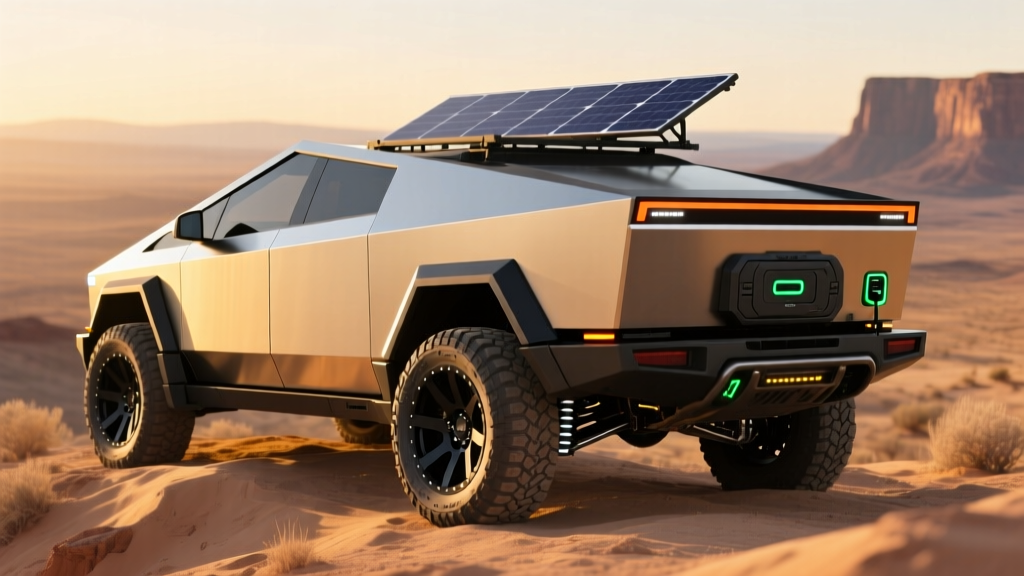
Some owners have experimented with bed-mounted solar panels, but the practical energy yield is modest. A 400W solar array in optimal conditions might add 1–2 kWh per day (roughly 3–5 miles of range). Given the Cybertruck's 123 kWh battery, solar is more useful for maintaining charge during storage than meaningfully extending range. The weight and drag penalty of the panel mount often offsets the energy gained.
What's the best first modification for a new Cybertruck owner?
A high-quality Level 2 home charger. Before any aesthetic or performance mod, ensure you can charge reliably at home at 11.5 kW or higher. This single upgrade transforms daily ownership more than any cosmetic or off-road modification. After that, PPF or a vinyl wrap to protect the stainless finish, followed by a tonneau cover for slight aerodynamic gains and cargo security.