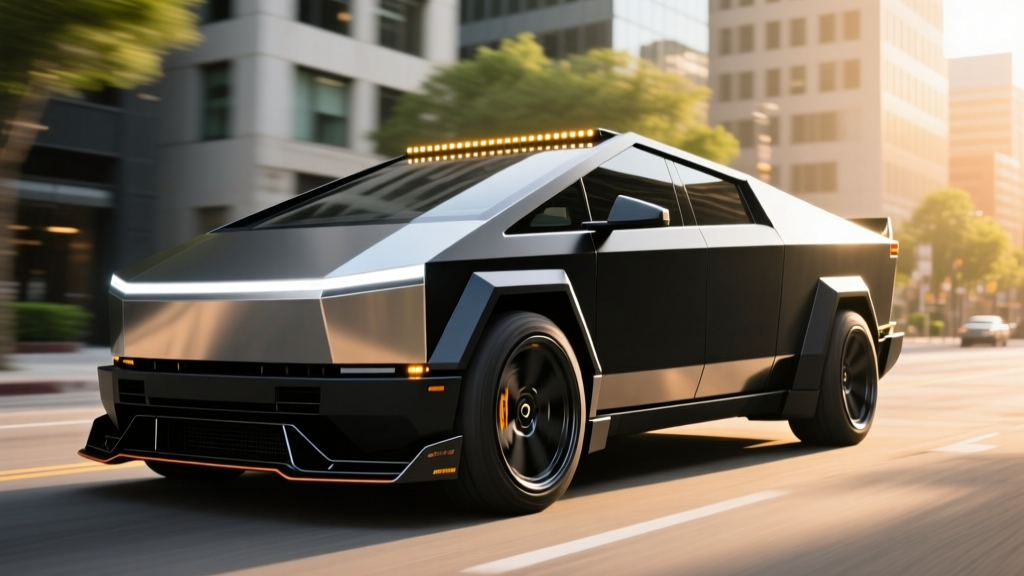
The Tesla Cybertruck already turns heads in stock form, but a growing aftermarket ecosystem is pushing owners to go further. From lift kits and 35-inch all-terrain tires to vinyl wraps, light bars, and rooftop tent mounts, a Cybertruck modded for overlanding or off-road duty is becoming a common sight on trails and at charging stations alike. But every modification carries trade-offs — and in an EV, those trade-offs show up in hard numbers: reduced range, slower charging efficiency, altered energy consumption, and potential warranty complications.
This review covers the 2025/2026 Tesla Cybertruck lineup — Dual Motor AWD, Cyberbeast, and the anticipated Long Range variant — through the lens of modification. We'll quantify what popular mods do to the truck's EPA-rated efficiency, how they affect DC fast charging in practice, and what Tesla's warranty actually covers when you start bolting on parts.
Stock Cybertruck Specs: Your Modification Baseline
Before evaluating mods, you need the baseline. Here are the official specifications for the current Cybertruck trims as sold in the 2025–2026 model years.
| Spec | Dual Motor AWD | Cyberbeast (Tri-Motor) | Long Range (RWD)* |
|---|---|---|---|
| EPA Range | 340 miles | 320 miles | ~470 miles (est.) |
| Battery (usable) | ~123 kWh (NMC) | ~123 kWh (NMC) | ~150 kWh (est., NMC) |
| Drivetrain | Dual Motor AWD | Tri-Motor AWD | Rear-Wheel Drive |
| Horsepower | 600 hp | 845 hp | TBD |
| 0–60 mph | 4.1 sec | 2.6 sec | ~6.5 sec (est.) |
| Max DC Charge Rate | 250 kW | 250 kW | ~250 kW (est.) |
| 10–80% DC Time | ~28 min | ~28 min | ~35 min (est.) |
| Level 2 Charge Rate | 11.5 kW (~30 mi/hr) | 11.5 kW (~30 mi/hr) | 11.5 kW (est.) |
| MPGe (combined) | 72 MPGe | 68 MPGe | TBD |
| Efficiency | 47 kWh/100 mi | 50 kWh/100 mi | ~38 kWh/100 mi (est.) |
| Base MSRP | $79,990 | $99,990 | $69,990 (est.) |
| Cargo (bed + frunk) | ~67 cu ft bed + ~7 cu ft frunk | ~67 cu ft bed + ~7 cu ft frunk | Similar |
| Towing Capacity | 11,000 lbs | 11,000 lbs | 11,000 lbs (est.) |
| Battery/Drive Unit Warranty | 8 yr / 120,000 mi | 8 yr / 120,000 mi | 8 yr / 120,000 mi (est.) |
*Long Range RWD was announced but had not begun customer deliveries as of early 2026. Specs marked (est.) are Tesla-announced projections; verify at purchase. Source: fueleconomy.gov, Tesla press materials.
The Cybertruck Dual Motor's EPA-estimated 340 miles is achievable under ideal conditions — mild weather, 55–65 mph, flat terrain. In real-world highway driving at 75–80 mph, expect ~270–290 miles. In cold weather (below 32°F), range can drop to ~220–250 miles due to battery preconditioning demands, cabin heating, and increased rolling resistance. The Cyberbeast's heavier tri-motor setup and stickier tires compound this further — real-world highway range often sits around 250–270 miles in moderate temps. The Cybertruck's angular, high-drag profile (estimated Cd ~0.38 despite Tesla's claims) penalizes highway efficiency more than sleeker EVs.
Popular Cybertruck Mods and Their Range Impact
EVs are uniquely sensitive to modification because every watt matters. Unlike a gas truck where a lift kit might cost you 1–2 MPG (a ~10% hit), the same mod on a Cybertruck can slash 15–25% of your usable range. Here's what the data and owner reports show:
| Modification | Typical Cost | Est. Range Loss | Primary Cause |
|---|---|---|---|
| 35" All-Terrain Tires (stock: 20" AT) | $1,800–$3,200 | 8–15% | Higher rolling resistance, increased unsprung weight |
| 2" Lift Kit | $1,500–$3,500 | 5–10% | Increased frontal area, altered aero, suspension geometry |
| Full Vinyl Wrap | $3,000–$5,500 | Negligible (<1%) | Minimal weight/aero change |
| Roof Rack + Cargo Box | $800–$2,000 | 10–18% | Major aero disruption at highway speed |
| LED Light Bar (roof-mounted) | $400–$1,200 | 3–7% | Aero drag + parasitic electrical draw |
| Bull Bar / Front Bumper Guard | $600–$1,500 | 3–6% | Added weight, disrupted front aero |
| Tonneau Cover (hard) | $500–$1,200 | Gain ~2–4% | Smoother bed airflow reduces drag |
| Combined Off-Road Build (lift + 35s + rack) | $5,000–$10,000 | 20–35% | Compounding aero, weight, and rolling resistance |
The compounding effect is the real story. A Cybertruck Dual Motor owner running a 2-inch lift, 35-inch BFGoodrich KO2s, and a loaded roof rack reported real-world highway range of ~195–215 miles at 70 mph in 65°F weather — a roughly 35% reduction from the 340-mile EPA sticker. That's a meaningful constraint for road trips, turning a two-stop Denver-to-Moab run into a three-stop affair.
Charging Speed: Do Mods Affect Your Charge Curve?
Modifications don't change the Cybertruck's peak DC charge rate of 250 kW at a V3 Supercharger — the battery management system doesn't know you've bolted on bigger tires. But they do change the effective charging experience in ways that matter.
| Metric | Stock Dual Motor | Modded (Lift + 35" AT + Roof Rack) |
|---|---|---|
| Peak DC Fast Charge | 250 kW | 250 kW (unchanged) |
| 10–80% DC Time | ~28 minutes | ~28 minutes (unchanged) |
| Miles Added per 15 min (DC) | ~150 miles | ~100–115 miles (effective) |
| Level 2 Home Charge | 11.5 kW (~30 mi/hr) | 11.5 kW (~20–22 mi/hr effective) |
| Level 1 (120V) Charge | ~1.4 kW (~3 mi/hr) | ~1.4 kW (~2 mi/hr effective) |
The key insight: miles added per minute drops significantly when your efficiency worsens. At 250 kW, a stock Cybertruck at ~47 kWh/100mi adds roughly 10 miles per minute. The same charge rate on a modded truck burning 65+ kWh/100mi yields only ~7 miles per minute. Your 28-minute Supercharger stop nets you fewer usable miles, which directly impacts road-trip planning.
Preconditioning tip: Always navigate to a Supercharger using the Cybertruck's built-in nav — this triggers battery preconditioning, warming the pack to optimal temperature for maximum charge acceptance. Skipping preconditioning (e.g., pulling into a charger without nav routing) can add 5–10 minutes to your 10–80% session, especially in cold weather. This applies whether your truck is stock or modified.
Tax Credit Eligibility and Modification Costs
The Cybertruck's eligibility for the §30D federal EV tax credit (up to $7,500) is a moving target governed by IRS rules on MSRP caps, buyer income, and battery-component/critical-mineral sourcing. Here's where things stand for the 2025–2026 tax year:
- MSRP Cap: Trucks/vans/SUVs must have an MSRP ≤ $80,000. The Dual Motor AWD at $79,990 squeaks under the cap; the Cyberbeast at $99,990 does not qualify.
- Income Caps (MAGI): $300,000 joint / $225,000 head of household / $150,000 single filer.
- Battery Sourcing: Battery components must be manufactured or assembled in North America (phased thresholds increase annually), and critical minerals must be sourced from the US or FTA partners. Tesla's supply chain has shifted significantly, but verify current-year eligibility at irs.gov before purchasing.
- Point-of-Sale Transfer: As of 2024, the credit can be transferred to the dealer at purchase for an immediate price reduction — but only if all requirements are met at the time of sale.
| Trim | Base MSRP | §30D Eligible? | Effective Price (with credit) | Modded Build Budget (est.) |
|---|---|---|---|---|
| Dual Motor AWD | $79,990 | Yes (if sourcing/income met) | ~$72,490 | $80,000–$90,000 total |
| Cyberbeast | $99,990 | No (exceeds $80K cap) | $99,990 | $107,000–$120,000 total |
| Long Range RWD* | $69,990 (est.) | Likely yes | ~$62,490 (est.) | $72,000–$82,000 total |
Modification budget reality: A moderately modded Dual Motor AWD — 2-inch lift, 35-inch tires, wrap, light bar, and roof rack — adds $8,000–$15,000 on top of the vehicle price. Factor in potential alignment costs ($200–$400 per service), accelerated tire wear (heavy EVs chew through rubber), and you're looking at a $90,000+ total investment for a capable off-road build.
Warranty Implications of Modifying Your Cybertruck
This is where a Cybertruck modded for adventure gets complicated. Tesla's warranty structure is specific, and modifications can create coverage gray areas.
What's covered (stock):
- Basic Vehicle Limited Warranty: 4 years / 50,000 miles
- Battery & Drive Unit Warranty: 8 years / 120,000 miles (minimum 70% capacity retention)
- Restraint System: 5 years / 60,000 miles
What mods can void or complicate:
- Lift kits: If Tesla determines a suspension failure, driveshaft issue, or premature wheel bearing wear resulted from altered geometry or increased stress from larger tires, they can deny the warranty claim for those specific components. The battery/drive unit warranty is generally protected under the Magnuson-Moss Warranty Act — Tesla must prove the mod caused the failure, not merely that a mod exists.
- Aftermarket wheels/tires: Tesla won't cover the aftermarket parts themselves, and can deny related suspension claims. TPMS sensor compatibility can also be an issue.
- Electrical mods (light bars, aux batteries, winches): Tapping into the Cybertruck's electrical system without using proper circuits or relays can void coverage for affected wiring, the 12V system, or in worst cases, trigger faults in the high-voltage system. Use dedicated auxiliary battery setups with proper isolation.
- Software tunes / speedometer recalibrators: Any modification that alters the vehicle's firmware or CAN bus signals is high-risk for warranty denial and could theoretically affect Autopilot/FSD calibration.
Practical advice: Keep all stock parts. Document everything with receipts and photos. Use reputable installers who understand EV architectures. And know that Magnuson-Moss protects you from blanket warranty voids — but fighting a denied claim takes time and potentially legal cost.
Driver-Assist Tech: Autopilot and FSD in a Modded Truck
Tesla Autopilot and Full Self-Driving (Supervised) are SAE Level 2 driver-assistance systems — not self-driving. The driver must remain fully attentive, hands on or near the wheel, and ready to take over at any moment. This applies regardless of vehicle modifications.
Modifications can affect ADAS performance in measurable ways:
- Larger tires / lift kits change the vehicle's ride height, which alters the calibration angle of the front-facing cameras and radar (if equipped). Tesla's vision-based system relies on precise camera positioning — even a 1–2 degree change can affect object detection at distance. Some owners report increased phantom braking and lane-keeping drift after lifts.
- Bull bars and light bars can partially obstruct camera sightlines or create reflections/glare that confuse the vision system.
- Raised center of gravity from a lift and roof load changes braking dynamics, meaning the AEB (Automatic Emergency Braking) system's stopping-distance assumptions may not match reality.
If you modify your Cybertruck's suspension or add front-mounted accessories, budget for a camera recalibration — and understand that Tesla Service may decline to recalibrate cameras on a vehicle with non-OEM suspension components.
Who Should (and Shouldn't) Mod Their Cybertruck
Mod It If You...
- Prioritize off-road capability and overlanding over maximum range
- Have reliable home Level 2 charging to offset efficiency losses
- Drive mostly under 150 miles/day and road-trip infrequently
- Accept a 20–35% range reduction as the cost of capability
- Understand the warranty gray areas and keep documentation
Keep It Stock If You...
- Commute 100+ miles daily and rely on public DC charging
- Want to maximize the Cybertruck's already-challenged highway range
- Plan frequent long road trips where charging time is critical
- Want full, hassle-free warranty coverage for 8 years
- Lease the vehicle (most lease agreements prohibit mods)
Pros and Cons: The Modded Cybertruck Reality
Pros
- Genuinely capable off-road platform with 11,000-lb towing, AWD, and adaptive air suspension
- Stainless exoskeleton resists trail pinstriping better than painted trucks
- Vast and growing aftermarket — Unplugged Performance, EV West, T-Sportline, and more
- 250 kW Supercharger access + expanding NACS-compatible public network
- Powershare (V2L/V2H) capability is invaluable for overlanding and emergencies
- Strong community and build documentation online
Cons
- Range drops significantly with common mods — a 340-mi truck becomes a ~220-mi truck
- High baseline energy consumption (47–50 kWh/100mi) worsens with every mod
- Warranty disputes possible; Magnuson-Moss helps but isn't a free pass
- Cyberbeast priced above §30D credit cap; Dual Motor barely under $80K threshold
- Angular design already creates high drag — mods compound it further
- ADAS calibration issues after suspension changes are an unresolved concern
- Tire costs are high — heavy EV with aggressive mods wears rubber quickly
Frequently Asked Questions
What is the real-world range of a modded Cybertruck?
A stock Dual Motor AWD delivers an EPA-estimated 340 miles. With a typical off-road build (2" lift, 35" AT tires, roof rack), expect ~200–240 miles in mixed driving at moderate temperatures, and potentially as low as 170–190 miles in cold weather or sustained highway speeds above 75 mph. A vinyl wrap alone has negligible impact (<1%).
How fast does a modded Cybertruck charge?
The peak DC charge rate remains 250 kW with a 10–80% time of approximately 28 minutes — mods don't change the battery's charge acceptance. However, because a modded truck consumes more energy per mile, you'll get fewer effective miles per charging minute: roughly 100–115 miles added in 15 minutes versus ~150 miles stock. Home Level 2 charging at 11.5 kW adds about 20–22 effective miles per hour (vs. ~30 stock).
Does the Cybertruck qualify for the federal EV tax credit?
The Dual Motor AWD at $79,990 MSRP is under the $80,000 truck/SUV cap and may qualify for up to $7,500 under IRS §30D, depending on your income (≤$300K joint / ≤$150K single) and current battery-sourcing compliance. The Cyberbeast at $99,990 does not qualify. Always verify at fueleconomy.gov and with a tax professional before purchasing — rules change annually.
Is a modded Cybertruck worth it vs. a Rivian R1T or Ford F-150 Lightning?
It depends on your priorities. The Rivian R1T (EPA 352–420 mi depending on pack) is a more polished off-roader from the factory with quad-motor capability and a mature adventure aftermarket — but starts higher and also loses range with mods. The F-150 Lightning (EPA 240–320 mi) is more affordable, has a proven truck platform, and handles mods similarly in terms of range loss. The Cybertruck's advantages are its 250 kW charge rate, Powershare V2L/V2H, and stainless durability. If you want a purpose-built overlander with the fastest DC charging, the modded Cybertruck has a niche — but it's not the most range-efficient choice.
Will modifying my Cybertruck void the battery warranty?
Not automatically. Under the Magnuson-Moss Warranty Act, Tesla cannot void your 8-year/120,000-mile battery warranty simply because aftermarket parts are installed. They must demonstrate that a specific modification caused a specific failure. However, electrical mods that tap into the HV system, software tunes, or suspension changes that damage drive units could lead to denied claims on those components. Keep stock parts, document everything, and avoid tapping into high-voltage circuits.
What's the single best mod for range efficiency?
A hard tonneau cover. It smooths airflow over the bed, reducing the turbulent drag that plagues the Cybertruck's open-bed design. Owners report a 2–4% range improvement — small but meaningful over a year of driving. It's also the cheapest, easiest, and most warranty-safe modification you can make.