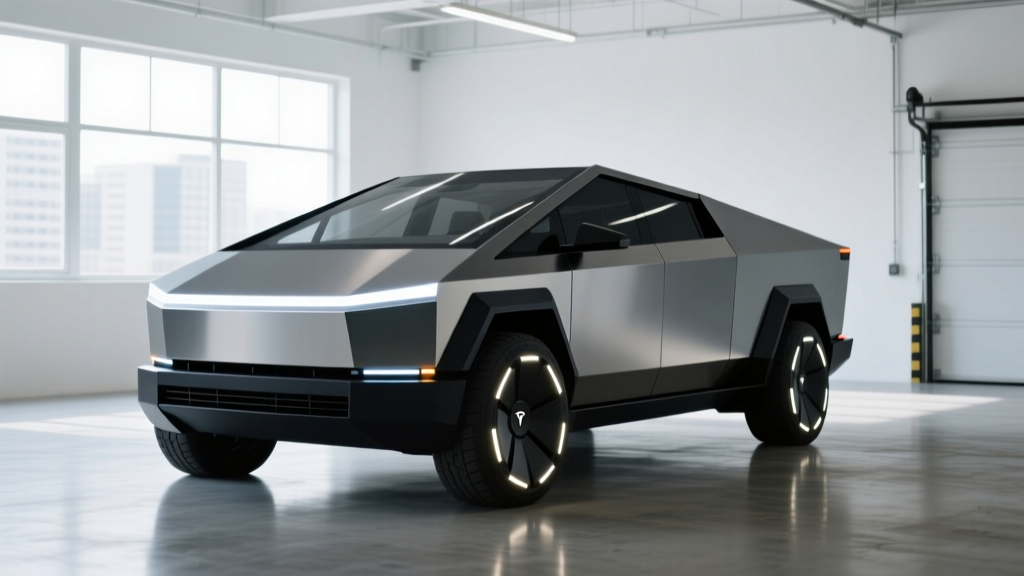
If you have been searching for Cybertruck Mini news, you are not alone. Rumors of a smaller, more affordable Tesla pickup have circulated since the original Cybertruck debuted, and the concept of a compact electric truck fills a genuine gap in the market. But separating confirmed facts from internet speculation is essential before you plan a purchase or a trade-in.
As of early 2026, Tesla has not officially announced a production model called "Cybertruck Mini." No vehicle by that name appears on Tesla's website, in its earnings reports, or in its regulatory filings. What we do have are comments from Tesla leadership about a next-generation, lower-cost vehicle platform, a growing competitive compact-pickup segment, and enough engineering breadcrumbs to make informed projections about what a smaller Cybertruck would look like if and when it arrives.
This article breaks down what is confirmed, what is estimated, and what buyers should watch for — with hard numbers wherever possible.
Is the Cybertruck Mini Real or Just a Rumor?
The short answer: it is a rumor, not an announced product. Tesla CEO Elon Musk has referenced a smaller, more affordable Tesla vehicle on multiple occasions, most recently tied to the company's next-generation platform aimed at significantly reducing manufacturing costs. However, Tesla has not published a model name, spec sheet, pricing, or production timeline for any compact pickup.
What drives the rumor is a clear market opportunity. The Ford Maverick hybrid starts around $28,000 and has become one of Ford's best-selling trucks. Hyundai's Santa Cruz targets a similar buyer. A compact electric pickup from Tesla — informally dubbed "Cybertruck Mini" by enthusiasts and automotive media — would slot below the full-size Cybertruck in both price and dimensions, targeting urban commuters and light-duty truck buyers who do not need 11,000 pounds of towing capacity.
Projected Specs: What a Compact Tesla Pickup Could Offer
While no official specs exist, we can build a reasonable projection based on Tesla's current battery chemistry strategy, the next-generation platform's stated cost-reduction targets, and the competitive landscape. The table below reflects estimated figures — treat them as informed projections, not guarantees.
| Attribute | Estimated / Projected | Basis for Estimate |
|---|---|---|
| EPA Range | 270–320 miles | Tesla Model Y RWD platform benchmark |
| Battery Capacity | ~60–75 kWh (usable) | Compact EV segment norms |
| Battery Chemistry | LFP (Lithium Iron Phosphate) | Tesla's cost-reduction strategy; already used in Model 3/Y RWD |
| Drivetrain | RWD base; AWD dual-motor optional | Tesla's current RWD/AWD trim strategy |
| 0–60 mph | 5.5–6.5 sec (RWD); ~4.5 sec (AWD) | Model Y performance benchmarks |
| Horsepower | ~295 hp (RWD); ~380 hp (AWD) | Comparable Tesla powertrain outputs |
| Max DC Fast Charge | ~170–250 kW (peak) | LFP charge-curve characteristics |
| 10–80% DC Charge Time | ~22–30 minutes (estimated) | Current LFP Tesla charging data |
| Level 2 Home Charging | ~11.5 kW / ~35–44 mi/hr | Tesla's onboard charger spec |
| Estimated Base MSRP | $35,000–$45,000 | Tesla next-gen platform cost targets |
| Bed Length | ~4.5 ft (estimated) | Compact truck segment norms (Maverick: 4.5 ft) |
| Towing Capacity | ~2,000–4,000 lbs (estimated) | Compact truck class limits |
A few things stand out in these projections. First, LFP chemistry is almost certain if Tesla wants to hit an aggressive price point. LFP (lithium iron phosphate) batteries are cheaper to produce than NMC (nickel manganese cobalt), contain no cobalt or nickel, and tolerate daily charging to 100% without the same degradation concerns. The trade-off is lower energy density — meaning a heavier or physically larger pack for the same range — and somewhat slower DC fast-charging speeds, particularly in cold weather.
Second, the range estimate of 270–320 miles is achievable on a ~60–75 kWh pack in a compact truck form factor, but real-world results will depend heavily on aerodynamics, vehicle weight, and driving conditions.
Real-World Range: What to Actually Expect
EPA Projected Range: 270–320 miles (unconfirmed, model not yet released)
Expected Highway Range (70–80 mph): ~220–270 miles — trucks face higher aerodynamic drag at speed, and a compact pickup's upright profile will reduce efficiency versus a sedan or crossover.
Expected Cold-Weather Range (below 32°F): ~180–240 miles — LFP batteries are more sensitive to cold than NMC, and cabin heating draws significant energy. A heat pump (standard on current Teslas) mitigates but does not eliminate this loss.
City / Commuter Range: Closest to the EPA sticker, potentially exceeding it with aggressive regenerative braking and low-speed driving.
Any compact electric pickup will face the same physics challenge: truck body shapes are inherently less aerodynamic than crossovers or sedans. The Ford F-150 Lightning, for example, achieves 230–320 EPA miles depending on battery pack, but real-world highway testing consistently shows 15–25% below the sticker at sustained 75+ mph speeds.
A smaller, lighter compact truck would fare better than a full-size, but buyers planning frequent highway road trips should budget for a realistic 230–260 miles between charges in mixed driving — and plan charging stops accordingly.
Charging Speed: DC Fast Charging and Home Level 2
Charging speed is often the most practical concern for EV buyers, and a compact Tesla pickup would likely share the company's current charging architecture with some LFP-specific nuances.
| Charging Level | Power (kW) | Miles Added per Hour | Notes |
|---|---|---|---|
| Level 1 (120V household) | ~1.4 kW | ~4–5 mi/hr | Emergency/overnight trickle only |
| Level 2 (240V home, 48A) | ~11.5 kW | ~35–44 mi/hr | Full charge overnight (~7–9 hours) |
| DC Fast Charge (peak) | ~170–250 kW | N/A (measured in minutes) | 10–80% in ~22–30 min (est.) |
Understanding kW vs. kWh: kW (kilowatts) measures charging power — how fast energy flows into the battery. kWh (kilowatt-hours) measures battery capacity — how much energy the battery stores. A 250 kW charger does not deliver 250 kWh; it delivers energy at a rate of up to 250 kW, tapering as the battery fills.
LFP charge-curve reality: LFP batteries typically sustain their peak charge rate for a shorter window than NMC batteries and taper more gradually. Where an NMC pack might hit 250 kW and taper sharply after 50% SoC (state of charge), an LFP pack might peak at 170–200 kW but hold a more consistent rate through 80%. The net result is that 10–80% charge times are competitive, but peak numbers on the spec sheet may look lower.
Cold-weather charging caveat: LFP batteries charge significantly slower when cold. Tesla's battery preconditioning — which warms the pack when you navigate to a Supercharger — is critical here. Without preconditioning, expect DC charge speeds to drop 40–60% in freezing temperatures. Always navigate to the charger through the car's system to trigger preconditioning.
Tesla's NACS (North American Charging Standard) connector is now the industry standard, with Ford, GM, Rivian, and others adopting it. A compact Tesla pickup would natively use NACS and have full access to the Tesla Supercharger network, which remains the most reliable DC fast-charging network in the U.S.
Pricing, Tax Credits, and Ownership Cost
The entire appeal of a "Cybertruck Mini" hinges on price. Tesla's stated goal for its next-generation platform is to roughly halve manufacturing costs compared to the Model 3/Y platform, which would theoretically enable a vehicle in the $30,000–$40,000 range before incentives.
| Trim (Projected) | Estimated MSRP | §30D Credit Eligibility | Effective Price (with credit) |
|---|---|---|---|
| Base RWD | $35,000–$38,000 | Likely eligible (if under MSRP cap) | $27,500–$30,500 |
| AWD Long Range | $42,000–$48,000 | Eligible (truck MSRP cap: $80,000) | $34,500–$40,500 |
| Performance / Top Trim | $50,000–$55,000 | Eligible (truck MSRP cap: $80,000) | $42,500–$47,500 |
Federal tax credit (§30D) rules for 2026: If this vehicle is classified as a truck (which a pickup would be), the MSRP cap is $80,000 — far above any projected price. However, the buyer must also meet income caps ($150,000 single / $300,000 joint modified AGI), and the battery must satisfy critical-minerals and battery-component sourcing requirements that have tightened significantly since the Inflation Reduction Act took effect. Tesla's U.S.-based manufacturing gives it an advantage here, but LFP cells sourced from China could complicate eligibility depending on how the rules are applied at launch.
The credit can now be transferred at the point of sale, meaning you get it as an immediate price reduction at the dealer rather than waiting for a tax refund. Always verify current eligibility on IRS.gov before making a purchase decision, as sourcing requirements have changed multiple times.
Estimated 5-year ownership cost advantage: At $0.13/kWh (national average residential electricity rate) and 3.5 miles/kWh efficiency, fuel cost would run roughly $0.037/mile — compared to $0.12–$0.15/mile for a 25 MPG gas truck at $3.50/gallon. Over 60,000 miles, that is a $5,000–$7,000 fuel savings, partially offset by potentially higher insurance premiums (EV insurance runs 15–25% above comparable gas vehicles on average).
Competitive Landscape: What Would a Cybertruck Mini Compete Against?
The compact and midsize electric truck segment is still thin but growing. Here is how a hypothetical Cybertruck Mini would stack up against current and announced competitors:
| Vehicle | EPA Range | Starting MSRP | Status |
|---|---|---|---|
| Tesla "Cybertruck Mini" (projected) | 270–320 mi (est.) | $35,000–$38,000 (est.) | Unannounced |
| Ford Maverick (Hybrid, gas) | ~500+ mi (gas); ~42 MPG | ~$28,000 | Available (no EV version yet) |
| Hyundai Santa Cruz (gas) | ~450 mi (gas); ~23 MPG | ~$28,500 | Available (no EV version yet) |
| Ford F-150 Lightning | 230–320 mi | ~$55,000 | Available (full-size, not compact) |
| Rivian R1T (Dual-Motor) | 270–420 mi | ~$70,000 | Available (midsize, premium price) |
| Chevrolet Silverado EV | 270–440 mi | ~$55,000 | Available (full-size) |
The gap is obvious: there is currently no affordable compact electric pickup on the U.S. market. The Maverick and Santa Cruz are gas/hybrid only. The F-150 Lightning and Silverado EV are full-size and start well above $50,000. The Rivian R1T is excellent but starts near $70,000. A sub-$40,000 compact electric truck with 300 miles of range, Supercharger access, and Tesla's software ecosystem would have virtually no direct competitor at launch.
That said, Ford has signaled interest in an electric Maverick, and Ford's compact truck platform is a proven seller. If Tesla delays, competitors will fill the gap.
Tech, Features, and the Tesla Ecosystem Advantage
If the Cybertruck Mini follows Tesla's current product strategy, it would share significant technology with the refreshed Model 3 and Model Y, including:
- Infotainment: 15.4-inch center touchscreen running Tesla's proprietary OS, with built-in navigation, streaming, and over-the-air updates. No Apple CarPlay or Android Auto — Tesla has never supported either.
- Autopilot (SAE Level 2): Standard adaptive cruise control and lane-centering. This is not self-driving. The driver must remain engaged with hands on the wheel at all times. Tesla's FSD (Supervised) would be an optional upgrade but remains a Level 2 system requiring full driver attention.
- Supercharger access: Native NACS connector with access to 50,000+ Superchargers globally — the most reliable and widespread DC fast-charging network available.
- Sentry Mode and Dashcam: Continuous camera recording when parked, a feature no competitor matches in the truck segment.
- Frunk + bed storage: A compact electric truck's flat-floor skateboard platform enables front trunk (frunk) storage in addition to the bed, plus potential under-bed locked storage.
Notable drawbacks to anticipate: Tesla's panel gaps and paint quality remain inconsistent across production vehicles, as documented by numerous owners and reviewers. The minimalist interior — no physical buttons, no instrument cluster — appeals to some and frustrates others. Service center wait times in many U.S. markets remain a persistent complaint, and Tesla's mobile-service network, while expanding, does not cover all areas.
Warranty, Battery Longevity, and What We Can Project
Tesla's current warranty structure provides a useful baseline for what a compact truck would likely carry:
- Vehicle Limited Warranty: 4 years / 50,000 miles (bumper-to-bumper)
- Battery & Drive Unit Warranty: 8 years / 100,000 miles (RWD) or 8 years / 120,000 miles (AWD), with a minimum 70% capacity retention threshold
LFP batteries have a significant longevity advantage: they typically sustain 2,000–3,000+ full charge cycles before degrading to 80% capacity, compared to 1,000–1,500 cycles for NMC. In practical terms, an LFP pack in a compact truck could outlast the vehicle itself for most owners. Tesla's LFP-equipped Model 3 RWD vehicles have shown strong State of Health (SoH) retention in fleet data, with many exceeding 100,000 miles with less than 10% degradation.
The trade-off: LFP batteries are heavier per kWh, which slightly reduces efficiency and range compared to an equivalent NMC pack. For a compact truck prioritizing cost over maximum range, this is the right trade-off.
Battery replacement cost context: If an out-of-warranty replacement were ever needed, current LFP pack replacement costs run roughly $8,000–$14,000 depending on capacity — significantly less than NMC packs. However, the vast majority of EV batteries outlast their warranty periods without needing replacement.
Who Should Wait for the Cybertruck Mini — and Who Should Buy Now?
Wait for a Cybertruck Mini if:
- You want a compact electric truck specifically and can wait 1–3+ years for an unannounced product
- Supercharger network access is a top priority for your road-trip habits
- You want Tesla's software ecosystem, OTA updates, and Autopilot integration
- Your budget target is $35,000–$45,000 for a new EV
Buy something else now if:
- You need a truck in the next 6 months — no compact electric truck is currently available at an affordable price
- You need proven towing capacity (5,000+ lbs) — look at the F-150 Lightning or Silverado EV
- You prefer physical buttons, CarPlay, or dealer-service convenience — Tesla's minimalist approach is not for everyone
- You want a hybrid compact truck today — the Ford Maverick Hybrid at ~42 MPG and ~$28,000 is available now with no charging infrastructure needed
Frequently Asked Questions
Is the Cybertruck Mini officially announced by Tesla?
No. As of early 2026, Tesla has not announced any vehicle called "Cybertruck Mini" or confirmed a compact pickup truck product. The name is an enthusiast and media label applied to the concept of a smaller, more affordable Tesla truck built on the company's next-generation platform.
How much would a Cybertruck Mini cost?
Based on Tesla's stated cost-reduction goals for its next-gen platform, industry analysts project a starting MSRP between $35,000 and $45,000 depending on drivetrain and battery configuration. If eligible for the full $7,500 federal tax credit under IRS §30D rules, the effective price could drop to $27,500–$37,500. However, credit eligibility depends on battery sourcing, buyer income, and MSRP caps that may change before any potential launch.
What would the real-world range be?
Projected EPA range is 270–320 miles, but real-world highway driving at 70–80 mph would likely yield 220–270 miles. In cold weather (below freezing), expect 180–240 miles due to LFP battery sensitivity to low temperatures and cabin-heating energy draw.
Would it qualify for the $7,500 federal EV tax credit?
Likely yes, if it is classified as a truck (MSRP cap of $80,000) and if Tesla's battery sourcing meets the critical-minerals and component-manufacturing requirements in effect at launch. The buyer must also meet income caps ($150,000 single / $300,000 joint). Verify current rules on IRS.gov before purchasing.
How fast would it charge?
Estimated peak DC fast-charging at 170–250 kW, with a 10–80% charge time of approximately 22–30 minutes. Home Level 2 charging at 11.5 kW would add roughly 35–44 miles per hour, enabling a full overnight charge in 7–9 hours.
Is it worth waiting for instead of buying a Ford Maverick Hybrid?
They serve different needs. The Maverick Hybrid is available now, starts around $28,000, gets ~42 MPG combined, and requires no charging infrastructure. A Cybertruck Mini would offer zero tailpipe emissions, lower per-mile fuel costs, Supercharger access, and Tesla's tech — but at a higher starting price, with charging logistics, and an uncertain release date. If you can charge at home and want an EV, waiting may make sense. If you need a truck now or lack home charging access, the Maverick Hybrid is the pragmatic choice.
When might the Cybertruck Mini be released?
Tesla has not provided any timeline. The company's next-generation platform was referenced in 2024–2025 earnings calls, but Tesla's production timelines have historically slipped by 1–2 years from initial projections. A 2027–2028 launch is an optimistic estimate; anything before that would be a surprise.
Sources: EPA Fuel Economy, IRS Clean Vehicle Credits, Tesla Battery Warranty.