The Cybertruck as an Overlanding Platform: What You Actually Get
If you've searched for a Cybertruck mattress setup, you're likely evaluating Tesla's polarizing pickup not just as a daily driver, but as a camping and overlanding platform. The angular stainless-steel exoskeleton and 6-foot vault-style bed have spawned an entire aftermarket of bed tents, inflatable mattresses, and custom sleeping platforms. But before you commit to a $200–$600 mattress system, you need to know exactly what the Cybertruck delivers in range, charging infrastructure, and real-world utility when loaded down with gear.
This review covers the 2026 Tesla Cybertruck lineup — AWD (Dual Motor), and Cyberbeast (Tri-Motor) — with a focus on the specs that matter for camping, road trips, and off-grid sleeping. We'll reconcile EPA range stickers with real-world expectations, break down DC fast-charging curves, and assess whether the Cybertruck's bed actually makes a viable sleeping platform compared to rivals like the Rivian R1T and Ford F-150 Lightning.
Range, Battery, and Real-World Efficiency
The Cybertruck's range story is more nuanced than Tesla's original 500-mile promises. Here's what the current lineup delivers according to EPA estimates on fueleconomy.gov:
| Trim | Battery (kWh, est.) | Chemistry | EPA Range | MPGe (Combined) | kWh/100 mi |
|---|---|---|---|---|---|
| AWD (Dual Motor) | ~123 kWh usable | NMC (4680 cells) | 340 miles | 67 MPGe | 50 kWh/100mi |
| Cyberbeast (Tri-Motor) | ~123 kWh usable | NMC (4680 cells) | 320 miles | 63 MPGe | 53 kWh/100mi |
The Cybertruck uses Tesla's 4680-format NMC (nickel-manganese-cobalt) cells in a structural battery pack. Unlike the LFP chemistry found in some Model 3/Y rear-wheel-drive variants, NMC offers higher energy density but is generally recommended to be charged to 80% for daily use and 100% only for long trips. For camping, this means your practical "full tank" before a weekend trip is closer to 272 miles (AWD) or 256 miles (Cyberbeast) unless you charge to 100% right before departure.
Charging Speed: DC Fast Charge and Home Level 2
Charging speed is arguably the most critical spec for road-tripping and overlanding. A slow-charging truck means 45-minute stops instead of 20-minute stops when you're trying to reach a campsite before dark.
| Charging Method | Peak Power | 10–80% Time | Miles Added per Hour |
|---|---|---|---|
| DC Fast Charge (Supercharger V4) | ~325 kW peak | ~15 minutes | N/A (session-based) |
| DC Fast Charge (third-party CCS/NACS) | ~250 kW peak | ~18–22 minutes | N/A |
| Level 2 Home (Tesla Wall Connector, 48A) | 11.5 kW | N/A (overnight) | ~34 miles/hr |
| Level 2 Home (standard 240V/32A) | 7.7 kW | N/A (overnight) | ~23 miles/hr |
| Level 1 (120V household) | ~1.4 kW | N/A (multi-day) | ~3–4 miles/hr |
The Cybertruck's 800-volt-class architecture enables impressive peak charge rates on Tesla's V4 Superchargers, but as with all EVs, the charge curve tapers significantly above 80%. You'll see 300+ kW only in the 10–40% state-of-charge window; from 60–80%, speeds drop to roughly 100–130 kW. This is normal physics — lithium-ion cells resist accepting energy as they approach full capacity to prevent overheating and degradation.
For camping trips, the key takeaway: a 15-minute Supercharger stop can add roughly 170–200 miles of range. That's enough to detour off-route, charge, and still reach a remote campsite. The NACS connector is native, meaning you also have access to Tesla's Supercharger network — currently the most reliable DC fast-charging ecosystem in North America, with over 25,000 stalls.
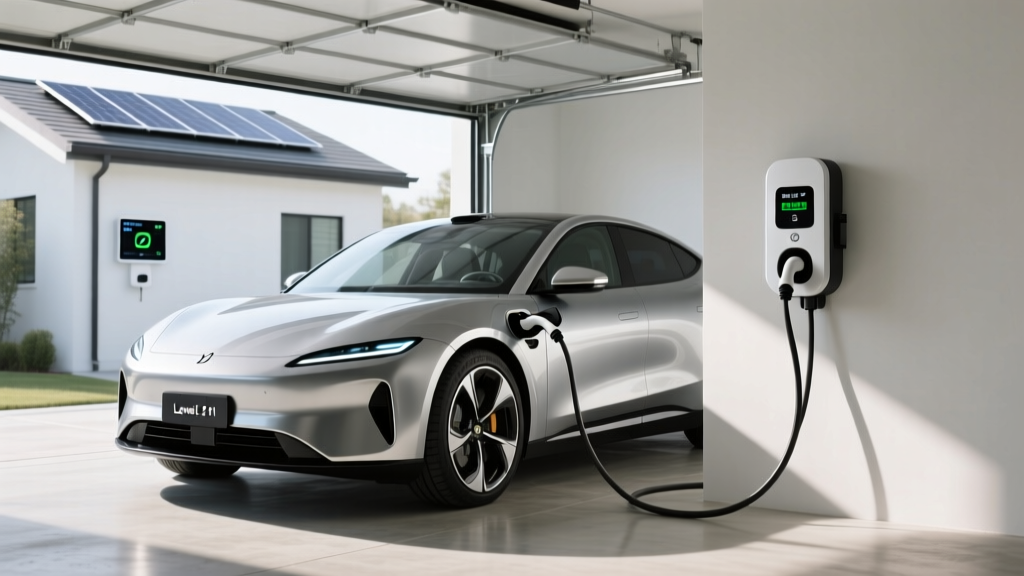
Home charging note: If you're running a Cybertruck mattress setup and using the truck for weekend camping, a Level 2 home charger is essential. Fully recharging the ~123 kWh battery from 10% on Level 1 (120V) would take roughly four days. On a 48-amp Level 2 circuit, it's an overnight affair — about 10–12 hours for a full charge.
Performance, Towing, and Payload Specs
| Spec | AWD (Dual Motor) | Cyberbeast (Tri-Motor) |
|---|---|---|
| 0–60 mph | 3.9 seconds | 2.6 seconds |
| Horsepower | ~600 hp | ~845 hp |
| Drivetrain | Dual-motor AWD | Tri-motor AWD |
| Max Towing Capacity | 11,000 lbs | 11,000 lbs |
| Payload Capacity | 2,500 lbs | 2,500 lbs |
| Bed Length | 6 feet (72 in) / ~67 cu ft volume | |
| Ground Clearance | Up to 17.4 in (with air suspension raised) | |
For overlanding, the air suspension is a standout feature. It offers approximately 12 inches of vertical travel, allowing you to raise the truck for rocky trail clearance or lower it for easier bed access when loading a mattress and gear. The adaptive damping also smooths out washboard forest roads — a genuine comfort advantage over leaf-sprung competitors when you're loaded down.
Towing a teardrop or small camping trailer (2,000–4,000 lbs) will reduce range by roughly 30–50%, depending on the trailer's aerodynamic profile. Plan for ~170–220 miles of range when towing a camper on the highway.
Cybertruck Mattress & Bed Camping: The Practical Setup
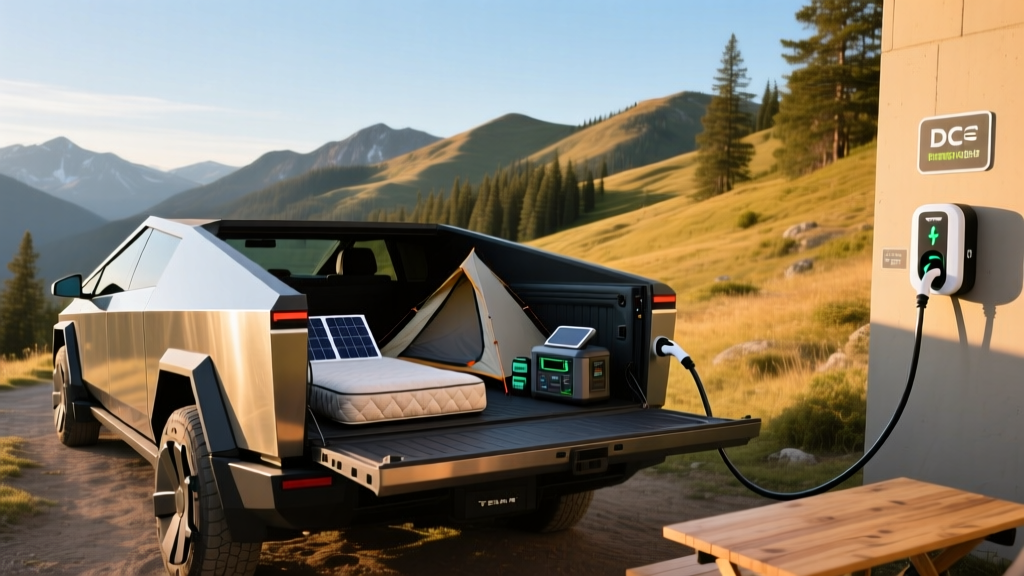
The Cybertruck's 6-foot composite bed with integrated tonneau cover (the "vault") is central to its appeal as a sleeping platform. Here's what you need to know about fitting a mattress:
- Bed dimensions: Approximately 72 inches long × 43–50 inches wide (narrower between wheel wells). This fits a standard twin mattress (75 × 38 in) with minor overhang, or purpose-built truck mattresses from brands like Tuff Stuff, Exped, or Luno.
- Vault height: With the tonneau closed, vertical clearance is limited (~26–28 inches at the bed floor). Most campers use the vault for gear storage and sleep on top of a bed rack or with the tonneau open.
- Power access: The bed includes two 120V outlets and USB-C ports, plus the Cybertruck's Powershare feature (V2L — vehicle-to-load) can output up to 9.6 kW. You can run a CPAP machine, electric blanket, induction cooktop, or LED lights directly from the truck's battery without a separate generator.
- Climate control: Tesla's Camp Mode keeps the HVAC system running overnight, maintaining cabin temperature. With the ~123 kWh battery, running Camp Mode for 8 hours consumes roughly 4–8 kWh (depending on outside temperature), reducing range by about 12–25 miles — a minor trade-off for comfortable sleep.
The 9.6 kW Powershare output is a genuine differentiator for camping. You can plug in a full-size refrigerator, charge e-bikes, or power a worksite. Rivian's R1T offers similar V2L capability, while the F-150 Lightning's Pro Power Onboard tops out at 9.6 kW on higher trims.
Pricing, Trim Levels, and Federal Tax Credit
| Trim | 2026 MSRP (est.) | Federal §30D Credit | Effective Price |
|---|---|---|---|
| AWD (Dual Motor) | $79,990 | Not eligible (MSRP over $80k cap for trucks) | $79,990 |
| Cyberbeast (Tri-Motor) | $99,990 | Not eligible (MSRP over $80k cap for trucks) | $99,990 |
Tax credit reality check: Under current IRS §30D rules, the federal EV tax credit caps eligible pickup trucks at an MSRP of $80,000. The Cybertruck AWD at $79,990 sits right at the threshold, but destination charges and mandatory options can push the final MSRP above the cap. Even if the base AWD qualifies, buyers must also meet income limits ($300,000 joint / $150,000 single for new vehicles) and the vehicle must satisfy critical mineral and battery component sourcing requirements — which have tightened significantly for 2025–2026 model years.
As of early 2026, Tesla has not confirmed that any Cybertruck trim meets the full battery-sourcing requirements for the $7,500 credit. The Cyberbeast at $99,990 is definitively above the MSRP cap regardless. Do not assume you'll receive the credit — verify current eligibility on the IRS clean vehicle credit page and consult a tax professional before purchase. Point-of-sale transfer is available for qualifying vehicles, allowing the credit to be applied as a down-payment reduction at the dealer.
Tech, Driver Assistance, and Interior
The Cybertruck's interior is minimalist even by Tesla standards — a single 18.5-inch front touchscreen handles all vehicle controls, navigation, and entertainment. A 9.4-inch rear touchscreen serves back-seat passengers. There are no physical buttons for climate, mirrors, or glovebox — everything is screen-driven, which some campers find frustrating when trying to adjust settings in the dark from a sleeping bag.
Autopilot and FSD (Supervised): Tesla's driver-assistance suite comes standard, with Full Self-Driving (Supervised) available as a $8,000 add-on or $99/month subscription. FSD Supervised is a SAE Level 2 system — it handles steering, acceleration, and braking on highways and city streets, but the driver must remain fully engaged, hands on the wheel, and eyes on the road at all times. It is not autonomous driving.
Other tech highlights relevant to camping: built-in navigation with Supercharger routing and preconditioning (the battery heats itself before arriving at a charger, enabling faster charge speeds), a HEPA air filtration system (useful on dusty forest roads), and a front trunk (frunk) offering ~7 cu ft of lockable storage for valuables while you're away from the truck.
Pros, Cons, and the Verdict for Campers
Pros
- 9.6 kW V2L Powershare eliminates the need for a camping generator
- Supercharger network access = most reliable road-trip charging in North America
- Air suspension provides 17.4" ground clearance for trail access and easy bed entry
- 11,000-lb towing capacity handles most camping trailers
- Stainless-steel exoskeleton resists trail pinstriping and dents
- Camp Mode provides overnight HVAC without a separate power source
Cons
- Real-world highway range drops to 270–300 mi (AWD); less when towing or loaded
- $80k+ price eliminates most buyers from federal tax credit eligibility
- 6-foot bed is shorter than competitors (F-150 Lightning offers 5.5' or 6.5' boxes, R1T has a 4.5' bed + gear tunnel)
- Bed width between wheel wells (~43") limits mattress options
- All-screen controls are frustrating for nighttime camping adjustments
- Range Extender pack still unavailable as of early 2026
- Insurance premiums are among the highest in the EV truck segment
Competitor Comparison: Is the Cybertruck the Best Camping EV Truck?
| Spec | Cybertruck AWD | Rivian R1T (Dual-Motor Max) | F-150 Lightning (Ext. Range) |
|---|---|---|---|
| EPA Range | 340 mi | 410 mi | 320 mi |
| Bed Length | 6 ft | 4.5 ft (+ gear tunnel) | 5.5 ft |
| Max Tow | 11,000 lbs | 11,000 lbs | 10,000 lbs |
| V2L Output | 9.6 kW | ~2.4 kW (bed outlet) | 9.6 kW (Pro Power) |
| Base MSRP | $79,990 | $75,900 | ~$69,995 |
| Fed. Tax Credit | Likely ineligible | Up to $7,500 (eligible trims) | Up to $7,500 (eligible trims) |
The Rivian R1T's 410-mile Max Pack range and available gear tunnel give it an edge for dedicated overlanders who prioritize range over raw performance. The F-150 Lightning's lower starting price and confirmed tax-credit eligibility make it the budget-friendlier camping truck — though its charging network access (CCS, transitioning to NACS) is less seamless than Tesla's Supercharger ecosystem.
The Cybertruck wins on V2L power output, Supercharger access, and air suspension versatility. It loses on bed length, tax-credit eligibility, and overall value proposition.
Warranty Coverage
Tesla provides the following warranty coverage for the 2026 Cybertruck:
- Basic Vehicle Limited Warranty: 4 years / 50,000 miles
- Battery & Drive Unit Warranty: 8 years / 120,000 miles (with minimum 70% battery capacity retention guaranteed)
- Restraint System: 5 years / 60,000 miles
The 8-year/120,000-mile battery warranty is competitive with Rivian (8/120k) and Ford (8/100k). Tesla's 70% capacity retention threshold is standard for the industry. The structural 4680 battery pack has not yet accumulated enough real-world mileage data to assess long-term degradation curves, but early reports suggest degradation in line with Model 3/Y NMC packs — approximately 8–12% loss over the first 100,000 miles.
Frequently Asked Questions
What is the real-world range of the Cybertruck when camping?
Expect 270–300 miles on the highway (AWD trim) under normal conditions. When loaded with camping gear, a bed tent, and passengers, plan for 250–280 miles. In cold weather (below 30°F), range can drop to 200–240 miles. Towing a trailer reduces range further to approximately 170–220 miles.
How fast does the Cybertruck charge on road trips?
On a Tesla V4 Supercharger, the Cybertruck peaks at approximately 325 kW and charges from 10–80% in about 15 minutes. On third-party DC fast chargers (using the NACS adapter), expect 250 kW peak and 18–22 minutes for 10–80%. At home on a 48-amp Level 2 charger, you'll add roughly 34 miles of range per hour.
Does the Cybertruck qualify for the $7,500 federal EV tax credit?
Likely not. The IRS §30D credit caps eligible trucks at $80,000 MSRP. The Cybertruck AWD's $79,990 base price is right at the threshold, and destination fees often push it over. The Cyberbeast at $99,990 is ineligible. Even if MSRP qualifies, buyers must meet income limits and the vehicle must satisfy battery-sourcing rules. Verify on IRS.gov before purchasing.
What size mattress fits in the Cybertruck bed?
The bed is approximately 72 inches long and 43–50 inches wide (narrower between wheel wells). A standard twin mattress (75 × 38 in) fits with slight overhang. Purpose-built truck camping mattresses (Exped Megamat Auto, Luno Life, Tuff Stuff) are designed for this footprint and are the better choice. Many campers use a bed rack to elevate the sleeping surface above the vault for standing-height gear storage below.
Can the Cybertruck power camping appliances overnight?
Yes. The Powershare V2L system outputs up to 9.6 kW through bed-mounted 120V outlets — enough to run a full-size fridge, electric blanket, CPAP machine, induction cooktop, and LED lighting simultaneously. Tesla's Camp Mode keeps the HVAC running for comfortable cabin temperature, consuming roughly 4–8 kWh over 8 hours (about 12–25 miles of range).
Is the Cybertruck worth buying for camping vs. the Rivian R1T or F-150 Lightning?
Choose the Cybertruck if Supercharger network access, 9.6 kW V2L, and air suspension trail capability are your top priorities. Choose the Rivian R1T if you need maximum range (410 mi EPA) and creative storage (gear tunnel). Choose the F-150 Lightning if budget and tax-credit eligibility matter most — it starts ~$10,000 lower and qualifies for the full $7,500 credit on eligible trims.