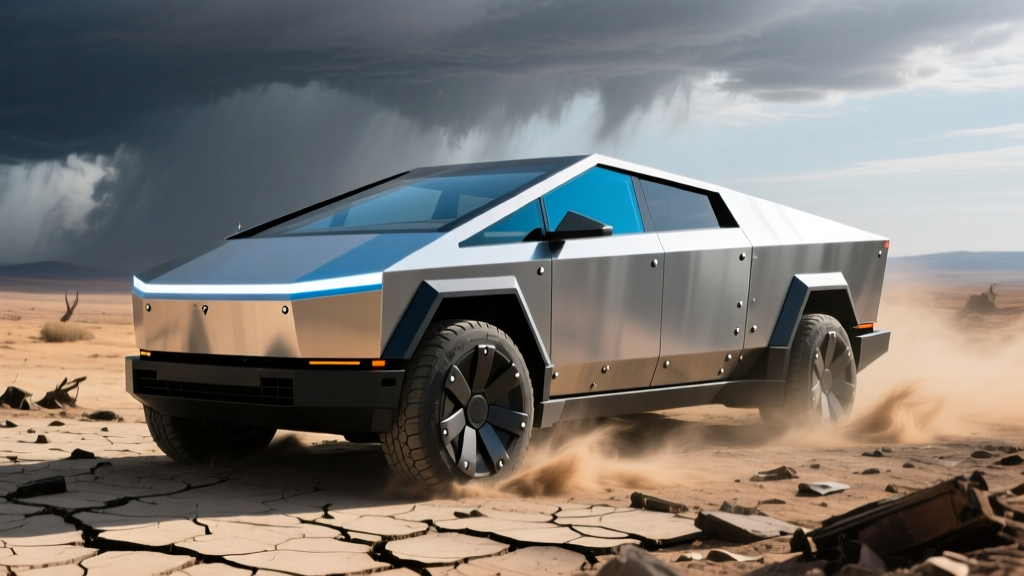
The phrase "Mad Max Tesla" has followed the Cybertruck since Elon Musk first rolled the stainless-steel wedge onto a stage in 2019. The angular, armor-clad aesthetic practically begs for a post-apocalyptic backdrop. But beyond the memes and the movie references, the 2026 Tesla Cybertruck is a production vehicle that real buyers are driving daily — one with genuine strengths, measurable limitations, and a price tag that demands scrutiny. This review strips away the hype and examines the Cybertruck as an electric pickup: its range, charging speed, utility, and whether it actually delivers on the dystopian promise its design implies.
What Makes the Cybertruck the "Mad Max Tesla"?
The Cybertruck earns its nickname from three design pillars: its cold-rolled stainless steel exoskeleton, its angular geometry that rejects every automotive styling convention, and its claimed off-road durability. Tesla markets the truck with imagery of desert runs, bullet-resistant panels, and a silhouette that looks like it rolled straight out of the Wasteland.
But the "Mad Max" persona is more than skin-deep. The Cybertruck features a 48-volt electrical architecture (an industry first for a production vehicle), steer-by-wire steering with no mechanical connection between wheel and rack, and an adaptive air suspension that can raise the truck for off-road clearance or lower it for highway efficiency. These are engineering choices that push beyond conventional pickup design — though they also introduce complexity that traditional truck buyers may find concerning.
Range, Battery, and Real-World Efficiency
The 2026 Cybertruck is available in two battery configurations across its trim lineup. Here's what the EPA says — and what you should actually expect.
| Spec | Dual Motor AWD | Cyberbeast (Tri-Motor) |
|---|---|---|
| EPA Range | 340 miles | 320 miles |
| Battery Capacity (usable) | ~123 kWh | ~123 kWh |
| Battery Chemistry | NMC (Nickel Manganese Cobalt) | NMC |
| Drivetrain | Dual Motor AWD | Tri-Motor AWD |
| Horsepower | 600 hp | 845 hp |
| 0–60 mph | 3.9 seconds | 2.6 seconds |
| MPGe (combined) | 66 MPGe | 63 MPGe |
| kWh per 100 mi | ~51 kWh | ~54 kWh |
| Towing Capacity | 11,000 lbs | 11,000 lbs |
| Payload Capacity | 2,500 lbs | 2,500 lbs |
| Bed Length | 6 ft (lockable vault) | 6 ft (lockable vault) |
The EPA rates the Dual Motor at 340 miles and the Cyberbeast at 320 miles. In real-world highway driving at 70–75 mph, expect approximately 260–290 miles before needing to charge. In cold weather (below 32°F / 0°C), range can drop an additional 15–25%, bringing usable highway range to roughly 210–245 miles. The Cybertruck's massive frontal area and ~6,800 lb curb weight work against highway efficiency. City driving with regenerative braking recovers more energy, but this is a truck that consumes electrons at a prodigious rate.
The NMC battery chemistry provides high energy density necessary for a vehicle this heavy, but it requires more careful thermal management than LFP (lithium iron phosphate) packs. Tesla's thermal management system is among the best in the industry, and the Cybertruck's battery pack sits within a structural frame that contributes to rigidity. For daily driving, Tesla recommends charging to 80–90% for NMC chemistry to preserve long-term battery health, which effectively reduces your daily usable range to approximately 270 miles (Dual Motor) or 256 miles (Cyberbeast).
Charging Speed: DC Fast and Home Level 2
The Cybertruck's 800-volt-class architecture enables impressive DC fast-charging speeds, but as with all EVs, the peak rate isn't sustained across the full charging session.
| Charging Level | Power / Rate | Speed / Time |
|---|---|---|
| Level 1 (120V outlet) | ~1.4 kW | ~3 miles per hour |
| Level 2 (240V, 48A Wall Connector) | 11.5 kW | ~34 miles per hour |
| Level 2 (240V, 80A Wall Connector) | 19.2 kW | ~56 miles per hour |
| DC Fast Charge (V4 Supercharger) | Peak 350 kW | 10–80% in ~20 minutes |
| DC Fast Charge (250 kW V3 Supercharger) | Peak 250 kW | 10–80% in ~28 minutes |
At a V4 Supercharger, the Cybertruck can accept up to 350 kW at peak, though the charge curve tapers significantly above 60% state of charge. The 10–80% time of roughly 20 minutes is competitive with the best EVs on the road, but that's only achievable when the battery is properly preconditioned (the Cybertruck does this automatically when you navigate to a Supercharger). At a 250 kW V3 station, expect closer to 28 minutes for the same 10–80% session.
For home charging, Tesla's Wall Connector at 48 amps adds about 34 miles of range per hour — enough to fully replenish the pack overnight from a typical daily driving session. If your electrical panel supports an 80-amp circuit, you can push to 19.2 kW and gain roughly 56 miles per hour, cutting a full charge to about 7 hours. Most buyers will find the 48-amp setup perfectly adequate.
Pricing, Trims, and Federal Tax Credit Eligibility
The Cybertruck's pricing has shifted considerably from the original 2019 promises. Here's where the 2026 lineup stands:
| Trim | Base MSRP | As-Tested (typical options) | §30D Federal Credit Eligible? |
|---|---|---|---|
| Dual Motor AWD | $79,990 | $84,000–$88,000 | Varies — see below |
| Cyberbeast (Tri-Motor) | $99,990 | $105,000–$112,000 | No — exceeds MSRP cap |
Federal tax credit nuances (§30D): The IRS §30D clean vehicle credit offers up to $7,500, but eligibility depends on three overlapping requirements:
- MSRP Cap: Pickup trucks must have an MSRP at or below $80,000 to qualify. The Dual Motor at $79,990 clears this threshold; the Cyberbeast at $99,990 does not.
- Buyer Income Cap: Modified adjusted gross income must not exceed $150,000 (single), $225,000 (head of household), or $300,000 (joint filing).
- Battery Sourcing: Critical minerals and battery components must meet escalating domestic-sourcing percentages. Tesla's supply chain has been adapting, but specific eligibility can change by production batch. Verify the VIN on fueleconomy.gov before purchase.
- Point-of-Sale Transfer: As of 2024, buyers can transfer the credit to the dealer at purchase, reducing the out-of-pocket price directly rather than waiting for a tax refund.
The Dual Motor AWD, if it meets all sourcing requirements and your income qualifies, could effectively cost $72,490 after the full $7,500 credit. The Cyberbeast is categorically ineligible due to its MSRP. Always confirm current eligibility with a tax professional and the IRS tool before committing to a purchase.
Performance, Handling, and the Steer-by-Wire Experience
The Cybertruck's performance figures are genuinely staggering for a vehicle weighing nearly three and a half tons. The Cyberbeast's 2.6-second 0–60 mph time rivals supercars, while the Dual Motor's 3.9 seconds is quicker than most sports sedans. The instant torque delivery from Tesla's electric motors means there's no turbo lag, no transmission hunting — just relentless, linear acceleration.
The steer-by-wire system is the most polarizing feature. With no mechanical link between the yoke and the wheels, the steering ratio changes dynamically — requiring less than a full turn lock-to-lock at low speeds and more at highway speeds. Proponents praise the precision and the reduced arm-shuffling; critics note a slight artificiality in feedback and a learning curve during emergency maneuvers. After approximately 500 miles of driving, most owners report adaptation, but test-driving is strongly recommended before purchasing.
Off-road, the adaptive air suspension provides up to 16 inches of ground clearance in Extract Mode. Approach and departure angles are competitive with mid-size off-roaders, and the stainless steel underbody armor provides genuine protection on rocky terrain. However, the Cybertruck's 6,800+ lb weight means it sinks in soft sand and mud more readily than lighter competitors, and the lack of traditional locking differentials (replaced by torque-vectoring via individual motors) is effective but not yet proven in extreme rock-crawling scenarios.
Interior Space, Cargo, and Daily Practicality
The Cybertruck seats five adults, though the rear middle seat is narrow and best suited for shorter trips. Front legroom measures 41.2 inches; rear legroom is 38.4 inches — adequate but not class-leading compared to full-size trucks like the Ford F-150 Lightning.
The 6-foot bed (Tesla calls it the "vault") features a motorized retractable hardcover and 67 cubic feet of enclosed cargo volume. The tailgate doubles as a ramp for loading ATVs or motorcycles. Under-bed storage is limited by the structural battery pack, but a front trunk (frunk) adds approximately 7 cubic feet of lockable space — useful for charging cables, groceries, or a weekender bag.
The 18.5-inch center touchscreen controls virtually every vehicle function, from mirror adjustment to glove box release. There are no physical buttons on the dashboard. This minimalist approach divides opinion: it's clean and futuristic, but adjusting climate settings or windshield wipers while driving requires menu-diving that takes your eyes off the road longer than physical controls would.
Warranty and Long-Term Ownership
| Component | Coverage |
|---|---|
| Limited Vehicle Warranty | 4 years / 50,000 miles |
| Battery & Drive Unit | 8 years / 120,000 miles (min. 70% retention) |
| Roadside Assistance | 4 years / 50,000 miles |
Tesla's battery warranty guarantees at least 70% capacity retention over 8 years or 120,000 miles — whichever comes first. Based on data from Model S and Model 3 fleets, NMC packs typically degrade 10–15% over the first 100,000 miles before the degradation curve flattens. A full battery replacement out of warranty would likely cost between $15,000 and $22,000, though this is a worst-case scenario most owners will never face.
The steer-by-wire system and 48-volt architecture are new to production vehicles at this scale. While Tesla has extensive over-the-air update capability to address software issues, hardware failures in these novel systems could prove costly once the 4-year bumper-to-bumper warranty expires. Extended warranty options are limited, and third-party EV warranty providers are still developing coverage for these unique components.
Pros, Cons, and the Verdict
Pros
- Class-leading acceleration (2.6s Cyberbeast, 3.9s Dual Motor)
- 350 kW peak DC fast charging — 10–80% in ~20 min
- Stainless steel exoskeleton is dent- and corrosion-resistant
- 11,000-lb towing capacity competitive with full-size trucks
- Tesla Supercharger network — the most reliable DC fast-charging network in the US
- Over-the-air updates continuously add features
- Lockable vault bed with integrated ramp tailgate
Cons
- Real-world highway range falls well short of EPA (260–290 mi vs. 340 mi)
- Cold weather range loss of 15–25% is significant
- Steer-by-wire learning curve and unproven long-term reliability
- Cyberbeast ineligible for federal tax credit (MSRP cap)
- No physical dashboard controls — everything through touchscreen
- ~6,800 lb weight limits soft-terrain off-road performance
- Insurance premiums 20–40% higher than comparable trucks
- Panel gap and build-quality inconsistencies persist in some deliveries
Who Should Buy the Cybertruck — And Who Shouldn't
Choose the Cybertruck if:
- You want a high-performance electric truck with genuine towing capability and access to the Supercharger network
- You value distinctive design and are willing to accept the attention (positive and negative) it draws
- You have home Level 2 charging and mostly drive within 200 miles of home
- You want the latest EV technology and don't mind being an early adopter on steer-by-wire and 48V systems
Look elsewhere if:
- You regularly drive 300+ miles in cold weather or at sustained highway speeds — the range shortfall will frustrate you
- You need a proven, no-surprises work truck with decades of service history (consider the F-150 Lightning or Silverado EV)
- You're budget-conscious and the Cyberbeast's $100K+ price and tax-credit ineligibility are dealbreakers
- You prefer physical controls and traditional steering feedback
Frequently Asked Questions
What is the real-world range of the Tesla Cybertruck?
The EPA rates the Dual Motor at 340 miles and the Cyberbeast at 320 miles. In real-world highway driving at 70+ mph, expect 260–290 miles. In cold weather, that drops to roughly 210–245 miles. The Cybertruck's weight and aerodynamic profile are the primary efficiency penalties.
How fast does the Cybertruck charge at home and on the road?
On a V4 Supercharger, peak DC fast charging reaches 350 kW, achieving 10–80% in approximately 20 minutes. At home on a 48-amp Level 2 Wall Connector, you'll gain about 34 miles per hour — a full overnight charge. An 80-amp circuit pushes this to ~56 miles per hour.
How much does the Cybertruck cost after the federal tax credit?
The Dual Motor AWD starts at $79,990 and may qualify for up to $7,500 in §30D credits if you meet income limits and the vehicle's battery sourcing qualifies — bringing the effective price to around $72,490. The Cyberbeast at $99,990 exceeds the $80,000 MSRP cap for trucks and is not eligible for the federal credit.
Is the Cybertruck worth buying over the Ford F-150 Lightning or Rivian R1T?
It depends on your priorities. The F-150 Lightning offers more conventional truck ergonomics, a lower starting price, and proven fleet reliability, but slower charging and a less extensive fast-charging network. The Rivian R1T excels in off-road capability and interior refinement but costs more and charges slower. The Cybertruck wins on acceleration, charging speed, and Supercharger access — but loses on real-world range efficiency and interior practicality.
Does the Cybertruck qualify for the federal EV tax credit?
The Dual Motor AWD potentially qualifies for up to $7,500 under IRS §30D, subject to buyer income caps ($300K joint / $150K single), the $80,000 MSRP limit for trucks, and battery critical-mineral sourcing requirements. The Cyberbeast does not qualify due to its $99,990 MSRP. Always verify your specific vehicle's VIN eligibility on fueleconomy.gov and consult a tax professional.
Is the Cybertruck actually good off-road?
It's capable, with 16 inches of ground clearance in Extract Mode, stainless steel underbody armor, and individual motor torque vectoring. However, its 6,800+ lb curb weight is a disadvantage in sand and deep mud compared to lighter vehicles. It's competent for fire roads and moderate trails, but it hasn't yet proven itself in extreme rock-crawling or competition use.
What's the biggest risk of owning a Cybertruck long-term?
The steer-by-wire system and 48-volt electrical architecture are production firsts at this scale. While Tesla's OTA update capability addresses software issues, hardware failures in these systems after the 4-year/50,000-mile warranty expires could be expensive. Insurance costs also run 20–40% higher than comparable trucks due to repair complexity and parts availability.
The Cybertruck earns its "Mad Max Tesla" nickname through sheer visual audacity and genuine engineering ambition. Whether it's the right truck for you depends less on the dystopian fantasy and more on the practical math: your commute distance, your charging access, your budget, and your tolerance for bleeding-edge technology. The numbers are here — the decision is yours.