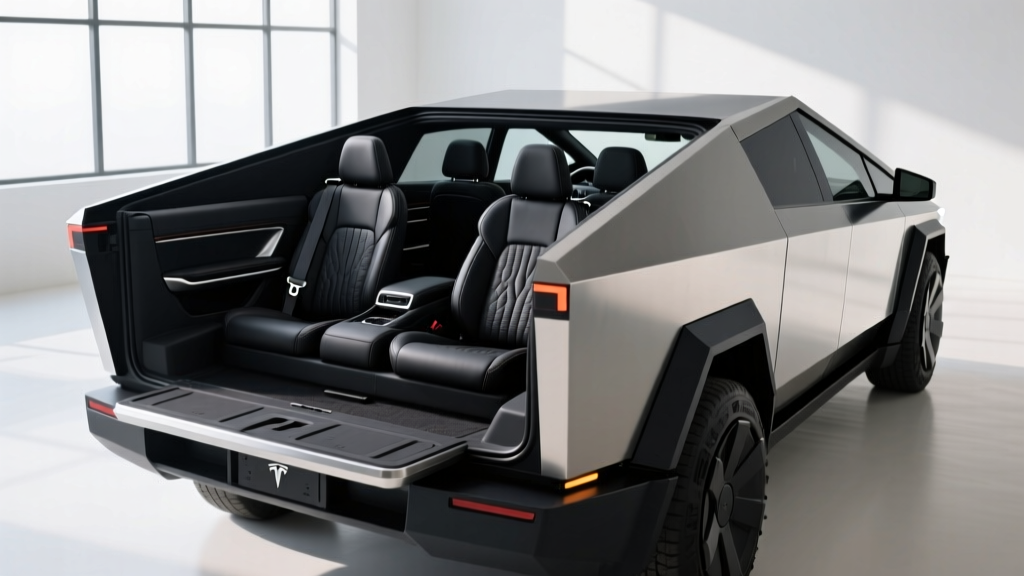
The Tesla Cybertruck's optional front jumpseat transforms the electric pickup from a five-passenger vehicle into a six-passenger truck — a feature that sounds practical on paper but demands careful evaluation. As of the 2026 model year, the Cybertruck lineup includes the Dual Motor AWD, Cyberbeast (tri-motor), and the long-awaited Rear-Wheel Drive variant. The jumpseat is available on select trims, adding a narrow center front seat that folds flat when not in use. But does a third front seat make sense in a stainless-steel EV with polarizing ergonomics and an $80,000+ price tag? This review covers every spec that matters — range, charging, pricing after tax credits, and whether the Cybertruck with the jumpseat option is a worthwhile buy against rivals like the Ford F-150 Lightning and Rivian R1T.
Cybertruck Jumpseat: How the 6-Seat Layout Works
The Cybertruck's front jumpseat is a compact, fold-down center seat positioned between the driver and front passenger. When deployed, it provides a third front-row seating position with a lap belt and shoulder harness. When folded flat, it becomes part of the center armrest/console area. Tesla has marketed this as a nod to classic pickup bench-seat utility, but the execution is very much a modern EV interpretation.
Key practical considerations for the jumpseat:
- Seat width: Approximately 14 inches of hip room — suitable for a child or smaller adult on short trips, tight for a full-size adult on longer drives.
- Legroom: Front legroom measures 41.4 inches on the driver and passenger sides; the center jumpseat position loses roughly 2-3 inches due to the footwell geometry around the center tunnel area.
- Weight capacity: Tesla rates the jumpseat for up to 175 lbs, which effectively limits it to children and smaller adults.
- Safety: The jumpseat position includes a 3-point belt, but there is no front-center airbag — a consideration for families with young children. Tesla recommends the rear seats for child safety seats.
The jumpseat is not available on the Cyberbeast trim due to the reinforced center console structure required for the tri-motor powertrain's cooling and electronics. It is offered as a $2,000 option on the Dual Motor AWD and the RWD trims.
Range, Battery, and Efficiency: Real-World Numbers
The 2026 Cybertruck Dual Motor AWD — the most common configuration paired with the jumpseat — carries a 123 kWh usable battery pack using 4680-format cells with a nickel-based (NMC-type) chemistry. Tesla does not publish the exact chemistry breakdown, but teardown analysis confirms an NMC variant optimized for energy density and high discharge rates rather than the LFP chemistry used in the Model 3 RWD.
EPA Estimated Range (Dual Motor AWD): 340 miles
Real-world highway (70-75 mph, moderate temps): ~280-300 miles
Cold-weather (below 32°F, highway): ~230-260 miles
Towing (5,000 lb trailer): ~170-200 miles
The Cybertruck's angular stainless-steel exoskeleton creates a drag coefficient of approximately 0.38 Cd — significantly worse than the Ford F-150 Lightning's ~0.34 Cd. This aerodynamic penalty shows up most at highway speeds and in cold weather, where the heat pump and cabin heating further reduce range.
| Spec | Dual Motor AWD | Cyberbeast (Tri-Motor) | RWD (Base) |
|---|---|---|---|
| EPA Range | 340 mi | 320 mi | ~250 mi (est.) |
| Battery (usable) | ~123 kWh (NMC, 4680 cells) | ~123 kWh (NMC, 4680 cells) | ~100 kWh (est.) |
| Efficiency | 72 MPGe / 46 kWh/100mi | 68 MPGe / 49 kWh/100mi | TBD |
| 0-60 mph | 3.9 sec | 2.6 sec | ~6.5 sec (est.) |
| Horsepower | 600 hp | 845 hp | ~315 hp (est.) |
| Drivetrain | Dual-Motor AWD | Tri-Motor AWD | Single-Motor RWD |
| Towing Capacity | 11,000 lbs | 11,000 lbs | ~7,500 lbs (est.) |
| Jumpseat Available? | Yes ($2,000 option) | No | Yes ($2,000 option) |
Charging Speed: 800V Architecture in Practice
The Cybertruck uses Tesla's 800-volt electrical architecture, which enables some of the fastest DC fast-charging speeds among production electric trucks. However, peak kW numbers tell only part of the story — the charge curve taper above 80% State of Charge (SoC) significantly affects real charging times on road trips.
| Charging Level | Power | Speed (approx.) | Notes |
|---|---|---|---|
| Level 1 (120V household) | ~1.4 kW | ~3-4 mi/hr | Emergency/trickle only; full charge takes ~80+ hours |
| Level 2 (240V, 48A Wall Connector) | 11.5 kW | ~30-34 mi/hr | Full charge in ~11 hours; ideal for overnight home charging |
| DC Fast Charge (V4 Supercharger) | Peak 350 kW | 10-80% in ~18 min | Peak rate sustained to ~50% SoC, then tapers; 80-100% adds another ~20 min |
| DC Fast Charge (non-Tesla CCS/NACS) | Peak 250 kW | 10-80% in ~25 min | Depends on station; some third-party chargers cap at 150 kW |
Charging-curve reality check: The Cybertruck's 350 kW peak is achievable at Tesla V4 Supercharger stalls with preconditioned batteries. However, that peak holds only from roughly 10-50% SoC. From 50-80%, the rate drops to approximately 150-180 kW, and above 80% it falls below 50 kW. On a road trip, plan your stops around the 10-80% window for the best time efficiency — charging from 80-100% at a DC fast charger is rarely worth the wait unless you're at your final destination.
The Cybertruck uses the NACS (North American Charging Standard) connector natively. Since Tesla opened the Supercharger network to other EVs, Cybertruck owners benefit from the largest fast-charging network in North America, with over 6,000 V3/V4 stalls as of early 2026. For non-Tesla networks like Electrify America or EVgo, the Cybertruck's NACS plug works at stations equipped with NACS connectors or through the included CCS adapter (for legacy CCS1 stations).
Pricing, Trims, and Federal Tax Credit Eligibility
The Cybertruck's pricing has shifted multiple times since its late-2023 launch. As of the 2026 model year, here is where the lineup stands — including the jumpseat option cost:
| Trim | Base MSRP | + Jumpseat | §30D Credit Eligible? | Est. After Credit |
|---|---|---|---|---|
| RWD (Base) | ~$60,990 | $62,990 | Yes (under $80K truck cap) | ~$55,490 (if eligible) |
| Dual Motor AWD | $79,990 | $81,990 | No (exceeds $80K MSRP cap for trucks) | $81,990 (no credit) |
| Cyberbeast | $99,990 | N/A | No (exceeds $80K cap) | $99,990 |
Federal tax credit reality: Under IRS §30D rules, the Cybertruck qualifies as a light-duty pickup (truck MSRP cap: $80,000). This means the RWD trim at ~$60,990 can qualify for up to $7,500 in federal tax credits — provided the buyer meets income caps ($150K single / $300K joint AGI) and the vehicle's battery components and critical minerals meet domestic sourcing thresholds. However, the moment you add the $2,000 jumpseat option to the RWD, the MSRP still clears the $80K cap, so credit eligibility remains intact for the RWD+jumpseat combo at ~$62,990.
The Dual Motor AWD at $79,990 sits right at the cap line. Adding the jumpseat pushes the MSRP to $81,990 — over the $80,000 truck cap, which disqualifies it from the §30D credit entirely. This is a critical gotcha: the jumpseat option on the AWD trim effectively costs you $2,000 in option price plus up to $7,500 in lost tax credits. The Cyberbeast is well above the cap regardless.
Additionally, the point-of-sale transfer option (available since January 2024) allows eligible buyers to apply the credit as an immediate price reduction at the dealer rather than waiting for a tax refund. Always verify current-year eligibility on the IRS clean vehicle credit page, as battery-sourcing requirements tighten annually.
Interior, Cargo, and Technology
The Cybertruck's interior is minimalist in typical Tesla fashion, dominated by an 18.5-inch center touchscreen that handles virtually all vehicle functions — including the glovebox release, mirror adjustments, and windshield wiper settings. The rear passengers get a 9.4-inch touchscreen for climate and media control.
Cargo and passenger dimensions:
- Front headroom: 40.9 inches
- Front legroom: 41.4 inches (driver/passenger); ~38-39 inches (jumpseat center)
- Rear headroom: 38.4 inches
- Rear legroom: 35.4 inches — adequate but tighter than the F-150 Lightning's 41.3 inches
- Bed length: 6 feet (72 inches), with a motorized retractable tonneau cover
- Bed volume: ~67 cu ft (bed only); ~75 cu ft with tailgate down and mid-gate folded
- Front trunk (frunk): ~7.1 cu ft — enough for a charging cable bag and small groceries, but far smaller than the F-150 Lightning's 14.1 cu ft Mega Power Frunk
- Max payload: ~2,500 lbs
Standout tech features:
- Steer-by-wire: The Cybertruck uses a fully electronic steering system with no mechanical connection between the yoke (or optional round wheel) and the wheels. This enables variable steering ratios — as little as 340 degrees lock-to-lock at low speeds — but has drawn criticism for reduced road feel.
- 48-volt electrical architecture: A first for a production vehicle, the 48V system reduces wiring harness weight and enables higher-power accessories.
- Autopilot / FSD (Supervised): Tesla's driver-assistance suite is standard (Autopilot) with Full Self-Driving (Supervised) available as a $8,000 purchase or $99/month subscription. Important: FSD is an SAE Level 2 system — the driver must remain fully engaged and hands-on (or eyes-on with the latest monitoring updates). It is not autonomous driving.
- Bioweapon Defense Mode: HEPA filtration system for cabin air quality.
- Powershare: V2L (vehicle-to-load) capability with 11.5 kW of onboard power output — enough to run power tools, a campsite, or essential home circuits during an outage.
Notable drawbacks:
- The stainless-steel exoskeleton makes the Cybertruck exceptionally heavy (~6,800 lbs curb weight for AWD), which hurts efficiency and increases tire wear.
- The angular windshield and lack of a traditional wiper system (a single wiper on early builds, updated for 2025+) can compromise visibility in heavy rain.
- Rear-seat comfort is mediocre for a truck in this price range — the seat cushion is relatively flat and the floor is high due to the battery pack, creating a knees-up seating position.
- Panel gaps and build quality have improved since the 2024 launch, but still draw scrutiny compared to legacy automakers at this price point.
Cybertruck vs. F-150 Lightning vs. Rivian R1T: Is It Worth Buying?
- Fastest-charging electric truck on V4 Superchargers (350 kW peak)
- Access to Tesla's Supercharger network — the most reliable public charging ecosystem
- 11,000-lb towing capacity leads the class
- 11.5 kW Powershare V2L is a genuine worksite and emergency asset
- Stainless-steel body is dent- and corrosion-resistant
- Unique jumpseat option provides 6-passenger seating in a mid-size footprint
- Real-world range falls well short of EPA, especially at highway speeds and in cold weather
- Adding jumpseat to AWD trim pushes MSRP past the $80K tax-credit cap
- Rear-seat comfort and legroom lag behind F-150 Lightning and R1T
- Steer-by-wire lacks road feel; yoke steering is divisive
- Aerodynamic drag (0.38 Cd) makes the Cybertruck one of the least efficient trucks per kWh
- Jumpseat center position is tight — best for children or short trips only
Against the Ford F-150 Lightning: The Lightning offers a more traditional truck experience with superior rear-seat comfort, a massive 14.1 cu ft frunk, and a lower starting price (~$55,000 for the base Pro trim). The Lightning Lariat qualifies for the full $7,500 tax credit and stays well under the $80K cap even when well-equipped. However, the Lightning's peak DC charging rate of 150 kW (extended-range battery) is less than half the Cybertruck's, and Ford's charging network access depends on the BlueOval Charge Network and adapters. For buyers who prioritize range and charging speed on road trips, the Cybertruck wins; for everyday comfort and value, the Lightning is the more practical truck.
Against the Rivian R1T: The R1T (Dual-Motor, ~$69,900 starting) offers a more premium interior, a unique gear tunnel for cross-bed storage, and quad-motor performance that rivals the Cyberbeast. The R1T's real-world range with the Max Pack (~400 miles EPA) exceeds the Cybertruck's. However, the R1T has no jumpseat option (strictly 5-passenger), charges at a peak of ~220 kW, and does not currently qualify for the §30D credit due to battery-sourcing constraints. For the 6-passenger requirement specifically, the Cybertruck with the jumpseat has no direct electric-truck rival.
Who the Cybertruck Jumpseat Is Really For
The Cybertruck with the jumpseat option serves a narrow but real use case:
- Families with 3 children who need 6 seatbelts but don't want to step up to a full-size SUV like the Model X or Rivian R1S. The jumpseat lets a third child ride up front on short school-run or errand trips, though it's not ideal for long highway drives.
- Worksite users who occasionally need to transport a 6-person crew short distances to a job site while retaining the 6-foot bed for tools and materials.
- Tesla loyalists who want maximum Supercharger network access, the Powershare V2L feature, and the fastest DC charging in the truck segment — and who view the jumpseat as a bonus rather than a daily necessity.
If you need 6-passenger seating daily and prioritize comfort, a 3-row electric SUV (Kia EV9, Tesla Model X, or Rivian R1S) will serve you better. If you need 6 seats only occasionally and value the truck bed and towing capacity, the Cybertruck's jumpseat fills a gap no other electric truck currently addresses.
Battery Warranty and Long-Term Ownership
Tesla provides the following warranty coverage for the 2026 Cybertruck:
- Battery & Drive Unit: 8 years / 120,000 miles (whichever comes first), with a minimum 70% capacity retention guarantee over the warranty period.
- Vehicle Limited Warranty: 4 years / 50,000 miles
- Corrosion warranty: The stainless-steel body is effectively immune to traditional rust, though surface staining can occur and Tesla's warranty does not cover cosmetic surface changes to the exoskeleton.
The 4680-cell NMC battery pack has shown promising degradation data in early Model Y applications (which share the same cell format). Real-world data from high-mileage Model Y 4680 packs suggests approximately 10-12% degradation over the first 100,000 miles — well within the 70% warranty threshold. However, the Cybertruck's heavier weight and higher discharge demands (especially when towing) may accelerate degradation relative to lighter Tesla vehicles. Plan for a realistic 85-90% capacity retention at 100,000 miles under normal use, with higher loss if you frequently DC fast-charge to 100% or tow heavy loads in hot climates.
Tesla's battery warranty details specify that the 70% retention threshold is measured via the vehicle's onboard BMS (Battery Management System) diagnostics. If you suspect significant degradation, a service center can perform a full capacity test.
Frequently Asked Questions
What is the real-world range of the Cybertruck with the jumpseat?
The jumpseat adds approximately 40-50 lbs to the vehicle's curb weight, which has a negligible effect on range. The Dual Motor AWD's EPA range is 340 miles; expect 280-300 miles in real-world highway driving at 70-75 mph, and 230-260 miles in freezing temperatures. Towing a 5,000-lb trailer reduces range to roughly 170-200 miles regardless of seating configuration.
How fast does the Cybertruck charge at home and on the road?
At home on a Level 2 Tesla Wall Connector (11.5 kW / 48A), the Cybertruck gains approximately 30-34 miles of range per hour, fully recharging overnight in about 11 hours. On a Tesla V4 Supercharger, it peaks at 350 kW and charges from 10-80% in roughly 18 minutes with a preconditioned battery. On non-Tesla DC fast chargers, expect peak rates of 150-250 kW and 10-80% times of 22-30 minutes depending on the station.
Does the Cybertruck qualify for the $7,500 federal EV tax credit?
It depends on the trim and configuration. The RWD trim (~$60,990 base, ~$62,990 with jumpseat) stays under the $80,000 truck MSRP cap and can qualify for up to $7,500 under IRS §30D — assuming the buyer meets income limits and the battery satisfies critical-mineral and component sourcing requirements. The Dual Motor AWD at $79,990 is borderline; adding the $2,000 jumpseat pushes MSRP to $81,990, which disqualifies it from the credit. The Cyberbeast ($99,990) does not qualify. Always verify current rules at irs.gov and consult a tax professional.
Is the Cybertruck jumpseat safe for children?
The jumpseat includes a 3-point seatbelt and is rated for up to 175 lbs. However, the front center position does not have a dedicated airbag, and Tesla recommends that child safety seats be installed in the rear outboard positions using the LATCH system. For older children who have outgrown booster seats, the jumpseat is acceptable for short trips, but the rear seats remain the safest position for all child passengers.
Can I install the jumpseat after purchase?
As of 2026, the jumpseat must be ordered as a factory option at the time of purchase. Tesla has not announced a retrofit program for existing Cybertrucks. The installation involves structural modifications to the center console area and seatbelt anchor points that are not designed for aftermarket addition.
How does the Cybertruck compare to the F-150 Lightning for a family?
For daily family use, the F-150 Lightning offers a more comfortable rear seat (35.4 vs. 41.3 inches of legroom), a far larger frunk, and a more intuitive interior layout. The Lightning also qualifies for the $7,500 tax credit in most trims. However, the Cybertruck charges roughly twice as fast on DC fast chargers and provides access to the Tesla Supercharger network, which remains the most reliable long-distance charging option. If the 6-passenger jumpseat is a must-have, the Cybertruck is the only electric truck that offers it.