First Look at the Tesla Cybertruck Interior
If you've been searching for Cybertruck interior pics to see whether Tesla's angular pickup actually delivers a livable cabin, you're not alone. The Cybertruck's stainless-steel exoskeleton grabs headlines, but it's the interior where owners spend every mile. This review pairs detailed interior impressions with the hard numbers that matter: EPA range, charging speed, battery chemistry, pricing, and federal tax credit eligibility under IRS §30D.
For 2026, the Cybertruck lineup includes the Long Range AWD and the tri-motor Cyberbeast. The base Rear-Wheel Drive model, originally announced at a lower price point, remains limited in availability and is not yet in broad production. We focus here on the models you can actually order and take delivery of today.
Cybertruck Interior Design, Materials, and Space
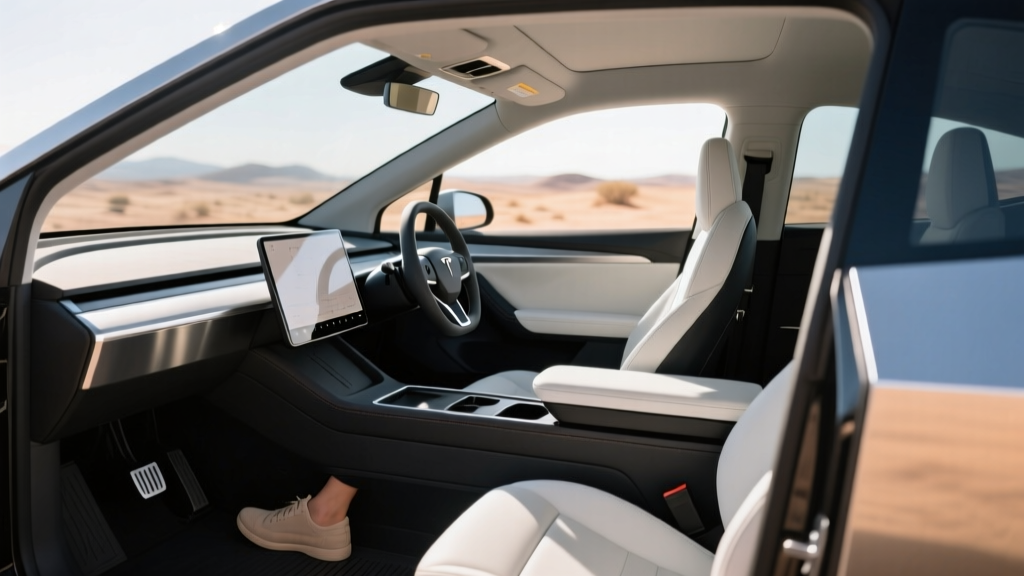
The Cybertruck cabin is unmistakably Tesla-minimalist, but scaled up for a full-size pickup. A single 18.5-inch touchscreen dominates the dash, running Tesla's latest vehicle software with integrated navigation, media, and vehicle controls. There is no instrument cluster; all driver information appears on the left third of the main screen or on the yoke-style steering wheel's small secondary display.
Materials are a mix of vegan leather (Tesla's synthetic upholstery standard across the fleet) and hard plastics that feel durable if not luxurious. The headliner is a dark alcantara-like material that hides the stamped-steel roof structure. Fit and finish on 2025–2026 production trucks has improved noticeably over the earliest 2024 deliveries, though panel-gap consistency on the exterior still varies unit to unit.
Seating and Passenger Dimensions
The Cybertruck seats five on a 60/40 split-folding rear bench. Front legroom measures 41.4 inches, while rear legroom comes in at 38.2 inches — adequate for adults on shorter trips but tighter than a Ford F-150 Lightning's rear row. Headroom is generous front and rear thanks to the flat roofline, though the sloping rear glass limits outward visibility.
Cargo Volume and the Vault
Tesla calls the 6-foot bed the "Vault." With the tonneau cover closed, it offers 67 cubic feet of lockable, weather-sealed storage. The bed width between the wheel wells is approximately 48 inches — enough for a standard sheet of plywood flat on the floor. The motorized tonneau can support up to 300 pounds of distributed load, useful for rooftop tent camping. There is no traditional front trunk (frunk); instead, a small front storage compartment holds roughly 7 cubic feet, enough for charging cables and a soft bag.
| Spec | Long Range AWD | Cyberbeast (Tri-Motor AWD) |
|---|---|---|
| EPA Range | 340 miles | 320 miles |
| Battery (usable) | ~123 kWh (NMC) | ~123 kWh (NMC) |
| Drivetrain | Dual-Motor AWD | Tri-Motor AWD |
| Horsepower | 600 hp | 845 hp |
| 0–60 mph | 4.1 seconds | 2.6 seconds |
| Max DC Fast Charge | 350 kW (peak) | 350 kW (peak) |
| 10–80% DC Charge | ~28 minutes | ~28 minutes |
| Level 2 Home Charge | 11.5 kW (~37 mi/hr) | 11.5 kW (~37 mi/hr) |
| MPGe (combined) | 67 MPGe | 64 MPGe |
| Efficiency | 50 kWh/100 mi | 52 kWh/100 mi |
| Towing Capacity | 11,000 lbs | 11,000 lbs |
| Base MSRP | $79,990 | $99,990 |
| Battery Warranty | 8 yr / 120,000 mi | 8 yr / 120,000 mi |
Sources: fueleconomy.gov, Tesla Cybertruck design page.
Range, Efficiency, and Real-World Expectations
EPA Estimated Range: 340 miles (Long Range AWD) / 320 miles (Cyberbeast)
Real-World Expectation: Expect roughly 270–300 miles on a highway road trip at 70–75 mph in mild weather. In cold conditions (below 30°F), range can drop 20–30%, yielding 230–270 miles before you'll want to find a charger. The Cybertruck's large frontal area and angular shape create significant aerodynamic drag at highway speed, which is the primary efficiency penalty.
The Cybertruck's ~123 kWh usable battery pack uses NMC (nickel-manganese-cobalt) chemistry, chosen for its high energy density — necessary to push a 6,800-pound vehicle past 300 miles. Efficiency lands around 50 kWh per 100 miles, which translates to 67 MPGe combined for the Long Range. That is thirstier than a Ford F-150 Lightning Extended Range (roughly 66 MPGe combined with a smaller 131 kWh pack), but the Cybertruck's advantage is its slightly lighter curb weight and more rigid structure.
For daily commuting under 80 miles round-trip, most owners will charge at home and rarely notice the efficiency penalty. On road trips, plan charging stops around the 250-mile mark to maintain a comfortable buffer, especially in mountainous terrain where regenerative braking can't fully offset elevation-driven consumption.
Charging Speed: DC Fast Charging and Home Level 2
The Cybertruck uses the NACS (North American Charging Standard) connector natively — no adapter needed at Tesla Superchargers. This is a significant infrastructure advantage in 2026, as the Tesla Supercharger network remains the most reliable and widespread DC fast-charging system in the U.S., with over 25,000 stalls nationally.
| Charging Level | Power (kW) | Speed | Typical Use Case |
|---|---|---|---|
| Level 1 (120V household) | ~1.4 kW | ~4 miles/hour | Emergency trickle only |
| Level 2 (240V home) | 11.5 kW | ~37 miles/hour | Daily overnight charging |
| DC Fast Charge (peak) | 350 kW | ~155 miles in 15 min | Road trips (Supercharger V4) |
| DC Fast Charge (10–80%) | Avg ~180 kW sustained | ~28 minutes | Typical fast-charge session |
A note on the charging curve: the Cybertruck peaks near 350 kW only between roughly 10–30% state of charge (SoC) on a V4 Supercharger with a preconditioned battery. Above 50% SoC, the rate tapers significantly, dropping below 100 kW past 80%. This is standard behavior for NMC packs managed conservatively for longevity, but it means the last 20% of a charge session takes nearly as long as the first 60%. For road trips, charge to 80% and move on — the time penalty for pushing to 100% is rarely worth it.
At home on an 11.5 kW Level 2 wall connector (Tesla's recommended home setup, requiring a 60-amp circuit), a full charge from 10% to 100% takes roughly 11–12 hours. Most owners charging overnight from a 30–40% daily low will wake up fully topped off.
Performance and Driving Dynamics
The dual-motor Long Range AWD produces 600 horsepower and reaches 60 mph in 4.1 seconds — sports-car territory in a vehicle that weighs over three tons. The Cyberbeast's tri-motor setup delivers 845 hp and a 2.6-second 0–60, placing it among the quickest production vehicles ever sold. Both models feature adaptive air suspension with up to 16 inches of ground clearance in Off-Road mode and a 4-wheel steer system (rear wheels turn up to 10 degrees) that gives the 20-foot-long truck a surprisingly tight 40-foot turning circle.
The 48-volt electrical architecture — a first for a mass-production vehicle — enables the steer-by-wire system and reduces wiring harness weight. In practice, the steering feels precise and responsive, though some drivers report an adjustment period to the lack of mechanical feedback through the yoke.
Towing capacity is rated at 11,000 pounds for both trims. However, towing at or near max capacity will cut range roughly in half — expect 150–180 miles between charges when pulling a heavy trailer. The integrated trailer brake controller and tow-assist camera views are standard.
Pricing, Trims, and Federal Tax Credit Eligibility
| Trim | Base MSRP | Federal Tax Credit (§30D) | Effective Price* |
|---|---|---|---|
| Long Range AWD | $79,990 | Up to $7,500 | ~$72,490 |
| Cyberbeast | $99,990 | $0 (exceeds MSRP cap) | $99,990 |
*Effective price assumes full §30D eligibility. Actual credit depends on buyer income, battery sourcing, and point-of-sale transfer. See IRS §30D rules.
The Cybertruck's tax credit situation requires careful attention. Under current IRS §30D rules, the Long Range AWD at $79,990 falls under the $80,000 MSRP cap for trucks and may qualify for up to $7,500 — provided the buyer meets income limits (modified AGI of $150,000 single / $300,000 joint) and the vehicle's battery components and critical minerals meet domestic-sourcing thresholds. Tesla has worked to increase North American mineral sourcing, but the exact credit amount can shift as supply chains evolve. Always verify current eligibility on the IRS clean vehicle credit page before purchase.
The Cyberbeast at $99,990 exceeds the $80,000 truck MSRP cap and does not qualify for the §30D federal credit regardless of buyer income. Buyers considering the Cyberbeast should budget the full MSRP plus destination and any options.
Point-of-sale transfer of the credit is available for eligible buyers, meaning the $7,500 can be applied as a down-payment reduction at the dealer rather than waiting for a tax refund. This requires completing IRS Form 15405 at the time of purchase.
Tech, Driver Assistance, and Standout Features
The Cybertruck ships with Tesla's latest infotainment stack, including native navigation with real-time Supercharger routing, a premium 15-speaker audio system, and over-the-air software updates that have added features like improved tow-mode range estimation and enhanced Sentry Mode camera coverage.
SAE Automation Level: Level 2
Tesla's Autopilot (standard) and Full Self-Driving Supervised (optional, ~$8,000 or $99/month) are SAE Level 2 driver-assistance systems. The driver must remain fully engaged, hands on the yoke, and eyes on the road at all times. These systems do not make the Cybertruck self-driving. Level 4 autonomous capability (no driver required) is limited to geofenced robotaxi services like Waymo.
Other standout tech includes:
- Armor glass: Laminated composite glass that resists impacts (Tesla demonstrated it surviving a baseball thrown at 50 mph)
- Bioweapon Defense Mode: HEPA-grade cabin air filtration with positive pressurization
- Powershare: Up to 11.5 kW of vehicle-to-load (V2L) and vehicle-to-home (V2H) bi-directional power output — enough to run power tools at a job site or keep essential home circuits alive during an outage
- Adaptive air suspension: Adjustable ride height with automatic load-leveling when towing
Warranty and Long-Term Ownership
Tesla covers the Cybertruck's battery and drive unit for 8 years or 120,000 miles, whichever comes first, with a minimum 70% capacity retention guarantee. The limited vehicle warranty is 4 years or 50,000 miles. These terms are competitive with the F-150 Lightning's 8-year/100,000-mile battery warranty (Ford guarantees 70% retention as well).
NMC battery degradation data from Tesla's fleet suggests an average capacity loss of roughly 10–12% over the first 100,000 miles, after which the degradation curve flattens. For a 123 kWh pack, that means roughly 110 kWh usable after 100,000 miles — still enough for ~290 miles of real-world range in the Long Range model.
Pros
- Class-leading Supercharger network access (NACS native)
- 11,000-lb towing capacity with integrated brake controller
- Powershare V2L/V2H bi-directional charging (11.5 kW)
- Quick 10–80% DC charge (~28 min at Supercharger V4)
- 4-wheel steer enables tight urban maneuvering
- Stainless-steel body resists dents and eliminates paint shop costs
Cons
- Cyberbeast ineligible for federal tax credit (exceeds $80K cap)
- Real-world highway range drops significantly below EPA (270–300 mi)
- Cold-weather range loss of 20–30% without preconditioning
- Rear visibility limited by sloping bed cover design
- Steer-by-wire yoke has a learning curve for truck veterans
- No frunk; limited front storage
- Insurance premiums run 20–40% above comparable F-150 Lightning
Who Should Buy the Cybertruck?
The Cybertruck makes the most sense for buyers who need serious towing and payload capability, want bi-directional power for job-site or home-backup use, and already have access to home Level 2 charging. Its NACS connector and Supercharger access give it the best road-trip charging experience of any electric pickup currently on sale.
If your primary use case is suburban commuting with occasional weekend hauling, the Long Range AWD with the potential $7,500 tax credit offers strong value at roughly $72,500 effective. If you want maximum performance and don't need the credit, the Cyberbeast delivers supercar acceleration in a truck form factor — but budget $100,000+.
Buyers who prioritize rear-seat space for a family, prefer a conventional steering wheel, or need the longest possible real-world range should cross-shop the Ford F-150 Lightning Extended Range (320 mi EPA, lower starting price, more traditional truck layout) or the Rivian R1T (adventure-focused, quad-motor option, smaller bed).
Frequently Asked Questions
What is the real-world range of the Cybertruck?
The EPA rates the Long Range AWD at 340 miles and the Cyberbeast at 320 miles. In real-world highway driving at 70–75 mph, expect 270–300 miles. In cold weather below 30°F, plan for 230–270 miles. Preconditioning the battery before driving can recover 5–10% of cold-weather range.
How fast does the Cybertruck charge at home and on the road?
On a 240V Level 2 home charger at 11.5 kW, the Cybertruck adds roughly 37 miles of range per hour, fully charging overnight in 11–12 hours. On a Tesla V4 Supercharger, it peaks at 350 kW and charges from 10–80% in approximately 28 minutes, though the rate tapers significantly above 80%.
How much does the Cybertruck cost after tax credits?
The Long Range AWD starts at $79,990 and may qualify for up to $7,500 under IRS §30D, bringing the effective price to roughly $72,490 for eligible buyers. The Cyberbeast at $99,990 exceeds the $80,000 MSRP cap for trucks and does not qualify for the federal credit.
Does the Cybertruck qualify for the federal EV tax credit?
The Long Range AWD may qualify for up to $7,500, subject to buyer income limits ($150K single / $300K joint MAGI), battery component and critical mineral sourcing requirements, and the $80,000 truck MSRP cap. The Cyberbeast does not qualify. Always check current IRS guidance before purchasing.
Is the Cybertruck worth buying vs. the F-150 Lightning or Rivian R1T?
The Cybertruck wins on Supercharger network access, bi-directional power output, and Cyberbeast performance. The F-150 Lightning offers a more traditional truck layout, better rear-seat comfort, and a lower entry price. The Rivian R1T excels in off-road capability and build quality but has a smaller bed and no Supercharger access (though it now uses NACS adapters). Your choice depends on whether you prioritize charging infrastructure (Cybertruck), traditional truck usability (Lightning), or adventure capability (R1T).
What are the Cybertruck's biggest drawbacks?
Real-world range falls notably below EPA estimates, especially at highway speed and in cold weather. The Cyberbeast's price disqualifies it from the federal tax credit. Insurance costs are elevated. The steer-by-wire yoke and lack of a rear window (replaced by a camera feed) require adjustment. And the angular design, while polarizing, creates aerodynamic inefficiency that directly impacts range.