The Cybertruck in 2026: Beyond the Headlines
Since deliveries began in late 2023, the Tesla Cybertruck has generated more viral moments than any pickup in history — from stainless-steel panel gaps and stuck accelerator pedals to windshield wiper failures and high-profile recalls. Search for any Cybertruck incident and you'll find no shortage of dashcam footage, owner complaints, and NHTSA investigation threads. But strip away the social-media spectacle, and a more nuanced picture emerges: a highly capable, technically ambitious electric truck that demands buyers understand exactly what they're signing up for.
This review reconciles the Cybertruck's spec sheet with real-world ownership data, safety records, and the practical realities of living with Tesla's angular EV pickup in 2026.
Range, Battery & Real-World Efficiency
| Specification | AWD (Dual Motor) | Cyberbeast (Tri-Motor) |
|---|---|---|
| EPA Range | 340 miles | 320 miles |
| Battery Capacity (usable) | ~123 kWh | ~123 kWh |
| Battery Chemistry | NMC (Nickel Manganese Cobalt) | NMC |
| Efficiency (MPGe) | 67 MPGe combined | 64 MPGe combined |
| Energy Consumption | ~50 kWh/100 mi | ~52 kWh/100 mi |
| Drivetrain | Dual-Motor AWD | Tri-Motor AWD |
| Horsepower | 600 hp | 845 hp |
| 0-60 mph | 4.1 seconds | 2.6 seconds |
| Top Speed | 130 mph | 130 mph |
| Towing Capacity | 11,000 lbs | 11,000 lbs |
| Payload Capacity | 2,500 lbs | 2,500 lbs |
EPA Range vs. Reality: The AWD model carries a 340-mile EPA estimate. In real-world highway driving at 70-75 mph, expect 260-290 miles before needing a charger. In cold weather (below 32°F), that figure drops to 220-250 miles due to battery resistance and cabin heating demands. The Cybertruck's massive frontal area and ~6,600 lb curb weight work against it at speed. City driving with regenerative braking recovers closer to the EPA sticker — some owners report 310-330 miles in stop-and-go conditions with mild temperatures.
The 123 kWh (usable) NMC pack is one of the largest in any consumer EV. Tesla uses a structural battery pack design where the cells are bonded into the vehicle's frame, reducing weight but making out-of-warranty replacement extraordinarily expensive. Source data on efficiency is available via fueleconomy.gov.
Charging Speed: 800V Architecture Under the Microscope
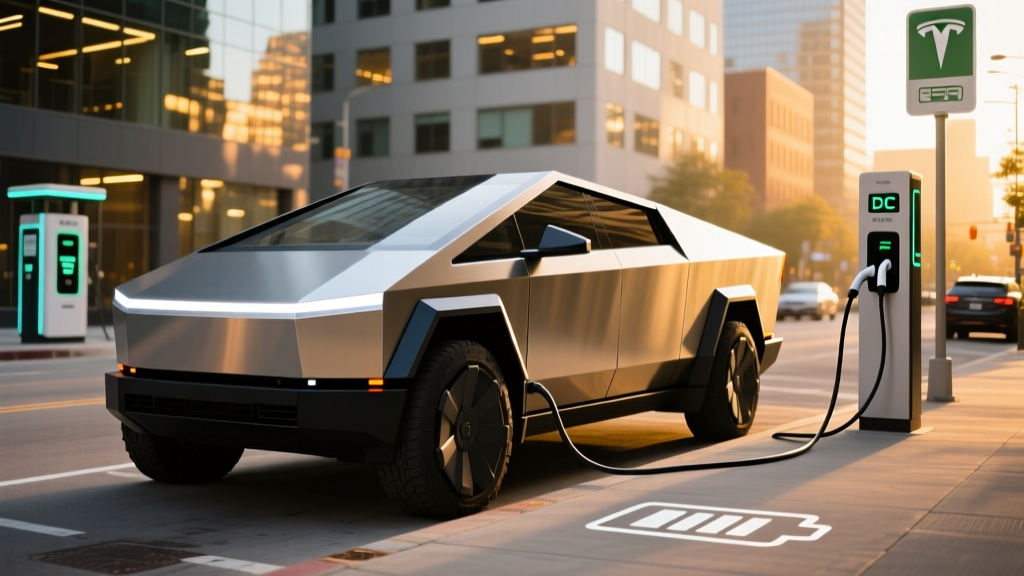
The Cybertruck runs on an 800-volt architecture, which is essential context for understanding its charging performance. Higher voltage allows the truck to accept more power (kW) without requiring excessive current, reducing cable weight and heat.
| Charging Level | Power / Rate | Time / Speed |
|---|---|---|
| Level 1 (120V household) | ~1.4 kW | ~3 miles per hour |
| Level 2 (240V home, 48A) | 11.5 kW | ~34 miles per hour (~10 hrs for 10-80%) |
| DC Fast Charge (V4 Supercharger) | Peak ~350 kW | 10-80% in ~18 minutes |
| DC Fast Charge (third-party 150 kW) | ~150 kW sustained | 10-80% in ~38 minutes |
Charging curve reality: The Cybertruck peaks at roughly 350 kW on V4 Superchargers, but that peak is sustained only between approximately 10-30% state of charge. From 30-60%, expect ~200-250 kW. Above 80%, the rate tapers sharply to protect the NMC cells — the last 20% can take as long as the first 60%. For road trips, plan stops around the 10-80% window for maximum efficiency.
At home on a Tesla Wall Connector (48A / 11.5 kW), a full overnight charge adds roughly 340 miles in about 10 hours. This is adequate for daily use but slower than some competitors with smaller packs. A 200-amp electrical panel is generally sufficient for a 48A circuit; older homes may require a panel upgrade ($1,500-$3,000 additional).
Notable Cybertruck Incidents, Recalls & Safety Data
Understanding the Cybertruck's safety profile requires separating viral moments from systemic issues. Here are the most significant incidents and recalls through early 2026:
Accelerator Pedal Trim Recall (NHTSA 24V-277)
In April 2024, Tesla recalled all ~3,878 delivered Cybertrucks after owners reported the accelerator pedal pad could dislodge and become trapped in the interior trim, causing unintended acceleration. The National Highway Traffic Safety Administration (NHTSA) opened an investigation. Tesla issued a software update to limit max torque and replaced the pedal assembly. This was the most widely covered Cybertruck incident and a genuine safety concern that Tesla addressed relatively quickly.
Windshield Wiper Motor Failure
Multiple owners reported wiper motor failures in heavy rain, leading to a recall and replacement campaign. The root cause was traced to an undersized motor for the large windshield area.
Stainless Steel Panel & Edge Concerns
Early-build Cybertrucks drew scrutiny for sharp exterior panel edges and inconsistent fitment. While not a recall item, several owners documented cuts from body seams. Tesla updated its assembly process for later production runs.
Towing & Trailer Sway Incidents
A small number of owners reported trailer sway control software issues when towing near the 11,000-lb maximum. Tesla addressed this through over-the-air updates. Buyers planning heavy towing should confirm their build includes the latest firmware.
Safety Rating Note: As of early 2026, the Cybertruck has not been crash-tested by NHTSA or IIHS. Tesla claims it will achieve 5-star ratings, but no independent verification exists. The stainless-steel exoskeleton and large mass may perform well in some crash scenarios but could pose compatibility risks with smaller vehicles in multi-vehicle collisions. Buyers prioritizing verified safety data should weigh this absence carefully.
Autopilot & FSD (Supervised) Context
The Cybertruck ships with Tesla's HW4 hardware and supports Autopilot (basic lane-keeping and adaptive cruise) and the optional Full Self-Driving (Supervised) package. FSD remains a SAE Level 2 system — the driver must remain fully attentive, hands on or near the wheel, and eyes on the road at all times. It is not autonomous driving. Several incidents involving Cybertrucks on Autopilot have been reported; in every documented case, driver inattention was a contributing factor.
Pricing, Trims & Federal Tax Credit Eligibility
| Trim | Base MSRP (2026) | Key Features |
|---|---|---|
| AWD (Dual Motor) | $79,990 | 340 mi range, 600 hp, tow package |
| Cyberbeast (Tri-Motor) | $99,990 | 320 mi range, 845 hp, performance tune |
| RWD (Single Motor) | $60,990 (announced, limited availability) | ~250 mi range, 2026+ delivery |
As-tested pricing: A well-equipped AWD model with FSD ($8,000 option), Foundation Series package, and accessories typically reaches $92,000-$97,000 before incentives. Cyberbeast models with full options approach $110,000-$115,000.
Federal Tax Credit (§30D) Eligibility
- Vehicle MSRP Cap: Trucks/vans/SUVs must have an MSRP at or below $80,000 to qualify. The AWD trim at $79,990 barely qualifies; the Cyberbeast at $99,990 does not qualify.
- Buyer Income Cap: Modified AGI must not exceed $150,000 (single), $225,000 (head of household), or $300,000 (joint filers).
- Battery Component Sourcing: A percentage of battery components must be manufactured or assembled in North America, and critical minerals must be sourced from the U.S. or free-trade-agreement partners. Tesla's supply chain has evolved to partially meet these requirements, but eligibility can change as sourcing rules tighten annually.
- Point-of-Sale Transfer: Eligible buyers can transfer the credit to the dealer at purchase, reducing the upfront price rather than waiting for a tax refund.
- Credit Amount: Up to $7,500 if both battery component and critical mineral requirements are met; $3,750 if only one is satisfied.
For the AWD trim, qualified buyers may see an effective price of approximately $72,490-$76,240 after the federal credit. Always verify current eligibility on IRS.gov, as sourcing requirements and qualifying vehicle lists update periodically.
Cargo, Interior & Daily Practicality
The Cybertruck's dimensions are genuinely useful for truck work:
- Bed length: 6 feet (72 inches) with the tonneau closed; the vault extends to the tailgate
- Bed width: ~48 inches between wheel wells
- Cargo volume (bed): ~67 cu ft
- Frunk (front trunk): ~7 cu ft — smaller than the F-150 Lightning's, due to the front motor and HVAC packaging
- Seating: 6-passenger bench (front 3-across), though the center front seat is best for children
- Rear legroom: ~41 inches — adequate for adults on longer trips
- Ground clearance: Up to 17.4 inches (adaptive air suspension, max raise)
- Approach/departure angles: 35°/30° (off-road mode)
The interior is minimalist in true Tesla fashion — an 18.5-inch center touchscreen handles nearly all controls, including climate, glove box, and mirror adjustments. There is no traditional instrument cluster; a slim bar display shows speed and range. Build quality on 2025-2026 models has improved markedly over early builds, though some owners still report panel-gap inconsistencies and rattles from the stainless-steel body on rough roads.
The steer-by-wire system (no mechanical connection between steering wheel and rack) is standard and takes acclimation. Most owners report adapting within a few days, but it's a dealbreaker for drivers who distrust fully electronic steering. The yoke-style steering wheel is standard; a round wheel option became available in late 2024.
Ownership Costs, Warranty & Competitor Comparison
Warranty coverage:
- Basic vehicle: 4 years / 50,000 miles
- Battery & drive units: 8 years / 120,000 miles (minimum 70% capacity retention)
- Roadside assistance: 4 years / 50,000 miles
The battery warranty's 70% retention threshold is standard for the industry but worth noting: if your 123 kWh pack degrades to 86 kWh over 8 years, Tesla considers that within specification. Real-world degradation data for the Cybertruck specifically is still limited given its production timeline, but Tesla's NMC packs in the Model S/X historically lose 8-12% capacity over 150,000 miles.
How Does It Compare?
| Metric | Cybertruck AWD | Ford F-150 Lightning Lariat | Rivian R1T Dual-Motor |
|---|---|---|---|
| EPA Range | 340 mi | 320 mi (Extended Range) | 352 mi (Max Pack) |
| Base MSRP | $79,990 | $69,995 | $83,900 |
| Towing | 11,000 lbs | 10,000 lbs | 11,000 lbs |
| 0-60 mph | 4.1 sec | 5.0 sec | 4.5 sec |
| DC Fast Charge Peak | ~350 kW | ~150 kW | ~220 kW |
| Battery Warranty | 8 yr / 120k mi | 8 yr / 100k mi | 8 yr / 175k mi |
| Crash Test Rating | Not rated | NHTSA 5-Star | IIHS Top Safety Pick+ |
| Federal Tax Credit | Up to $7,500 (AWD only) | Up to $7,500 | Up to $7,500 |
The F-150 Lightning is the pragmatic choice: proven crash-test ratings, conventional truck ergonomics, a massive frunk, and lower pricing. The Rivian R1T offers the best battery warranty, superior build quality, and genuine off-road credibility with a quad-motor option. The Cybertruck wins on peak charging speed, raw acceleration (especially the Cyberbeast), and head-turning presence — but carries the most ownership uncertainty.
Pros, Cons & Verdict: Who Should Buy a Cybertruck?
Pros
- Class-leading DC fast-charge speed (~350 kW peak, 10-80% in ~18 min)
- Exceptional acceleration — Cyberbeast rivals supercars at 2.6 sec 0-60
- 11,000-lb towing capacity matches heavy-duty gas trucks
- Stainless-steel body is dent- and corrosion-resistant
- Adaptive air suspension with up to 17.4" ground clearance
- Over-the-air updates continuously add features
- Supercharger network access (NACS native)
Cons
- No independent crash-test rating (NHTSA or IIHS) as of 2026
- Early-build quality issues and multiple recalls erode confidence
- Steer-by-wire requires acclimation; no mechanical fallback
- Poor rear visibility; camera-dependent driving
- Highway real-world range falls ~15-25% below EPA sticker
- Cyberbeast exceeds $80k MSRP cap — no federal tax credit
- Polarizing design limits resale appeal in some markets
- Insurance premiums 20-40% above comparable trucks
Choose the Cybertruck if: You want the fastest-charging electric truck available, value performance above all else, have reliable home charging, and can tolerate being an early adopter of a vehicle still maturing through recalls and OTA fixes.
Choose the F-150 Lightning or Rivian R1T if: You prioritize verified safety ratings, proven build quality, conventional truck ergonomics, or need a work truck today without the beta-test ownership experience.
Frequently Asked Questions
What is the real-world range of the Tesla Cybertruck?
The AWD model carries a 340-mile EPA estimate. Expect 260-290 miles in real-world highway driving and 220-250 miles in cold weather. City driving with regen braking can approach 310-330 miles in mild conditions.
How fast does the Cybertruck charge?
On a V4 Supercharger, the Cybertruck peaks at ~350 kW and charges from 10-80% in approximately 18 minutes. At home on a 48A Level 2 charger, it adds about 34 miles per hour, requiring roughly 10 hours for a full charge.
How much does the Cybertruck cost after tax credits?
The AWD model at $79,990 MSRP may qualify for up to $7,500 in federal tax credits, bringing the effective price to roughly $72,490 for eligible buyers. The Cyberbeast at $99,990 exceeds the $80,000 MSRP cap and does not qualify.
Does the Cybertruck qualify for the federal EV tax credit?
Only the AWD trim qualifies, as its $79,990 MSRP falls under the $80,000 truck cap. Buyers must also meet income limits ($150k single / $300k joint) and the vehicle must satisfy battery component and critical mineral sourcing requirements. Verify current eligibility at IRS.gov before purchasing.
Is the Cybertruck worth buying vs. the F-150 Lightning or Rivian R1T?
It depends on priorities. The Cybertruck leads in charging speed and acceleration but lacks crash-test ratings and has a track record of recalls. The Lightning is the safest, most practical choice; the R1T offers the best build quality and battery warranty. The Cybertruck suits performance-oriented buyers comfortable with early-adopter risk.
What are the biggest Cybertruck incidents and recalls?
The most significant was the accelerator pedal trim recall (NHTSA 24V-277) affecting all early-build trucks, along with windshield wiper motor failures and panel-edge concerns. Tesla has addressed these through recalls and OTA updates, but the pattern of early-build issues is worth noting for used buyers.