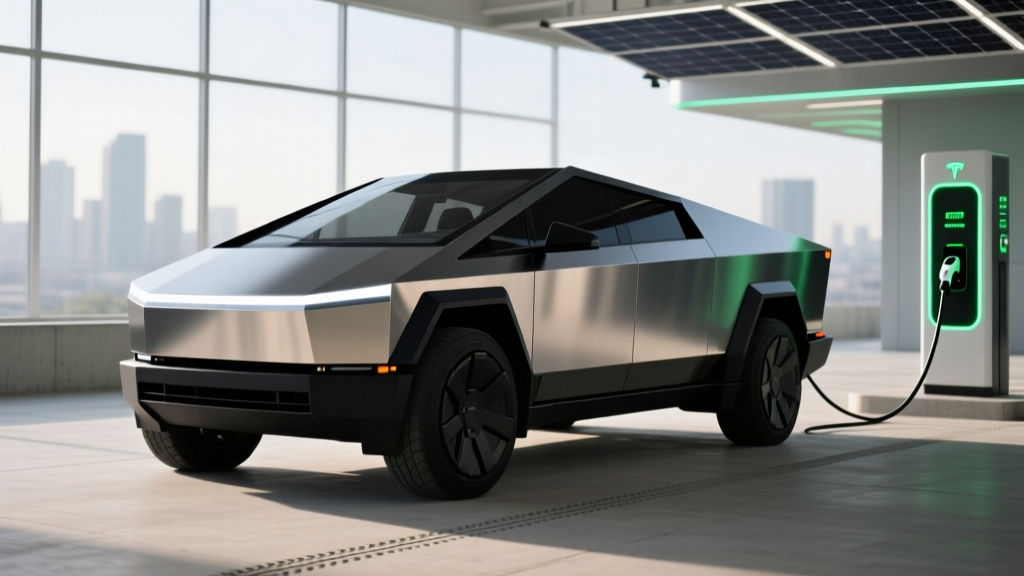
The Tesla Cybertruck remains one of the most polarizing and talked-about electric vehicles on the road. But beyond the stainless-steel exoskeleton and the angular silhouette, the question most buyers actually need answered is practical: Cybertruck how much does it really cost to buy, charge, and own? This review cuts through the hype with exact 2026 pricing, EPA range figures, real-world efficiency data, and a clear-eyed look at tax credit eligibility.
Whether you're weighing the dual-motor AWD against the tri-motor Cyberbeast, or trying to figure out if the $7,500 federal tax credit applies to your situation, this guide gives you the numbers you need to make a decision — no marketing gloss, just data.
2026 Cybertruck Pricing by Trim: What You'll Actually Pay
Tesla has streamlined the Cybertruck lineup for 2026 after a tumultuous launch period that saw Foundation Series markups and production delays. Here's where the pricing stands for the current model year:
| Trim | Drivetrain | Base MSRP | Est. After §30D Credit* | 0-60 mph |
|---|---|---|---|---|
| Long Range AWD | Dual-Motor AWD | $79,990 | $72,490 | 3.9 sec |
| Cyberbeast | Tri-Motor AWD | $99,990 | $92,490 | 2.6 sec |
*Federal §30D credit eligibility is not guaranteed. See the tax credit section below for full requirements including MSRP caps, income limits, and battery-sourcing rules.
A critical note on MSRP caps: Under current IRS §30D rules, trucks (which the Cybertruck is classified as) have an MSRP cap of $80,000 for new clean vehicle credit eligibility. This means the Long Range AWD at $79,990 qualifies on price, but the Cyberbeast at $99,990 does not — it exceeds the truck MSRP ceiling. This is a dealbreaker for buyers counting on the credit to offset the Cyberbeast's cost. Always verify current-year rules at IRS.gov §30D guidance before purchasing.
EPA Range and Real-World Efficiency
Range is where Cybertruck ownership gets complicated. The stainless-steel body is heavy, and the angular design creates more aerodynamic drag than a sleek sedan or crossover. Here's what the EPA says versus what you'll actually experience:
Long Range AWD: EPA est. 340 miles | Real-world highway: ~270-290 miles | Cold weather (below 32°F): ~230-260 miles
Cyberbeast: EPA est. 320 miles | Real-world highway: ~250-270 miles | Cold weather: ~210-240 miles
Highway driving at 75+ mph, headwinds, and cold temperatures all reduce range significantly. The Cybertruck's boxy profile is particularly sensitive to speed — expect a steeper range drop-off above 70 mph than a Model Y or Rivian R1T.
On the efficiency side, the EPA rates the Long Range AWD at approximately 2.0 kWh/mile (50 MPGe combined). That's notably less efficient than a Tesla Model Y Long Range (~3.5 mi/kWh or ~120 MPGe) because of the Cybertruck's ~6,600 lb curb weight and poor drag coefficient. In practical terms, you'll spend more per mile charging a Cybertruck than almost any other Tesla.
For context on how the EPA arrives at these figures, see fueleconomy.gov's EV testing methodology.
Battery, Chemistry, and Charging Speeds
The 2026 Cybertruck uses a structural battery pack with Tesla's 4680 cells. Here are the key specs:
| Specification | Long Range AWD | Cyberbeast |
|---|---|---|
| Battery Capacity (usable) | ~123 kWh | ~123 kWh |
| Chemistry | NMC (Nickel Manganese Cobalt) | NMC (Nickel Manganese Cobalt) |
| Max DC Fast Charge | ~250 kW (peak) | ~250 kW (peak) |
| 10-80% DC Fast Charge | ~28-30 minutes | ~28-30 minutes |
| Level 2 Home Charging (max) | 11.5 kW (48A) | 11.5 kW (48A) |
| Miles Added per Hour (L2) | ~30-34 mi/hr | ~28-32 mi/hr |
| Charge Port | NACS (native Tesla) | NACS (native Tesla) |
Understanding the Charge Curve
The 250 kW peak figure requires context. Like all EVs, the Cybertruck charges fastest at a low state of charge (SoC) and tapers significantly as the battery fills. You'll see peak rates roughly between 10-30% SoC. By 60%, charging speed drops to roughly 120-140 kW, and above 80% it falls further to around 40-60 kW. This is why the 10-80% metric matters far more than peak kW — charging from 80-100% can add another 25-35 minutes to your session.
The 4680 NMC cells prioritize energy density over the LFP (lithium iron phosphate) chemistry found in the base Model 3. NMC offers more range per kilogram but is more sensitive to sustained 100% SoC storage. Tesla recommends daily charging to 80-90% for NMC packs and reserving 100% for road trips.
Home Charging Setup
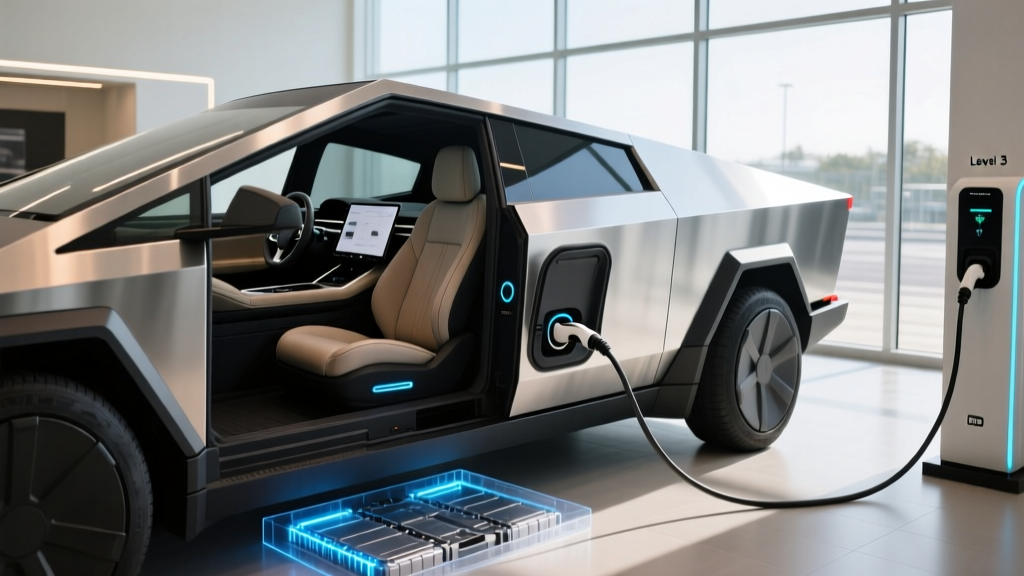
At 11.5 kW on Level 2 (using a Tesla Wall Connector on a 60A circuit), overnight charging adds roughly 30 miles of range per hour. A full charge from 10% to 90% takes about 10-11 hours at home. If your home electrical panel supports only a 40A circuit (9.6 kW), expect closer to 25 mi/hr — still adequate for most daily driving but slower for back-to-back road trip days.
Home charger installation typically costs $800-$2,500 depending on panel capacity and conduit runs. If you need a panel upgrade from 100A to 200A service, add $1,500-$3,500. Consult a licensed electrician for your specific situation.
Performance and Drivetrain
The Cybertruck's performance figures are genuinely impressive, especially given its truck duties:
| Metric | Long Range AWD | Cyberbeast |
|---|---|---|
| Horsepower | 600 hp | 845 hp |
| 0-60 mph | 3.9 seconds | 2.6 seconds |
| Top Speed | 130 mph | 130 mph |
| Drivetrain | Dual-Motor AWD | Tri-Motor AWD (torque vectoring) |
| Max Towing Capacity | 11,000 lbs | 11,000 lbs |
| Payload Capacity | 2,500 lbs | 2,500 lbs |
The Cyberbeast's 2.6-second 0-60 time puts it in supercar territory, which is genuinely absurd for a 6,600-lb truck. The tri-motor setup provides torque vectoring on the rear axle, which improves cornering stability — useful given the high center of gravity.
Towing at or near the 11,000-lb maximum will slash range by roughly 40-50%. Plan for 150-170 miles of range when towing heavy — and more frequent Supercharger stops. The Cybertruck includes integrated trailer brake control and a 240V bed outlet (NEMA 14-50) for powering equipment at job sites or campsites.
Cargo, Passenger Space, and Practicality
The Cybertruck is a full-size crew cab truck, but its unconventional design creates some unusual trade-offs:
| Measurement | Specification |
|---|---|
| Bed Length | 6 feet (72 inches) |
| Bed Width (between wheel wells) | ~48 inches |
| Cargo Bed Volume | ~67 cu ft |
| Front Trunk (Frunk) | ~7 cu ft (lockable) |
| Seating Capacity | 5 passengers (2+3 bench) |
| Rear Legroom | ~38 inches |
| Overall Length | 226.2 inches |
| Ground Clearance (adjustable air suspension) | 7.9 - 17.4 inches |
The 6-foot bed is shorter than a traditional full-size truck (most competitors offer 6.5-8 ft beds). The powered tonneau cover is strong enough to support 300 lbs of distributed weight and is lockable — a genuine advantage over soft covers. However, the bed's angled sides and the sail pillars limit loading of wide or tall items. A standard 4x8 sheet of plywood does not fit flat between the wheel wells.
Interior space is adequate for five adults, though the rear seat is less spacious than a Ford F-150 Lightning or Rivian R1T. The minimalist dashboard centers entirely on an 18.5-inch touchscreen. There is no traditional instrument cluster — all information, including speed and range, is displayed on the central screen. This takes adjustment.
Technology, Driver Assistance, and Drawbacks
Infotainment and Features
The Cybertruck runs Tesla's latest vehicle software on a fast processor. The 18.5-inch front display and 9.4-inch rear touchscreen handle navigation, media, climate, and vehicle settings. Wireless phone mirroring is not supported — Tesla uses its own app ecosystem. A premium 15-speaker audio system with active noise cancellation is standard. The powered frunk, motorized tonneau, and air suspension are all controllable from the touchscreen or the Tesla app.
Autopilot and FSD (Supervised)
Tesla Autopilot and Full Self-Driving (Supervised) are Level 2 driver-assist systems under SAE classification. They do not make the Cybertruck self-driving. The driver must keep hands on the steering wheel, eyes on the road, and remain prepared to take over at any moment. FSD (Supervised) can navigate highways, handle lane changes, and manage some city intersections, but it makes errors, misses construction zones, and requires constant oversight. Only Level 4 services like Waymo operate without a human driver.
FSD (Supervised) remains a $8,000 one-time purchase or $99/month subscription as of 2026. Whether it's worth the cost is a personal calculation — it reduces fatigue on long highway stretches but does not replace attentive driving.
Notable Drawbacks
After extended driving, several issues stand out:
- Visibility: The thick A-pillars and angular windshield create significant blind spots. The camera-based mirror system (where equipped) requires adaptation.
- Ride quality: The stainless-steel body and stiff suspension transmit more road imperfections than a unibody SUV. The air suspension helps but doesn't eliminate it.
- Panel gaps and finish: Early-production Cybertrucks had widely documented panel-gap inconsistencies. 2025-2026 build quality has improved but still doesn't match legacy luxury truck fit-and-finish.
- No Apple CarPlay / Android Auto: Tesla's closed ecosystem means no phone mirroring for navigation or music — a frustration for many buyers accustomed to it.
- Insurance costs: Cybertruck insurance premiums run 30-50% higher than comparable trucks due to repair costs for the stainless-steel body and structural battery.
Federal Tax Credit: Does the Cybertruck Qualify?
The §30D New Clean Vehicle Credit offers up to $7,500 for eligible buyers purchasing eligible vehicles. Here's the eligibility checklist for the 2026 Cybertruck:
- Vehicle MSRP cap: Trucks must be ≤ $80,000. The Long Range AWD ($79,990) qualifies; the Cyberbeast ($99,990) does not.
- Buyer income cap: Modified AGI must not exceed $150,000 (single), $225,000 (head of household), or $300,000 (joint filers).
- Battery sourcing: A percentage of critical minerals and battery components must be sourced from the US or free-trade-agreement countries. Tesla's US-built 4680 cells generally satisfy current-year thresholds, but these requirements tighten annually. Verify on the fueleconomy.gov credit lookup for your exact build date.
- Point-of-sale transfer: As of 2024+, buyers can transfer the credit to the dealer at purchase, reducing the sale price by up to $7,500 rather than waiting for a tax refund. This requires dealer participation.
- One-vehicle limit: You can only claim the §30D credit once every three years.
Bottom line: If you buy a Long Range AWD, meet the income thresholds, and the vehicle's battery sourcing qualifies for the current year, you can reduce your effective purchase price to roughly $72,490. The Cyberbeast does not qualify due to the MSRP cap — budget the full $99,990 (plus destination and any options).
Consult a tax professional for your specific situation. Rules change, and the IRS has final say on eligibility. See IRS §30D official guidance.
Cybertruck vs. Competitors: Is It Worth Buying?
| Metric | Cybertruck LR AWD | Ford F-150 Lightning Lariat | Rivian R1T Dual-Motor |
|---|---|---|---|
| Base MSRP | $79,990 | ~$69,995 | ~$75,900 |
| EPA Range | 340 mi | ~320 mi (ext. range) | ~352 mi (Max Pack) |
| 0-60 mph | 3.9 sec | ~4.5 sec | ~4.5 sec |
| Max Towing | 11,000 lbs | 10,000 lbs | 11,000 lbs |
| Bed Length | 6 ft | 5.5 ft | 4.5 ft (+ Gear Tunnel) |
| §30D Eligible | Yes (MSRP under cap) | Yes | Yes (varies by pack) |
| Supercharger Access | Native NACS | NACS adapter required | NACS adapter required |
- You want the fastest production truck available (Cyberbeast)
- Native Supercharger access without adapters is important
- You value the air suspension and 17+ inches of ground clearance for off-road use
- The 6-foot bed and powered tonneau cover suit your cargo needs
- You need a traditional truck bed that fits 4x8 sheets flat
- Build quality and interior refinement are top priorities (consider F-150 Lightning or R1T)
- You want Apple CarPlay or a conventional instrument cluster
- Insurance cost is a major concern
Warranty Coverage
Tesla provides the following warranty coverage for the 2026 Cybertruck:
- Basic Vehicle: 4 years / 50,000 miles
- Battery & Drive Unit: 8 years / 120,000 miles (whichever comes first), with a minimum 70% capacity retention threshold during the warranty period
- Rust-Through: No separate corrosion perforation warranty — the stainless-steel body is theoretically corrosion-resistant, though surface staining can occur
The 8-year/120,000-mile battery warranty is competitive. However, out-of-warranty battery replacement for a ~123 kWh 4680 pack is estimated at $15,000-$25,000 based on current Tesla service pricing for large packs. Battery degradation data on 4680 cells is still maturing — most NMC packs lose 8-12% capacity in the first 100,000 miles based on Tesla fleet data, though the 4680's tabless design may improve longevity.
Who Should Buy the Cybertruck?
The Cybertruck fits a specific buyer profile. It's best suited for:
- Tech-forward truck buyers who want maximum performance and don't mind the unconventional design
- Tesla ecosystem loyalists who already use Powerwall, solar, or own other Teslas and want seamless Supercharger integration
- Light off-road users who benefit from the adjustable air suspension and high ground clearance
- Performance enthusiasts who want supercar acceleration in a truck body
It's less ideal for traditional truck buyers who need maximum bed utility, fleet buyers concerned about repair costs and insurance, or anyone who values conventional ergonomics and proven build quality over novelty.
Frequently Asked Questions
What is the real-world range of the Cybertruck?
The Long Range AWD's EPA estimate is 340 miles, but real-world highway driving at 70-80 mph typically yields 270-290 miles. In cold weather (below freezing), expect 230-260 miles. The Cyberbeast delivers roughly 20 fewer miles in each scenario due to its tri-motor power draw.
How fast does the Cybertruck charge?
On a DC fast charger (V3/V4 Supercharger), the Cybertruck peaks at approximately 250 kW and charges from 10-80% in roughly 28-30 minutes. At home on a Level 2 Wall Connector (11.5 kW), it adds about 30-34 miles per hour, requiring 10-11 hours for a near-full charge.
How much does the Cybertruck cost after tax credits?
The Long Range AWD at $79,990 can drop to approximately $72,490 if you qualify for the full $7,500 §30D credit (income, MSRP, and battery-sourcing requirements all met). The Cyberbeast at $99,990 exceeds the $80,000 truck MSRP cap and does not qualify for the federal credit.
Does the Cybertruck qualify for the federal EV tax credit?
The Long Range AWD qualifies on MSRP (under the $80,000 truck cap). The Cyberbeast does not. Both trims require the buyer to meet IRS income thresholds ($150K single / $300K joint) and the vehicle must meet current-year battery-sourcing requirements. Verify at fueleconomy.gov and consult a tax professional.
Is the Cybertruck worth buying versus the F-150 Lightning or Rivian R1T?
It depends on priorities. The Cybertruck wins on acceleration, native Supercharger access, and ground clearance. The F-150 Lightning wins on traditional truck utility, interior space, and lower starting price. The Rivian R1T wins on adventure versatility (Gear Tunnel, quad-motor option) and build quality. Test-drive all three before deciding.
What are the biggest pros and cons?
- Class-leading acceleration (2.6s Cyberbeast)
- Native NACS / Supercharger network
- Adjustable air suspension (7.9-17.4 in.)
- Powered, lockable tonneau cover
- 11,000-lb towing capacity
- 240V bed outlet for job-site power
- High MSRP; Cyberbeast ineligible for §30D credit
- Below-average efficiency (~2.0 kWh/mi)
- Short 6-ft bed; no flat 4x8 plywood loading
- Visibility and blind-spot challenges
- No Apple CarPlay / Android Auto
- Elevated insurance premiums
- Build quality still inconsistent vs. legacy OEMs
How long will the Cybertruck battery last?
Tesla warranties the battery for 8 years / 120,000 miles at 70% minimum capacity retention. Based on NMC chemistry fleet data, most owners can expect 85-90% capacity at 100,000 miles with normal charging habits (daily limit of 80-90%). Out-of-warranty replacement is estimated at $15,000-$25,000.
Can the Cybertruck tow a camper or boat?
Yes, up to 11,000 lbs with integrated trailer brake control. However, towing near maximum capacity reduces range by approximately 40-50%. Plan for 150-170 miles between Supercharger stops when towing heavy, and factor in longer charge times due to the higher energy draw.