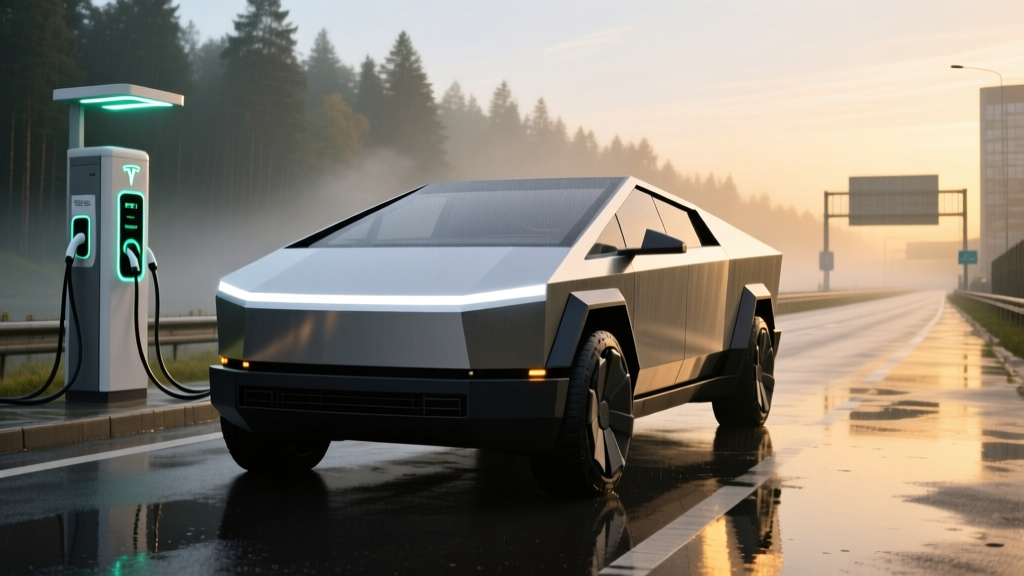
The Tesla Cybertruck has never been a subtle vehicle, and recent headlines about a Cybertruck Germany military ban haven't made it any quieter. While the German military (Bundeswehr) story revolves around base-access restrictions rather than a consumer sales prohibition, the controversy has pushed curious U.S. buyers to search the model's name at record levels. Setting the geopolitics aside, this review puts the 2026 Cybertruck under the microscope the way we evaluate every EV: with exact numbers, real-world caveats, and a clear-eyed look at who should (and shouldn't) buy one.
Why the Cybertruck Germany Military Ban Is Trending
Reports in late 2025 and early 2026 indicated that certain German military installations restricted Cybertruck access to base parking areas, citing concerns about the stainless-steel exoskeleton's interaction with automated bollard sensors and pedestrian-safety geometry. This is an institutional access decision by the Bundeswehr, not a national consumer ban, and it has no bearing on U.S. registration, sales, or NHTSA compliance. For American shoppers, the practical takeaway is simply that the Cybertruck's angular design and 6,800-plus-pound curb weight make it an outlier in any regulatory or institutional environment — something worth understanding before you sign the paperwork.
2026 Cybertruck Trim Lineup and Pricing
Tesla streamlined the Cybertruck lineup for 2026 after discontinuing the single-motor Rear-Wheel-Drive variant in late 2025. Three trims remain, all dual- or tri-motor AWD:
| Trim | Drivetrain | Horsepower | 0-60 mph | EPA Range | Base MSRP |
|---|---|---|---|---|---|
| Long Range AWD | Dual Motor | 600 hp | 3.9 s | 340 mi | $79,990 |
| Performance (formerly Cyberbeast) | Tri-Motor | 845 hp | 2.6 s | 320 mi | $99,990 |
| Off-Road Package (add-on) | Tri-Motor | 845 hp | 2.8 s | 305 mi | + $7,500 |
Destination fees add $1,990. As-tested Performance models with Full Self-Driving (Supervised) and the Off-Road Package routinely cross $115,000 before incentives.
Range, Battery Chemistry, and Real-World Efficiency
Real-World Expectation: Plan for 270–295 miles on highway road trips at 70–80 mph, and 230–260 miles in sub-freezing winter conditions. The Cybertruck's 6,600–6,850 lb curb weight and flat-panel aerodynamics hurt highway efficiency relative to sedans.
The 2026 Cybertruck uses a ~123 kWh usable battery pack built on Tesla's 4680 cell architecture. Tesla has not publicly broken out the exact cathode chemistry per trim, but teardown data and supply-chain reporting point to a high-nickel NMC variant optimized for energy density rather than the LFP chemistry used in the standard-range Model 3. That matters for longevity: NMC packs typically tolerate fewer full charge cycles than LFP before measurable degradation, which is why Tesla recommends daily charging to 80% unless you need the full range for a trip.
EPA efficiency lands at roughly 58 MPGe combined (about 58 kWh/100 mi) for the Long Range and 54 MPGe for the Performance trim, per fueleconomy.gov. Expect real-world highway efficiency closer to 65–72 kWh/100 mi — the brick-like drag coefficient shows up at speed.
Charging Speeds: DC Fast, Level 2, and Home Setup
| Level | Power | Speed / Time | Notes |
|---|---|---|---|
| DC Fast (Supercharger V4) | Peak 250 kW | 10–80% in ~28 min | Curve tapers hard above 80%; plan stops to 80% |
| DC Fast (third-party CCS/NACS) | Up to 350 kW capable | ~22 min 10–80% on 350 kW post | Requires NACS-to-CCS adapter at non-Tesla stations |
| Level 2 (Tesla Wall Connector) | 11.5 kW (48A) | ~34 mi/hr added | Full charge in ~11 hours from 10% |
| Level 2 (generic J1772/NACS) | 7.7 kW (32A) | ~23 mi/hr added | Common for older home installs |
| Level 1 (120V outlet) | 1.4 kW | ~4 mi/hr | Emergency/top-up only on a 123 kWh pack |
The Cybertruck's 800-volt-class architecture lets it sustain higher charge rates deeper into the curve than older 400V trucks, but the massive pack means absolute charge times are still longer than a Model Y. Preconditioning the battery via the nav-routed Supercharger warm-up is non-negotiable in cold weather — skipping it can add 10–15 minutes to a DC session.
Tax Credits, Incentives, and True Cost of Ownership
Federal §30D EV tax credit eligibility for the 2026 Cybertruck is limited. Under current IRS rules, the credit phases out for trucks with MSRP above $80,000, which eliminates the Performance trim outright. The Long Range AWD at $79,990 technically clears the MSRP cap, but buyers must also meet adjusted gross income limits ($150,000 single / $300,000 joint) and the vehicle must satisfy critical-mineral and battery-component sourcing requirements that shift annually. Per IRS.gov, the point-of-sale transfer option lets dealers apply up to $7,500 at signing — but only if all three tests (MSRP, income, sourcing) pass. Many 2026 Long Range buyers will qualify for a partial credit ($3,750) rather than the full $7,500.
| Scenario | MSRP | Est. Federal Credit | Effective Price |
|---|---|---|---|
| Long Range, full credit | $79,990 | $7,500 | $72,490 |
| Long Range, partial credit | $79,990 | $3,750 | $76,240 |
| Performance (over MSRP cap) | $99,990 | $0 | $99,990 |
Consult a tax professional before relying on the credit — the sourcing rules in particular change with supply-chain shifts and are not guaranteed at point of delivery.
Interior, Cargo, and Daily Livability
The Cybertruck seats five (six with the optional front bench delete replaced by a center seat). Rear legroom measures 38.4 inches, which is tighter than a Ford F-150 Lightning's 43.2 inches and will be noticeable on long family trips. Cargo volume behind the second row is approximately 34 cu ft in the sealed bed vault, expanding to 68 cu ft with the tonneau retracted and the fold-forward midgate deployed. The front trunk (frunk) adds 7.1 cu ft — enough for a charging cable kit and a soft-sided cooler, but smaller than the Lightning's massive frunk.
Standout tech includes steer-by-wire (no mechanical linkage between the yoke and the rack), a 18.5-inch center touchscreen running Tesla's latest infotainment stack, rear-seat 9.4-inch display, and the Full Self-Driving (Supervised) package. FSD remains an SAE Level 2 driver-assist system — it does not make the Cybertruck self-driving, and the driver must remain attentive at all times.
Warranty, Longevity, and Service Considerations
Tesla's warranty for the 2026 Cybertruck:
- Basic vehicle: 4 years / 50,000 miles
- Battery and drive units: 8 years / 120,000 miles, with a minimum 70% capacity retention threshold
- Stainless exoskeleton: Corrosion perforation covered 5 years / unlimited miles
Replacement cost for a full 123 kWh 4680 pack is not published, but industry estimates for comparable large packs put out-of-warranty replacement between $18,000 and $28,000. Tesla's 70% retention threshold is standard but less generous than Hyundai's 8-year/100,000-mile with no stated floor on some models.
Cybertruck vs. the Competition
- Class-leading 845 hp tri-motor performance (2.6 s 0-60)
- Stainless exoskeleton is dent- and corrosion-resistant
- Supercharger network access (largest reliable U.S. DC network)
- Steer-by-wire enables tight turning radius despite 20+ ft length
- 11,000-lb max towing capacity (with Off-Road Package)
- Real-world highway range falls 15–20% below EPA sticker
- Rear-seat legroom trails F-150 Lightning and Rivian R1T
- Performance trim disqualified from §30D credit by MSRP cap
- Steer-by-wire feel polarizes reviewers — not for everyone
- Insurance premiums run 20–35% higher than comparable trucks
Against the Ford F-150 Lightning, the Cybertruck wins on performance and Supercharger access but loses on interior space, conventional controls, and fleet/service familiarity. Against the Rivian R1T, the Cybertruck is cheaper at the Long Range trim but offers less refined on-road manners and a smaller service network.
Who Should (and Shouldn't) Buy the 2026 Cybertruck
The Cybertruck fits buyers who want a statement truck with genuine performance credentials, tow toys on weekends, and have reliable Level 2 home charging. It does not suit families prioritizing rear-seat comfort, fleet buyers needing conventional service channels, or anyone whose daily commute exceeds 250 miles one-way without DC fast-charger access.
Frequently Asked Questions
What is the real-world range of the 2026 Cybertruck?
EPA rates the Long Range AWD at 340 miles and the Performance at 320 miles. Real-world highway driving at 75 mph yields 270–295 miles; sub-freezing winter conditions reduce that to 230–260 miles.
How fast does the Cybertruck charge at home and on the road?
On a Tesla V4 Supercharger it peaks at 250 kW and reaches 10–80% in about 28 minutes. At home on an 11.5 kW Wall Connector, expect roughly 34 miles of range per hour of charging.
Does the 2026 Cybertruck qualify for the federal EV tax credit?
Only the Long Range AWD ($79,990 MSRP) potentially qualifies, and only if buyer income and battery-sourcing requirements are met. The Performance trim is ineligible due to the §30D truck MSRP cap of $80,000.
Is the Cybertruck Germany military ban a real consumer restriction?
No. Reports describe base-access limitations at specific Bundeswehr installations, not a German consumer sales ban. It has no effect on U.S. registration or purchase.
Is the Cybertruck worth buying over the F-150 Lightning or Rivian R1T?
Choose the Cybertruck if you prioritize tri-motor performance and Supercharger access. Choose the Lightning for interior space and service familiarity, or the R1T for on-road refinement and adventure-oriented design.