The Tesla Cybertruck is as polarizing as it is capable, and nowhere is that tension more visible than in its front trunk. The Cybertruck frunk — officially a lockable, weather-sealed compartment under the hood — promises secure, dry storage that a traditional truck bed can't match. But does it actually deliver for daily use, and how does the rest of the truck stack up in range, charging, and ownership cost? This review covers the full 2026 Cybertruck lineup with hard numbers and real-world context.
Cybertruck Frunk: Dimensions, Capacity, and Real-World Use
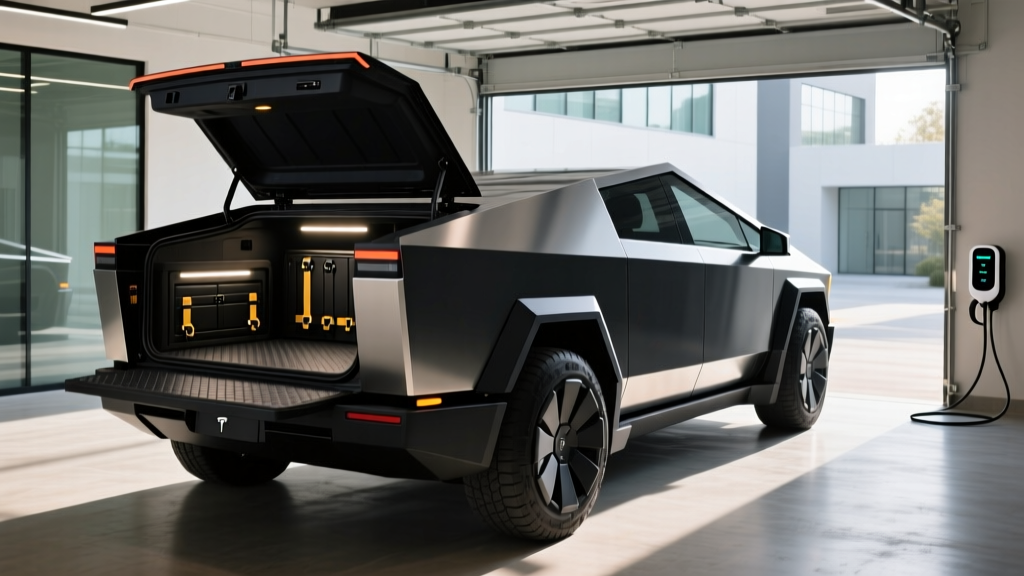
Unlike a conventional pickup where the hood hides an engine bay, the Cybertruck's dual- and tri-motor powertrains leave room up front for a genuine storage compartment. Tesla rates the frunk at approximately 7.1 cubic feet of sealed volume — enough for a large soft-sided cooler, a pair of carry-on bags, or a full set of grocery runs without touching the bed.
Key frunk specifications and features:
- Volume: ~7.1 cu ft (lockable, weather-sealed)
- Access: Power-operated hood via key fob, app, or touchscreen
- Drain plug: Yes — doubles as an ice chest for tailgating
- 120V outlet: Available inside for powering tools or accessories
- Lighting: Integrated LED illumination
In practice, the frunk's best use case is securing valuables (laptops, camera gear, luggage) that you'd rather not leave in the open bed or exposed cabin. The drain plug makes it genuinely useful for iced drinks at a campsite, though the irregular floor shape limits stacking. Compared to the Ford F-150 Lightning's mega power frunk (14.1 cu ft), the Cybertruck's is roughly half the size — a trade-off for its aggressive front-end geometry and structural exoskeleton.
Full Cargo Profile: Bed, Vault, and Cabin Storage
The frunk is just one piece of the Cybertruck's cargo story. The 6-foot composite bed (Tesla calls it the "Vault") offers 43.5 cubic feet of lockable storage behind the motorized tonneau cover. Combined with the cabin's rear under-seat storage and the frunk, total enclosed secure volume approaches 55+ cubic feet — a meaningful advantage over open-bed trucks for urban owners.
| Area | Volume / Dimension | Notes |
|---|---|---|
| Frunk (front trunk) | ~7.1 cu ft | Sealed, lockable, drain plug |
| Bed (Vault) | 43.5 cu ft (bed cover closed) | 6 ft length, motorized tonneau |
| Bed payload capacity | 2,500 lbs | Per Tesla specs |
| Towing capacity | 11,000 lbs (AWD) / 10,000 lbs (Cyberbeast) | Integrated brake controller |
| Rear cabin storage | Under-seat compartments | Lockable via touchscreen |
| Front row legroom | 41.2 in | |
| Rear row legroom | 38.5 in | Tight for tall passengers |
The 11,000-lb tow rating is competitive with half-ton gas trucks, but real-world towing will slash range by 40–55% depending on trailer weight and aerodynamics. Plan for 140–180 miles of range when towing near max capacity.
Range, Battery, and Efficiency: EPA vs. Reality
EPA Estimated: 340 miles (AWD Dual Motor) / 320 miles (Cyberbeast)
Real-World Expectation: ~270–300 miles highway at 70 mph; ~210–250 miles in cold weather (below 32°F); ~140–180 miles towing max load
The Cybertruck's angular stainless-steel body creates significant aerodynamic drag at highway speeds, which disproportionately cuts range compared to sleeker EVs.
The Cybertruck uses an estimated ~123 kWh usable battery pack (gross capacity slightly higher) built on Tesla's 4680 structural cell architecture. Tesla has not officially published the exact kWh figure or chemistry breakdown for 2026, though industry teardowns confirm a high-nickel NMC-type chemistry optimized for energy density and power delivery rather than LFP's cycle-life advantages.
Efficiency, per fueleconomy.gov, lands at roughly 52 MPGe combined for the AWD model — translating to approximately 65 kWh per 100 miles. That's thirsty by EV standards; for comparison, the Rivian R1T Quad Motor achieves around 53 MPGe, while the F-150 Lightning Extended Range manages 70 MPGe. The Cybertruck's mass (nearly 7,000 lbs curb weight) and brick-like drag coefficient are the primary culprits.
Charging Speed: DC Fast, Level 2, and the 400V Question
The Cybertruck supports a peak DC fast-charge rate of 325 kW at V4 Supercharger stalls — but that peak only holds briefly before the charge curve tapers. In real-world testing, expect a 10–80% charge in approximately 28–32 minutes at a 350 kW-capable Supercharger. At more common 150 kW stalls, plan for 45–55 minutes for the same 10–80% session.
| Charging Level | Max Power | Speed / Time |
|---|---|---|
| DC Fast (V4 Supercharger, 350 kW capable) | 325 kW peak | 10–80% in ~28–32 min |
| DC Fast (150 kW Supercharger) | 150 kW | 10–80% in ~45–55 min |
| Level 2 (home, 48A / 11.5 kW) | 11.5 kW | ~30–37 miles of range per hour |
| Level 2 (Tesla Wall Connector, 80A capable) | ~19.2 kW (truck-limited) | ~50–60 mi/hr (if onboard charger supports) |
| Level 1 (120V household) | ~1.4 kW | ~3–4 mi/hr (emergency only) |
The Cybertruck uses the NACS (Tesla) connector natively, which is now the de facto North American standard adopted by Ford, GM, Rivian, and others. It ships with a NACS-to-J1772 adapter for non-Tesla Level 2 stations. Note that the Cybertruck operates on a 400V architecture, not 800V — meaning it cannot match the sustained charge rates of 800V rivals like the Hyundai Ioniq 5 or Porsche Macan EV. The 325 kW peak is impressive, but the taper above 60% SoC is steep.
Home charging reality: Most Cybertruck owners will install a Tesla Wall Connector on a 60A circuit (48A continuous), adding roughly 30–37 miles of range per hour. An overnight 10-hour session replenishes approximately 300+ miles — sufficient for nearly all daily use. Expect a 240V/60A installation to cost $800–$2,000 depending on panel proximity; a full 200A panel upgrade can add $2,000–$4,000.
Performance: 0–60, Horsepower, and Drivetrain
The 2026 Cybertruck is offered in two primary configurations:
| Spec | AWD (Dual Motor) | Cyberbeast (Tri-Motor) |
|---|---|---|
| Horsepower | ~600 hp | ~845 hp |
| 0–60 mph | 3.9 seconds | 2.6 seconds |
| Top Speed | 130 mph | 130 mph |
| Drivetrain | Dual-motor AWD | Tri-motor AWD (torque vectoring) |
| Adaptive Air Suspension | Standard | Standard |
| Ground Clearance (max) | ~17.4 in | ~17.4 in |
The Cyberbeast's 2.6-second 0–60 time makes it one of the quickest production trucks ever built, rivaling supercars. The AWD model's 3.9 seconds is still extraordinary for a 7,000-lb vehicle. Both trims feature rear-wheel steering (up to 10 degrees), which dramatically tightens the turning circle to approximately 40 feet — critical for a truck this size in urban environments.
Pricing, Trims, and Federal Tax Credit Eligibility
The Cybertruck's pricing has climbed since its 2023 unveiling. For 2026, Tesla lists the following MSRPs (before destination or options):
| Trim | Base MSRP | §30D Credit Eligible? | Effective Price (if eligible) |
|---|---|---|---|
| AWD (Dual Motor) | $79,990 | Yes (meets $80K truck cap) | ~$72,490 |
| Cyberbeast (Tri-Motor) | $99,990 | No (exceeds $80K truck MSRP cap) | $99,990 |
- MSRP Cap: $80,000 for trucks/vans/SUVs; $55,000 for sedans — the Cyberbeast exceeds the cap
- Buyer Income Cap: AGI ≤ $300K (joint), $225K (head of household), $150K (single)
- Battery Sourcing: Critical minerals and battery components must meet escalating domestic/free-trade sourcing thresholds — verify current-year compliance on IRS.gov
- Point-of-Sale Transfer: Eligible buyers can apply the up-to-$7,500 credit as a down-payment reduction at the dealer
The AWD trim, at $79,990, squeaks under the $80K truck MSRP cap and can qualify for the full $7,500 credit if the buyer meets income thresholds and the battery sourcing requirements are satisfied. The Cyberbeast at $99,990 is ineligible regardless of buyer income. Tesla also offers a Rear-Wheel Drive (RWD) variant at a lower price point (~$60,990), but availability has been limited and fleet-only at times — check Tesla's configurator for current status.
Tech, Driver Assistance, and Ownership Experience
The Cybertruck's interior is minimalist in the extreme: an 18.5-inch center touchscreen handles nearly all vehicle functions, including climate vents (no physical dash vents), glovebox release, and mirror adjustments. A 9.4-inch rear touchscreen serves second-row passengers. The yoke-style steering wheel (now optional alongside a round wheel for 2026) remains a love-it-or-hate-it choice.
Driver Assistance (SAE Level 2): The Cybertruck ships with Tesla's Autopilot (adaptive cruise + lane centering). Full Self-Driving (Supervised) remains a $8,000 add-on or $99/month subscription. Despite the name, FSD is SAE Level 2 — the driver must remain fully engaged, hands on the wheel (or yoke), and eyes on the road at all times. It is not autonomous driving.
Tesla Autopilot and FSD (Supervised) are Level 2 driver-assist systems, not self-driving. The driver is legally and operationally responsible for the vehicle at all times. These systems can fail to detect stopped emergency vehicles, construction zones, and unusual road geometries. Never use them while impaired, distracted, or fatigued.
Notable tech features include steer-by-wire (no physical steering column connection), 48-volt electrical architecture (a first for a production vehicle), and integrated "Powershare" — V2L capability providing up to 11.5 kW of combined 120V/240V output from bed and frunk outlets, enough to power tools at a job site or essentials during a home outage.
Notable drawbacks: The stainless-steel body panels are fingerprint magnets and difficult to repair after dents. Panel-gap quality has improved since launch but still draws criticism. Visibility is compromised by the thick A-pillars and small rear window. The rear bench is tight for adults on long trips. Insurance premiums run 25–40% higher than comparable trucks due to repair costs.
Warranty Coverage
Tesla provides the following warranty for the 2026 Cybertruck:
- Basic Vehicle: 4 years / 50,000 miles
- Battery & Drive Units: 8 years / 120,000 miles (whichever comes first), with minimum 70% capacity retention
- Restraint System: 5 years / 60,000 miles
- Corrosion: 12 years / unlimited miles (limited coverage)
The 8-year/120,000-mile battery warranty is competitive and aligns with industry norms for premium EVs. Tesla's 70% capacity retention threshold is standard; most owners report degradation in the 8–12% range over 100,000 miles based on fleet data, though the 4680 cells are still relatively new and long-term data is still accumulating. A full battery replacement out of warranty is estimated at $15,000–$25,000 based on current Tesla service pricing for large packs.
Cybertruck vs. Competitors: Is It Worth Buying?
- You want the most secure integrated storage (frunk + sealed bed vault) in an electric truck
- You value extreme acceleration and steer-by-wire tech
- You're already in the Tesla/Supercharger ecosystem
- You need V2L (Powershare) for job-site or backup power use
- Ford F-150 Lightning: You need a larger frunk (14.1 cu ft), more conventional styling, or lower starting price
- Rivian R1T: You want a more refined interior, better off-road capability (quad-motor), or a mid-size footprint
- Chevy Silverado EV: You need a longer bed (5'11" with midgate open) or fleet/commercial pricing
The Cybertruck's closest rival, the F-150 Lightning, starts significantly lower (~$55,000 for Pro trim), offers a far larger frunk, and provides a more traditional truck experience. However, the Lightning's range tops out at 320 miles (Extended Range), and its charging speed peaks at 150 kW — roughly half the Cybertruck's peak. The Rivian R1T offers superior build quality and off-road chops but starts above $70,000 and has a smaller battery. None of the competitors match the Cybertruck's combination of sub-3-second acceleration (Cyberbeast), steer-by-wire, and 48V architecture.
Frequently Asked Questions
What is the real-world range of the Cybertruck?
The EPA rates the AWD at 340 miles and the Cyberbeast at 320 miles. In real-world highway driving at 70 mph, expect 270–300 miles. In cold weather (below freezing), plan for 210–250 miles. Towing near the 11,000-lb max will drop range to roughly 140–180 miles.
How fast does the Cybertruck charge at home and on the road?
At a V4 Supercharger, the Cybertruck peaks at 325 kW and charges 10–80% in approximately 28–32 minutes. At home on a 48A Level 2 charger, it adds about 30–37 miles of range per hour, fully replenishing overnight in roughly 10–12 hours.
Does the Cybertruck qualify for the $7,500 federal tax credit?
The AWD trim at $79,990 qualifies (it's under the $80K truck MSRP cap), provided the buyer's AGI is within IRS limits and battery sourcing requirements are met. The Cyberbeast at $99,990 does not qualify. Always verify current-year rules on IRS.gov and consult a tax professional.
How big is the Cybertruck frunk compared to the F-150 Lightning?
The Cybertruck frunk offers approximately 7.1 cubic feet — about half the F-150 Lightning's 14.1-cu-ft Mega Power Frunk. The Cybertruck frunk compensates with a drain plug (ice-chest mode) and a 120V outlet, but the Lightning's is more practical for bulky items.
Is the Cybertruck good for daily commuting?
It's capable but oversized for urban commuting. The rear-wheel steering helps in parking lots, and the 340-mile range covers most commutes for a week between charges. However, its 7,000-lb weight, wide stance, and compromised rear visibility make it less nimble than a sedan or crossover in tight city traffic. Home charging is strongly recommended.
What are the biggest pros and cons?
- Secure, lockable frunk + sealed bed vault
- Class-leading acceleration (Cyberbeast: 2.6s 0–60)
- 325 kW peak DC fast charging
- V2L Powershare (11.5 kW output)
- 11,000-lb towing capacity
- Supercharger network access (NACS native)
- High starting price ($79,990+ for credit-eligible trim)
- Poor aerodynamic efficiency (~65 kWh/100 mi)
- Smaller frunk than F-150 Lightning
- Tight rear-seat legroom (38.5 in)
- 400V architecture limits sustained charge rate
- High insurance premiums (25–40% above peers)
- Stainless-steel body is difficult to repair
The Cybertruck — frunk and all — is a truck built for buyers who want maximum technology integration, secure storage, and performance that defies physics. It's not the most efficient, practical, or affordable electric truck, but it remains the most distinctive. If the frunk size, range compromises, and pricing align with your needs, it's a genuinely capable daily driver and job-site tool. If you prioritize value and conventional utility, the F-150 Lightning or Rivian R1T may serve you better.