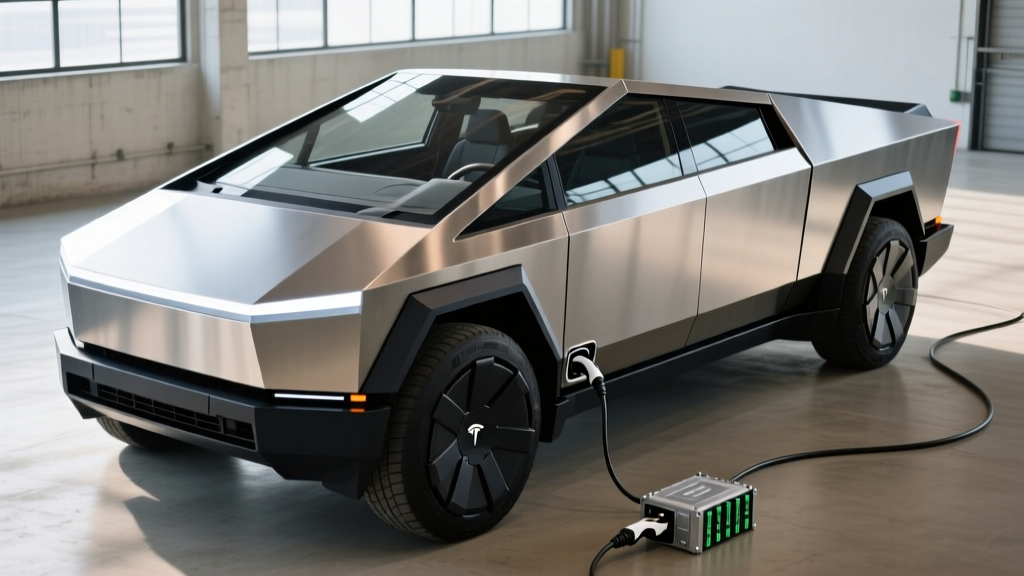
The Tesla Cybertruck's most polarizing feature isn't its angular silhouette — it's the structural philosophy underneath. Unlike conventional body-on-frame pickups or unibody crossovers, the Cybertruck uses what Tesla calls an "exoskeleton" architecture: a load-bearing cold-rolled stainless-steel skin bonded to a rigid underbody that integrates the battery pack as a stressed member. This approach fundamentally changes how the truck handles impacts, carries loads, and manages weight, and it has direct consequences for range, repairability, and daily ownership.
After extensive time with the dual-motor and tri-motor variants, we've compiled everything buyers need to know about the Cybertruck's platform — from the chemistry inside its battery to the real-world charging curve at a Supercharger, and how the §30D federal tax credit applies (or doesn't) in 2026.
The Cybertruck Frame and Exoskeleton Explained
Traditional pickups use a ladder frame: two parallel steel rails with crossmembers, upon which a separate body is bolted. The Cybertruck abandons this. Its structural skeleton is formed largely by the exterior panels themselves — 30X-series cold-rolled stainless steel, bent on massive press brakes rather than stamped. These panels are not cosmetic; they carry structural loads.
Beneath the cabin floor, a cast-aluminum and high-strength-steel substructure houses the battery pack, which serves as a structural element tying the front and rear sections together. Tesla uses large single-piece megacastings for the front and rear underbody, reducing part count and increasing torsional rigidity. The result is a platform that Tesla claims exceeds the torsional stiffness of conventional body-on-frame trucks, though this comes with trade-offs in panel repair — minor dents that a body shop might pop out on an aluminum F-150 Lightning require specialized stainless-steel work on the Cybertruck.
The frame architecture also dictates the Cybertruck's 6.5-foot bed length (with the tonneau closed), its steer-by-wire system (no mechanical column to route through a traditional firewall), and its 48-volt low-voltage electrical architecture — a first for a production vehicle — which allows thinner wiring harnesses and reduces weight.
Range, Efficiency, and the Real-World Reality
- AWD (Dual Motor): EPA 340 miles — expect 270–300 miles highway, ~220–250 miles in cold weather (below 30°F) or while towing.
- Cyberbeast (Tri Motor): EPA 320 miles — expect 250–280 miles highway, ~200–230 miles cold/towing.
- RWD (Base, announced): EPA 250 miles (preliminary) — expected late availability; limited production.
Stainless steel is heavy. The Cybertruck AWD's curb weight of approximately 6,600 lbs demands more energy per mile than lighter EVs. Highway driving at 75+ mph and cold temperatures compound this. If you plan to tow the rated 11,000 lbs, plan for 120–160 miles of range between charges depending on trailer aerodynamics and terrain.
Efficiency figures from fueleconomy.gov list the AWD at approximately 67 MPGe combined, translating to roughly 50 kWh per 100 miles. That's thirstier than a Rivian R1T (which returns closer to 43–47 kWh/100mi) and significantly less efficient than a Ford F-150 Lightning Extended Range (~48 kWh/100mi). The exoskeleton's mass penalty is the primary culprit.
| Trim | Drivetrain | EPA Range | MPGe (Combined) | kWh/100mi | Real-World Highway |
|---|---|---|---|---|---|
| RWD (Base) | Rear-Wheel Drive | 250 mi (prelim.) | ~65 | ~52 | ~200 mi |
| AWD | Dual Motor | 340 mi | 67 | 50 | 270–300 mi |
| Cyberbeast | Tri Motor | 320 mi | 64 | 52 | 250–280 mi |
Battery Chemistry, Capacity, and Longevity
The Cybertruck AWD and Cyberbeast use a structural battery pack with an estimated usable capacity of approximately 123 kWh. Tesla has not officially published the exact figure, but teardown analysis and charging-session data point to this range. The cells are 4680-format cylindrical lithium-ion units manufactured at Tesla's Texas Gigafactory.
The chemistry is NMC (nickel-manganese-cobalt), chosen for its high energy density — necessary to push range above 300 miles in a 6,600-lb vehicle. This differs from Tesla's LFP (lithium iron phosphate) packs used in the Model 3/Y RWD, which are heavier but offer longer cycle life and tolerate regular 100% charging. With the Cybertruck's NMC pack, Tesla recommends daily charging to 80–90% and reserving 100% for long trips, which slightly reduces usable daily range compared to the EPA sticker.
Battery degradation data is still maturing given the truck's late-2023 launch, but Tesla's 4680 cells in other products have shown roughly 5–8% capacity loss over the first 50,000 miles, with the curve flattening afterward. The battery warranty covers 8 years or 150,000 miles (whichever comes first) with a minimum 70% capacity retention threshold — one of the more generous terms in the segment.
| Component | Warranty |
|---|---|
| Battery Pack | 8 years / 150,000 miles (70% retention) |
| Drive Units | 8 years / 150,000 miles |
| Vehicle (Bumper-to-Bumper) | 4 years / 50,000 miles |
Charging Speed: DC Fast, Supercharger, and Home Level 2
The Cybertruck supports Tesla's 800-volt electrical architecture, enabling peak DC fast-charge rates up to 350 kW at V4 Superchargers. In practice, the charge curve peaks around 325 kW briefly in optimal conditions (pack preconditioned, low state of charge) and tapers progressively above 60% SoC. A 10–80% session takes approximately 18–22 minutes at a capable Supercharger.
For home charging, the Cybertruck accepts up to 17 kW on Level 2 AC (using the Tesla Wall Connector on a 60-amp circuit). At this rate, you'll add roughly 50–55 miles of range per hour of charging, meaning a full overnight session (10 hours) replenishes the pack from near-empty. On a standard 48-amp circuit, expect about 11.5 kW and ~35 miles per hour.
| Charging Level | Max Rate | Miles Added/Hr | Notes |
|---|---|---|---|
| Level 1 (120V) | ~1.4 kW | ~3 mi/hr | Emergency/top-up only |
| Level 2 (240V, 48A) | 11.5 kW | ~35 mi/hr | Typical home install |
| Level 2 (240V, 60A) | 17 kW | ~52 mi/hr | Wall Connector max |
| DC Fast (Supercharger V4) | 350 kW peak | ~200+ mi in 15 min | 10–80% in ~18–22 min |
| DC Fast (CCS adapter, non-Tesla) | ~250 kW | Varies by network | Requires Tesla CCS adapter (included) |
Preconditioning matters: navigate to a Supercharger using the built-in navigation, and the truck will warm the battery to optimal temperature before arrival, maximizing charge speed. Without preconditioning — for instance, arriving at a charger after the truck has sat cold — peak rates may be limited to 150–200 kW for the first several minutes.
Performance, Towing, and Payload
The Cybertruck AWD produces 600 horsepower and achieves a 0–60 mph time of 3.9 seconds. The Cyberbeast tri-motor variant pushes 845 horsepower and hits 60 mph in 2.6 seconds — absurd numbers for a vehicle that weighs as much as a loaded box truck. All variants feature adaptive air suspension with up to 16 inches of ground clearance in Off-Road mode and a self-leveling rear for payload management.
Towing capacity is rated at 11,000 pounds across AWD and Cyberbeast trims, competitive with the F-150 Lightning (10,000 lbs) and slightly behind the Rivian R1T (11,000 lbs). Payload capacity is rated at 2,500 pounds. The 6.5-foot composite bed (called the "vault") features a power-retractable tonneau cover that Tesla claims can support up to 300 lbs of distributed weight when closed, and the bed includes built-in 120V and 240V outlets for job-site power or camping — functioning as a large-scale V2L (vehicle-to-load) system.
| Spec | AWD | Cyberbeast |
|---|---|---|
| Horsepower | 600 hp | 845 hp |
| 0–60 mph | 3.9 sec | 2.6 sec |
| Top Speed | 112 mph | 130 mph |
| Max Towing | 11,000 lbs | 11,000 lbs |
| Payload | 2,500 lbs | 2,500 lbs |
| Ground Clearance (max) | 16 in | 16 in |
| Bed Length | 6.5 ft | 6.5 ft |
Pricing, Trims, and the Federal Tax Credit Question
The Cybertruck lineup has shifted since launch. As of early 2026, Tesla lists the following MSRPs before destination fees and options:
- RWD (Base): ~$60,990 — announced, limited availability expected late 2026
- AWD: $79,990
- Cyberbeast: $99,990
These prices represent significant increases from the originally announced 2019 figures, reflecting production complexity, material costs, and Tesla's pricing strategy. Fully optioned Cyberbeast examples with Foundation Series packages have pushed past $120,000 at launch, though Tesla has since phased out the Foundation Series markup.
This is where the math gets complicated. Under current IRS §30D rules, the Cybertruck faces several hurdles:
- MSRP Cap: Pickup trucks must have an MSRP at or below $80,000 to qualify. The AWD at $79,990 squeaks under; the Cyberbeast at $99,990 does not qualify.
- Buyer Income Cap: Modified adjusted gross income must not exceed $150,000 (single), $225,000 (head of household), or $300,000 (joint filing).
- Battery Sourcing: Critical minerals and battery components must meet escalating domestic-content and FEA (foreign entity of concern) thresholds. Tesla's 4680 cells use materials sourced from multiple global suppliers; eligibility for the full $7,500 versus a partial $3,750 credit depends on the specific production batch and model year. Check the official fueleconomy.gov tax credit lookup for the exact VIN-eligible credit amount.
- Point-of-Sale Transfer: Eligible buyers can transfer the credit to the dealer at purchase, reducing the out-of-pocket price directly.
Bottom line: The AWD trim may qualify for up to $7,500, bringing the effective price to ~$72,490 — but verify sourcing compliance for the specific vehicle you're ordering. Consult a tax professional before relying on credit eligibility.
Interior Space, Tech, and Driver Assistance
The Cybertruck seats five (a front bench option was initially teased but the production truck uses a 2+3 layout with front buckets). Rear legroom measures approximately 38 inches — adequate for adults but not class-leading compared to the F-150 Lightning's generous back seat. Cargo volume behind the rear seats is limited; the truck relies primarily on the 6.5-foot vault and the front trunk (frunk), which offers roughly 7 cubic feet of lockable storage.
The interior is minimalist in the extreme: a single 18.5-inch touchscreen handles all infotainment, climate, and vehicle controls, with a secondary 9.4-inch rear touchscreen for passengers. There are no physical buttons for climate or audio. The yoke-style steering wheel (a conventional wheel is now available as a no-cost option) pairs with Tesla's steer-by-wire system, which varies the steering ratio based on speed — eliminating the need to hand-over-hand during parking maneuvers.
On the driver-assistance front, the Cybertruck ships with Tesla's Autopilot (SAE Level 2) including Traffic-Aware Cruise Control and Autosteer. Full Self-Driving (Supervised) — still SAE Level 2, requiring active driver engagement at all times — is available as a $8,000 option or $99/month subscription. FSD Supervised handles highway lane changes, city-street navigation, and stop-sign/traffic-light recognition, but it is not autonomous driving and requires continuous attention.
Cybertruck vs. the Competition: Is It Worth Buying?
The Cybertruck competes in the full-size electric pickup segment against the Ford F-150 Lightning, Rivian R1T, Chevrolet Silverado EV, and the GMC Sierra EV. Each makes different trade-offs:
- You prioritize acceleration and performance above all else in a truck
- You value the stainless-steel exoskeleton for its durability and corrosion resistance
- You rely on the Tesla Supercharger network for frequent long-distance travel
- You want integrated 120V/240V bed power for job-site or overlanding use
- You need maximum rear-seat comfort and cargo versatility (F-150 Lightning, Rivian R1T)
- You want the longest possible range for towing (Silverado EV 4WT offers 400+ mi EPA)
- You prefer a conventional steering wheel and physical controls
- Repair network breadth matters — Tesla's body-shop network is narrower than Ford's or GM's
- Class-leading acceleration (2.6s Cyberbeast)
- Stainless-steel exoskeleton: corrosion-resistant, dent-resistant
- 800V architecture with 350 kW peak DC charging
- Steer-by-wire with variable ratio is genuinely useful in tight spaces
- Integrated bed power (120V/240V) and air suspension self-leveling
- Access to the Tesla Supercharger network (most reliable DC network in the U.S.)
- Heavy: 6,600+ lbs hurts efficiency (50 kWh/100mi) and real-world range
- Towing range is severely limited (~120–160 mi at max load)
- Cyberbeast exceeds $80K MSRP cap — no federal tax credit
- Minimalist interior won't suit traditional truck buyers
- Stainless-steel body repair is specialized and potentially costly out of warranty
- 6.5-foot bed is shorter than most full-size competitors
Frequently Asked Questions
What is the real-world range of the Tesla Cybertruck?
The AWD's EPA rating is 340 miles, but real-world highway driving at 70–80 mph typically yields 270–300 miles. In cold weather (below 30°F), expect 220–250 miles. Towing at or near the 11,000-lb maximum drops range to roughly 120–160 miles depending on trailer profile and terrain.
How fast does the Cybertruck charge at home and on the road?
At home on a 240V/60A Tesla Wall Connector, the Cybertruck charges at up to 17 kW, adding about 52 miles of range per hour. On a V4 Supercharger, it peaks at 350 kW and completes a 10–80% session in approximately 18–22 minutes with battery preconditioning.
How much does the Cybertruck cost after tax credits?
The AWD at $79,990 may qualify for up to $7,500 under §30D (subject to buyer income, battery sourcing, and MSRP cap compliance), bringing the effective price to ~$72,490. The Cyberbeast at $99,990 exceeds the $80,000 truck MSRP cap and does not qualify. The base RWD at ~$60,990 may qualify when it becomes available. Always verify eligibility on fueleconomy.gov and consult a tax professional.
Is the Cybertruck worth buying over the F-150 Lightning or Rivian R1T?
It depends on priorities. The Cybertruck wins on raw acceleration, Supercharger network access, and the unique exoskeleton durability. The F-150 Lightning offers a more traditional truck experience with better rear-seat space and a broader dealer/service network. The Rivian R1T provides superior off-road capability, a more refined interior, and a quad-motor option. If towing range is your top concern, the Silverado EV's larger battery is worth considering.
Does the Cybertruck frame rust or corrode?
The 30X-series stainless-steel exoskeleton is highly corrosion-resistant — significantly more so than painted mild steel or aluminum. However, it is not immune to surface staining or "tea staining" in salty environments. Tesla recommends regular washing, particularly after exposure to road salt. The underbody and structural castings use different materials and are coated for corrosion protection.
Can the Cybertruck's stainless-steel body be repaired after a collision?
Minor dents and creases in stainless steel require different techniques than aluminum or mild steel. Tesla has been building out a network of approved body shops with stainless-steel capability, but availability varies by region. Major panel damage may require full panel replacement rather than traditional paintless dent repair. Factor this into long-term ownership cost considerations, especially after the 4-year/50,000-mile bumper-to-bumper warranty expires.
What battery chemistry does the Cybertruck use?
The Cybertruck AWD and Cyberbeast use NMC (nickel-manganese-cobalt) chemistry in Tesla's 4680 cylindrical cell format. NMC offers higher energy density than LFP, which is necessary for the Cybertruck's weight and range targets, but it requires more careful charge management (daily charging to 80–90% rather than 100%) for optimal longevity.