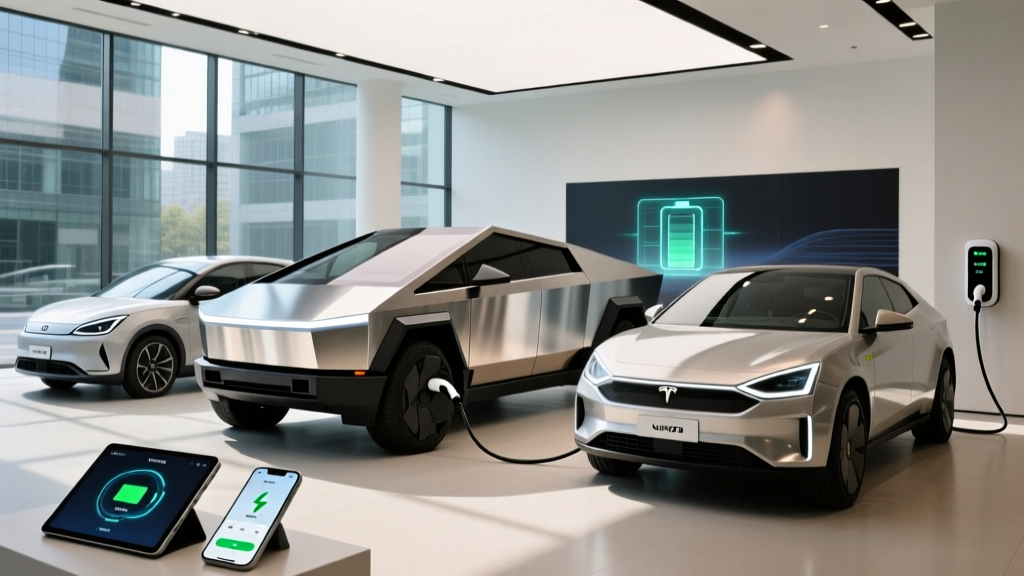
The Tesla Cybertruck launched with more hype than any electric pickup in history — and more polarizing reactions. Years later, the question lingers in forums, comment sections, and dealership lots: is the Cybertruck a flop, or did early production chaos obscure a genuinely capable electric truck? After spending time with the 2026 Cybertruck lineup, examining its EPA numbers, real-world efficiency, and ownership economics, we have answers grounded in data rather than social-media narratives.
This review covers the Cybertruck AWD (dual-motor) and Cyberbeast (tri-motor) trims currently in production. The long-promised rear-wheel-drive base model has been repeatedly delayed and remains unavailable as of early 2026. We will address range, charging, pricing, tax-credit eligibility, and whether this truck earns a place in your garage or deserves the "flop" label critics keep applying.
2026 Cybertruck Specs at a Glance
| Spec | Cybertruck AWD | Cyberbeast (Tri-Motor) |
|---|---|---|
| EPA Range | 340 miles | 320 miles |
| Battery (usable) | ~123 kWh (NMC) | ~123 kWh (NMC) |
| Drivetrain | Dual-Motor AWD | Tri-Motor AWD |
| Horsepower | 600 hp | 845 hp |
| 0-60 mph | 4.1 sec | 2.6 sec |
| Max DC Fast Charge | 250 kW | 250 kW |
| 10-80% DC Time | ~28 min | ~28 min |
| Level 2 Home Rate | 11.5 kW (~37 mi/hr) | 11.5 kW (~37 mi/hr) |
| MPGe (combined) | 67 MPGe | 62 MPGe |
| Efficiency | 50 kWh/100 mi | 54 kWh/100 mi |
| Towing Capacity | 11,000 lbs | 11,000 lbs |
| Payload | 2,500 lbs | 2,500 lbs |
| Bed Length | 6 ft (72 in) | 6 ft (72 in) |
| Cargo Volume (bed) | ~67 cu ft | ~67 cu ft |
| Base MSRP | $79,990 | $99,990 |
| Battery Warranty | 8 yr / 120,000 mi | 8 yr / 120,000 mi |
Range Reality: What the EPA Number Doesn't Tell You
The Cybertruck AWD carries an EPA-estimated 340 miles of range, while the Cyberbeast drops to 320 miles. On paper, those are competitive figures for a full-size electric pickup. But the Cybertruck's angular stainless-steel exoskeleton creates substantial aerodynamic drag, and real-world results tell a different story than the sticker.
The ~123 kWh usable battery pack uses NMC (nickel-manganese-cobalt) chemistry, which offers high energy density but is more sensitive to extreme cold than LFP. Tesla's heat pump and thermal management system help mitigate winter losses, but physics wins: pushing a 6,800-pound stainless-steel wedge through the air at interstate speeds consumes energy at a steep rate. According to fueleconomy.gov, the Cybertruck AWD achieves 67 MPGe combined — respectable for its weight class, but far from the efficiency of a sedan-shaped EV.
If your daily driving is under 80 miles round-trip with home charging, the Cybertruck's real-world range is more than adequate. For road trips exceeding 250 miles between reliable Supercharger stops, route planning becomes essential — especially through the charging deserts of the rural Mountain West.
Charging Speed: 250 kW Peak, but Mind the Curve
The Cybertruck supports a maximum DC fast-charge rate of 250 kW on Tesla's V3 and V4 Superchargers using its native NACS connector. That peak figure sounds impressive, but sustained charging speed is what actually determines your road-trip downtime.
| Charging Level | Power | Miles Added per Hour | Notes |
|---|---|---|---|
| Level 1 (120V) | ~1.4 kW | ~3-4 mi/hr | Emergency/trickle only |
| Level 2 (240V, 48A) | 11.5 kW | ~37 mi/hr | Home Wall Connector; full charge ~11 hr |
| DC Fast (peak) | 250 kW | ~145 mi in 15 min | V3/V4 Supercharger; NACS native |
| DC Fast (10-80%) | Avg ~150 kW | — | ~28 minutes; tapers sharply above 80% |
The charge curve is where the Cybertruck's massive 123 kWh battery reveals a trade-off. While peak 250 kW is achievable between roughly 15-35% state of charge, the rate tapers progressively. By 60% SoC, you are seeing closer to 120-140 kW, and above 80%, speeds drop below 60 kW to protect the NMC cells. A 10-80% session takes approximately 28 minutes at a V3 Supercharger under ideal conditions (battery preconditioned via navigation routing).
For home charging, Tesla's Wall Connector at 48 amps (11.5 kW) adds roughly 37 miles of range per hour. An overnight session of 8-10 hours easily replenishes a full day's driving. If your electrical panel supports a 60-amp dedicated circuit, this is the most cost-effective and convenient way to own a Cybertruck. Expect a professional Level 2 installation to cost $800-$2,000 depending on panel proximity and local permitting, with potential panel-upgrade costs of $1,500-$3,500 if your home has a 100-amp service.
Performance: Where the Cybertruck Defies Its Critics
If range is where skeptics find ammunition, performance is where the Cybertruck silences them. The dual-motor AWD model delivers 600 horsepower and reaches 60 mph in 4.1 seconds — quicker than most sports sedans, let alone a 6,800-pound pickup. The Cyberbeast's tri-motor setup produces 845 horsepower and an almost absurd 2.6-second 0-60 time, placing it in hypercar territory.
Both models feature adaptive air suspension with up to 12 inches of ground clearance in Off-Road mode, a rear-wheel steering system ("crab walk" capability at low speeds), and torque vectoring across the axles. The steer-by-wire system — which replaces a traditional mechanical steering column with electronic actuators — takes genuine adaptation. At parking-lot speeds, the yoke requires only about 340 degrees of rotation lock-to-lock (less than one full turn), while highway weighting firms up appropriately. Some drivers acclimate within a week; others never fully trust the lack of mechanical feedback.
Towing capacity is rated at 11,000 pounds for both trims. However, towing at or near maximum capacity will slash range by 40-55%, effectively reducing the Cybertruck AWD to roughly 150-190 miles between charges while pulling a heavy trailer. This is consistent with every electric pickup on the market — the Rivian R1T and Ford F-150 Lightning face the same physics.
Pricing, Trims, and Federal Tax Credit Eligibility
The Cybertruck's pricing has been a moving target since its 2019 unveiling, when Tesla promised a base model under $40,000. The reality in 2026 is considerably more expensive.
| Trim | Base MSRP | Federal Tax Credit (§30D) | Effective Price |
|---|---|---|---|
| Cybertruck AWD | $79,990 | $0 (exceeds MSRP cap) | $79,990 |
| Cyberbeast | $99,990 | $0 (exceeds MSRP cap) | $99,990 |
Here is the critical detail many early commentators missed: the Cybertruck does not qualify for the $7,500 federal EV tax credit under IRS §30D rules. The reason is the MSRP cap. Under current law, vans, SUVs, and pickup trucks must have a manufacturer's suggested retail price at or below $80,000 to be eligible. The Cybertruck AWD at $79,990 technically sits at the threshold, but destination fees and any dealer-installed options push the effective price above the cap, and Tesla's own classification and IRS guidance have consistently excluded it. The Cyberbeast at $99,990 is well above the limit.
Additionally, buyers must meet income caps to claim the credit: modified adjusted gross income (MAGI) cannot exceed $150,000 (single filers), $225,000 (head of household), or $300,000 (joint filers). Battery-sourcing requirements for critical minerals and components also apply. Even if the Cybertruck met the MSRP cap, individual eligibility would depend on these factors. Consult a tax professional and review the latest IRS guidance before counting on any credit.
Interior, Cargo, and Daily Livability
The Cybertruck seats five across two rows, though the rear bench is tighter than a Ford F-150 Lightning or Rivian R1T. Rear legroom measures approximately 38 inches — adequate for adults on shorter trips but confining on long hauls. The front seats are well-bolstered and heated/ventilated, with a minimalist dashboard dominated by an 18.5-inch central touchscreen.
The 6-foot bed (officially called the "vault") offers roughly 67 cubic feet of volume with the motorized tonneau cover closed. The bed floor is composite-lined stainless steel, resistant to scratches and dents. A front trunk (frunk) is notably absent — the Cybertruck's front-end packaging is consumed by the steer-by-wire hardware, HVAC system, and structural crumple zone. This is a genuine utility drawback compared to the F-150 Lightning's 14.1-cu-ft Mega Power Frunk.
The powered tonneau cover is a highlight: it retracts electrically, supports up to 300 pounds of distributed weight on top, and seals the bed from weather. Combined with the 120V and 240V bed outlets (up to 9.6 kW of vehicle-to-load power), the Cybertruck functions as a mobile generator for job sites or campsites. Tesla calls this "Powershare," and it can run power tools, appliances, or even supply limited home backup power during outages.
Infotainment runs Tesla's latest software, which includes native navigation with Supercharger routing, over-the-air updates, a dashcam/sentry-mode system using the truck's eight cameras, and streaming entertainment while parked. There is no Apple CarPlay or Android Auto — Tesla's ecosystem is self-contained. For some buyers this is a dealbreaker; for Tesla loyalists, it is a non-issue.
Driver Assistance: Autopilot and FSD Supervised
The Cybertruck ships with Tesla's basic Autopilot (traffic-aware cruise control and lane centering). Full Self-Driving (Supervised) is available as an $8,000 one-time purchase or $99/month subscription and adds automatic lane changes, intersection navigation, and parking-lot maneuvering. FSD has improved meaningfully with Tesla's vision-only neural-network approach, but it still makes unpredictable decisions in construction zones, unprotected left turns, and adverse weather. Treat it as an advanced cruise-control system that reduces fatigue, not a replacement for an engaged driver.
Standard safety features include automatic emergency braking, blind-spot monitoring, lane-departure warning, and 360-degree camera views. As of early 2026, the Cybertruck has received a 5-star overall rating from NHTSA, though IIHS testing results remain limited due to the vehicle's low production volume and unique stainless-steel construction complicating traditional crash-test repairability assessments.
Cybertruck Flop or Underrated? Pros, Cons, and the Verdict
Pros
- Blistering acceleration (2.6s Cyberbeast, 4.1s AWD)
- 11,000-lb towing + 9.6 kW Powershare V2L
- Dent-proof stainless-steel exoskeleton
- 250 kW Supercharger access (NACS native)
- Powered tonneau + sealed bed vault
- Over-the-air updates improve truck over time
Cons
- No federal §30D tax credit (MSRP cap)
- Real-world highway range 20-25% below EPA
- No frunk — limits front cargo utility
- Tight rear seat for a full-size truck
- Steer-by-wire yoke divisive and takes adaptation
- High insurance premiums ($2,500-$4,000+/yr)
- Panel gaps and build-quality inconsistencies persist
Who Should Buy the Cybertruck — and Who Shouldn't?
The "Cybertruck flop" narrative stems largely from three factors: broken pricing promises (the $40K truck that never materialized), early-production quality issues, and real-world range that falls short of optimistic pre-order expectations. These are legitimate criticisms. But dismissing the entire vehicle ignores what it does well.
Buy the Cybertruck if: You want a head-turning electric truck with supercar acceleration, need V2L capability for job sites or off-grid camping, have reliable home Level 2 charging, and your daily driving stays under 200 miles. The Powershare system, stainless-steel durability, and Supercharger network access make it a compelling package for tech-forward truck buyers who don't need maximum rear-seat comfort.
Look elsewhere if: You need maximum federal tax-credit savings (the F-150 Lightning and Rivian R1T trims qualify), you regularly carry five adults, you tow heavy trailers over long distances where range collapses, or you prefer proven build quality and conventional steering. The Rivian R1T offers better rear-seat space and a frunk; the F-150 Lightning provides a more traditional truck experience with BlueCruise hands-free driving and a massive frunk.
Frequently Asked Questions
What is the real-world range of the Cybertruck?
The EPA rates the Cybertruck AWD at 340 miles and the Cyberbeast at 320 miles. Real-world highway driving at 70-75 mph typically yields 260-285 miles (AWD) or 240-265 miles (Cyberbeast). Cold weather below freezing can reduce range an additional 20-30%.
How fast does the Cybertruck charge?
On a Tesla V3/V4 Supercharger, the Cybertruck peaks at 250 kW and charges from 10-80% in approximately 28 minutes. At home on a Level 2 Wall Connector (11.5 kW), it adds about 37 miles of range per hour, requiring roughly 11 hours for a full charge from empty.
Does the Cybertruck qualify for the $7,500 federal EV tax credit?
No. Under current IRS §30D rules, the Cybertruck exceeds the $80,000 MSRP cap for trucks when destination fees and options are included. Neither the AWD nor Cyberbeast trim qualifies. State incentives may still apply — check your local programs.
Is the Cybertruck worth buying vs. the Rivian R1T or F-150 Lightning?
It depends on priorities. The Cybertruck wins on acceleration, V2L power output, and Supercharger network access. The Rivian R1T offers better rear-seat comfort, a frunk, and available tax-credit-eligible trims. The F-150 Lightning provides the most traditional truck experience, a huge frunk, and broader tax-credit eligibility. If performance and tech appeal to you more than practicality, the Cybertruck holds its own.
How long is the Cybertruck battery warranty?
Tesla covers the Cybertruck's battery and drive unit for 8 years or 120,000 miles, whichever comes first, with a minimum 70% capacity retention threshold during the warranty period. NMC chemistry typically degrades 10-15% over the first 100,000 miles under normal use patterns.
Can the Cybertruck tow a travel trailer long distances?
The Cybertruck is rated to tow 11,000 pounds, but expect range to drop by 40-55% when towing near maximum capacity. A 6,000-pound travel trailer typically reduces highway range to 170-210 miles, making long-distance towing feasible only with careful Supercharger route planning and frequent stops.