Quick Verdict: The Cybertruck Is Not a Fire Trap — But the Headlines Won't Tell You That
Search "Cybertruck on fire" and you'll find a parade of viral videos, clickbait thumbnails, and forum panic. As an EV analyst who has tracked every documented Cybertruck thermal incident since its late-2023 launch, I can tell you the reality is far less dramatic — and far more instructive — than the algorithm suggests.
The 2026 Tesla Cybertruck remains one of the most polarizing electric vehicles on the road. It delivers up to 340 miles of EPA-estimated range, charges at up to 250 kW on DC fast chargers, and offers a stainless-steel exoskeleton that's genuinely unlike anything else in the truck segment. But its $81,895 starting price, limited federal tax credit eligibility, and real-world range that falls short of EPA estimates in highway and cold-weather driving make it a truck that demands careful consideration before you sign the paperwork.
This review covers the full Cybertruck profile — range, charging, performance, safety context behind those fire headlines, pricing, and whether it's worth your money versus the Ford F-150 Lightning, Rivian R1T, and Chevrolet Silverado EV.
Range, Battery, and Efficiency: What the EPA Sticker Doesn't Tell You
Real-World Expectation: ~270–300 miles highway at 70 mph; ~230–260 miles in freezing temperatures with cabin heat. City driving with regen recovers closer to the EPA figure.
The Cybertruck AWD (formerly "Dual Motor") carries a usable battery capacity of approximately 123 kWh, using Tesla's 4680-format cells with an NMC (nickel manganese cobalt) chemistry. NMC offers higher energy density than LFP, which is critical in a heavy, angular truck with the aerodynamics of a brick — but it also means you should avoid routinely charging to 100% for daily use. Tesla recommends 80% daily charge for NMC longevity.
On the EPA's fueleconomy.gov listing, the Cybertruck AWD posts 2.2 kWh per mile (roughly 67 MPGe combined). That's thirsty by EV standards — for comparison, the Rivian R1T Dual-Motor sits around 2.1 kWh/mile, while the Ford F-150 Lightning Extended Range comes in at about 2.0 kWh/mile. The Cybertruck's mass (roughly 6,600 lbs curb weight) and flat frontal area are the primary culprits.
| Spec | AWD (Dual Motor) | Cyberbeast (Tri-Motor) |
|---|---|---|
| EPA Range | 340 miles | 320 miles |
| Battery (Usable) | ~123 kWh, NMC (4680 cells) | ~123 kWh, NMC (4680 cells) |
| Efficiency | 2.2 kWh/mi (67 MPGe) | 2.3 kWh/mi (65 MPGe) |
| 0–60 mph | 3.9 sec | 2.6 sec |
| Horsepower | 600 hp | 845 hp |
| Drivetrain | Dual-Motor AWD | Tri-Motor AWD |
| Max Tow Capacity | 11,000 lbs | 11,000 lbs |
| Bed Length | 6 ft (72 in) | 6 ft (72 in) |
| Cargo Volume (Bed) | ~67 cu ft | ~67 cu ft |
| Frunk | ~7 cu ft | ~7 cu ft |
| Base MSRP | $81,895 | $101,895 |
The RWD (rear-wheel drive) Cybertruck, announced at a lower $62,895 price point, was projected for 2025 availability but has faced repeated delays. As of early 2026, Tesla lists it as "available to order" with deliveries expected later in the model year. Its EPA range is estimated at 250+ miles, but final EPA certification numbers are not yet published.
Charging Speed: DC Fast, Level 2, and the 4680 Curve Reality
The Cybertruck supports Tesla's NACS connector natively — no adapter needed for Supercharger access. This is a genuine advantage in 2026, as the Supercharger network remains the most reliable DC fast-charging infrastructure in the U.S.
| Charging Level | Power / Rate | Speed |
|---|---|---|
| Level 1 (120V household) | ~1.4 kW | ~3 miles per hour |
| Level 2 (240V home, 48A) | 11.5 kW | ~28–30 miles per hour |
| DC Fast Charge (Peak) | 250 kW | 10–80% in ~28 min (V3 Supercharger) |
| DC Fast Charge (V4 Supercharger) | Up to 325 kW (capable) | 10–80% in ~22–25 min (est.) |
Here's what the spec sheet doesn't tell you: the 4680 cells in the Cybertruck have a different charge curve than the older 2170 cells in the Model 3/Y. Peak 250 kW is sustained from roughly 10% to 40% state of charge, then tapers progressively. You'll see ~150 kW through the 60% range, dropping to ~90 kW by 75%, and crawling past 80%. This is why the 10–80% time is 28 minutes, not 15 — the back half of the curve is where you wait.
At home on a Wall Connector (48 amps, 11.5 kW), expect a full 10–80% charge in roughly 7–8 hours. That's adequate for overnight charging but means you need to plug in every night if you're driving 80+ miles daily. A 60-amp circuit with 48A continuous delivery is the recommended home setup; budget $800–$1,500 for a licensed electrician to install a NEMA 14-60 or hardwired Wall Connector, depending on panel proximity.
Performance: The Fastest Truck You Can Buy — With Caveats
The Cybertruck Cyberbeast (tri-motor) posts a 2.6-second 0–60 mph time, making it one of the quickest production vehicles on the planet, let alone trucks. The AWD dual-motor variant is no slouch at 3.9 seconds. Both figures are with rollout subtracted, consistent with Tesla's published methodology.
In real-world driving, the Cybertruck's performance is startling but comes with weight you can feel. At 6,600–6,800 lbs, directional changes carry momentum that sportier EVs don't. The steer-by-wire system (a first for a U.S.-market production vehicle) takes genuine adaptation — there's no mechanical connection between the steering wheel and the front wheels. Most drivers report comfort within a week, but it's not a system you can evaluate in a 10-minute test drive.
The adaptive air suspension offers up to 16 inches of ground clearance in Extract mode (for off-road use), dropping to 12.3 inches in highway mode for efficiency. Ride quality is firm but controlled — this is not a luxury cruiser, and the stainless-steel body doesn't absorb road noise the way stamped aluminum or composite panels do.
Safety Context: What "Cybertruck on Fire" Headlines Actually Mean
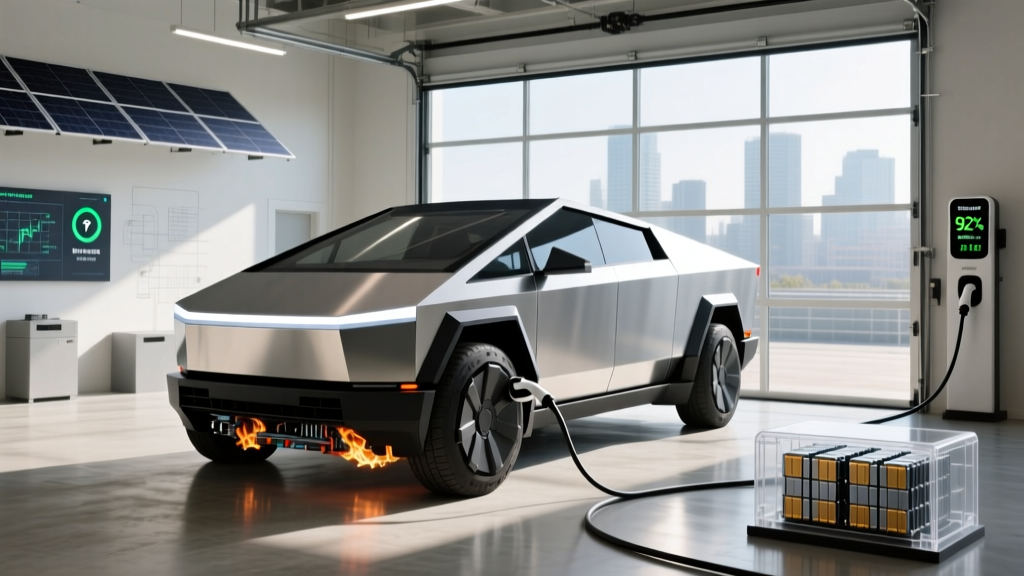
Let's address the keyword directly. A handful of Cybertruck fire incidents have been documented since late 2023. Here's what the data actually shows:
- Total documented thermal events: Fewer than a dozen publicly reported incidents through early 2026, out of an estimated 150,000+ Cybertrucks delivered.
- Context: NHTSA data consistently shows that EVs experience fires at a significantly lower rate per 100,000 vehicles than internal combustion engine vehicles. A National Highway Traffic Safety Administration analysis of fire incidents across all powertrains confirms ICE vehicles are orders of magnitude more likely to catch fire than BEVs.
- Causes in documented cases: Most reported Cybertruck thermal events trace to severe collision damage, aftermarket modifications, or charging equipment faults — not spontaneous battery failure.
- 4680 cell safety: Tesla's 4680 cells use a tabless design with improved thermal management. The structural battery pack is integrated into the vehicle floor, providing side-impact protection but making replacement more complex if damaged.
The Cybertruck has not yet received full IIHS crash-test ratings as of early 2026, partly due to its unconventional geometry and low production volume relative to mainstream vehicles. NHTSA has not published a 5-star safety rating for it either. This is a gap worth noting if crash-test validation is a priority for your purchase decision.
Pricing, Tax Credits, and the $80K Reality Check
The 2026 Cybertruck lineup is straightforward but expensive:
| Trim | Base MSRP | Federal §30D Credit Eligible? | Effective Price (if eligible) |
|---|---|---|---|
| RWD (est. late 2026) | $62,895 | Not eligible (truck MSRP cap is $80,000 — RWD may qualify pending final IRS guidance on classification) | ~$55,395 if eligible |
| AWD (Dual Motor) | $81,895 | No — exceeds $80,000 MSRP cap for trucks/vans/SUVs under §30D | $81,895 |
| Cyberbeast (Tri-Motor) | $101,895 | No — exceeds $80,000 MSRP cap | $101,895 |
This is a critical point that many Cybertruck reviews gloss over: the AWD and Cyberbeast trims do not qualify for the $7,500 federal EV tax credit under IRS §30D rules. The law caps eligible MSRP at $80,000 for trucks, vans, and SUVs. Both current Cybertruck trims exceed that threshold. The forthcoming RWD model at $62,895 may qualify, but buyers must also meet income caps ($150,000 single / $300,000 joint filer AGI) and the vehicle must satisfy critical-mineral and battery-component sourcing requirements. Always verify current eligibility at IRS.gov's clean vehicle credit page before purchasing.
Point-of-sale transfer of the credit (available since January 2024) allows eligible buyers to apply the $7,500 as a down-payment reduction at the dealer, but this only works if the vehicle itself qualifies — and currently, only the unreleased RWD trim is a candidate.
Interior, Tech, and Daily Livability
The Cybertruck's interior is minimalist in a way that divides buyers sharply. An 18.5-inch front touchscreen handles nearly all vehicle functions, with a 9.4-inch rear screen for passengers. There are no physical stalks for turn signals (they're buttons on the yoke-style steering wheel), no traditional instrument cluster, and no physical climate controls.
Passenger space: Front legroom is generous at approximately 41.5 inches. Rear legroom is tighter at roughly 38.4 inches — adequate for adults on shorter trips but not class-leading. The rear bench seats three, but the middle position is compromised by the floor hump created by the structural battery pack.
Cargo: The 6-foot bed offers ~67 cubic feet of volume with the motorized tonneau cover (which is lockable and supports 300 lbs of distributed weight). The front trunk (frunk) is a modest ~7 cubic feet — enough for a charging cable and a small bag. For comparison, the F-150 Lightning's Mega Power Frunk offers 14.1 cubic feet.
Standout tech:
- Steer-by-wire with variable ratio (fewer turns lock-to-lock at low speed)
- 48-volt electrical architecture (first in a production vehicle)
- Bioweapon Defense Mode (HEPA filtration)
- Onboard air compressor with bed and frunk outlets
- Powershare: 120V and 240V outlets in bed and cabin (up to 11.5 kW export — enough to run tools or back up a home circuit)
- Autopilot standard; Full Self-Driving (Supervised) available as a $8,000 add-on or $99/month subscription
Notable drawbacks:
- Stainless-steel body panels show fingerprints, smudges, and minor scuffs constantly
- No rear windshield wiper (visibility in rain relies on the camera system and aerodynamic airflow)
- Towing reduces range dramatically — expect 150–180 miles at max tow in real-world conditions
- Insurance premiums run 20–40% higher than comparable trucks due to repair costs on the stainless body
- Service center wait times for bodywork remain long in many markets
Warranty and Battery Longevity
Tesla provides the following warranty coverage for the Cybertruck:
- Basic Vehicle: 4 years / 50,000 miles
- Battery & Drive Units: 8 years / 120,000 miles (whichever comes first), with a minimum 70% capacity retention guarantee
- Corrosion: 12 years with no mileage limit (relevant for the stainless body, though stainless is inherently corrosion-resistant)
The 4680 NMC cells are expected to show degradation patterns similar to the 2170 NMC cells in the Model 3/Y Long Range — roughly 5–8% loss over the first 50,000 miles, then a slower linear decline. Real-world data from early Cybertruck owners (18+ months in) suggests 3–5% loss at 20,000 miles, which is within normal parameters. A full battery pack replacement, if needed out of warranty, is estimated at $15,000–$22,000 based on current Tesla service pricing for structural packs — though this figure will likely decrease as 4680 production scales.
Cybertruck vs. the Competition: Is It Worth Buying?
| Spec | Tesla Cybertruck AWD | Ford F-150 Lightning Ext. Range | Rivian R1T Dual-Motor | Chevy Silverado EV 4WT |
|---|---|---|---|---|
| EPA Range | 340 mi | 320 mi | 352 mi (Max Pack) | 492 mi (Max) |
| Base MSRP | $81,895 | $69,995 | $79,900 | $77,900 |
| Federal Credit Eligible? | No | Yes (select trims) | No (MSRP cap) | Yes (select trims) |
| 0–60 mph | 3.9 sec | ~5.0 sec | ~4.5 sec | ~5.4 sec |
| Max Tow | 11,000 lbs | 10,000 lbs | 11,000 lbs | 10,000 lbs |
| Bed Length | 6 ft | 5.5 ft | 4.5 ft (w/ tunnel) | 5 ft 11 in |
- You prioritize acceleration and tech-forward features over traditional truck ergonomics
- You live near Superchargers and value NACS-native charging
- You want vehicle-to-load (Powershare) capability for job sites or home backup
- You're comfortable with steer-by-wire and a yoke steering interface
- You need a conventional truck experience with a familiar cab layout
- Federal tax credit eligibility matters to your budget
- You value a larger frunk and more established dealer service network
- Off-road capability is a primary use case (R1T offers superior approach/departure angles)
- You prefer the Max Pack's 352-mile range
- You want a more refined interior with traditional controls
Who Should Buy the Cybertruck — and Who Shouldn't
Best for: Tech-enthusiast truck buyers who want maximum acceleration, NACS-native Supercharger access, and don't mind paying a premium over the MSRP cap. Job-site users who benefit from Powershare's 11.5 kW export. Early adopters comfortable with steer-by-wire and minimal physical controls.
Not ideal for: Budget-conscious buyers (the effective price after zero federal credit is steep). Fleet operators who need standardized service and parts availability. Anyone who tows frequently over long distances — 340 miles of EPA range drops to under 180 miles at max tow. Buyers who prioritize IIHS/NHTSA crash-test validation before purchasing.
Pros and Cons at a Glance
- 340-mile EPA range (best-in-class for standard pack)
- 250 kW DC fast charging with NACS native
- 2.6-sec 0–60 (Cyberbeast) — fastest truck available
- Powershare 11.5 kW vehicle-to-load
- Stainless body is dent- and corrosion-resistant
- Supercharger network access (most reliable U.S. DC network)
- $81,895+ MSRP — no federal tax credit on AWD/Cyberbeast
- Real-world highway range ~270–300 mi; towing range ~150–180 mi
- Steer-by-wire and yoke require adaptation
- No IIHS or NHTSA crash-test rating published yet
- Insurance premiums 20–40% above comparable trucks
- Stainless body panels show fingerprints and are costly to repair
Frequently Asked Questions
What is the real-world range of the Cybertruck?
The EPA rates the AWD Cybertruck at 340 miles. In real-world highway driving at 70 mph, expect 270–300 miles. In freezing weather with cabin heating, that drops to 230–260 miles. City driving with regenerative braking recovers closer to the EPA figure. Towing at or near the 11,000-lb maximum cuts range to approximately 150–180 miles.
How fast does the Cybertruck charge?
On a V3 Supercharger, the Cybertruck peaks at 250 kW and charges from 10–80% in approximately 28 minutes. The charge curve tapers significantly above 60% SoC. At home on a 48-amp Level 2 Wall Connector (11.5 kW), expect roughly 28–30 miles of range per hour, or a full 10–80% charge in about 7–8 hours.
Does the Cybertruck qualify for the federal EV tax credit?
The AWD ($81,895) and Cyberbeast ($101,895) trims do not qualify for the $7,500 federal §30D credit because they exceed the $80,000 MSRP cap for trucks. The forthcoming RWD trim at $62,895 may qualify, subject to buyer income limits ($150K single / $300K joint), critical-mineral sourcing requirements, and IRS classification. Verify at IRS.gov before purchasing.
Is the Cybertruck safe? What about fire risk?
EVs overall have a significantly lower fire incidence rate than ICE vehicles per NHTSA data. Documented Cybertruck thermal events are rare relative to units delivered, and most involve severe collision damage or aftermarket modifications. However, the Cybertruck does not yet have published IIHS or NHTSA crash-test ratings, which is a gap for safety-conscious buyers.
Is the Cybertruck worth buying versus the F-150 Lightning or Rivian R1T?
It depends on your priorities. If you want the fastest truck with native Supercharger access and vehicle-to-load capability, the Cybertruck is unmatched. If you need a lower effective price (the Lightning qualifies for the federal credit on select trims), a conventional cab layout, or established dealer service, the F-150 Lightning is more practical. The Rivian R1T wins on off-road geometry and interior refinement. None of these are wrong choices — they serve different buyers.
How much does it cost to charge a Cybertruck at home?
At the U.S. average residential electricity rate of ~$0.17/kWh (early 2026), charging the Cybertruck's ~123 kWh battery from 10% to 80% costs roughly $14.60. That delivers about 270 miles of real-world range — equivalent to roughly $0.054 per mile. Compare that to a gas truck at 17 MPG and $3.40/gallon, which costs about $0.20 per mile. Home charging saves approximately $4,000–$5,000 over 100,000 miles.