The Cybertruck Reality Check: Separating Viral Fails from Daily Ownership
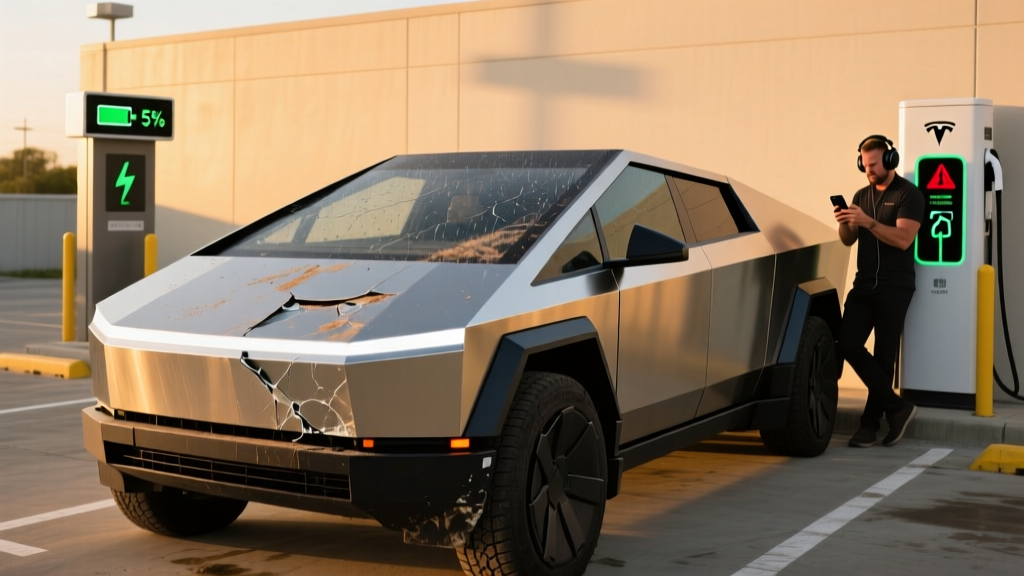
Search "Cybertruck fails" on any platform and you'll find a highlight reel: stuck door handles, misaligned panels, a stainless-steel exoskeleton that shows every fingerprint, and the occasional drive-unit replacement. Some of these issues are real engineering shortcomings; others are amplified by the internet's appetite for Tesla drama. As of the 2026 model year, the Cybertruck has been on sale for roughly two years, and enough ownership data now exists to separate chronic problems from one-off defects.
This review catalogs the most documented Cybertruck fails and reliability concerns, then puts them in context with hard specs — EPA range, charging speed, battery chemistry, pricing, and federal tax-credit eligibility — so you can decide whether the truck's strengths outweigh its growing pains.
| Spec | AWD (Dual-Motor) | Cyberbeast (Tri-Motor) |
|---|---|---|
| EPA Range | 340 miles | 320 miles |
| Battery (usable) | ~123 kWh, NMC | ~123 kWh, NMC |
| Max DC Fast Charge | 250 kW (V3 Supercharger) | 250 kW (V3 Supercharger) |
| 10–80% DC Charge Time | ~30 minutes | ~30 minutes |
| Level 2 Home Charging | 11.5 kW (~37 mi/hr) | 11.5 kW (~37 mi/hr) |
| 0–60 mph | 3.9 sec | 2.6 sec |
| Horsepower | 600 hp | 845 hp |
| Drivetrain | Dual-motor AWD | Tri-motor AWD |
| Towing Capacity | 11,000 lbs | 11,000 lbs |
| Efficiency | 2.0 kWh/mi (~100 MPGe) | 2.1 kWh/mi (~95 MPGe) |
| Base MSRP | $79,990 | $99,990 |
| Battery/Drive Unit Warranty | 8 yr / 120,000 mi | 8 yr / 120,000 mi |
Documented Cybertruck Fails: The Most Common Complaints
Based on NHTSA complaint filings, owner forums, and service-center reports through early 2026, the following issues appear with enough frequency to be considered patterns rather than isolated incidents:
1. Electronic Door-Handle and Window Failures
The Cybertruck uses fully electronic door releases (no mechanical backup handle on early builds). Multiple owners have reported doors that fail to unlatch after a software update, a 12V battery dropout, or moisture ingress. Tesla issued a service bulletin addressing the actuator firmware, but some 2024-build trucks required full handle replacement. Later 2025–2026 builds added a secondary mechanical release cable, reducing but not eliminating the complaint rate.
2. Steer-by-Wire Calibration Drift
The Cybertruck is the first high-volume Tesla to use a fully steer-by-wire system with no mechanical column. Some owners report intermittent dead zones or a "notchy" feel after hard cornering or after the truck sits in extreme cold. Tesla has pushed several over-the-air (OTA) calibration updates, but a small percentage of units have required rack replacement under warranty.
3. Stainless-Steel Panel Alignment and Corrosion Spotting
The 30X cold-rolled stainless panels are welded and bonded differently from conventional stamped steel. Early trucks showed visible panel gaps exceeding 4 mm in places, and some coastal-state owners have reported superficial surface rust spots (tea-staining) where iron particles from brake dust embed in the passive oxide layer. Tesla's service centers polish these out, but it's a maintenance item many buyers didn't anticipate on a "stainless" vehicle.
4. Drive-Unit and Half-Shaft Failures on Cyberbeast
The tri-motor Cyberbeast puts 845 hp through a relatively compact rear drive unit. A handful of high-mileage and drag-strip-use owners have reported rear drive-unit replacements and half-shaft CV joint failures. Tesla's warranty covers these for 8 years / 120,000 miles, but the downtime (often 2–4 weeks for parts) has frustrated performance-oriented buyers.
5. Tonneau Cover and Vault Seal Leaks
The powered tonneau cover on the 6-foot bed ("vault") has been a source of water intrusion complaints. Several owners documented leaks at the tailgate seal during heavy rain or car-wash use. Tesla revised the seal profile in late 2025 production, but pre-revision trucks may need a retrofit.
Real-World Range: What the EPA Sticker Doesn't Tell You
EPA Estimated Range: 340 miles (AWD) / 320 miles (Cyberbeast)
Real-World Expectation: Expect 270–300 miles on a mixed highway trip at 70–75 mph in fair weather. In cold weather (below 32°F), range drops 20–30%, putting realistic winter highway range at roughly 210–250 miles for the AWD model. The Cybertruck's 2.0 kWh/mi efficiency is poor by EV standards — blame the 6,800+ lb curb weight, tall frontal area, and angular aero profile.
For context, the EPA's fueleconomy.gov listing confirms the combined efficiency figure. If you regularly tow, expect range to halve — roughly 150–170 miles at highway speeds with a 5,000-lb trailer, based on third-party towing tests. This is a critical limitation for road-trippers and trailer users.
Charging Speed: 250 kW Peak, But the Curve Tells the Real Story
The Cybertruck charges on Tesla's V3 Supercharger network at a peak rate of 250 kW. However, that peak is sustained only between roughly 10–35% state of charge (SoC). By 50% SoC, the rate tapers to approximately 150 kW, and above 80% it drops below 60 kW. This charge-curve behavior is standard for NMC lithium-ion packs but is worth understanding for trip planning.
| Charging Level | Power (kW) | Speed (miles/hr added) | Typical Use Case |
|---|---|---|---|
| Level 1 (120V outlet) | 1.4 kW | ~3 mi/hr | Emergency / trickle only |
| Level 2 (240V, 48A) | 11.5 kW | ~37 mi/hr | Home overnight charging |
| DC Fast (V3 Supercharger) | Up to 250 kW | ~750 mi/hr at peak | Road trips; 10–80% in ~30 min |
At home on a Wall Connector (11.5 kW), a full charge from 10% takes roughly 11 hours. Most owners charging overnight from 30–80% will add about 185 miles in 5 hours — sufficient for most daily needs. For road trips, the 10–80% time of approximately 30 minutes is competitive with the Ford F-150 Lightning (which charges at up to 150 kW on its extended-range pack but has a smaller battery).
Preconditioning note: Navigate to a Supercharger using the truck's built-in navigation, and the battery thermal management system will warm or cool the pack to optimize charge speed. Skipping preconditioning in cold weather can add 10–15 minutes to your charging stop.
Pricing, Trims, and Federal Tax Credit Eligibility
| Trim | Base MSRP | As-Tested (typical options) | §30D Federal Tax Credit |
|---|---|---|---|
| AWD (Dual-Motor) | $79,990 | $83,000–$88,000 | Not eligible (MSRP exceeds $80,000 truck cap) |
| Cyberbeast (Tri-Motor) | $99,990 | $103,000–$110,000 | Not eligible (MSRP exceeds $80,000 truck cap) |
Under current IRS §30D rules, new electric trucks must have an MSRP at or below $80,000 to qualify for the up-to-$7,500 federal tax credit. The Cybertruck AWD starts at $79,990 — technically under the cap — but once any factory option or destination fee pushes the adjusted MSRP above $80,000, eligibility is lost. As currently configured on Tesla's order page, both trims typically exceed the threshold. Additionally, §30D imposes buyer income caps ($300,000 joint / $150,000 single for new vehicles) and battery critical-mineral sourcing requirements that further narrow eligibility.
Bottom line: Most Cybertruck buyers should not count on the federal tax credit. Consult a tax professional and verify current-year rules on the IRS website before purchasing.
Interior, Cargo, and Practicality
The Cybertruck seats five (a front bench seat option was briefly available on 2024 models but has since been discontinued, leaving a standard front-row two-seat configuration with a center console). Rear legroom measures approximately 38 inches — adequate for adults on shorter trips but tighter than a Rivian R1T or F-150 Lightning due to the sloping roofline.
The 6-foot bed ("vault") offers 67 cubic feet of lockable storage with the tonneau closed. The front trunk (frunk) provides roughly 7 cubic feet — enough for a charging cable bag and a small duffel. Total payload capacity is approximately 2,500 lbs, and the 11,000-lb max tow rating is competitive with the class.
Notable interior drawbacks include the lack of physical buttons (nearly everything routes through the 18.5-inch center touchscreen), no Apple CarPlay or Android Auto support, and a rear-view camera that replaces a traditional rearview mirror — an adjustment that divides owners.
Driver Assistance: Autopilot and FSD (Supervised)
SAE Automation Level: Level 2
Tesla's Autopilot and Full Self-Driving (Supervised) are driver-assistance systems, not autonomous driving. The driver must remain attentive, keep hands on the yoke (or steering wheel), and be prepared to take over at any moment. FSD (Supervised) costs $8,000 as a one-time purchase or $99/month as of 2026 and adds features like automated lane changes, traffic-light recognition, and city-street navigation — but it does not eliminate the need for an engaged driver.
Real-world FSD performance in the Cybertruck is broadly similar to other Tesla models: competent on well-marked highways, occasionally hesitant in construction zones, and prone to phantom braking on shadowed roads. The steer-by-wire system introduces slightly different feedback characteristics compared to Tesla's column-assist vehicles, which some drivers find less confidence-inspiring during FSD use.
Who Should Buy the Cybertruck — And Who Shouldn't
Pros
- Class-leading acceleration (2.6 sec 0–60 Cyberbeast)
- 11,000-lb tow rating with integrated trailer brake controller
- Stainless-steel exoskeleton resists dents; lockable vault bed
- Access to Tesla Supercharger network (17,000+ stalls in North America)
- OTA updates continuously add features
- 8 yr / 120,000 mi battery and drive-unit warranty
Cons
- Efficiency is poor: 2.0 kWh/mi means high charging costs on road trips
- Real-world range drops sharply when towing or in cold weather
- Does not qualify for the $7,500 federal tax credit in most configurations
- Steer-by-wire and electronic door handles have documented failure modes
- No CarPlay/Android Auto; touchscreen-only controls frustrate some drivers
- Panel alignment and surface spotting require more maintenance than expected
Choose the Cybertruck if: You prioritize performance and tech over efficiency, you want the Supercharger network for road trips, you value the lockable vault for gear security, and you accept that early-production EVs carry higher service-visit risk.
Choose a competitor (Rivian R1T, F-150 Lightning, Chevy Silverado EV) if: You need maximum real-world range, you tow frequently and want better towing efficiency, you want a more traditional truck interior with physical controls, or you need a vehicle with a longer track record of reliability.
Frequently Asked Questions
What is the real-world range of the Cybertruck?
The EPA rates the AWD at 340 miles and the Cyberbeast at 320 miles. In real-world highway driving at 70–75 mph, expect 270–300 miles in mild weather and 210–250 miles in freezing temperatures. Towing cuts range roughly in half.
How fast does the Cybertruck charge at home and on the road?
On a home Level 2 charger (11.5 kW / 48A), the Cybertruck adds approximately 37 miles of range per hour, or a full overnight charge in about 11 hours. On a V3 Supercharger (250 kW peak), 10–80% takes approximately 30 minutes, though the charge curve tapers significantly above 50% SoC.
Does the Cybertruck qualify for the $7,500 federal EV tax credit?
In most configurations, no. The §30D credit requires trucks to have an MSRP at or below $80,000. While the AWD base MSRP is $79,990, destination fees and options typically push it over the cap. Buyer income limits and battery-sourcing requirements further restrict eligibility. Verify current rules at irs.gov.
What are the most common Cybertruck reliability problems?
The most documented issues through early 2026 include electronic door-handle failures, steer-by-wire calibration drift, stainless-steel panel surface spotting, rear drive-unit failures on Cyberbeast models, and tonneau-cover water leaks. Tesla has addressed several via OTA updates and service bulletins, but some require hardware replacement.
Is the Cybertruck worth buying vs. the Rivian R1T or F-150 Lightning?
The Cybertruck wins on acceleration, tech integration, and Supercharger access. The Rivian R1T offers a more refined interior, better efficiency, and a quad-motor option. The F-150 Lightning provides a more traditional truck experience, better towing range, and broader tax-credit eligibility. Your priority — performance vs. practicality vs. proven reliability — should drive the choice.
How long is the Cybertruck's battery warranty?
Tesla covers the battery and drive units for 8 years or 120,000 miles, whichever comes first, with a minimum 70% capacity retention threshold. This is slightly more generous in mileage than the standard Tesla 8 yr / 100,000 mi warranty on sedans, reflecting the truck's intended use case.
Can the Cybertruck's battery chemistry affect longevity?
The Cybertruck uses an NMC (nickel-manganese-cobalt) chemistry, which offers higher energy density than LFP (lithium iron phosphate) but is more sensitive to sustained high SoC and extreme heat. For maximum longevity, Tesla recommends daily charging to 80–90% and only charging to 100% before long trips. NMC packs in Tesla vehicles historically show 10–15% degradation over 150,000 miles based on fleet data.
Final Verdict: A Polarizing Truck With Real Trade-Offs
The "Cybertruck fails" narrative is neither entirely hype nor entirely fair. The truck has genuine engineering growing pains — steer-by-wire, electronic door handles, and a novel stainless-steel body all introduce failure modes that conventional trucks don't have. At the same time, it delivers performance, charging infrastructure access, and utility that no other EV truck currently matches in a single package.
For buyers who understand the trade-offs — poor efficiency, no tax credit, higher service-visit probability, and cold-weather range loss — the Cybertruck remains a compelling, if polarizing, choice. For buyers who prioritize reliability track records and maximum range per dollar, the Rivian R1T or F-150 Lightning are safer bets in 2026.