The Aerodynamics Paradox: Why Cybertruck's Drag Coefficient Matters
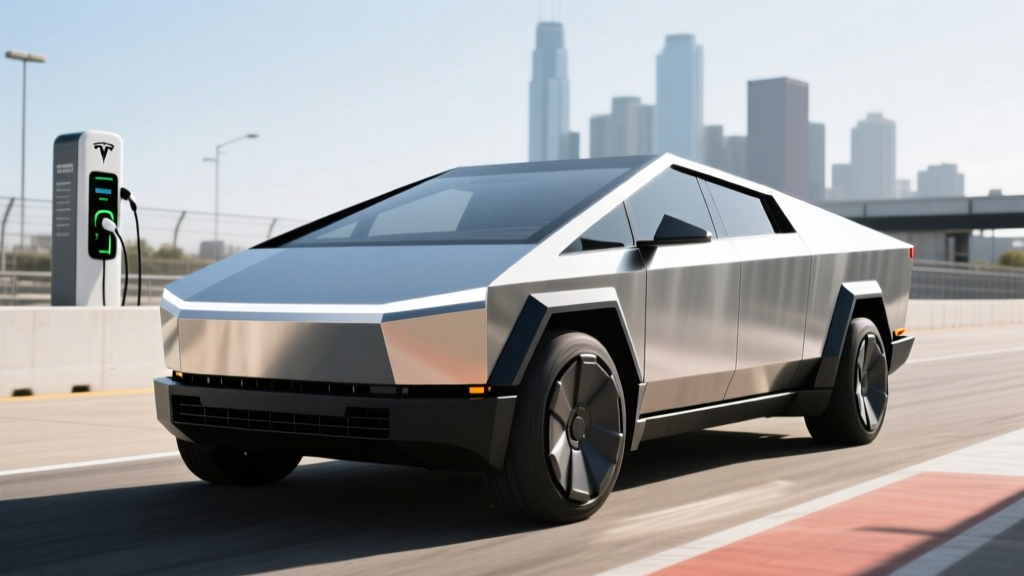
When Tesla unveiled the Cybertruck, its brutalist stainless-steel exoskeleton looked like it would punch holes through the air rather than slip past it. Yet beneath those flat panels and sharp creases lies a carefully engineered aerodynamic profile that directly determines how far this 6,900-pound electric truck can travel on a single charge. The Cybertruck drag coefficient (Cd) is a number that deserves serious scrutiny from any prospective buyer, because in an EV, aerodynamic drag is the single largest consumer of energy at highway speeds.
Tesla has published a drag coefficient of approximately 0.335 for the Cybertruck AWD and Cyberbeast trims. For context, that sits between the Ford F-150 Lightning (Cd ~0.36) and the Rivian R1T (Cd ~0.30). It's a remarkable figure given the truck's visual bulk, achieved through design tricks that aren't obvious at first glance: an active adaptive air suspension that lowers the body at speed, a motorized tonneau cover that creates a sealed bed, and carefully sculpted underbody panels that manage airflow beneath the chassis.
But drag coefficient alone doesn't tell the full story. What matters for your wallet and your road-trip planning is the total aerodynamic drag, which is Cd multiplied by frontal area. The Cybertruck's frontal area is large — estimated at roughly 38 square feet — meaning its total drag area (CdA) is approximately 12.7 sq ft. That's competitive with other electric trucks but still significantly higher than a Tesla Model Y (CdA ~6.8 sq ft), which explains why the Cybertruck consumes far more energy per mile despite Tesla's powertrain efficiency advantages.
| Spec | Value |
|---|---|
| EPA Range | 340 miles (AWD) / 320 miles (Cyberbeast) |
| Battery (usable) | ~123 kWh (NMC chemistry) |
| Efficiency | 79 MPGe combined / 43 kWh/100 mi (AWD) |
| Drag Coefficient (Cd) | ~0.335 |
| Peak DC Fast Charge | 250 kW |
| 10–80% DC Charge Time | ~28 minutes (preconditioned) |
| Level 2 Home Charging | 11.5 kW (~34 mi/hr) |
| 0–60 mph | 3.9 sec (AWD) / 2.6 sec (Cyberbeast) |
| Horsepower | 600 hp (AWD) / 845 hp (Cyberbeast) |
| Drivetrain | Dual-motor AWD / Tri-motor AWD |
| Towing Capacity | 11,000 lbs |
| Battery/Powertrain Warranty | 8 years / 120,000 miles |
| Base MSRP | $79,990 (AWD) / $99,990 (Cyberbeast) |
Real-World Range: What the EPA Sticker Doesn't Tell You
EPA estimated: 340 miles (AWD, 20" wheels)
Real-world highway (70 mph, 75°F): ~270–290 miles
Real-world highway (32°F, no heat pump benefit): ~220–250 miles
Real-world towing (5,000-lb trailer): ~150–175 miles
The EPA's combined-cycle test blends city and highway driving, and the Cybertruck's regenerative braking recovers meaningful energy in stop-and-go conditions. On the highway, where regen provides no benefit and aerodynamic drag dominates, the energy consumption rises sharply. According to fueleconomy.gov, the Cybertruck AWD is rated at 79 MPGe combined, which translates to approximately 43 kWh per 100 miles — a substantial figure that reflects both the truck's mass and its aero profile.
At 75 mph on a flat interstate in moderate temperatures, expect to see consumption closer to 48–52 kWh/100 mi, which yields roughly 270–290 miles from the ~123 kWh usable battery pack. In cold weather (below 40°F), battery resistance increases, cabin heating draws power, and air density rises (increasing drag), compounding range loss to 25–35%. The Cybertruck is equipped with a heat pump for cabin and battery thermal management, which mitigates some cold-weather loss compared to resistive heating, but physics is unforgiving to a vehicle with this much frontal area.
The Cyberbeast trim, with its tri-motor setup, wider 35" tires, and 320-mile EPA rating, will see slightly worse real-world highway numbers due to increased rolling resistance and the additional drivetrain mass, though the third motor's efficiency under load partially offsets this on hilly terrain.
Charging Speed: 250 kW Peak, but Mind the Curve
The Cybertruck supports a peak DC fast-charge rate of 250 kW on Tesla's V3 and V4 Superchargers using the native NACS connector. Tesla claims a 10–80% charge in approximately 28 minutes when the battery is properly preconditioned — and preconditioning matters enormously here.
Preconditioning warms the battery pack to its optimal charging temperature (typically 95–110°F at the cell level) before you arrive at the charger. The Cybertruck's navigation system initiates this automatically when you route to a Supercharger. Without preconditioning — for example, if you pull into a charger with a cold-soaked battery on a winter morning — peak charge rates may be limited to 50–80 kW for the first several minutes until the thermal management system catches up.
| Charging Level | Power / Rate | Miles Added per Hour | Notes |
|---|---|---|---|
| Level 1 (120V / 12A) | ~1.4 kW | ~3 mi/hr | Emergency/trickle only; 100+ hrs for full charge |
| Level 2 (240V / 48A) | 11.5 kW | ~34 mi/hr | Full charge in ~11 hrs; recommended home setup |
| DC Fast (V3 Supercharger) | Up to 250 kW | ~150 mi in 15 min | Peak rate; tapers above 60% SoC |
| DC Fast (V4 Supercharger) | Up to 250 kW | ~150 mi in 15 min | Same peak; improved cable management |
The charge curve is where real-world experience diverges from marketing. The Cybertruck sustains its peak 250 kW rate only in a narrow state-of-charge window — roughly 10–35% SoC. From 35–60%, rates taper to approximately 150–180 kW. Above 60%, the curve steepens further, dropping to 80–100 kW through 80%, and below 40 kW above 90%. This is normal for NMC lithium-ion chemistry, but it means the "28-minute" 10–80% figure is an average, not a sustained rate. If you're road-tripping and charging from 20–80% at each stop, plan for 25–35 minutes per session including plug-in and payment time.
For home charging, the Cybertruck's onboard charger accepts up to 11.5 kW on a 240V/48A circuit. A full charge from near-empty takes approximately 11 hours, which is practical for overnight replenishment. Installation of a Tesla Wall Connector on a dedicated 60A circuit typically costs $500–$1,500 for the equipment and electrician labor, depending on panel proximity and whether your home's electrical service requires an upgrade to 200A.
How the Angular Design Tricks the Wind
Understanding the Cybertruck's drag coefficient requires looking past the angular aesthetic. Several features contribute to a Cd that's better than its silhouette suggests:
- Active air suspension: At highway speeds, the Cybertruck lowers by approximately 1.5 inches in its default ride height, reducing the gap between the body and the road and limiting turbulent airflow underneath. The underbody is fully paneled, creating a smoother air path.
- Motorized tonneau cover: The powered bed cover (standard on all trims) seals the bed, preventing the low-pressure wake that an open bed creates. An open pickup bed can increase drag by 5–10%; the Cybertruck's cover eliminates this penalty when closed.
- Flat underbody panels: The structural battery pack serves double duty as a smooth aerodynamic floor, eliminating the protrusions and cross-members typical of body-on-frame trucks.
- Flush door handles and minimal panel gaps: The stainless-steel exoskeleton's tight tolerances reduce surface turbulence compared to traditional truck body seams.
- Angled windshield header: Despite the flat-glass appearance, the windshield is raked at an angle that manages airflow separation over the roof.
The trade-offs are real, however. The flat side windows generate more wind noise than curved glass at speeds above 70 mph — something you'll notice on long highway drives. And the sharp rear edge of the bed creates a clean separation point for airflow, but it also means there's no rear window in the traditional sense; the tonneau cover and a camera system replace rearward visibility.
Performance, Efficiency, and the Cost of Aero
The Cybertruck AWD's dual-motor setup produces 600 horsepower and rockets from 0–60 mph in 3.9 seconds. The Cyberbeast's tri-motor configuration (one front, two rear) delivers 845 horsepower and a 2.6-second 0–60 time — figures that would have seemed absurd for a production pickup truck just five years ago. The 48-volt electrical architecture enables faster motor response and more efficient power delivery than traditional 12V systems.
But performance and efficiency exist in tension. The Cybertruck's 43 kWh/100 mi combined efficiency means you're paying roughly $0.13–$0.17 per mile to drive it (depending on your electricity rate), compared to $0.04–$0.05 per mile for a Tesla Model 3 Long Range. Over 15,000 miles per year, that's an annual energy cost of approximately $1,950–$2,550 for the Cybertruck versus $600–$750 for a more efficient EV. The drag coefficient and frontal area are the primary reasons.
For buyers who need truck capability — the 11,000-lb towing capacity, the 6-foot bed, the 2,500-lb payload — this efficiency penalty is the cost of admission. For buyers who want a fast, distinctive daily driver without regular truck use, the math is less compelling compared to a Model X or even a Rivian R1T, which offers similar capability with slightly better highway efficiency (Cd ~0.30, though with a smaller battery).
Pricing, Tax Credits, and What You'll Actually Pay
| Trim | Base MSRP | §30D Credit Eligibility | Effective Price (if eligible) |
|---|---|---|---|
| AWD | $79,990 | Not eligible (MSRP exceeds $80,000 truck cap) | $79,990 |
| Cyberbeast | $99,990 | Not eligible (MSRP exceeds $80,000 truck cap) | $99,990 |
This is where many Cybertruck shoppers encounter a painful reality. Under current IRS §30D rules, the federal EV tax credit provides up to $7,500 for qualifying new EVs — but the credit is subject to strict MSRP caps. For vans, SUVs, and pickup trucks, the cap is $80,000. The Cybertruck AWD starts at $79,990, which is technically under the cap, but once you add destination charges and any options, the vehicle typically exceeds $80,000, rendering it ineligible. The Cyberbeast at $99,990 is well above the threshold.
Additionally, §30D eligibility requires the buyer to meet income caps ($150,000 single / $300,000 joint MAGI), and the vehicle's battery must satisfy critical-mineral and battery-component sourcing requirements that have tightened progressively through 2025–2026. Always verify current eligibility on IRS.gov before relying on the credit in your purchase decision. The point-of-sale transfer option (allowing the credit to be applied as a down-payment reduction at the dealer) is available for qualifying vehicles, but the Cybertruck's MSRP situation makes this largely moot for most configurations.
State and local incentives may partially offset the cost. States like Colorado, California, and others offer their own EV rebates or tax credits that may apply regardless of the federal MSRP cap — but these vary by jurisdiction and change frequently. Consult your state's energy office or a tax professional for current availability.
Cargo, Passenger Space, and Daily Practicality
The Cybertruck's dimensions create an interesting practicality profile. The 6-foot bed offers approximately 42 cubic feet of lockable storage under the tonneau cover, with an additional 15 cubic feet in the front trunk (frunk). The bed's motorized cover supports up to 300 lbs of distributed weight and can be operated from the cabin touchscreen or the Tesla app.
Inside, the cabin seats five with a 60/40 split rear bench. Front legroom measures approximately 41.5 inches, while rear legroom is tighter at around 38 inches — adequate for adults on shorter trips but less generous than the F-150 Lightning's rear seat. The 18.5-inch center touchscreen handles all infotainment, climate, and vehicle controls, and the yoke-style steering wheel (standard, with a round wheel available as a no-cost option) takes some acclimation.
The air suspension provides up to 16 inches of ground clearance in Off-Road mode and can lower to approximately 7 inches for highway driving or garage entry. Approach and departure angles are competitive for the segment, and the stainless-steel body panels resist dents and scratches better than painted aluminum — though fingerprints and smudges are a constant maintenance reality.
Notable drawbacks include the lack of a traditional rear window (replaced by a camera feed on the display), the yoke steering's learning curve for low-speed maneuvering, and the fact that the Cybertruck's width (approximately 80 inches without mirrors) makes it challenging in tight parking structures and narrow urban streets.
Driver Assistance and Standout Technology
The Cybertruck comes equipped with Tesla's Autopilot suite as standard, which includes adaptive cruise control, lane-keeping assist, and automatic emergency braking. Full Self-Driving (Supervised) is available as a $8,000 add-on or $99/month subscription, adding features like automatic lane changes, navigation-guided on-ramp to off-ramp driving, and traffic-light recognition.
Tesla Autopilot and FSD (Supervised) are SAE Level 2 driver-assistance systems. The driver must remain fully engaged, hands on the yoke (or wheel), and eyes on the road at all times. These are NOT self-driving systems. Tesla's camera-only vision approach provides robust lane-keeping and adaptive cruise, but the driver is legally and practically responsible for all vehicle operation.
Unique technology features include steer-by-wire (eliminating the mechanical connection between the yoke and the wheels, enabling variable steering ratios), four-wheel steering for tighter low-speed turns, and Powershare — Tesla's vehicle-to-load (V2L) and vehicle-to-home (V2H) capability that can output up to 11.5 kW of AC power to run tools, appliances, or even back-feed a home during an outage.
The Armor Glass windshield and side windows are designed for impact resistance (though early-production units had documented quality issues with optical distortion that Tesla has addressed in subsequent builds). The bioweapon defense mode HEPA filtration system is standard, and the vehicle's 48V architecture supports higher-power accessories without the voltage-drop issues common in 12V systems.
Warranty, Ownership Costs, and Long-Term Outlook
Tesla covers the Cybertruck's battery and drive units with an 8-year / 120,000-mile warranty (whichever comes first), with a capacity retention threshold of 70% — meaning Tesla will repair or replace the battery if it degrades below 70% of original capacity within the warranty period. The vehicle's basic limited warranty covers 4 years / 50,000 miles.
The Cybertruck's NMC battery pack is expected to retain approximately 85–90% of its original capacity after 100,000 miles based on degradation data from Tesla's other NMC-equipped vehicles (Model 3 Long Range, Model S/X). The ~123 kWh pack's replacement cost, should it be needed out of warranty, is estimated at $15,000–$22,000 based on current battery pricing and labor — a significant but not catastrophic figure relative to the vehicle's purchase price.
Insurance premiums for the Cybertruck run 20–40% higher than comparable trucks due to repair costs for the stainless-steel body panels, the specialized nature of the steer-by-wire system, and the vehicle's high performance. Expect annual premiums of $3,000–$4,500 depending on your location, driving record, and coverage level.
Pros, Cons, and Who Should Buy the Cybertruck
Pros
- Competitive Cd (0.335) for a full-size truck, aided by active suspension and sealed bed
- Class-leading acceleration (2.6s Cyberbeast) and 11,000-lb towing
- Stainless-steel exoskeleton resists dents; no paint to chip or fade
- Access to Tesla Supercharger network (now NACS-standard across the industry)
- Powershare V2L/V2H capability (11.5 kW output)
- Steer-by-wire and four-wheel steering for surprising agility
- Over-the-air updates continuously add features
Cons
- Real-world highway range significantly below EPA (270–290 mi vs 340 mi)
- Likely ineligible for $7,500 federal tax credit due to MSRP caps
- High energy consumption (43 kWh/100 mi) means costly charging vs smaller EVs
- Rear visibility relies entirely on cameras — no rear window
- Insurance premiums 20–40% above segment average
- Yoke steering divisive; round wheel availability limited
- Build quality inconsistencies in early production units
- 250 kW peak charge rate trails competitors like the F-150 Lightning (no 800V architecture)
Who Should Buy the Cybertruck
Choose the Cybertruck if: You need genuine truck capability (towing, payload, off-road clearance), you want access to the Tesla Supercharger network, you value the stainless-steel body's durability, and you can charge at home to minimize the impact of high energy consumption. The Cyberbeast appeals to performance-truck buyers who want sports-car acceleration in a utility vehicle.
Look elsewhere if: Your primary need is daily commuting efficiency (a Model Y or Ioniq 5 will cost far less per mile), you need the $7,500 federal tax credit to make the math work, you regularly carry rear-seat passengers who need generous legroom, or you're uncomfortable relying on camera-based rear visibility. The Rivian R1T offers a more conventional truck experience with competitive range, and the F-150 Lightning provides more interior space at a lower starting price.
Frequently Asked Questions
What is the Cybertruck's drag coefficient, and how does it compare?
The Cybertruck has a published drag coefficient (Cd) of approximately 0.335. This is better than the Ford F-150 Lightning (~0.36) but slightly worse than the Rivian R1T (~0.30). However, the Cybertruck's large frontal area means its total drag area (CdA ~12.7 sq ft) is comparable to other full-size trucks and significantly higher than aerodynamic passenger EVs.
What is the real-world range of the Cybertruck?
The EPA rates the Cybertruck AWD at 340 miles and the Cyberbeast at 320 miles. In real-world highway driving at 70 mph in moderate temperatures, expect approximately 270–290 miles. In cold weather (below 40°F), range drops to roughly 220–250 miles due to increased air density, battery resistance, and cabin heating demands. Towing a 5,000-lb trailer reduces range to approximately 150–175 miles.
How fast does the Cybertruck charge?
On a V3 or V4 Tesla Supercharger, the Cybertruck peaks at 250 kW and can add approximately 150 miles of range in 15 minutes (with preconditioning). A full 10–80% charge takes about 28 minutes. At home on a Level 2 (240V/48A) charger, it adds roughly 34 miles per hour, with a full charge taking approximately 11 hours.
Does the Cybertruck qualify for the federal EV tax credit?
Under current IRS §30D rules, the Cybertruck AWD at $79,990 base MSRP is technically under the $80,000 truck cap, but destination charges and options typically push it over, making it ineligible. The Cyberbeast at $99,990 exceeds the cap outright. Additionally, buyer income limits ($300,000 joint / $150,000 single) and battery-sourcing requirements apply. Always verify on IRS.gov before purchasing.
Is the Cybertruck worth buying vs the F-150 Lightning or Rivian R1T?
The Cybertruck wins on acceleration, Supercharger network access, and stainless-steel durability. The F-150 Lightning wins on interior space, conventional truck familiarity, and lower pricing with tax-credit eligibility on most trims. The Rivian R1T wins on build quality, off-road capability (quad-motor), and a slightly better drag coefficient. Your choice depends on which trade-offs matter most for your use case.
What battery chemistry does the Cybertruck use?
The Cybertruck uses NMC (nickel manganese cobalt) lithium-ion cells in its ~123 kWh usable battery pack. NMC offers higher energy density than LFP (lithium iron phosphate), which is important for fitting sufficient range into the truck's package, but it requires more careful thermal management and typically has a slightly shorter cycle life than LFP. Tesla's battery warranty covers degradation below 70% for 8 years or 120,000 miles.
How much does it cost to charge a Cybertruck?
At the national average residential electricity rate of approximately $0.16/kWh, a full home charge costs roughly $19.70 (123 kWh × $0.16). On Tesla Superchargers (average $0.30–$0.40/kWh), a full charge costs $37–$49. Annual energy cost for 15,000 miles of mixed driving is approximately $1,950–$2,550, depending on your charging mix and local rates.