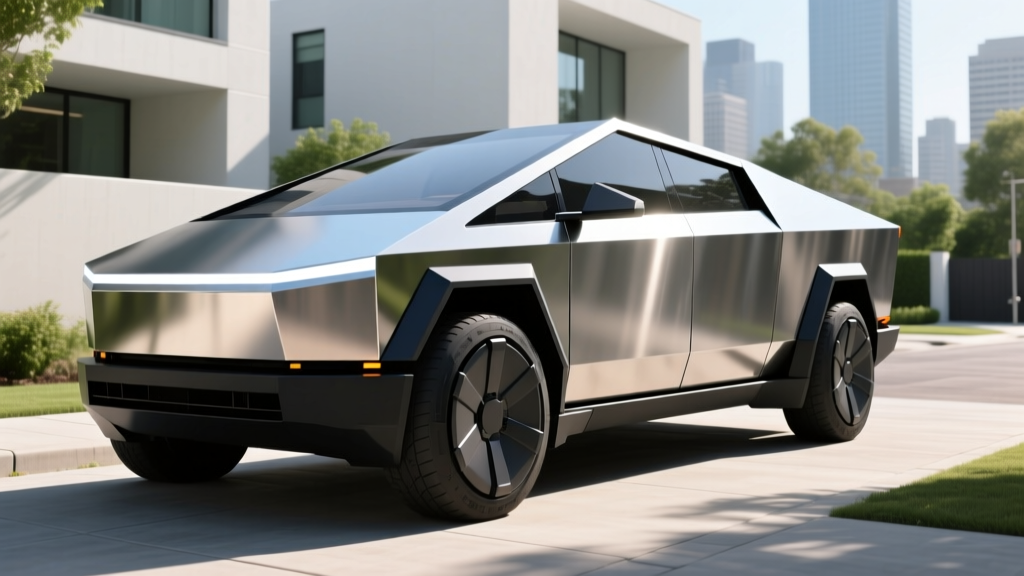
The Tesla Cybertruck's angular stainless-steel exoskeleton grabs headlines, but it's the Cybertruck doors — their powered operation, unique actuation, and real-world reliability — that owners interact with dozens of times a day. In this comprehensive review, we examine the truck's door system in detail while delivering the full spec breakdown buyers need: EPA range, charging speed, battery chemistry, pricing, and whether the Cybertruck still qualifies for the federal EV tax credit in 2026.
Cybertruck Doors: Powered Actuation and Design Deep Dive
Unlike any other production pickup, the Cybertruck uses fully powered, electronically actuated doors with no traditional exterior handles. Instead, a small recessed button on each door pillar triggers an electric motor that pushes the door outward, after which the occupant pulls it open manually. Interior release is via a thumb-press button on the door panel.
This design choice serves the truck's minimalist aesthetic and eliminates handle mechanisms that could ice up or break. But it introduces complexity: each door relies on a 12V auxiliary system and the main traction battery for operation. In the event of a total electrical failure, Tesla includes a manual emergency release cable accessible from inside the cabin, though reaching it requires knowing its location before an emergency occurs.
Owner forums and early recall data have flagged some concerns. In 2024, Tesla issued a recall for the electronic door-latch system after reports that doors could unlatch unexpectedly or fail to open after a crash. Software updates addressed most issues, but the powered-door design remains a polarizing choice — convenient when it works, problematic when electronics misbehave. As of early 2026, Tesla has refined the actuation software and strengthened the latch mechanism on newer production units.
EPA Range and Real-World Efficiency
EPA Range (Cyberbeast AWD): 320 miles
Real-World Expectation: Plan for ~270–300 miles on highway trips at 70 mph; cold-weather (below 30°F) can reduce range by 20–30%, dropping effective range to ~220–260 miles depending on cabin heating use. The stainless-steel body adds mass and the angular shape creates a higher drag coefficient (~0.38 Cd) than sleeker EVs, which penalizes highway efficiency.
The Cybertruck's efficiency lands at approximately 2.0–2.2 kWh/mile (roughly 56–60 MPGe combined, per fueleconomy.gov). That's significantly less efficient than a Model Y or even the Rivian R1T. The stainless-steel panels, 6,600+ lb curb weight, and boxy aerodynamics all contribute. For daily commuting under 60 miles round-trip, range is a non-issue. For road trips, expect to stop more often than in a lighter, more aerodynamic EV.
Battery, Chemistry, and Charging Specs
| Specification | Dual Motor AWD | Cyberbeast (Tri-Motor) |
|---|---|---|
| Battery Capacity (usable) | ~123 kWh | ~123 kWh |
| Chemistry | NMC (nickel manganese cobalt) | NMC |
| Architecture | 800V | 800V |
| Max DC Fast-Charge Rate | 350 kW (peak) | 350 kW (peak) |
| 10–80% DC Fast Charge | ~27 minutes | ~27 minutes |
| Level 2 Home Charging | 11.5 kW (~44 mi/hr) | 11.5 kW (~44 mi/hr) |
| Connector | NACS (native Tesla) | NACS (native Tesla) |
The Cybertruck uses Tesla's 4680-format cells in a structural battery pack with NMC chemistry. Unlike Tesla's LFP-equipped Model 3 RWD, the Cybertruck's high energy demands require NMC's superior energy density. The 800V architecture enables the 350 kW peak charge rate, though sustained rates taper significantly above 60% state of charge — expect the charge curve to drop to ~150 kW by 70% SoC and below 50 kW past 85%. This taper is normal physics for large NMC packs protecting cell longevity.
At home on a Level 2 Tesla Wall Connector (48A/11.5 kW), a full charge from 10% takes approximately 11–12 hours. For most owners, plugging in overnight delivers more than enough daily range. The native NACS connector means seamless access to the entire Tesla Supercharger network — now the largest and most reliable DC fast-charging network in North America.
Performance, Dimensions, and Capability
| Metric | Dual Motor AWD | Cyberbeast |
|---|---|---|
| 0–60 mph | 3.9 seconds | 2.6 seconds |
| Horsepower | 600 hp | 845 hp |
| Drivetrain | Dual-motor AWD | Tri-motor AWD |
| Towing Capacity | 11,000 lbs | 11,000 lbs |
| Payload Capacity | 2,500 lbs | 2,500 lbs |
| Bed Length | 6 ft | 6 ft |
| Cargo Volume (bed) | 67 cu ft | 67 cu ft |
| Front Trunk (frunk) | 7.1 cu ft | 7.1 cu ft |
| Ground Clearance | Up to 17.4 in (Extract Mode) | Up to 17.4 in (Extract Mode) |
| Seating | 5 passengers | 5 passengers |
| Rear Legroom | ~38.4 inches | ~38.4 inches |
The Cybertruck's adaptive air suspension provides up to 12 inches of travel and the Extract Mode lifts the truck to 17.4 inches of ground clearance — competitive with body-on-frame off-road trucks. The steer-by-wire system eliminates the mechanical connection between the yoke and the wheels, offering variable steering ratios. It takes some acclimation, but most reviewers find it precise at speed. The 48-volt electrical architecture (a first for a production vehicle) reduces wiring harness weight and enables the high-torque steer-by-wire and brake-by-wire systems.
Notably, towing at max capacity will slash range by roughly 40–50%. Plan on 160–180 miles of effective range when towing 10,000+ lbs — a limitation shared by all electric pickups.
Pricing, Trims, and Federal Tax Credit Eligibility
| Trim | Base MSRP (2026) | Federal §30D Credit | Effective Price |
|---|---|---|---|
| Dual Motor AWD | $79,990 | Eligibility varies* | From ~$72,490 |
| Cyberbeast (Tri-Motor) | $99,990 | Eligibility varies* | From ~$92,490 |
Federal §30D Tax Credit Eligibility (2026 rules — per IRS.gov):
- MSRP Cap: Trucks/vans/SUVs must have an MSRP at or below $80,000. The Dual Motor AWD at $79,990 meets this cap; the Cyberbeast at $99,990 does NOT qualify.
- Buyer Income Cap: Modified AGI must not exceed $150,000 (single), $225,000 (head of household), or $300,000 (joint filers).
- Battery Sourcing: Critical minerals and battery components must meet escalating domestic/free-trade sourcing thresholds. Tesla's supply chain has been evolving — verify current-year compliance on the IRS qualified vehicle list before purchasing.
- Point-of-Sale Transfer: Eligible buyers can transfer the credit to the dealer at purchase, reducing the upfront price rather than waiting for tax filing.
- Final Assembly: Must be assembled in North America (Cybertruck is built in Austin, TX — this requirement is met).
*Tax credit rules change frequently. Consult a tax professional and verify on the IRS qualified vehicles list before purchasing. The Dual Motor trim's eligibility depends on current battery-component sourcing compliance, which has shifted multiple times since 2024.
Tech, Driver Assistance, and Interior
The Cybertruck's cabin centers on an 18.5-inch touchscreen running Tesla's latest software, with a secondary 9.4-inch rear-seat display. There is no traditional instrument cluster — all driving information routes through the main screen. The yoke-style steering wheel (a rectangular, Formula-1-inspired design) is standard; a round wheel is not offered.
Autopilot is standard, providing adaptive cruise control and lane-keeping — a SAE Level 2 driver-assistance system that requires constant driver supervision. Full Self-Driving (Supervised) is an optional upgrade that adds automatic lane changes, traffic-light recognition, and city-street navigation, but it remains a Level 2 system. The driver must keep hands on the yoke and eyes on the road at all times. Tesla's camera-only vision system (no LiDAR or radar) powers these features.
The stainless-steel interior trim, while striking, draws mixed reviews for comfort. The front seats are well-bolstered, but rear-seat cushioning is thinner than competitors like the Rivian R1T or Ford F-150 Lightning. Cargo space behind the rear seats is minimal — this is a five-seat truck with a 6-foot bed, not a family hauler for bulky gear inside the cabin.
Pros, Cons, and Who Should Buy
Pros
- Best-in-class Supercharger network access (native NACS)
- 800V architecture with ~350 kW peak DC charging
- Tri-motor Cyberbeast delivers supercar-level 2.6s 0–60 mph
- 11,000-lb towing and 2,500-lb payload are genuinely useful
- Adaptive air suspension with Extract Mode for off-road clearance
- Stainless-steel body resists dents and corrosion
- 48V electrical architecture reduces weight and enables steer-by-wire
Cons
- Poor efficiency (~2.0 kWh/mile) limits real-world highway range
- Powered doors add complexity and have had reliability/recall issues
- Cold-weather range loss is significant due to mass and aerodynamics
- Cyberbeast trim exceeds $80K MSRP cap — no federal tax credit
- Yoke steering and screen-only controls polarize and distract
- Rear-seat comfort and cabin cargo space lag competitors
- Towing cuts range nearly in half
- Panel-gap and build-quality inconsistencies persist on some units
Who Should Buy the Cybertruck?
Choose the Cybertruck if: You want a fast, tech-forward electric pickup with best-in-class charging infrastructure access, need serious towing/payload capability, and accept the efficiency and range trade-offs that come with a heavy stainless-steel truck. It works best for owners with home Level 2 charging who commute daily and take occasional road trips where Supercharger stops are acceptable.
Look elsewhere if: Maximum range and efficiency are priorities (consider the Rivian R1T with its larger battery option or wait for next-gen platforms). If you need a comfortable rear seat for long family trips, the F-150 Lightning or R1T are better choices. If you want a proven, low-risk purchase, the Cybertruck's novel systems (steer-by-wire, powered doors, 48V architecture) carry higher early-adoption risk.
Warranty and Ownership Costs
| Coverage | Term |
|---|---|
| Basic Vehicle Limited Warranty | 4 years / 50,000 miles |
| Battery & Drive Unit Warranty | 8 years / 120,000 miles (min 70% retention) |
| Roadside Assistance | 4 years / 50,000 miles |
Tesla's battery warranty guarantees that the NMC pack will retain at least 70% of its original capacity over 8 years or 120,000 miles. If degradation drops below this threshold, Tesla will repair or replace the battery to bring it above 70%. Full battery replacement outside warranty currently runs $15,000–$25,000+ depending on labor — a figure worth considering for high-mileage owners planning to keep the truck past the warranty period.
Insurance costs for the Cybertruck run higher than average for the pickup segment, driven by expensive stainless-steel body panels, specialized repair requirements, and high performance. Expect annual premiums 20–40% above a comparably priced F-150 Lightning, depending on your state and driving record.
Frequently Asked Questions
What is the real-world range of the Tesla Cybertruck?
The EPA rates the Dual Motor AWD at 340 miles and the Cyberbeast at 320 miles. In real-world highway driving at 70 mph, expect 270–300 miles. In cold weather below 30°F, plan for 220–260 miles. The truck's heavy weight and high drag coefficient make it more range-sensitive to speed and temperature than lighter EVs.
How fast does the Cybertruck charge?
On a DC fast charger, the Cybertruck peaks at 350 kW and charges from 10–80% in approximately 27 minutes, though the charge curve tapers significantly above 60% SoC. At home on a Level 2 Tesla Wall Connector (11.5 kW), it adds roughly 44 miles of range per hour, with a full 10–100% charge taking about 11–12 hours.
Does the Cybertruck qualify for the federal EV tax credit?
The Dual Motor AWD at $79,990 MSRP is under the $80,000 truck/SUV cap and may qualify for up to $7,500, depending on buyer income limits and current battery-component/critical-mineral sourcing rules. The Cyberbeast at $99,990 exceeds the MSRP cap and does not qualify. Always verify on the IRS qualified vehicle list and consult a tax professional before purchasing.
Are the Cybertruck's powered doors reliable?
Tesla issued a recall in 2024 for the electronic door-latch system. Software updates and hardware revisions on 2025–2026 production units have improved reliability, but the powered-door design inherently carries more risk than a conventional mechanical handle. Owners should familiarize themselves with the manual emergency release procedure.
Is the Cybertruck worth buying vs. the Rivian R1T or Ford F-150 Lightning?
The Cybertruck wins on DC charging speed (350 kW vs. ~220 kW for the R1T and ~150 kW for the Lightning) and Supercharger network access. The R1T offers better rear-seat comfort, more refined build quality, and a quad-motor option. The F-150 Lightning provides a more conventional truck experience with a larger frunk and lower starting price. Your choice depends on whether charging speed and Tesla's ecosystem outweigh the Cybertruck's efficiency and comfort compromises.
How much does it cost to charge a Cybertruck at home vs. gas?
At the US average residential electricity rate of ~$0.16/kWh, fully charging the 123 kWh battery costs roughly $19.70, yielding about $0.06 per mile. A comparable gas truck getting 18 MPG at $3.50/gallon costs $0.19 per mile. Home charging saves approximately $0.13 per mile, or roughly $1,560 per year at 12,000 miles. Public DC fast charging at $0.35–$0.50/kWh narrows this advantage significantly.