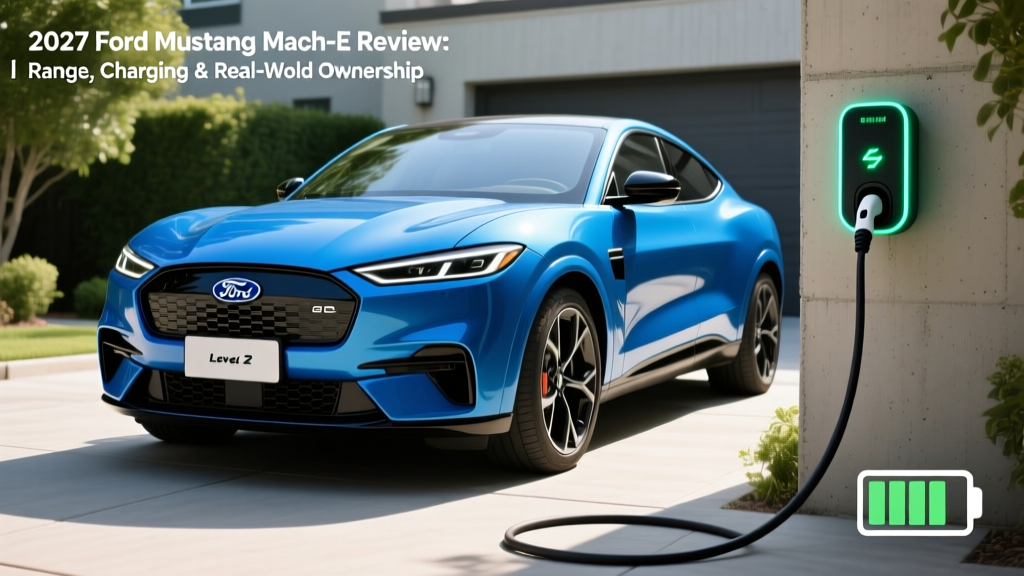
The Ford Mustang Mach-E enters the 2027 model year with incremental but meaningful updates: a slightly revised battery pack, faster DC charging on upper trims, and the latest version of Ford's BlueCruise hands-off driving system. As one of the original mainstream electric crossovers — now in its seventh year of production — the Mach-E has matured into a predictable, competent EV that appeals to buyers who want a non-Tesla alternative with broad dealer support and proven reliability data.
This review covers every spec that matters to real owners: EPA range versus what you'll actually see on the highway in January, the charging curve taper that nobody talks about on the spec sheet, and exactly what the 2027 Mach-E costs after the federal tax credit. All pricing and specs reflect Ford's announced 2027 model-year information as of early 2026.
EPA estimates: 250 mi (Standard Range RWD) / 320 mi (Extended Range RWD) / 290 mi (Extended Range AWD) / 280 mi (GT).
Real-world expectation: Plan for ~220–280 mi on highway road trips at 70+ mph, and 20–30% range loss in sustained sub-30°F weather. The 320-mi EPA figure is achievable in mild city driving at moderate speeds — not on the interstate.
Range, Battery, and Efficiency
The 2027 Mach-E continues with two battery options. The Standard Range pack is a 75.7 kWh usable lithium-ion NMC (nickel manganese cobalt) battery, while the Extended Range pack stores 91 kWh usable, also NMC chemistry. Ford has not adopted LFP (lithium iron phosphate) for the Mach-E, which means owners should follow the typical NMC best practice: daily charging to 80% and reserving 100% sessions for road trips to minimize long-term degradation.
| Spec | SR RWD | ER RWD | ER AWD | GT (AWD) |
|---|---|---|---|---|
| EPA Range | 250 mi | 320 mi | 290 mi | 280 mi |
| Battery (usable) | 75.7 kWh NMC | 91 kWh NMC | 91 kWh NMC | 91 kWh NMC |
| Horsepower | 266 hp | 290 hp | 346 hp | 480 hp |
| 0–60 mph | 6.1 sec | 5.8 sec | 4.8 sec | 3.5 sec |
| MPGe (combined) | 101 MPGe | 105 MPGe | 98 MPGe | 86 MPGe |
| kWh/100 mi | 33 | 32 | 34 | 39 |
| Drivetrain | RWD | RWD | AWD | AWD |
Efficiency peaks with the Extended Range RWD at 105 MPGe combined (32 kWh/100 mi), which is competitive with the Hyundai Ioniq 5 and Volkswagen ID.4 in this segment. The GT's 39 kWh/100 mi reflects the performance trade-off — you're burning more electrons for 480 hp and a 3.5-second 0–60 time. Per fueleconomy.gov, these figures translate to roughly $550–$650 per year in electricity costs at the national average of $0.17/kWh, compared to $1,800+ for a comparable gas crossover.
Charging Speed: DC Fast and Home Level 2
Charging is where the 2027 Mach-E shows its age relative to 800V competitors like the Hyundai Ioniq 5 and Kia EV6. The Mach-E runs on a 400V architecture, which caps its DC fast-charging peak and forces a steeper taper curve above 80% state of charge.
| Charging Level | Rate / Speed | Notes |
|---|---|---|
| Level 1 (120V) | ~1.4 kW / ~4 mi/hr | Emergency/trickle only |
| Level 2 (240V, 48A) | 10.5 kW / ~33 mi/hr | Full charge in ~9 hrs (ER) |
| DC Fast Charge (SR) | Peak 115 kW / 10–80% in ~38 min | Tapers sharply above 80% |
| DC Fast Charge (ER) | Peak 150 kW / 10–80% in ~33 min | Sustains ~120 kW to ~65% SoC |
The critical detail for road-trippers: the Extended Range pack peaks at 150 kW but only sustains that rate briefly. From roughly 15% to 65% state of charge, you'll see 120–150 kW. Above 65%, the curve drops to 70–90 kW, and above 80% it falls below 50 kW. This means a 10–80% session takes about 33 minutes at a capable 150+ kW charger (like Electrify America or Tesla Superchargers open to non-Tesla EVs via the Magic Dock adapter), but a 10–90% session stretches past 50 minutes. Plan your stops accordingly.
At home, the Mach-E's 10.5 kW onboard charger is solid. A 9-hour overnight session on a 48-amp Level 2 unit (like the Ford Connected Charge Station or a ChargePoint Home Flex) replenishes the full 91 kWh Extended Range pack. Installation typically runs $800–$2,000 depending on your electrical panel's capacity — factor that into your purchase budget.
Performance and Driving Dynamics
The 2027 Mach-E GT remains the performance halo: 480 hp, 634 lb-ft of torque, and a 3.5-second 0–60 mph time that embarrasses many sports cars off the line. But the volume sellers — the Select and Premium trims with the Extended Range RWD powertrain — deliver 290 hp and a 5.8-second 0–60, which is more than adequate for merging, passing, and daily driving.
The Mach-E rides on Ford's GE1 platform, and the low center of gravity from the floor-mounted battery gives it composed handling that feels more car-like than SUV-like. The steering is direct if slightly numb, and the regenerative braking offers a one-pedal driving mode that is genuinely strong enough to bring the car to a full stop without touching the friction brake pedal. The ride quality is firm but well-damped — not floaty like some competitors.
One drawback: the GT's performance comes at a real-world range cost. Expect 230–240 miles on a highway road trip in the GT, not the 280-mi EPA sticker. Aggressive throttle use will cut that further.
Interior, Cargo, and Technology
The Mach-E's cabin has aged gracefully since its 2021 debut. The centerpiece remains a 15.5-inch portrait touchscreen running Ford's SYNC 4A infotainment system, which supports wireless Apple CarPlay and Android Auto. The 2027 model year adds an updated digital instrument cluster and improved voice recognition, but the fundamental layout remains unchanged.
Passenger space is generous for the segment: 43.3 inches of front legroom and 38.9 inches in the rear, which comfortably fits two adults on long trips. Cargo volume behind the rear seats is 29.7 cubic feet, expanding to 59.7 cubic feet with the rear seats folded. The front trunk (frunk) adds 4.7 cubic feet of lockable storage with a drain plug — useful for tailgating or storing wet gear.
BlueCruise is Ford's SAE Level 2 hands-off highway driving system, available on prequalified divided highways (over 130,000 miles of mapped roads in the US and Canada as of 2026). It allows hands-off operation but requires eyes-on attention via an infrared driver-monitoring camera. This is not autonomous driving — you remain responsible for the vehicle at all times. BlueCruise is included for a trial period (typically 90 days or 2 years depending on trim), after which it requires a subscription (~$75/month or $800/year).
Pricing, Trims, and Federal Tax Credit
The 2027 Mach-E lineup starts at $39,995 for the Select trim with Standard Range RWD and climbs to approximately $59,995 for the GT with the Performance Upgrade. Here's the full trim breakdown with as-tested pricing that reflects common option packages:
| Trim | Base MSRP | As-Tested (typical) | §30D Credit Eligibility* |
|---|---|---|---|
| Select SR RWD | $39,995 | $41,500 | Up to $3,750 |
| Premium ER RWD | $47,595 | $50,800 | Up to $3,750 |
| Premium ER AWD | $50,095 | $53,200 | Up to $3,750 |
| GT ER AWD | $56,995 | $61,500 | Up to $3,750 |
*Federal tax credit eligibility under IRS §30D is subject to multiple requirements that change frequently. As of 2026, the Mach-E qualifies for up to $3,750 (the critical-minerals half of the credit) because Ford sources battery components from North American suppliers, but the battery-sourcing requirement for the full $7,500 has not been fully met. Eligibility also depends on:
- MSRP cap: SUVs/crossovers must be under $80,000 — all Mach-E trims qualify.
- Buyer income cap: Modified AGI must not exceed $150,000 (single), $225,000 (head of household), or $300,000 (joint filers).
- Battery sourcing: Critical minerals and battery component percentages must meet annual thresholds set by the IRS. These thresholds increase each year, which is why the credit amount may shift.
- Point-of-sale transfer: Qualified buyers can apply the credit at the dealership to reduce the purchase price directly, rather than waiting for a tax refund.
Always verify current eligibility on IRS.gov before purchasing — battery sourcing rules and eligible vehicle lists update periodically throughout the year.
Warranty and Long-Term Ownership
Ford backs the 2027 Mach-E with a competitive warranty package:
- Bumper-to-bumper: 3 years / 36,000 miles
- Powertrain: 5 years / 60,000 miles
- Battery (high-voltage): 8 years / 100,000 miles — guaranteed to retain at least 70% of original capacity
The 70% capacity retention threshold at 8 years/100,000 miles is industry-standard but not class-leading — Hyundai offers 10 years/100,000 miles on the Ioniq 5. Real-world degradation data from 2021–2024 Mach-E owners suggests the NMC packs lose roughly 5–8% capacity over the first 60,000 miles with normal charging habits (80% daily limit, occasional 100% for trips). This is within acceptable norms, but NMC packs do degrade faster than LFP packs if routinely charged to 100%.
Long-term ownership costs are favorable compared to gas crossovers. The Mach-E eliminates oil changes, has fewer brake replacements thanks to regenerative braking, and electricity costs roughly one-third of gasoline per mile. Insurance premiums, however, run 15–25% higher than equivalent gas vehicles — get quotes before committing.
Pros, Cons, and Who Should Buy
- Competitive real-world range (280–300 mi highway in ER RWD)
- Strong BlueCruise highway assist on mapped roads
- Spacious rear seat and generous 29.7 cu ft cargo area
- GT offers genuine sports-car acceleration (3.5 sec 0–60)
- Broad Ford dealer network for service and warranty work
- NACS adapter included — access to Tesla Supercharger network
- 400V architecture limits DC charging to 150 kW peak
- Charging taper above 80% makes 10–90% stops slow
- Only qualifies for $3,750 of the federal credit (not full $7,500)
- NMC battery requires 80% daily charge limit discipline
- BlueCruise subscription cost after trial period
- Firm ride may not suit buyers expecting luxury-crossover comfort
Who the 2027 Mach-E suits best: Daily commuters with home Level 2 charging who need a practical, spacious electric crossover for family duties and occasional road trips. The Extended Range RWD Premium trim hits the sweet spot: 320-mi EPA range, 290 hp, comfortable cabin, and enough cargo space for weekend gear. The GT is for enthusiasts who prioritize acceleration over efficiency. If you frequently road-trip in cold climates or need the fastest possible charging, the Hyundai Ioniq 5 (800V architecture, 240 kW peak) or the Tesla Model Y (Supercharger network, faster charging) may serve you better.
Frequently Asked Questions
What is the real-world range of the 2027 Mach-E?
The Extended Range RWD is EPA-rated at 320 miles, but in real-world highway driving at 70–75 mph, expect 260–280 miles in mild weather and 220–250 miles in winter conditions below 30°F. The GT typically delivers 230–240 highway miles. City driving at lower speeds can match or slightly exceed EPA estimates.
How fast does the 2027 Mach-E charge at home and on the road?
At home on a 240V Level 2 charger (48 amps), the Mach-E charges at 10.5 kW, adding roughly 33 miles of range per hour — a full charge takes about 9 hours for the Extended Range pack. On DC fast chargers, the ER model peaks at 150 kW and charges from 10–80% in approximately 33 minutes, though the rate tapers significantly above 80%.
Does the 2027 Mach-E qualify for the $7,500 federal EV tax credit?
As of 2026, the Mach-E qualifies for up to $3,750 under the critical-minerals portion of the IRS §30D credit. It does not currently meet the battery-component sourcing threshold for the additional $3,750. Buyer income caps ($150K single / $300K joint) and the $80K MSRP cap for SUVs also apply. The credit can be applied at the point of sale. Verify current eligibility at IRS.gov.
Is the 2027 Mach-E worth buying over the Tesla Model Y or Hyundai Ioniq 5?
The Mach-E wins on dealer support, interior space, and BlueCruise availability. The Tesla Model Y charges faster and has broader Supercharger access. The Hyundai Ioniq 5 charges much faster (240 kW peak, 10–80% in ~18 min) thanks to its 800V architecture, making it better for frequent road-trippers. If you value a traditional dealership experience and don't road-trip often, the Mach-E is a strong choice.
What is the battery warranty on the 2027 Mach-E?
Ford covers the high-voltage battery for 8 years or 100,000 miles, whichever comes first, guaranteeing at least 70% capacity retention. Real-world data from earlier model years suggests 5–8% degradation over 60,000 miles with proper charging habits (daily 80% limit, avoiding prolonged 100% storage).