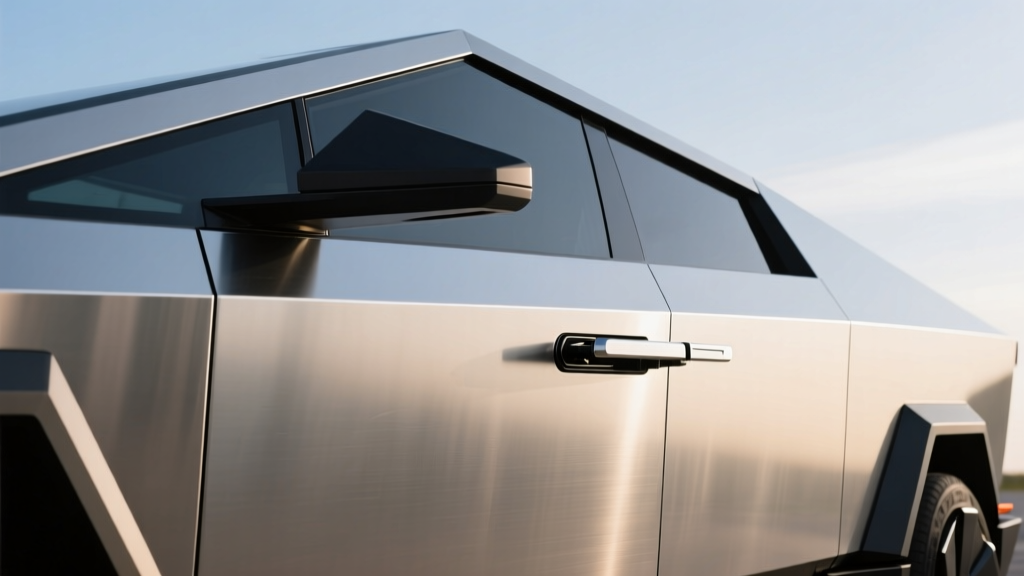
The Tesla Cybertruck's exterior design leaves almost nothing to convention — and that includes how you get inside. The Cybertruck door handle system ditches traditional pull-handles entirely in favor of flush-mounted, electronic push-button releases integrated directly into the door panels and bed pillars. It's a detail that sounds minor until you're standing in a freezing parking lot with gloved hands, at which point it becomes the most important feature on the truck.
This review breaks down the Cybertruck's entry system alongside the full vehicle profile — range, charging, performance, pricing, and tax-credit eligibility — so you can evaluate whether the truck's design philosophy works for your daily life or just looks good on a spec sheet.
How the Cybertruck Door Handle System Works
The Cybertruck uses fully electronic door releases rather than mechanical pull handles. Here's the system in practice:
- Front doors: A recessed push-button sits in the B-pillar area. Press it, and the window drops slightly while the door unlatches electronically. You then pull the door open by its edge — there's no handle to grab.
- Rear doors: A similar push-button is located on the C-pillar. The rear doors are full-size (not suicide doors like the Model X Falcon Wing) and open conventionally once unlatched.
- Tonneau / bed access: The powered tonneau cover opens via a button on the bed pillar or through the touchscreen. The tailgate uses a powered latch with a recessed release.
- Keyless entry: Phone-as-key (Bluetooth) and key card unlock all doors simultaneously when you approach. Walk-away locking is standard.
- Emergency mechanical release: Inside each door, a manual cable release exists for situations where the 12V or 48V electrical system loses power. Tesla documents this in the owner's manual, though it's not immediately obvious to passengers.
Full Cybertruck Specs: Range, Battery, and Efficiency
| Spec | AWD (Dual Motor) | Cyberbeast (Tri-Motor) |
|---|---|---|
| EPA Range | 340 miles | 320 miles |
| Battery (usable, est.) | ~123 kWh, NMC | ~123 kWh, NMC |
| Efficiency | 73 MPGe / 46 kWh/100mi | 69 MPGe / 49 kWh/100mi |
| 0–60 mph | 3.9 seconds | 2.6 seconds |
| Horsepower | 600 hp | 845 hp |
| Drivetrain | Dual-motor AWD | Tri-motor AWD |
| Towing Capacity | 11,000 lbs | 11,000 lbs |
| Bed Length | 6 ft (72 in), 67 cu ft volume | |
| Cargo (frunk) | ~7 cu ft (front trunk) | |
| Rear Legroom | ~38.3 inches | |
Tesla uses a 48-volt electrical architecture in the Cybertruck — a first for a production vehicle — which allows thinner wiring harnesses and more efficient power delivery to accessories like the steer-by-wire system, the powered tonneau, and yes, those electronic door latches. The battery pack itself is a structural NMC (nickel manganese cobalt) unit integrated into the stainless-steel exoskeleton.
Real-World Range: What the EPA Number Doesn't Tell You
Expect ~270–300 miles on sustained highway driving at 70–75 mph. In cold weather (below 30°F), plan for 20–30% range reduction, dropping effective range to roughly 220–260 miles depending on cabin heat usage and whether you precondition. The Cybertruck's large frontal area and 6,600+ lb curb weight work against efficiency at highway speeds. Towing cuts range dramatically — expect 120–170 miles when pulling a loaded trailer.
Charging Speed and Infrastructure
The Cybertruck supports Tesla's 800-volt architecture, enabling some of the fastest DC fast-charging in the current EV market. It also comes with the NACS connector natively — no adapter needed for Tesla Superchargers, and an increasing number of third-party networks (Electrify America, EVgo) now offer NACS cables at select stations.
| Charging Level | Power | Speed / Time |
|---|---|---|
| Level 1 (120V household) | ~1.4 kW | ~3–4 miles per hour |
| Level 2 (240V home, 48A) | 11.5 kW | ~34 miles per hour (full charge in ~11 hrs) |
| DC Fast Charge (peak) | Up to 350 kW | 10–80% in ~15–18 minutes |
| DC Fast Charge (sustained avg.) | ~200–250 kW | 10–80% realistic: ~20 min |
The 10–80% time is where the 800V architecture earns its keep. Peak charge rate tapers significantly above 80% SoC to protect battery longevity — a full 80–100% top-off can add another 15–20 minutes. For road trips, plan stops around the 10–80% sweet spot and precondition the battery via the navigation system (set a Supercharger as your destination) to hit peak charge rates upon arrival.
For home Level 2 charging, a Tesla Wall Connector on a 60-amp circuit delivers the full 11.5 kW. Installation costs vary widely: $500–$1,500 if your electrical panel is near the garage and has capacity; $2,000–$4,000+ if you need a panel upgrade to 200A service. Always get a quote from a licensed electrician before committing.
Pricing, Trims, and Federal Tax Credit Eligibility
| Trim | Base MSRP | Federal Credit (§30D) | Effective Price (if eligible) |
|---|---|---|---|
| AWD (Dual Motor) | $79,990 | Up to $7,500 | ~$72,490 |
| Cyberbeast (Tri-Motor) | $99,990 | Up to $7,500 | ~$92,490 |
The Cybertruck qualifies as a light truck under IRS §30D rules, which means it falls under the $80,000 MSRP cap for trucks, vans, and SUVs (not the $55,000 sedan cap). The AWD trim at $79,990 squeaks under that threshold. The Cyberbeast at $99,990 exceeds it and does not qualify for the federal credit.
Eligibility requirements for the §30D credit (source: IRS):
- Income caps: Modified AGI ≤ $150,000 (single), $225,000 (head of household), $300,000 (married filing jointly)
- MSRP cap: ≤ $80,000 for trucks/SUVs/vans
- Battery sourcing: Critical minerals and battery components must meet phased-in domestic-sourcing thresholds (increasing annually through 2029)
- Point-of-sale transfer: You can transfer the credit to the dealer at purchase to reduce the upfront price, rather than waiting to claim it on your tax return
Because battery-sourcing rules tighten each year, eligibility can shift between model years. Confirm current-year status with your dealer and a tax professional before relying on the credit in your budget.
Performance, Ride, and Daily Driving
The Cybertruck AWD hits 60 mph in 3.9 seconds — faster than most sports sedans — while the Cyberbeast's 2.6-second run puts it in supercar territory despite a curb weight north of 6,600 pounds. The tri-motor Cyberbeast uses torque vectoring across all three motors for cornering agility that defies the truck's slab-sided proportions.
The steer-by-wire system (no mechanical connection between the yoke and the wheels) is the most polarizing feature. It requires adaptation: the variable ratio means small inputs at highway speed and aggressive turning at low speed. Some drivers adjust within a day; others never trust it. There is no conventional steering-wheel option.
Ride quality benefits from the adaptive air suspension, which offers up to 12 inches of ground clearance in Extract Mode (useful for off-road obstacles) and automatically lowers at highway speeds for efficiency. The stainless-steel exoskeleton is dent-resistant but shows fingerprints aggressively — Tesla includes microfiber cloths, but plan on frequent wipe-downs if appearance matters to you.
ADAS includes Tesla's Autopilot (lane centering + adaptive cruise) and the optional Full Self-Driving (Supervised) package. Both are SAE Level 2 systems — you must remain attentive, hands on the yoke, and ready to take over at any moment. This is not autonomous driving.
Interior, Tech, and Practicality
The Cybertruck interior is minimalist even by Tesla standards. An 18.5-inch center touchscreen handles virtually every vehicle function — climate, mirrors, glove box, and the tonneau cover. A 9.4-inch rear touchscreen serves back-seat passengers. There are no physical buttons for climate or volume; everything routes through the screen or voice commands.
Seating is six-across (3 front, 3 rear) in a bench configuration up front. Rear legroom measures approximately 38.3 inches — adequate for adults but not class-leading versus the Ford F-150 Lightning's more generous SuperCrew cab. The 6-foot bed with powered roll-up tonneau offers 67 cubic feet of lockable storage, and the front trunk (frunk) adds roughly 7 cubic feet for cables and smaller items.
The 120V/240V bed outlets (up to 9.6 kW output via Powershare) make the Cybertruck a legitimate mobile generator for job sites or camping — you can run power tools, a refrigerator, or even a welder within the truck's output limits.
Warranty and Long-Term Ownership
- Basic vehicle warranty: 4 years / 50,000 miles
- Battery & drive unit warranty: 8 years / 120,000 miles (with minimum 70% capacity retention)
- Stainless-steel body: Corrosion-resistant by nature, but Tesla's panel-gap consistency has drawn criticism — inspect delivery carefully
Tesla's service network remains a mixed bag depending on your region. Mobile service handles many issues (software, minor hardware), but body damage to the stainless panels requires specialized repair facilities that not all Tesla service centers are equipped for. Insurance premiums run higher than comparable trucks — get a quote before purchasing.
Pros
- Class-leading DC fast-charge speed (350 kW peak, ~15 min 10–80%)
- Supercar-level acceleration, especially Cyberbeast (2.6 sec 0–60)
- 11,000-lb towing + 9.6 kW Powershare bed outlets
- Stainless-steel exoskeleton resists dents and corrosion
- Flush door-handle design reduces drag and eliminates handle-breakage risk
Cons
- Cyberbeast exceeds $80K MSRP cap — no federal tax credit
- Steer-by-wire requires significant adaptation; no wheel option
- Real-world highway range falls well short of EPA, especially when towing
- Electronic door latches depend on 48V system; manual release not intuitive
- Insurance premiums significantly above segment average
Who Should Buy the Cybertruck?
Choose the Cybertruck AWD if: You want a fast-charging electric truck for daily driving and weekend towing, you qualify for the §30D credit (income + MSRP), and you're comfortable with the steer-by-wire learning curve. The AWD trim's $79,990 price keeps it credit-eligible.
Choose the Cyberbeast if: Performance is the priority and you don't need the tax credit. The tri-motor setup delivers unmatched acceleration and torque vectoring, but the $99,990 MSRP disqualifies it from §30D.
Look at the F-150 Lightning or Rivian R1T instead if: You need conventional controls (steering wheel, physical buttons), more rear-seat space, or a broader service network. The Lightning offers comparable range and towing with a more traditional truck experience.
Cybertruck Door Handle & Ownership FAQ
Can you open the Cybertruck doors if the battery dies?
Yes. Each door has an internal mechanical cable release documented in the owner's manual. However, the exterior push-button releases require electrical power. If the 48V system is completely depleted, you'd need to access the mechanical release from inside (if a door is already ajar) or use the key card at the driver's door, which has a low-power backup reader.
What is the real-world range of the Cybertruck?
The EPA rates the AWD at 340 miles and Cyberbeast at 320 miles. In real-world highway driving at 70–75 mph, expect 270–300 miles. Cold weather (below 30°F) reduces this further to roughly 220–260 miles. Towing a loaded trailer cuts range to approximately 120–170 miles depending on weight and aerodynamics.
How fast does the Cybertruck charge?
On a DC fast charger capable of 350 kW, the Cybertruck charges from 10–80% in approximately 15–18 minutes under ideal conditions (preconditioned battery, moderate ambient temperature). Sustained average charge rate is closer to 200–250 kW. Home Level 2 charging at 11.5 kW adds roughly 34 miles per hour, requiring about 11 hours for a full charge.
Does the Cybertruck qualify for the $7,500 federal EV tax credit?
The AWD trim at $79,990 MSRP falls under the $80,000 truck/SUV cap and may qualify, subject to your income (≤ $150K single / $300K joint), battery-sourcing requirements, and point-of-sale transfer rules. The Cyberbeast at $99,990 exceeds the MSRP cap and does not qualify. Always verify current-year rules at IRS.gov and consult a tax professional.
Are the Cybertruck's electronic door latches reliable in winter?
The recessed push-buttons can accumulate ice in freezing rain or sleet conditions. Tesla's puddle lights help illuminate the button location, and the powered window drop usually breaks light ice seal. In extreme ice buildup, the buttons may require firm pressure or de-icer spray. This is a legitimate concern in northern climates compared to traditional pull-handles that give you mechanical leverage.
Is the Cybertruck worth buying versus the F-150 Lightning or Rivian R1T?
The Cybertruck wins on charging speed (800V architecture), acceleration, and bed power output (9.6 kW). The F-150 Lightning offers a more conventional truck experience with better rear-seat room and a broader dealer network. The Rivian R1T provides more refined on-road manners and a quad-motor option but at a higher price point. Your choice depends on whether you prioritize cutting-edge EV tech (Cybertruck) or traditional usability (Lightning/R1T).