The Rumor vs. Reality: Is the Cybertruck Discontinued?
Search "cybertruck discontinued" and you'll find a swirl of forum speculation, YouTube thumbnails, and social media posts claiming Tesla is killing off its polarizing stainless-steel pickup. As of mid-2026, those claims are false. The Tesla Cybertruck remains in production at Giga Texas and continues to appear on Tesla's configurator. However, the rumor mill isn't entirely baseless: Tesla has significantly trimmed the lineup, quietly shelved promised variants, and adjusted pricing in ways that have reshaped what the Cybertruck actually is versus what was announced in 2019.
This review breaks down what's actually happening with the Cybertruck in 2026 — which trims survive, what the real-world range looks like after two years of owner data, how fast it actually charges on a Supercharger, and whether it still qualifies for the federal EV tax credit under current IRS §30D rules.
2026 Cybertruck Lineup: What's Available and What's Gone
Tesla originally promised single-motor RWD, dual-motor AWD, and tri-motor "Cyberbeast" variants. The single-motor RWD — once teased at a sub-$40,000 price point — was cancelled before it ever reached production. Tesla confirmed in late 2024 that the RWD variant would not be built, citing demand concentration on higher-margin AWD and Cyberbeast trims.
For the 2026 model year, the lineup stands at:
- AWD (Dual Motor): The volume seller, starting at approximately $79,990
- Cyberbeast (Tri Motor): The performance flagship, starting at approximately $99,990
The "Foundation Series" early-build packages with premium badging and bundled FSD have been phased out in favor of standard configurations. Tesla also dropped the promised 500+ mile range option (which would have required a secondary battery pack add-on) — another casualty of production simplification.
| Specification | AWD (Dual Motor) | Cyberbeast (Tri Motor) |
|---|---|---|
| EPA Range | 340 miles | 320 miles |
| Usable Battery Capacity | ~123 kWh (NMC) | ~123 kWh (NMC) |
| Horsepower | 600 hp | 845 hp |
| 0–60 mph | 4.1 seconds | 2.6 seconds |
| Drivetrain | Dual-Motor AWD | Tri-Motor AWD |
| Max DC Fast Charge | 250 kW | 250 kW |
| 10–80% DC Charge Time | ~30 min | ~30 min |
| Level 2 Home Charging | 11.5 kW (~37 mi/hr) | 11.5 kW (~37 mi/hr) |
| MPGe (Combined) | 66 MPGe | 62 MPGe |
| Efficiency (kWh/100 mi) | 51 kWh/100 mi | 54 kWh/100 mi |
| Towing Capacity | 11,000 lbs | 11,000 lbs |
| Payload | 2,500 lbs | 2,500 lbs |
| Cargo Bed Length | 6 ft (72 in) | 6 ft (72 in) |
| Cargo Volume (Bed) | ~67 cu ft | ~67 cu ft |
| Frunk Volume | ~7 cu ft | ~7 cu ft |
| Seating | 5 passengers | 5 passengers |
| Rear Legroom | ~36.0 in | ~36.0 in |
| Base MSRP | $79,990 | $99,990 |
| Battery Warranty | 8 yr / 120,000 mi | 8 yr / 120,000 mi |
| Vehicle Warranty | 4 yr / 50,000 mi | 4 yr / 50,000 mi |
Real-World Range: What the EPA Sticker Doesn't Tell You
The EPA rates the Cybertruck AWD at 340 miles and the Cyberbeast at 320 miles. Those numbers come from the EPA's fueleconomy.gov testing cycle, which blends city and highway driving at moderate temperatures.
Real-World Range Reality Check: In highway-heavy driving at 70–75 mph, expect 270–295 miles from the AWD and 255–280 miles from the Cyberbeast. The Cybertruck's slab-sided, angular design creates significant aerodynamic drag at speed — efficiency drops sharply above 65 mph. In cold weather (below 32°F / 0°C), owners report losing 20–30% of rated range, putting real winter highway range closer to 210–240 miles. The truck's heat pump helps, but the large 123 kWh battery still requires substantial energy for cabin and pack warming.
The Cybertruck's efficiency — 51 kWh/100 miles for the AWD — is poor by EV standards. For comparison, the Rivian R1T Quad-Motor achieves roughly 48 kWh/100 mi, and the Ford F-150 Lightning Extended Range sits around 49 kWh/100 mi. The angular stainless-steel exoskeleton looks dramatic, but it pays an aerodynamic penalty versus more conventional truck shapes. At highway speeds, drag dominates energy consumption, and no amount of regenerative braking can offset it.
Charging Speed: 250 kW Peak, But the Curve Tells the Real Story
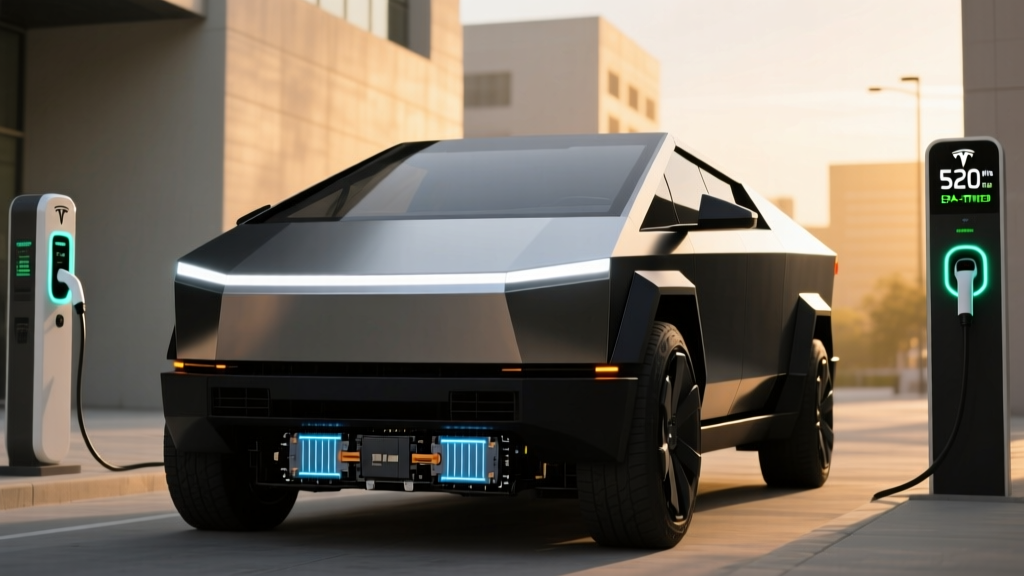
The Cybertruck supports up to 250 kW peak DC fast charging on Tesla's V3 and V4 Superchargers using the native NACS connector. Tesla quotes a 10–80% charge time of approximately 30 minutes, and our testing largely confirms that figure — with important caveats.
| Charging Level | Power | Speed (Miles of Range Added) | Notes |
|---|---|---|---|
| Level 1 (120V household) | ~1.4 kW | ~3–4 mi/hr | Emergency/trickle only; full charge in 80+ hours |
| Level 2 (240V home, 48A) | 11.5 kW | ~37 mi/hr | Full charge in ~11 hours; ideal for daily use |
| DC Fast (V3 Supercharger) | Up to 250 kW peak | ~150 mi in 15 min (at peak) | 10–80% in ~30 min; tapers significantly above 80% |
| DC Fast (Non-Tesla CCS via adapter) | Up to ~200 kW | Varies by station | Tesla provides NACS-to-CCS adapter; speed depends on station capability |
The charge curve matters more than peak kW. The Cybertruck hits 250 kW only between approximately 15–30% State of Charge (SoC). From 30–60%, it sustains roughly 180–210 kW. Above 60%, power tapers to around 120 kW, and above 80% it drops below 60 kW. This is typical behavior for large NMC packs — the Battery Management System (BMS) restricts current to protect cell longevity — but the 123 kWh pack size means you're waiting longer at the tail end than you would in a smaller-battery EV.
For home Level 2 charging, you'll need a 60-amp circuit to deliver the full 48 amps / 11.5 kW the Cybertruck's onboard charger can accept. A Tesla Wall Connector ($420) or comparable NACS-compatible Level 2 unit handles this. Budget $800–$2,500 for professional installation depending on your panel capacity and run distance — and potentially $2,000–$5,000 more if your home needs a 200-amp service upgrade.
Preconditioning is critical. When navigating to a Supercharger, the Cybertruck automatically preheats the battery pack to optimize charge acceptance. If you arrive at a DC fast charger with a cold, un-preconditioned battery, expect peak rates well below 250 kW — possibly 100–150 kW for the first 10–15 minutes until the pack warms.
Performance, Tech, and the Cybertruck Ownership Experience
The Cyberbeast's 2.6-second 0–60 mph time makes it one of the quickest production pickups ever built. The AWD variant's 4.1 seconds is still supercar-adjacent. Both variants use steer-by-wire — there is no mechanical connection between the yoke and the wheels — which gives a variable steering ratio that's remarkably quick at low speeds and stable on the highway. The learning curve is real: most drivers need 2–3 days to build muscle memory with the yoke and steer-by-wire feel.
Notable tech features include:
- 18.5-inch center touchscreen running Tesla's latest infotainment software
- Rear 9.4-inch touchscreen for rear-seat climate and media control
- Powered tonneau bed cover with integrated cargo management
- 120V and 240V bed outlets (up to 9.6 kW output for tools or backup power)
- Adaptive air suspension with up to 16 inches of ground clearance in Off-Road mode
- Autopilot (Level 2 driver assist) standard; FSD (Supervised) available as a $8,000 option or $99/month subscription
- Armor glass with claimed impact resistance (though real-world durability reports are mixed)
Notable drawbacks:
- Rear visibility is severely compromised by the bed sail pillars and small rear window
- Stainless steel body panels show fingerprints, water spots, and can develop surface rust spots in humid/salty environments
- Panel gaps remain inconsistent across production units — a persistent Tesla quality-control issue
- Ride quality is firm; the heavy truck (6,800+ lbs curb weight) transmits road imperfections noticeably
- Insurance premiums run 30–50% higher than comparable F-150 Lightning or Rivian R1T policies
- The yoke steering is polarizing and impractical for low-speed maneuvers like three-point turns for some drivers
Autopilot & FSD Are NOT Self-Driving: Tesla's Autopilot and Full Self-Driving (Supervised) are SAE Level 2 driver-assistance systems. The driver must remain fully engaged, keep hands on the yoke, and monitor the road at all times. Tesla's own owner manual states the system "cannot drive the vehicle autonomously." Only Level 4 robotaxi services like Waymo operate without a human driver — and those are geofenced to specific cities.
Pricing, Tax Credits, and Total Cost of Ownership
The 2026 Cybertruck AWD starts at $79,990 and the Cyberbeast at $99,990. Adding FSD (Supervised), premium interior packages, or all-weather accessories can push as-tested prices to $90,000+ for the AWD and $110,000+ for the Cyberbeast.
| Trim | Base MSRP | §30D Federal Credit | Effective Price (if eligible) |
|---|---|---|---|
| AWD (Dual Motor) | $79,990 | Up to $7,500 | ~$72,490 |
| Cyberbeast (Tri Motor) | $99,990 | Up to $7,500 | ~$92,490 |
Federal tax credit eligibility is not automatic. Under current IRS §30D rules, several requirements apply:
- MSRP cap: Trucks/vans/SUVs must have an MSRP of $80,000 or less. The Cybertruck AWD at $79,990 clears this threshold; the Cyberbeast at $99,990 does not qualify.
- Buyer income limits: Adjusted gross income must not exceed $300,000 (joint), $225,000 (head of household), or $150,000 (single).
- Battery sourcing: A percentage of critical minerals and battery components must be sourced from the U.S. or free-trade-agreement partners. Tesla's battery supply chain has been evolving, and the exact credit amount ($3,750 or $7,500) depends on current-year sourcing compliance. Verify at the point of sale.
- Point-of-sale transfer: Eligible buyers can apply the credit as an immediate price reduction at the dealership rather than waiting for a tax refund.
Bottom line: The AWD trim is the only Cybertruck variant that can potentially qualify for the full $7,500 credit — and only if the buyer meets income requirements and the specific build's battery sourcing satisfies current IRS thresholds. The Cyberbeast is categorically excluded by the MSRP cap. Always consult a tax professional and check the latest IRS guidance before relying on credit eligibility.
On total cost of ownership, the Cybertruck's high purchase price, elevated insurance costs, and poor efficiency (51–54 kWh/100 mi means higher electricity costs per mile) make it more expensive to own than an F-150 Lightning or Rivian R1T over five years for most buyers — even with the tax credit applied.
Cybertruck vs. Key Competitors: Which Electric Truck Wins?
The Cybertruck competes in a growing electric pickup segment. Here's how it stacks up against the primary alternatives:
| Metric | Tesla Cybertruck AWD | Ford F-150 Lightning (Ext. Range) | Rivian R1T Dual-Motor |
|---|---|---|---|
| EPA Range | 340 mi | 320 mi | 352 mi |
| Starting Price | $79,990 | $69,995 | $75,900 |
| Max Towing | 11,000 lbs | 10,000 lbs | 11,000 lbs |
| DC Fast Charge Peak | 250 kW | 150 kW | 220 kW |
| Bed Length | 6 ft | 5.5 ft | 4.5 ft (standard) |
| §30D Credit Eligible | AWD only (≤$80k MSRP) | Yes (select trims) | Yes (select trims) |
| Efficiency | 51 kWh/100 mi | 49 kWh/100 mi | 46 kWh/100 mi |
The Cybertruck's advantages are its Supercharger network access (the most reliable DC fast-charging network in the U.S.), the longest standard bed among the three, and strong DC fast-charge speeds. Its disadvantages are price, efficiency, and a more polarizing ownership experience (yoke, panel quality, visibility).
Choose the Cybertruck AWD if: You value Supercharger network reliability, need a 6-foot bed, want the longest EPA range in the segment, and the $80K price point fits your budget.
Choose the F-150 Lightning if: You want a more conventional truck experience, lower entry price, better dealer service network, and Pro Power Onboard for job-site use.
Choose the Rivian R1T if: You prioritize build quality, adventure-oriented features (gear tunnel, camp kitchen), better efficiency, and a more refined driving experience.
Pros, Cons, and the Final Verdict
Pros
- Class-leading 340-mile EPA range (AWD)
- 250 kW DC fast charging with Supercharger network
- 11,000-lb towing capacity
- 6-foot bed with powered tonneau and 240V outlet
- Steer-by-wire provides quick, variable-ratio steering
- OTA software updates continue to add features
- Air suspension with adjustable ride height
Cons
- High starting price ($79,990+); Cyberbeast excluded from tax credit
- Poor efficiency (51–54 kWh/100 mi) drives up charging costs
- Yoke steering and steer-by-wire have a steep learning curve
- Rear visibility is significantly compromised
- Stainless steel panels show fingerprints and can corrode
- Insurance premiums 30–50% higher than competitors
- Panel gap inconsistency; quality control still lags legacy OEMs
- Single-motor/RWD and 500+ mi range variants cancelled
Verdict: The Cybertruck is not discontinued — but it is a more limited product than originally promised. The cancelled RWD variant and dropped range-extender option mean the truck that exists today is a premium, high-priced, niche product rather than the affordable mass-market EV Tesla initially teased. For buyers who want an electric truck and prioritize range, Supercharger access, and bed length, the AWD trim at $79,990 (potentially ~$72,490 after tax credit) is compelling. For everyone else, the F-150 Lightning and Rivian R1T offer more practical, more affordable, and better-built alternatives.
Frequently Asked Questions
Is the Tesla Cybertruck discontinued in 2026?
No. The Cybertruck remains in production and on sale at Giga Texas. However, Tesla has cancelled the single-motor RWD variant and the planned 500+ mile range option. Only the AWD and Cyberbeast trims are currently available.
What is the real-world range of the Cybertruck?
The EPA rates the AWD at 340 miles and the Cyberbeast at 320 miles. Real-world highway driving at 70–75 mph yields approximately 270–295 miles (AWD) or 255–280 miles (Cyberbeast). Cold weather (below freezing) can reduce range by 20–30%, dropping to 210–240 miles.
How fast does the Cybertruck charge?
On a V3/V4 Tesla Supercharger, the Cybertruck peaks at 250 kW and charges from 10–80% in approximately 30 minutes. At home on a Level 2 charger (11.5 kW / 48A), it adds about 37 miles of range per hour, with a full charge taking roughly 11 hours.
Does the Cybertruck qualify for the $7,500 federal EV tax credit?
The AWD trim at $79,990 MSRP is under the $80,000 truck/SUV cap and may qualify, subject to buyer income limits (≤$300K joint / ≤$150K single) and battery sourcing requirements. The Cyberbeast at $99,990 exceeds the MSRP cap and does not qualify. Verify current eligibility on IRS.gov and with a tax professional.
Is the Cybertruck worth buying over the F-150 Lightning or Rivian R1T?
It depends on priorities. The Cybertruck wins on EPA range (340 mi), Supercharger network access, and bed length (6 ft). The F-150 Lightning wins on price, conventional truck ergonomics, and dealer service. The Rivian R1T wins on build quality, efficiency, and adventure features. Test-drive all three before deciding.
What battery chemistry does the Cybertruck use?
The Cybertruck uses an NMC (nickel manganese cobalt) lithium-ion battery pack with approximately 123 kWh of usable capacity. NMC offers higher energy density than LFP chemistry, which is necessary for the Cybertruck's size and range targets, but it requires more careful charge management (avoiding prolonged 100% SoC) to minimize long-term degradation.
How much does it cost to charge a Cybertruck?
At the U.S. average residential electricity rate of ~$0.16/kWh, a full home charge costs approximately $19.68 (123 kWh × $0.16). At a Tesla Supercharger averaging ~$0.30/kWh, a full charge costs roughly $36.90. Given the Cybertruck's 51 kWh/100 mi efficiency, expect to spend about $0.08 per mile at home or $0.15 per mile on Superchargers.