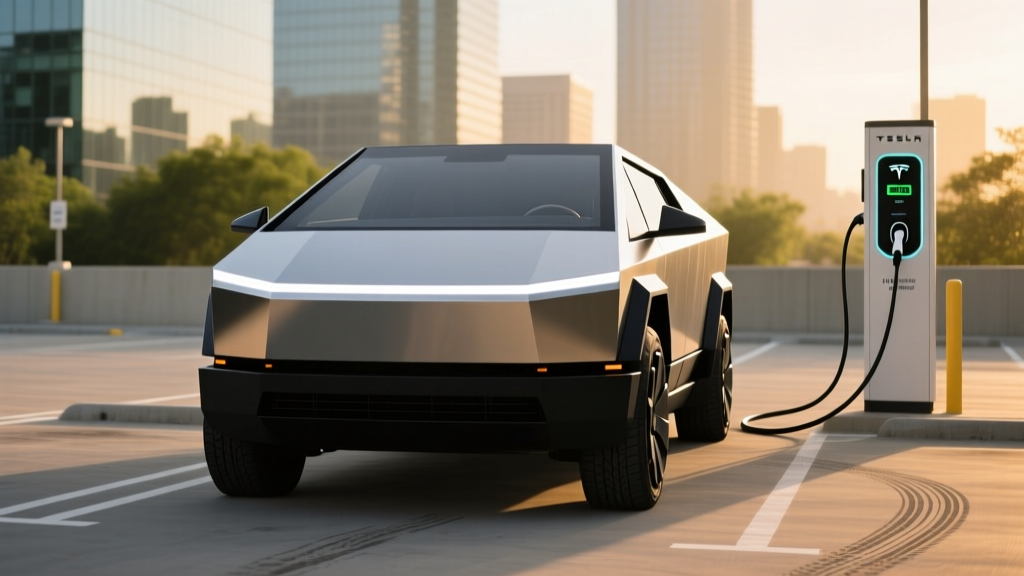
If you've been searching "how long is the Cybertruck" while planning your garage build or comparing it to a Ford F-150 Lightning or Rivian R1T, you've landed on the right spec sheet. Tesla's stainless-steel pickup is polarizing in design but brutally specific in its numbers. Below, we cover every dimension buyers actually need — from overall length and bed size to turning radius — and pair that with the range, charging, pricing, and ownership data that determine whether this truck earns a spot in your driveway in 2026.
Tesla Cybertruck Exterior Dimensions: The Exact Numbers
The Tesla Cybertruck measures 223.6 inches (18.63 feet) in overall length, making it shorter than a full-size F-150 SuperCrew (~231 inches) but longer than a midsize Ford Ranger (~211 inches). It sits in a size class of its own — what Tesla calls a "full-size footprint with a midsize wheelbase."
| Dimension | Cybertruck | F-150 Lightning | Rivian R1T |
|---|---|---|---|
| Overall Length | 223.6 in | 231.7 in | 217.1 in |
| Wheelbase | 141.7 in | 145.5 in | 135.8 in |
| Width (w/o mirrors) | 79.9 in | 79.9 in | 81.8 in |
| Height | 70.5 in | 78.8 in | 73.0 in |
| Bed Length | 72.0 in (6 ft) | 66.0 in (5.5 ft) | 54.0 in (4.5 ft) |
| Curb Weight (AWD) | ~6,600 lbs | ~6,171 lbs | ~7,148 lbs |
| Turning Circle | 43.5 ft | 44.7 ft | 42.0 ft |
The 6-foot composite bed (officially called the "vault") is longer than both the Lightning's 5.5-foot box and the R1T's 4.5-foot bed. It includes a powered tonneau cover rated for 300 lbs of distributed load and 120V/240V bed outlets. However, the Cybertruck's sloping exoskeleton limits vertical clearance for tall cargo — you'll need the vault's 43-inch height for anything that doesn't fit under the closed cover.
EPA Range and Real-World Efficiency
Tesla offers the Cybertruck in three trims for 2026, each with different range profiles:
| Trim | Battery (usable) | EPA Range | MPGe (combined) | kWh/100 mi |
|---|---|---|---|---|
| Rear-Wheel Drive | ~123 kWh (NMC) | 340 mi | 67 MPGe | 50 |
| All-Wheel Drive | ~123 kWh (NMC) | 325 mi | 64 MPGe | 52 |
| Cyberbeast | ~123 kWh (NMC) | 320 mi | 62 MPGe | 54 |
The Cybertruck uses an NMC (nickel manganese cobalt) lithium-ion pack — chosen for energy density over the LFP chemistry found in Tesla's Model 3 RWD. This matters for longevity: NMC packs prefer daily charging to 80% with 100% reserved for trips. Tesla's battery management system and structural pack design help, but plan for gradual degradation of 8–12% over the first 100,000 miles based on current Tesla fleet data.
Charging Speed: DC Fast and Home Level 2
Charging speed is where the Cybertruck's 800-volt architecture pays off — but only at compatible chargers.
| Charging Level | Peak Rate | Speed | Notes |
|---|---|---|---|
| DC Fast (V4 Supercharger) | ~350 kW peak | 10–80% in ~15 min | Requires preconditioning; tapers above 80% |
| DC Fast (CCS via adapter) | ~250 kW peak | 10–80% in ~25 min | Varies by network (EA, EVgo) |
| Level 2 (home 48A Wall Connector) | 11.5 kW | ~37 mi/hr | Full charge in ~11 hrs |
| Level 2 (home 32A) | 7.7 kW | ~25 mi/hr | Full charge in ~16 hrs |
| Level 1 (120V outlet) | 1.4 kW | ~4 mi/hr | Emergency/trickle only |
The Cybertruck ships with a NACS (North American Charging Standard) port natively. Since Tesla opened its Supercharger network to NACS-equipped vehicles, this is the most seamless charging experience in the EV market. The 350 kW peak rate is achievable at V4 Supercharger stalls with integrated cabinets — but sustained charging averages closer to 200–250 kW across the 10–80% window due to the charge curve taper. Always precondition the battery via the Tesla app or navigation before a DC fast-charge session; skipping this can add 10+ minutes to your stop.
For home charging, a 48-amp Tesla Wall Connector on a 60-amp circuit is the sweet spot. Expect to pay $800–$2,500 for professional installation depending on panel capacity and run distance. If your home has a 100-amp main panel, a panel upgrade to 200 amps ($1,500–$3,000) may be required to support 48A charging alongside other large loads.
Performance: 0-60, Towing, and Drivetrain
The Cybertruck's tri-motor Cyberbeast trim posts a 0–60 mph time of 2.6 seconds — supercar territory in a 6,800-lb truck. The dual-motor AWD achieves 3.9 seconds, and the single-motor RWD (slated for broader 2026 availability) targets 6.5 seconds.
| Trim | Drivetrain | Horsepower | Torque (lb-ft) | 0–60 mph | Top Speed |
|---|---|---|---|---|---|
| RWD | Single Motor | ~400 hp | ~550 | 6.5 sec | 112 mph |
| AWD | Dual Motor | ~600 hp | ~740 | 3.9 sec | 130 mph |
| Cyberbeast | Tri-Motor AWD | ~845 hp | ~1,000+ | 2.6 sec | 130 mph |
Towing capacity is rated at 11,000 lbs across all trims — competitive with the F-150 Lightning's 10,000-lb rating and ahead of the Rivian R1T's 11,000-lb max (quad-motor). However, towing any trailer above 5,000 lbs will slash range roughly in half. Plan for 140–160 miles of range with a heavy trailer on the AWD trim. The Cybertruck includes an integrated trailer brake controller and Tesla's hitch-assist camera system.
Ground clearance adjusts via adaptive air suspension: 9 inches standard, up to 16 inches in Extract mode for off-road use. Approach, departure, and breakover angles are respectable for a unibody truck, though the long front overhang (stainless steel exoskeleton) limits rock-crawling versus a body-on-frame competitor.
Pricing, Trims, and Federal Tax Credit Eligibility
The Cybertruck's pricing has shifted since its 2023 launch. For the 2026 model year, base MSRPs are as follows:
| Trim | Base MSRP | §30D Credit Eligible? | Effective Price (if eligible) |
|---|---|---|---|
| RWD | $60,990 | Yes (meets MSRP cap) | ~$53,490 |
| AWD | $79,990 | No (exceeds $80K truck cap) | $79,990 |
| Cyberbeast | $99,990 | No (exceeds $80K truck cap) | $99,990 |
- MSRP Cap: Vans, SUVs, and pickup trucks must have an MSRP at or below $80,000. Only the base RWD Cybertruck qualifies.
- Income Cap: Modified AGI must not exceed $150K (single), $225K (head of household), or $300K (joint).
- Battery Sourcing: Critical minerals and battery components must meet escalating domestic-content thresholds. Tesla's supply chain has been evolving — verify current-year compliance on IRS.gov before purchase.
- Point-of-Sale Transfer: Eligible buyers can transfer the credit to the dealer for an upfront price reduction (effective Jan 2024 onward).
Consult a tax professional for your specific situation. State incentives (e.g., California, Colorado, New York) may stack on top — check your state's energy office for current programs.
Destination fees, paint options (the Cybertruck's raw stainless steel is standard; Satin and Matte wraps cost extra), and the Full Self-Driving (Supervised) package ($8,000 as of 2026) push as-tested prices higher. A well-equipped AWD Cybertruck with FSD and accessories can land near $95,000 before any state incentives.
Interior, Cargo, and Technology
The Cybertruck seats five across two rows. Rear legroom is ~38.0 inches — adequate for adults but tighter than the F-150 Lightning's crew-cab rear seat (~43 inches). The rear bench folds flat for expanded cargo.
| Spec | Measurement |
|---|---|
| Front Headroom | 40.2 in |
| Rear Headroom | 38.1 in |
| Front Legroom | 41.5 in |
| Rear Legroom | 38.0 in |
| Bed Volume | ~67 cu ft |
| Front Trunk (Frunk) | ~7.1 cu ft |
| Max Payload | 2,500 lbs |
The cabin is minimalist — a single 18.5-inch landscape touchscreen handles infotainment, climate, vehicle settings, and camera views. There is no instrument cluster; all driving data appears on the left portion of the main screen. A rear 9.4-inch touchscreen serves second-row passengers. The yoke-style steering wheel is standard, with a round wheel available as a no-cost option (and strongly recommended for low-speed maneuvering).
Notable tech includes:
- Steer-by-Wire: No mechanical connection between wheel and rack — enables variable ratio steering (fewer turns lock-to-lock at low speed).
- 48-Volt Architecture: Reduces wiring harness weight by ~70% and powers accessories more efficiently.
- Autopilot (standard): SAE Level 2 adaptive cruise + lane centering. Full Self-Driving (Supervised) adds automated lane changes, traffic-light response, and city-street navigation — but requires full driver attention at all times.
- Bioweapon Defense Mode: HEPA-grade cabin air filtration.
- Powershare: 120V and 240V outlets in bed and cabin for job-site or camping use (up to 11.5 kW continuous output).
Warranty and Ownership Costs
Tesla provides the following warranty coverage for the 2026 Cybertruck:
- Basic Vehicle: 4 years / 50,000 miles
- Battery & Drive Unit: 8 years / 120,000 miles (whichever comes first), with a minimum 70% capacity retention threshold
- Corrosion: 12 years (unlimited miles) — relevant for the stainless-steel exoskeleton
The 8-year/120,000-mile battery warranty is competitive with the F-150 Lightning (8/100K) and slightly better than Rivian's (8/175K on battery, but 8/100K on drive unit). Tesla's battery warranty guarantees the pack retains at least 70% of its original capacity — if it drops below that threshold within the warranty period, Tesla replaces or refurbishes it at no cost.
Insurance premiums for the Cybertruck run 20–40% higher than comparable pickups due to repair costs (stainless-steel panel replacement, specialized body shops) and high performance. Expect $2,500–$4,000 annually depending on your driving record, state, and coverage level. Tesla Insurance is available in select states and may offer competitive rates tied to real-time driving data.
Maintenance costs are low — no oil changes, no transmission fluid, brake pads last 100K+ miles thanks to regenerative braking. Budget for cabin air filter replacement ($100–$150 every 2 years), wiper fluid, tire rotation, and eventual tire replacement (the Cybertruck's 35-inch all-terrain tires run $350–$500 each).
Pros and Cons
Pros
- Class-leading 350 kW DC fast charging at V4 Superchargers
- 11,000-lb towing capacity with integrated brake controller
- Steer-by-wire and 48V architecture are genuinely innovative
- 6-foot bed with powered tonneau and 120V/240V outlets
- Air suspension with up to 16 inches of ground clearance
- Access to Tesla Supercharger network (20,000+ stalls in North America)
Cons
- Only RWD trim qualifies for §30D federal tax credit (MSRP cap)
- Real-world highway range significantly below EPA sticker (~260 mi AWD)
- Yoke steering is polarizing and impractical for some drivers
- Insurance premiums 20–40% above comparable trucks
- Rear legroom tighter than F-150 Lightning and R1T
- Stainless-steel body limits repair options (few qualified shops)
- FSD (Supervised) costs $8,000 extra and remains Level 2
Who Should Buy the Cybertruck?
Choose the Cybertruck if: You want the fastest DC fast-charging EV truck available, need a 6-foot bed with onboard power for job-site or overlanding use, and value the Supercharger network for road trips. The AWD trim is the volume seller for a reason — 325 miles of EPA range, 11,000-lb towing, and 3.9-second 0–60 cover most use cases.
Choose the F-150 Lightning instead if: You need a full-size crew cab with genuine rear-seat comfort, want a traditional steering wheel and instrument cluster, or require a truck that fits existing fleet-service infrastructure. The Lightning also qualifies for the §30D credit on more trims (MSRP under $80K on XLT and Lariat trims).
Choose the Rivian R1T instead if: You prioritize off-road capability (quad-motor tank turns), want a more conventional truck interior, or need a truck that qualifies for the §30D credit on mid-tier trims. The R1T also offers a gear tunnel for enclosed cargo.
Frequently Asked Questions
How long is the Tesla Cybertruck compared to a standard garage?
The Cybertruck is 223.6 inches (18.63 feet) long. A standard single-car garage is typically 20–22 feet deep, so it will fit — but you'll have only 1–3 feet of clearance in front of the bumper. Measure your garage before ordering, especially if you have shelving or a workbench at the front wall.
What is the real-world range of the Cybertruck?
The EPA rates the AWD trim at 325 miles, but expect 260–280 miles at highway speeds (70–80 mph) in moderate temperatures. Cold weather (below freezing) reduces that to 210–240 miles. City driving with regenerative braking can approach or exceed the EPA number.
How fast does the Cybertruck charge at home?
On a 48-amp Level 2 Tesla Wall Connector (11.5 kW), the Cybertruck gains approximately 37 miles of range per hour, with a full charge taking about 11 hours. On a standard 240V/32A circuit, expect 25 miles per hour.
Does the Cybertruck qualify for the $7,500 federal tax credit?
Only the base RWD trim ($60,990 MSRP) falls under the §30D $80,000 MSRP cap for trucks. The AWD ($79,990) and Cyberbeast ($99,990) exceed the cap and do not qualify. Even for the RWD, buyer income limits and battery-sourcing requirements apply — verify on IRS.gov before purchasing.
Can the Cybertruck tow a camper?
Yes — it's rated for 11,000 lbs of towing. However, towing a 7,000+ lb trailer will cut range roughly in half, so plan charging stops accordingly on trips over 150 miles. The integrated trailer brake controller and hitch-assist cameras make hookup straightforward.
Is the Cybertruck's stainless-steel body maintenance-free?
Not entirely. The ultra-hard 30X cold-rolled stainless steel resists dents and won't rust like conventional steel, but it shows fingerprints, smudges, and water spots prominently. Tesla recommends specific cleaning products. Minor scratches can be buffed out, but deeper damage requires panel replacement at a Tesla-approved body shop — and the repair network is still limited.