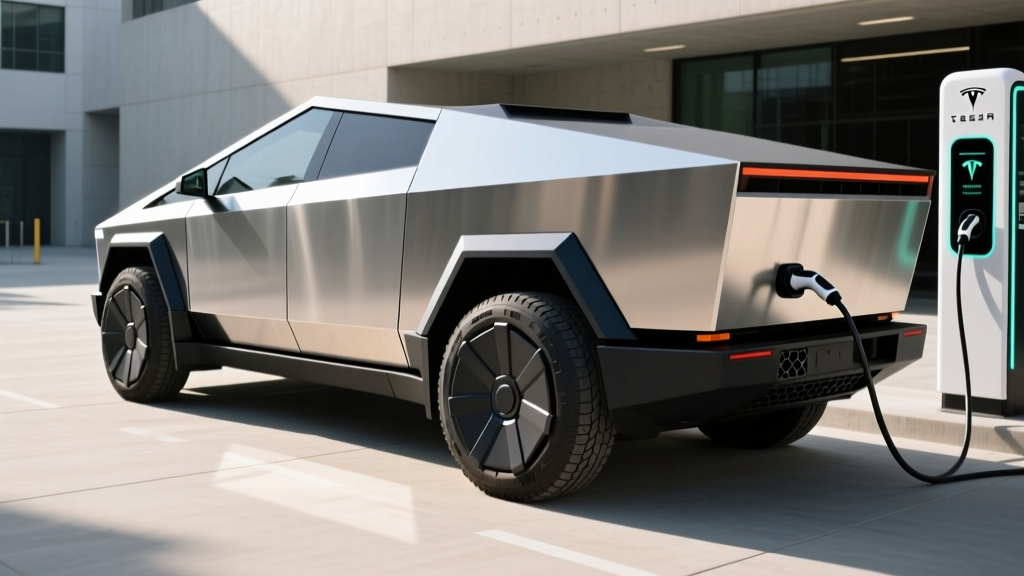
The Tesla Cybertruck is the most polarizing vehicle on the road. Its origami-folded stainless-steel skin and brutalist geometry have sparked endless memes, but the question buyers actually need answered isn't aesthetic — it's whether the engineering behind that shape delivers real-world utility. Below, we break down the design rationale and pair it with hard numbers on range, charging, performance, and ownership cost for the 2026 model year.
The Engineering Case Behind the Cybertruck's Shape
When Tesla unveiled the Cybertruck in 2019, the reaction was shock. By the time it reached driveways in late 2023 and ramped through 2024–2026, the angular form had become a rolling statement. But why does the Cybertruck look like that? The answer is materials, not marketing.
Tesla chose a 30X cold-rolled ultra-hard stainless steel alloy for the exoskeleton — the same family of steel used in SpaceX Starship tooling. This material is too hard to stamp with conventional automotive dies. Traditional truck bodies use stamped aluminum or mild steel that can be formed into curves; Tesla's alloy can only be bent along straight lines. Every flat panel and sharp crease on the Cybertruck is a direct consequence of manufacturing constraints. The result is a vehicle whose silhouette is dictated by metallurgy rather than a designer's sketchpad.
The angular geometry also serves structural and ballistic purposes. The exoskeleton carries load rather than relying on a traditional unibody or body-on-frame architecture, and Tesla rates the panels to withstand 9mm handgun impacts. Whether you need bullet-resistant doors for a grocery run is debatable, but the engineering logic is consistent: form follows fabrication.
Range, Battery, and Real-World Efficiency
Real-World Expectation: ~260–290 miles at sustained highway speeds (70–80 mph); ~220–250 miles in cold weather (below 32°F) with cabin heating. Towing a 5,000-lb trailer drops effective range to approximately 150–170 miles.
| Specification | AWD (Dual-Motor) | Cyberbeast (Tri-Motor) |
|---|---|---|
| EPA Range | 340 mi | 320 mi |
| Battery Capacity | ~123 kWh usable (NMC) | ~123 kWh usable (NMC) |
| MPGe (Combined) | 66 MPGe | 63 MPGe |
| Efficiency | 51 kWh/100 mi | 53 kWh/100 mi |
| 0–60 mph | 3.9 sec | 2.6 sec |
| Horsepower | 600 hp | 845 hp |
| Drivetrain | Dual-Motor AWD | Tri-Motor AWD |
| Towing Capacity | 11,000 lbs | 11,000 lbs |
| Payload | 2,500 lbs | 2,500 lbs |
| Base MSRP | $79,990 | $99,990 |
The Cybertruck uses an NMC (nickel-manganese-cobalt) battery pack rather than Tesla's LFP chemistry found in the Model 3 RWD. NMC offers higher energy density, which is critical in a 6,800-lb truck where every pound of battery matters. The trade-off: NMC degrades slightly faster over thousands of cycles and is more sensitive to sustained 100% states of charge. Tesla recommends daily charging to 80–90% for longevity, reserving 100% for road trips.
Efficiency is the Cybertruck's weak point. At 51–53 kWh per 100 miles, it consumes significantly more energy per mile than a Rivian R1T (~43 kWh/100 mi) or a Ford F-150 Lightning (~47 kWh/100 mi). The flat, un-aerodynamic bed and massive frontal area create drag that no amount of angular styling can hide. At highway speeds, that drag compounds, which is why real-world highway range falls well short of the EPA sticker.
Charging Speed: DC Fast, Level 2, and the 800V Advantage
The Cybertruck operates on an 800-volt architecture, which enables faster DC charging with lower current (and thus less heat). On a V4 Supercharger or compatible 350 kW station, the Cybertruck peaks at approximately 250 kW.
| Charging Level | Max Power | Rate / Time | Connector |
|---|---|---|---|
| Level 1 (120V) | ~1.4 kW | ~3–4 mi/hr | NACS (native) |
| Level 2 (240V, 48A) | 11.5 kW | ~28–30 mi/hr | NACS |
| DC Fast Charge | 250 kW peak | 10–80% in ~28 min | NACS / CCS via adapter |
The 10–80% time of roughly 28 minutes is competitive but not class-leading. The Hyundai Ioniq 5 and Kia EV9 hit 10–80% in 18 minutes on 350 kW chargers, though neither is a full-size truck. The Cybertruck's charge curve tapers noticeably above 60% state of charge — a characteristic of the NMC pack and thermal management strategy. Expect sustained rates of 180–200 kW in the 20–60% window, dropping to 80–100 kW past 70%.
For home charging, a 48-amp Level 2 wall connector on a 60-amp circuit adds roughly 28–30 miles of range per hour. An overnight 8-hour session restores approximately 230 miles — enough for most daily driving and towing prep. Installation costs for a dedicated 60-amp circuit typically range from $800 to $2,000 depending on panel proximity and local permitting, according to Tesla's home charging guide.
Performance, Towing, and Payload
The Cyberbeast's 2.6-second 0–60 mph time makes it quicker than a Porsche 911 Carrera, which is absurd for a truck weighing nearly 7,000 pounds. The dual-motor AWD variant hits 60 mph in 3.9 seconds — still supercar territory from a decade ago. Both versions use steer-by-wire, eliminating the mechanical connection between the steering yoke and the wheels. This enables variable steering ratios (fewer turns lock-to-lock at low speeds) but takes genuine adaptation. Plan for at least a week of muscle-memory retraining.
Towing capacity is rated at 11,000 lbs, matching heavy-duty gas truck territory. However, towing at capacity cuts range roughly in half. If your use case involves frequent 8,000+ lb trailer hauls over long distances, the Cybertruck will require strategic charging stops every 150 miles or so. For lighter boat or camper towing (3,000–5,000 lbs), effective range sits around 170–200 miles — manageable with Supercharger route planning.
The 6-foot bed (Tesla calls it the "vault") offers 67 cubic feet of lockable storage with the tonneau cover closed. The powered frunk adds roughly 7 cubic feet. Rear legroom measures 36.5 inches — adequate for adults on short trips but tighter than an F-150 SuperCrew.
Pricing, Tax Credits, and Ownership Cost
| Trim | Base MSRP | §30D Credit Eligible? | Effective Price (if eligible) |
|---|---|---|---|
| AWD (Dual-Motor) | $79,990 | No — exceeds $80,000 truck cap* | $79,990 |
| Cyberbeast (Tri-Motor) | $99,990 | No — exceeds $80,000 truck cap* | $99,990 |
*Under IRS §30D clean vehicle rules, new pickup trucks must have an MSRP at or below $80,000 to qualify for the up-to-$7,500 federal tax credit. The Cybertruck AWD sits just $10 under that cap at $79,990 before destination, but once delivery fees and any options are added, it typically crosses the threshold. The Cyberbeast is well above the cap. Additionally, buyer income limits ($150K single / $300K joint AGI) and battery critical-mineral sourcing requirements apply. Always verify current-year eligibility with a tax professional before purchasing.
Without the federal credit, the Cybertruck is positioned as a premium luxury truck rather than a mass-market EV. Insurance premiums run 15–25% higher than a comparable F-150 Lightning due to repair costs for the stainless exoskeleton and steer-by-wire components. Depreciation data is still limited given the truck's 2023 launch, but early resale values have softened from the initial markup frenzy of 2024.
Tech, Driver Assistance, and the Yoke Debate
The Cybertruck ships with Tesla's latest infotainment stack on an 18.5-inch center touchscreen and a 9.4-inch rear display. The UI is responsive, and the vehicle integrates natively with the Tesla Supercharger network — still the most reliable DC fast-charging ecosystem in North America, with over 20,000 stalls as of 2026.
The yoke steering wheel (standard, no round-wheel option) remains controversial. At low speeds and on twisty roads, the variable-ratio steer-by-wire compensates well. For three-point turns and parking lots, you'll miss a full round wheel. Tesla's steer-by-wire also includes rear-wheel steering, which tightens the turning circle to 34.8 feet — surprisingly compact for a 223-inch-long truck.
Pros, Cons, and the Verdict
Pros
- Stainless exoskeleton is dent-proof and structurally unique
- 800V architecture with 250 kW peak DC charging
- 11,000-lb towing and 2,500-lb payload are class-competitive
- Cyberbeast acceleration (2.6s 0–60) defies physics for a 7,000-lb truck
- Native NACS connector and Supercharger access
- Lockable vault bed + powered frunk for secure cargo
Cons
- 51–53 kWh/100 mi efficiency trails Rivian R1T and F-150 Lightning
- Real-world highway and towing range significantly below EPA sticker
- No federal §30D tax credit in most configurations (MSRP cap)
- Yoke-only steering with no round-wheel option
- Rear legroom tight for a full-size truck
- Insurance premiums above segment average
- Panel gap consistency and early-build quality issues persist in owner reports
Who Should Buy the Cybertruck?
The Cybertruck makes sense for a narrow buyer profile: someone who values the stainless-steel durability and futuristic design, needs genuine truck capability (towing, payload, off-road clearance), and has reliable home Level 2 charging. It works as a daily driver with weekend towing duties — provided your typical trailer weighs under 5,000 lbs and your routes have Supercharger coverage.
It does not make sense for buyers who prioritize efficiency, maximum interior space, federal tax credit savings, or conventional driving ergonomics. If you need a work truck that qualifies for the §30D credit and offers better range under load, the F-150 Lightning (starting around $55,000 and eligible for the credit on Lariat trims) or the Rivian R1T (eligible on Dual-Motor Standard pack) are more pragmatic choices. The Cybertruck is a statement vehicle that happens to be a competent truck — not a truck that happens to be a statement.
Warranty Coverage
Tesla covers the Cybertruck with a 4-year/50,000-mile limited vehicle warranty and an 8-year/120,000-mile battery and drive unit warranty. The battery warranty guarantees retention of at least 70% capacity over the coverage period. Given the NMC chemistry and the truck's heavy curb weight (which drives higher cycle loads), monitoring state of health via the Tesla app and avoiding habitual 100% charges will help preserve longevity.
Frequently Asked Questions
What is the real-world range of the Cybertruck?
The EPA rates the AWD at 340 miles and the Cyberbeast at 320 miles. In real-world highway driving at 75 mph, expect 260–290 miles. In cold weather (below freezing), plan for 220–250 miles. Towing at capacity drops range to approximately 150–170 miles.
How fast does the Cybertruck charge?
On a 250 kW DC fast charger, the Cybertruck charges from 10–80% in approximately 28 minutes, with peak rates around 250 kW in the 20–50% state-of-charge window. At home on a 48-amp Level 2 charger, it adds roughly 28–30 miles of range per hour.
Does the Cybertruck qualify for the $7,500 federal EV tax credit?
Generally, no. The §30D credit caps new trucks at $80,000 MSRP. The Cybertruck AWD starts at $79,990 but typically exceeds the cap once destination fees are added. The Cyberbeast at $99,990 is well above the limit. Buyer income caps and battery-sourcing rules add further restrictions. Consult the IRS §30D guidelines and a tax professional.
Is the Cybertruck worth buying over the Rivian R1T or F-150 Lightning?
If you want the most efficient, spacious, and tax-credit-eligible electric truck, choose the F-150 Lightning or Rivian R1T. If you want a stainless-steel exoskeleton, steer-by-wire, tri-motor performance, and don't need the tax credit, the Cybertruck is uniquely compelling. It's a design and engineering statement first, a practical truck second.
Why does the Cybertruck look like that?
The angular, flat-panel design is a direct result of the 30X cold-rolled stainless steel exoskeleton, which is too hard to stamp into curves using conventional automotive dies. The panels can only be bent along straight lines, producing the geometric silhouette. The shape also serves structural load-bearing and impact-resistance functions.