If you have been tracking Tesla's stainless-steel pickup, 2026 is the first year where supply has largely caught up with demand — and that shift is quietly reshaping what Cybertruck deals actually look like. Lease incentives, dealer inventory availability, and evolving federal tax credit rules all affect the out-of-pocket cost. This profile breaks down every number that matters: real-world range, charging speed, battery chemistry, pricing by trim, and whether the Cybertruck is a smart buy against the Rivian R1T, Ford F-150 Lightning, and Chevrolet Silverado EV.
2026 Tesla Cybertruck: Quick Verdict
The Cybertruck remains one of the most polarizing vehicles on the road, but its engineering substance is harder to dismiss. With up to an EPA-estimated 340 miles of range (AWD), a peak 250 kW DC fast-charge rate, and a tri-motor Cyberbeast variant that hits 60 mph in 2.6 seconds, it is a legitimate performance truck. However, its polarizing design, panel-gap variability, and the realities of towing range loss mean it is not for every buyer. For 2026, Tesla has stabilized build quality and expanded production enough that inventory sits on lots — opening the door to deals that were unthinkable at launch.
Range, Efficiency, and the Real-World Reality Check
| Trim | EPA Est. Range | Real-World Highway | Cold Weather (20°F) |
|---|---|---|---|
| AWD (Dual Motor) | 340 mi | ~280–300 mi | ~230–260 mi |
| RWD (Rear-Wheel Drive) | ~250 mi (est.) | ~210–230 mi | ~175–200 mi |
| Cyberbeast (Tri-Motor) | 320 mi | ~260–285 mi | ~215–245 mi |
Figures assume 70 mph highway cruise. Cold-weather estimates based on LFP/NMC chemistry behavior and Tesla's heat-pump thermal management. Towing a 7,000-lb trailer can cut range by 40–50%.
The AWD Cybertruck carries an EPA-estimated 340 miles of range, placing it near the top of the electric pickup segment. The usable battery capacity is approximately 123 kWh in a 4680-cell NMC (nickel-manganese-cobalt) configuration, per Tesla's specifications. The upcoming RWD trim, expected to be the most affordable entry point, is projected around 250 miles EPA but has not yet received a final EPA certification at this writing.
Efficiency is rated at approximately 67 MPGe combined for the AWD variant, translating to roughly 50 kWh per 100 miles. That is not class-leading — the Ford F-150 Lightning Extended Range achieves around 70 MPGe combined — but the Cybertruck's heavier stainless-steel exoskeleton and angular aerodynamics explain the difference.
Charging Speed: DC Fast Charge and Home Level 2
| Charging Level | Max Power | Speed / Rate | Notes |
|---|---|---|---|
| Level 1 (120V) | ~1.4 kW | ~3–4 mi/hr | Emergency/trickle only |
| Level 2 (240V, 48A) | 11.5 kW | ~34 mi/hr | Full charge in ~11 hrs |
| DC Fast Charge | 250 kW (peak) | 10–80% in ~28 min | Tapers above 60% SoC |
| Tesla Supercharger V4 | 250–350 kW | 10–80% in ~22 min (est.) | Depends on station generation |
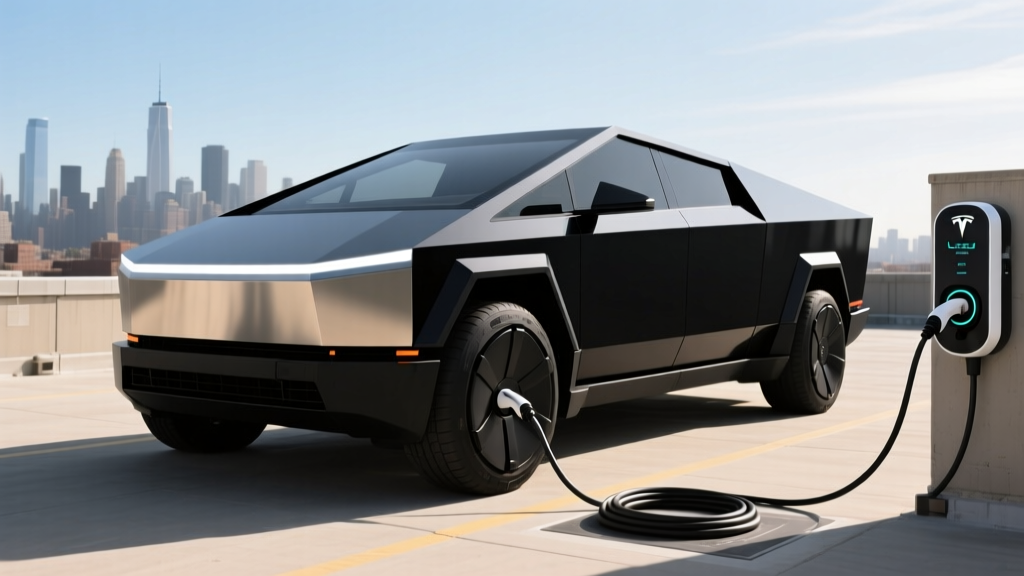
The Cybertruck supports a peak DC fast-charge rate of 250 kW on Tesla's Supercharger network. In controlled testing, the charge curve sustains above 200 kW up to approximately 50–55% State of Charge before tapering. A 10–80% session takes roughly 28 minutes at a V3 Supercharger. At newer V4 cabinets with higher power delivery, that time can drop to around 22 minutes, though real-world results depend on battery preconditioning, ambient temperature, and station load.
For home charging, the onboard charger accepts up to 11.5 kW on a 240-volt, 48-amp Level 2 circuit. That translates to about 34 miles of range per hour of charging, meaning a full 0–100% session takes roughly 11 hours. Most owners who plug in nightly will never need a full depletion charge. Installation of a Tesla Wall Connector on a dedicated 60-amp circuit typically runs $800–$2,500 including electrician labor, depending on panel proximity and local permitting.
Performance and Powertrain
| Spec | AWD | Cyberbeast | RWD (Est.) |
|---|---|---|---|
| Drivetrain | Dual-Motor AWD | Tri-Motor AWD | Single-Motor RWD |
| Horsepower | 600 hp | 845 hp | ~315 hp (est.) |
| 0–60 mph | 3.9 sec | 2.6 sec | ~6.5 sec (est.) |
| Top Speed | 112 mph | 130 mph | ~110 mph (est.) |
| Towing Capacity | 11,000 lbs | 11,000 lbs | ~7,500 lbs (est.) |
The dual-motor AWD Cybertruck delivers 600 horsepower and a 3.9-second 0–60 time — performance that would have been absurd in a full-size pickup five years ago. The tri-motor Cyberbeast pushes that to 845 hp and 2.6 seconds, rivaling sports cars. The RWD variant, when it arrives, will be the value play with adequate but unremarkable acceleration.
All trims feature adaptive air suspension with up to 17 inches of ground clearance in Extract Mode, a 6.5-foot composite bed with a powered tonneau cover, and a maximum towing capacity of 11,000 pounds on AWD and Cyberbeast trims. However, towing at or near max capacity will cut effective range nearly in half — plan charging stops accordingly.
Pricing, Trims, and Federal Tax Credit Eligibility
| Trim | Base MSRP | Federal §30D Credit | Effective Price |
|---|---|---|---|
| RWD (est.) | ~$60,990 | Up to $7,500* | ~$53,490 |
| AWD | $79,990 | Up to $7,500* | ~$72,490 |
| Cyberbeast | $99,990 | Up to $7,500* | ~$92,490 |
*Federal EV tax credit eligibility under IRS §30D depends on buyer income caps ($150K single / $300K joint MAGI), vehicle MSRP caps ($80,000 for trucks/SUVs), battery critical-mineral and component sourcing requirements, and point-of-sale transfer rules. The Cyberbeast at $99,990 MSRP exceeds the $80K truck cap and does NOT qualify. Always confirm eligibility with a tax professional before purchase.
- ✅ AWD ($79,990 MSRP) — under the $80,000 truck cap
- ❌ Cyberbeast ($99,990 MSRP) — exceeds the $80,000 truck cap
- ⚠️ RWD (~$60,990 MSRP) — under cap, qualifies on price
- ⚠️ Buyer income: MAGI must not exceed $150K (single) or $300K (joint)
- ⚠️ Battery sourcing: critical minerals and component rules must be met — verify current-year Tesla battery supply chain status on IRS guidance
- ✅ Point-of-sale transfer available — dealer can apply credit at purchase
For 2026 Cybertruck deals specifically, the AWD trim is the sweet spot for buyers seeking the federal credit. Tesla has also been offering periodic lease incentives — typically $3,000–$5,000 off — on select inventory, which can stack with state-level rebates in states like California, Colorado, and Massachusetts. Always check current inventory at your local Tesla delivery center, as pricing can vary with options like the Foundation Series package (which adds $20,000 and pushes even the AWD above the credit cap).
Interior, Cargo, and Technology
The Cybertruck seats five across a single row of bench-style front seating and a three-across rear bench. Rear legroom is approximately 38 inches — adequate for adults but not class-leading. The 6.5-foot bed offers 67 cubic feet of cargo volume under the powered tonneau, and the front trunk (frunk) adds approximately 7 cubic feet of lockable storage with integrated drainage.
Tech highlights include an 18.5-inch center touchscreen running Tesla's latest infotainment software, a rear 9.4-inch touchscreen for passengers, a 15-speaker audio system, and over-the-air software updates that continuously add features. The Cybertruck comes standard with Tesla's Basic Autopilot (lane centering, adaptive cruise control). Full Self-Driving (Supervised) remains an $8,000 add-on — and it is critical to understand that FSD is an SAE Level 2 driver-assistance system, not a self-driving system. The driver must remain fully engaged at all times.
Notable drawbacks: the stainless-steel body is fingerprint-prone and difficult to repair after minor dents, panel gaps remain inconsistent across production batches, the steer-by-wire system takes meaningful adaptation time, and visibility out of the angular rear window is poor — you will rely heavily on the backup camera.
Pros and Cons
- Class-leading 0–60 performance (2.6s Cyberbeast)
- 340-mile EPA range (AWD) among the best in electric trucks
- Access to Tesla Supercharger network — most reliable DC charging
- 11,000-lb towing capacity with integrated trailer brake controller
- Stainless-steel exoskeleton and armored glass offer unique durability
- OTA updates continuously improve the vehicle post-purchase
- Cyberbeast trim ineligible for federal tax credit (over $80K cap)
- Real-world towing range drops 40–50% — limits road-trip utility
- Steer-by-wire and yoke steering require significant adaptation
- Stainless-steel panels are difficult and expensive to repair
- Rear visibility is poor; heavy camera reliance
- RWD trim availability still limited as of early 2026
Cybertruck vs. the Competition: Is It Worth It?
| Spec | Cybertruck AWD | Rivian R1T Dual-Motor | F-150 Lightning Ext. Range |
|---|---|---|---|
| EPA Range | 340 mi | 352 mi (Max Pack) | 320 mi |
| 0–60 mph | 3.9 sec | 4.5 sec | ~5.0 sec |
| DC Fast Charge (peak) | 250 kW | 220 kW | 150 kW |
| Towing | 11,000 lbs | 11,000 lbs | 10,000 lbs |
| Base MSRP | $79,990 | $79,900 | ~$69,995 |
| Federal Credit Eligible | Yes (AWD) | Yes | Yes |
The Cybertruck trades blows with the Rivian R1T on performance and range, and it charges faster. The F-150 Lightning is more affordable and more conventional in its driving experience, making it easier for truck-traditionalists. If you value Tesla's Supercharger network, the Cybertruck's acceleration, and its futuristic design language, it is a strong choice. If you want a more refined interior, better off-road capability, or a lower starting price, the R1T or Lightning deserve serious consideration.
- Choose the Cybertruck if: You want the fastest electric truck available, prioritize Supercharger access, and are comfortable with unconventional design and steer-by-wire.
- Choose the Rivian R1T if: You want a more traditional truck experience with superior off-road capability and a refined interior.
- Choose the F-150 Lightning if: Budget is a priority and you want a full-size truck that feels familiar to drive.
Battery Warranty and Long-Term Ownership
Tesla covers the Cybertruck's battery and drive unit with an 8-year / 120,000-mile warranty (whichever comes first), with a guaranteed minimum 70% capacity retention over that period. The 4680 NMC cells are among the most energy-dense in production, but long-term degradation data for the Cybertruck-specific pack is still being collected. Based on Model 3/Y data, owners can expect approximately 10–12% degradation over the first 100,000 miles under normal use.
The vehicle limited warranty covers 4 years / 50,000 miles — competitive with the segment but not exceptional. Insurance costs for the Cybertruck run 15–30% higher than comparable trucks due to repair complexity of the stainless-steel body. Factor this into your total cost of ownership calculation.
Frequently Asked Questions
What is the real-world range of the Cybertruck?
The AWD Cybertruck is EPA-rated at 340 miles, but real-world highway driving at 70 mph typically yields 280–300 miles. In cold weather (below 30°F), expect 230–260 miles. Towing reduces range by 40–50%.
How fast does the Cybertruck charge?
On a Tesla V3 Supercharger, the Cybertruck peaks at 250 kW and charges from 10–80% in approximately 28 minutes. At home on a 240V Level 2 charger at 11.5 kW, it adds about 34 miles per hour, with a full charge taking roughly 11 hours.
Does the Cybertruck qualify for the federal EV tax credit?
The AWD trim ($79,990 MSRP) qualifies for up to $7,500 under IRS §30D, provided the buyer meets income caps ($150K single / $300K joint) and battery sourcing requirements are satisfied. The Cyberbeast ($99,990) exceeds the $80,000 truck MSRP cap and does not qualify. The RWD trim (~$60,990) should qualify on price. Always verify current-year rules at irs.gov and consult a tax professional.
Is the Cybertruck worth buying over the Rivian R1T or F-150 Lightning?
The Cybertruck wins on acceleration, DC charging speed, and Supercharger network access. The Rivian R1T offers a more refined interior and better off-road capability. The F-150 Lightning is the most affordable and familiar option. Your choice depends on whether you prioritize performance and Tesla's ecosystem (Cybertruck), adventure refinement (R1T), or value and convention (Lightning).
What battery chemistry does the Cybertruck use?
The Cybertruck uses Tesla's 4680-format NMC (nickel-manganese-cobalt) cells with approximately 123 kWh of usable capacity. NMC offers higher energy density than LFP but is more sensitive to sustained 100% State of Charge — Tesla recommends daily charging to 80–90% for battery longevity.
What are the biggest Cybertruck deals available in 2026?
Tesla periodically offers lease incentives of $3,000–$5,000 on select inventory, particularly AWD trims. Combining a lease incentive with the $7,500 federal credit (via point-of-sale transfer on eligible purchases) and state-level rebates can reduce effective cost significantly. Check Tesla's current inventory page and your state's EV incentive program for the latest offers.